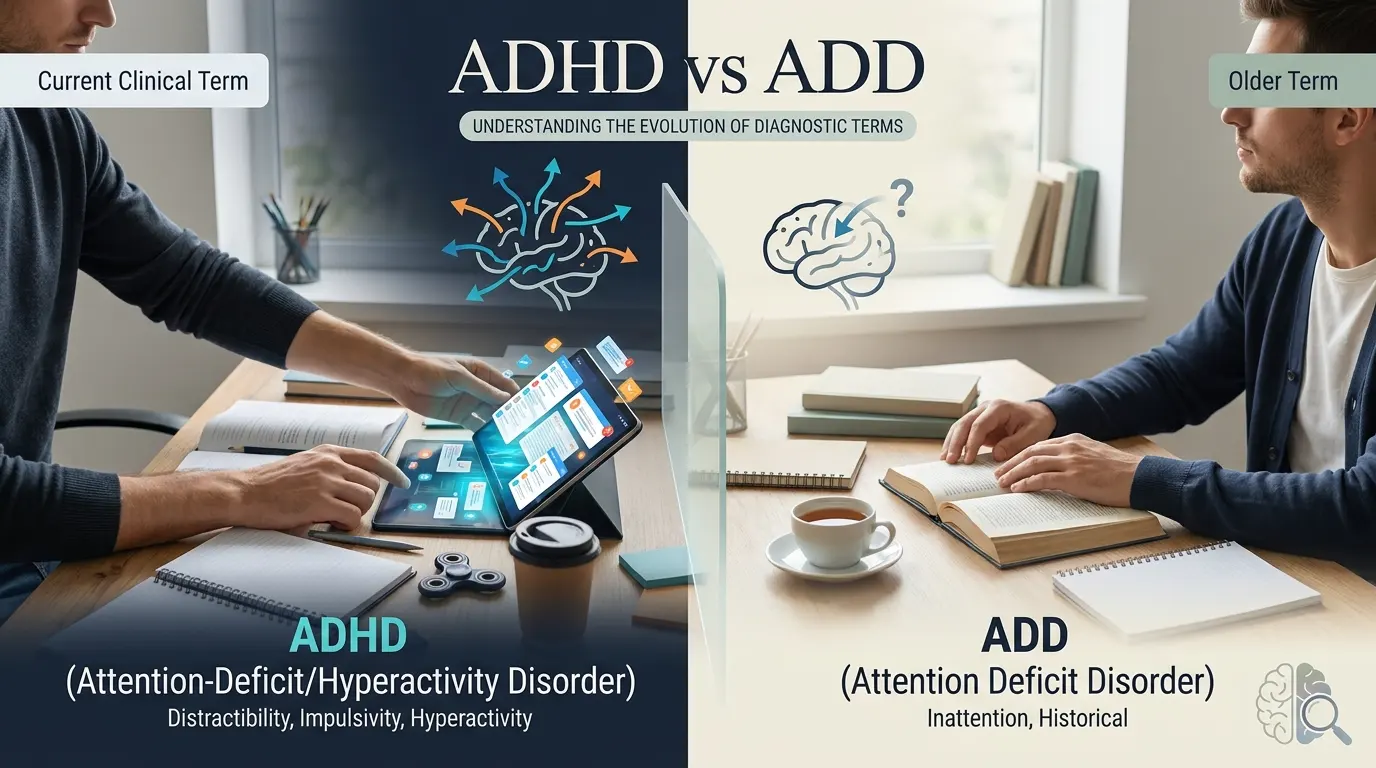
Difference between adhd and add often confuses students, parents, and even adults trying to understand attention issues. Imagine a child who cannot sit still in class, while another quietly stares out the window and misses instructions. Both struggle with attention, but in different ways.
The difference between adhd and add is mainly about symptoms and modern medical terminology. Today, doctors use one main term: Attention-Deficit/Hyperactivity Disorder (ADHD). The term ADD is older and refers to a specific type without hyperactivity.
Many people still use both terms interchangeably. However, understanding the difference between adhd and add helps you communicate clearly and support people more effectively ❤️.
Let’s explore what these terms really mean and how they differ.
Key Difference Between the Both
The main difference is:
- ADHD is the current medical term with different types.
- ADD is an older term that usually refers to ADHD without hyperactivity.
In simple words, ADD is now considered a type of ADHD.
Importance – Why Their Difference Matters
Understanding this difference is important in education and daily life.
First, students and parents benefit because they can better understand learning challenges. This helps them support children in school.
Second, professionals such as teachers, psychologists, and doctors must use correct terminology. It ensures proper diagnosis and treatment.
Finally, society benefits when people understand these conditions. It reduces stigma and promotes empathy and inclusion 🌍.
🔊 Pronunciation Section
ADHD
US: /ˌeɪ.diː.eɪtʃˈdiː/
UK: /ˌeɪ.diː.eɪtʃˈdiː/
ADD
US: /ˌeɪ.diːˈdiː/
UK: /ˌeɪ.diːˈdiː/
Now that you know how to say them, let’s define each term clearly before comparing them.
📚 Core Definitions
ADHD
Attention-Deficit/Hyperactivity Disorder is a neurodevelopmental condition that affects attention, impulse control, and sometimes hyperactivity. It includes different types, such as inattentive and hyperactive-impulsive.
- Example: A child who cannot sit still and interrupts others may have ADHD.
ADD
ADD is an older term that describes a form of ADHD without hyperactivity. It mainly involves difficulty focusing and staying organized.
- Example: A student who daydreams and forgets tasks may have what was once called ADD.
📚 10 Clear Differences Between ADHD and ADD
1. Terminology Status
ADHD is the official medical term today. ADD is outdated but still commonly used.
- Example for ADHD: Used in medical diagnosis.
- Example for ADD: Used in informal conversation.
2. Hyperactivity Presence
ADHD may include hyperactivity. ADD does not include hyperactivity.
- Example for ADHD: Constant movement and restlessness.
- Example for ADD: Quiet inattention without movement.
3. Medical Classification
ADHD includes multiple types. ADD is now part of ADHD (inattentive type).
- Example for ADHD: Combined type diagnosis.
- Example for ADD: Inattentive presentation.
4. Behavior Style
ADHD can be active and impulsive. ADD is usually calm but distracted.
- Example for ADHD: Talking excessively.
- Example for ADD: Silent daydreaming.
5. Visibility
ADHD symptoms are more noticeable. ADD symptoms are less visible.
- Example for ADHD: Disruptive behavior in class.
- Example for ADD: Quietly missing instructions.
6. Diagnosis Process
Doctors diagnose ADHD using modern criteria. ADD is not used in formal diagnosis.
- Example for ADHD: Clinical evaluation.
- Example for ADD: Informal labeling.
7. Social Impact
ADHD may lead to social challenges due to impulsivity. ADD may lead to misunderstanding due to quiet behavior.
- Example for ADHD: Interrupting conversations.
- Example for ADD: Appearing uninterested.
8. Academic Impact
ADHD affects both behavior and focus. ADD mainly affects focus and organization.
- Example for ADHD: Trouble sitting in class.
- Example for ADD: Forgetting homework.
9. Emotional Response
ADHD may involve frustration and impulsive reactions. ADD may involve low motivation or confusion.
- Example for ADHD: Quick anger.
- Example for ADD: Feeling overwhelmed.
10. Usage in Language
ADHD is used in formal and medical contexts. ADD is used casually.
- Example for ADHD: Doctor’s report.
- Example for ADD: Everyday speech.
🎯 Why Knowing the Difference Matters
Students must understand this difference to improve awareness and empathy. It helps them support classmates and learn better.
Professionals need accurate terms to provide proper care and guidance. Mislabeling can lead to incorrect support strategies.
In society, awareness reduces stigma. People become more understanding and supportive.
Real-world consequences of confusion
If someone uses ADD instead of ADHD in a medical context, it may cause misunderstanding. This can affect diagnosis and treatment plans.
🧠 Why People Get Confused
Similar Names
ADHD and ADD look and sound similar, which causes confusion.
Historical Usage
ADD was widely used in the past, so people still use it today.
Overlapping Symptoms
Both involve attention problems, making them seem identical.
Informal Speech
People often use ADD casually without knowing the updated term.
🎭 Connotation & Emotional Tone
Connotation = the emotional meaning associated with a word.
ADHD
- Neutral/Medical: Seen as a clinical condition.
- Example: “He was diagnosed with ADHD.”
ADD
- Neutral/Informal: Seen as a casual or outdated term.
- Example: “She says she has ADD.”
🗣 Usage in Metaphors, Similes & Idioms
These terms sometimes appear informally:
- “I feel so ADHD today—can’t sit still.”
- “My mind is like ADD—always wandering.”
These expressions describe distraction or restlessness.
📊 Comparison Table
| Feature | ADHD | ADD |
|---|---|---|
| Meaning | Medical condition | Older term |
| Tone | Clinical | Informal |
| Usage | Diagnosis | Casual speech |
| Context | Medical/educational | Everyday talk |
| Formality | Formal | Informal |
⚖️ Which Is Better in What Situation?
When to use ADHD
Use ADHD in medical, academic, or professional contexts. It is the correct modern term.
When to use ADD
Use ADD only in informal conversation or when referring to older terminology.
Situational clarity
Choose ADHD for accuracy. Use ADD only when discussing historical or casual usage.
Contextual correctness
Using the correct term avoids confusion and shows awareness.
📖 Literary or Cultural References
- “Driven to Distraction” (Non-fiction, Edward M. Hallowell, 1994)
- “Percy Jackson & The Lightning Thief” (Fantasy Novel, Rick Riordan, 2005) – features a character with ADHD
❓ FAQs
1. Is ADD still a medical diagnosis?
No, ADD is no longer used as a formal diagnosis. Doctors now use ADHD.
2. What type of ADHD is ADD?
ADD is now considered ADHD, predominantly inattentive type.
3. Can someone have ADHD without hyperactivity?
Yes, that is the inattentive type, previously called ADD.
4. Why do people still say ADD?
Many people learned the term years ago, so they still use it out of habit.
5. Which term should I use today?
You should use ADHD for accuracy, especially in formal or medical contexts.
🏁 Conclusion
The difference between adhd and add is mainly about terminology and symptoms. ADHD is the modern medical term that includes different types, while ADD is an older term that refers to the inattentive form.
Understanding this difference helps you communicate clearly and support others effectively. It also reduces confusion in education and healthcare.
As awareness grows, using correct terms becomes more important. Keep learning and stay informed you’ll build stronger knowledge and empathy along the way.

Ezra Hale is a thoughtful contributor to Distinly.com, where he explores philosophical ideas and the subtle differences behind everyday concepts. His writing blends logic, language, and human insight to clarify complex distinctions. Ezra encourages readers to think deeper, question assumptions, and appreciate the meaning behind words and ideas in modern discourse.