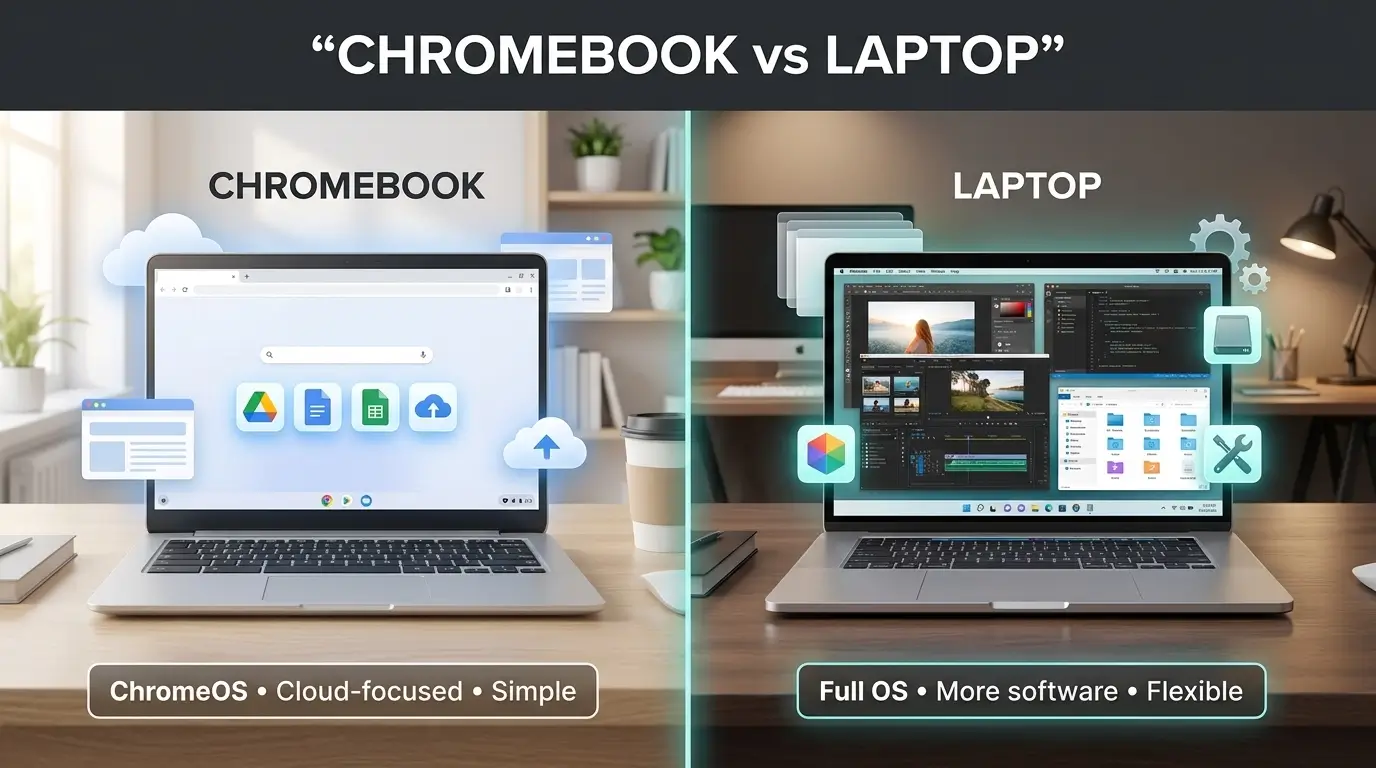
Difference between Chromebook and laptop is something many people wonder about when buying a new device. Imagine you walk into a store or browse online, and you see two options: a Chromebook and a laptop. They look similar, but the price and features differ. That can feel confusing.
The difference between Chromebook and laptop mainly comes down to how they work, what software they use, and what tasks they handle best. A Chromebook runs on Chrome OS and focuses on online tasks. A laptop, on the other hand, usually runs Windows, macOS, or Linux and supports a wider range of programs.
Understanding the difference between Chromebook and laptop helps you make smarter decisions. It saves money and ensures you pick the right tool for your needs.
Let’s now explore their key differences in a clear and simple way.
Key Difference Between the Both
The main difference is simple:
A Chromebook is designed for internet-based tasks using Chrome OS, while a laptop is a more flexible computer that can run many types of software offline and online.
Importance – Why Knowing the Difference Matters
Knowing the difference helps students choose affordable tools for study. Many schools now use Chromebooks because they are simple and fast.
For professionals, the choice affects productivity. A designer or programmer needs a laptop with powerful software support, not a Chromebook.
In society, technology choices impact learning, work, and communication. Choosing the wrong device can slow you down or limit your abilities.
🔊 Pronunciation Section
Chromebook
US: /ˈkroʊm.bʊk/
UK: /ˈkrəʊm.bʊk/
Laptop
US: /ˈlæp.tɑːp/
UK: /ˈlæp.tɒp/
Now that you know how to say them, let’s define them clearly.
📚 Core Definitions
Chromebook
A Chromebook is a lightweight computer that runs Chrome OS. It mainly uses web apps and cloud storage. It feels simple and fast.
Example: A student uses a Chromebook to write assignments in Google Docs.
Laptop
A laptop is a portable computer that runs systems like Windows or macOS. It supports many offline and online programs. It feels powerful and flexible.
Example: A designer uses a laptop to edit photos in Photoshop.
📚 10 Clear Differences Between Chromebook and Laptop
1. Operating System
Chromebooks use Chrome OS, while laptops use Windows, macOS, or Linux.
- Example (Chromebook): Opens apps in a browser.
- Example (Laptop): Runs full software like Microsoft Word.
2. Software Support
Chromebooks rely on web apps and Android apps. Laptops support full desktop programs.
- Example (Chromebook): Uses Google Docs online.
- Example (Laptop): Uses offline Word or Excel.
3. Internet Dependency
Chromebooks need the internet for most tasks. Laptops work well offline too.
- Example (Chromebook): Needs Wi-Fi for full use.
- Example (Laptop): Can edit files without internet.
4. Performance Power
Chromebooks are lighter and less powerful. Laptops can be very powerful.
- Example (Chromebook): Good for browsing.
- Example (Laptop): Handles gaming or video editing.
5. Storage Type
Chromebooks use cloud storage. Laptops have larger internal storage.
- Example (Chromebook): Saves files in Google Drive.
- Example (Laptop): Stores files on hard drive.
6. Price Range
Chromebooks are usually cheaper. Laptops vary from budget to high-end.
- Example (Chromebook): Affordable for students.
- Example (Laptop): Expensive for high performance.
7. Security
Chromebooks have built-in security updates. Laptops need antivirus software.
- Example (Chromebook): Auto-updates protect system.
- Example (Laptop): Needs manual security setup.
8. Battery Life
Chromebooks often last longer on a single charge. Laptops vary.
- Example (Chromebook): Lasts a full school day.
- Example (Laptop): May need charging sooner.
9. Usage Context
Chromebooks are best for education and light work. Laptops suit all types of work.
- Example (Chromebook): Used in classrooms.
- Example (Laptop): Used in offices and studios.
10. Flexibility
Chromebooks are limited in features. Laptops are highly flexible.
- Example (Chromebook): Limited software choices.
- Example (Laptop): Runs almost any software.
🎯 Why Knowing the Difference Matters
Students benefit by choosing a device that fits their study style. A Chromebook is great for online learning and basic tasks.
Professionals must choose carefully. A laptop supports complex tools like coding software or design apps.
In daily life, choosing the wrong device can cause frustration. You may not be able to complete important tasks easily.
Real-world consequences of confusion
Buying a Chromebook for heavy video editing will lead to disappointment. Similarly, buying an expensive laptop for simple browsing wastes money.
🧠 Why People Get Confused
Similar Appearance
Both look almost the same. This makes it hard to tell them apart.
Overlapping Uses
Both can browse the web, watch videos, and write documents.
Context-Based Usage
People use the word “laptop” for all portable computers, including Chromebooks.
Influence of Informal Speech
Many people casually call Chromebooks “laptops,” adding to confusion.
🎭 Connotation & Emotional Tone
Connotation = the emotional meaning associated with a word.
Chromebook
- Positive: Simple, fast, affordable
- Neutral: Basic computing tool
- Negative: Limited features
Example: “It’s great for school, but not for heavy work.”
Laptop
- Positive: Powerful, versatile
- Neutral: Standard computing device
- Negative: Expensive, complex
Example: “It can do everything, but it costs more.”
🗣 Usage in Metaphors, Similes & Idioms
While not common in idioms, comparisons can be made:
- “A Chromebook is like a notebook—simple and focused.”
- “A laptop is like a toolbox—it can do many things.”
📊 Comparison Table
| Feature | Chromebook | Laptop |
|---|---|---|
| Meaning | Cloud-based computer | Full-featured computer |
| Tone | Simple, limited | Powerful, flexible |
| Usage | Online tasks | Online and offline tasks |
| Context | Education, light work | Work, gaming, design |
| Formality | Informal/basic use | Professional use |
⚖️ Which Is Better in What Situation?
When to Use Chromebook
Use a Chromebook for school, browsing, and online work. It is perfect for students and casual users.
When to Use Laptop
Choose a laptop for heavy tasks like programming, gaming, or design work. It offers more power and flexibility.
Situational Clarity
If your work depends on the internet, a Chromebook is enough. If you need advanced software, go for a laptop.
Contextual Correctness
Always match the device to your task. Simple tasks need simple tools, while complex tasks need powerful systems.
📖 Literary or Cultural References
- Book: The Innovators (Technology, Walter Isaacson, 2014)
Shows how computing evolved into modern devices like laptops. - Movie: The Social Network (USA, 2010)
Highlights the importance of laptops in coding and business.
❓ FAQs
1. What is the main difference between Chromebook and laptop?
The main difference is the operating system and software support. Chromebooks rely on web apps, while laptops run full programs.
2. Can a Chromebook replace a laptop?
Yes, but only for basic tasks like browsing, writing, and streaming. It cannot fully replace a laptop for advanced work.
3. Which is cheaper, Chromebook or laptop?
Chromebooks are generally cheaper. Laptops range from low to very high prices.
4. Do Chromebooks work without internet?
Yes, but with limited features. Most functions need internet access.
5. Are laptops better for gaming?
Yes, laptops are better because they support high-performance games.
6. Is Chromebook good for students?
Yes, it is excellent for students due to simplicity and affordability.
7. Can I install Windows on a Chromebook?
It is not easy and not recommended for most users.
8. Which device is more secure?
Chromebooks are more secure due to automatic updates and built-in protection.
9. Can laptops run Android apps?
Some can, but not all. Chromebooks support Android apps more easily.
10. Which should I buy?
Choose based on your needs. Simple tasks → Chromebook. Complex tasks → laptop.
🏁 Conclusion
The difference between Chromebook and laptop comes down to purpose, power, and flexibility. Chromebooks are simple, affordable, and ideal for online tasks. Laptops offer more features, better performance, and support for advanced software.
Understanding this difference helps you choose wisely. It saves time, money, and frustration. Whether you are a student, professional, or casual user, the right device makes your work easier.
Always think about your needs before buying. A smart choice leads to better productivity and satisfaction. Keep learning, and make informed tech decisions.

Aamer Shahzad is the founder of Distinly.com, a fast-growing educational platform focused on high-intent “difference between” topics. With over 8 years of experience in English language education and analytical writing, I specialize in breaking down complex “difference between” topics into clear, structured, and easy-to-understand explanations. Distinly.com is your go-to resource for enhancing English skills and writing with confidence.
I specializes in building search-optimized, research-driven comparison content designed for clarity, authority, and long-term digital asset value.