Difference between PA and NP often comes up when you visit a hospital or clinic. Imagine you’re waiting to see a doctor, but instead, a skilled medical professional walks in and treats you. You later learn they are either a PA or an NP. 🤔
The difference between PA and NP is not always obvious at first. Both are highly trained healthcare providers who diagnose illnesses, prescribe medicines, and care for patients. However, their training paths and approaches differ.
Many people use these roles interchangeably, but that can lead to confusion. Understanding the difference between PA and NP helps you know who is treating you and how they are trained.
Let’s explore their key differences in a simple and clear way.
Key Difference Between the Both
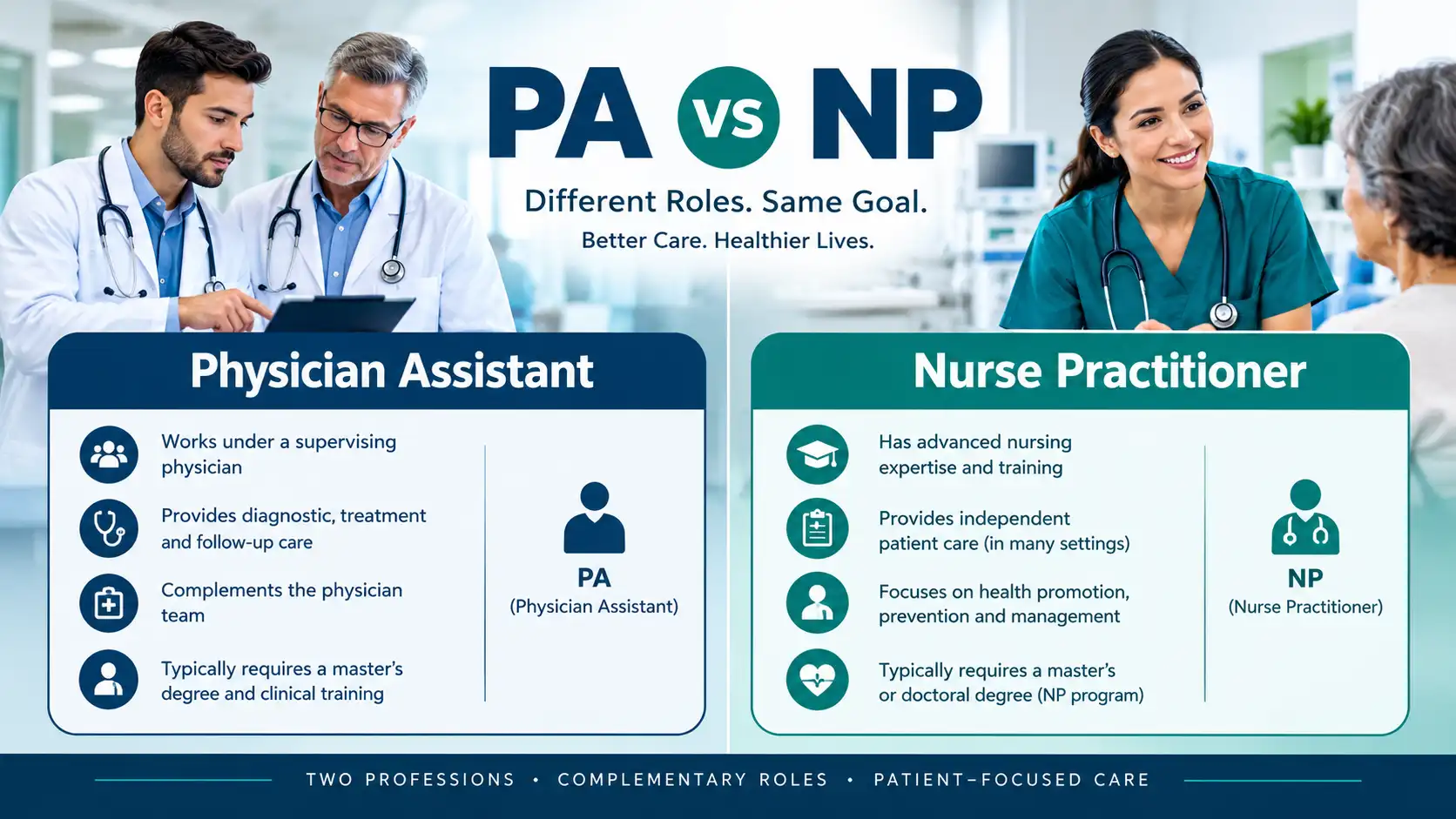
The main difference between PA and NP lies in their training model and approach to care.
- A PA (Physician Assistant) is trained using a medical model, similar to doctors.
- An NP (Nurse Practitioner) is trained using a nursing model, focusing more on patient-centered care.
Both work in healthcare teams, but their education and philosophy differ.
Importance – Why Their Difference Matters
Knowing the difference between PA and NP is important for both learners and professionals.
For students, it helps in choosing the right healthcare career path. Each role offers unique opportunities and responsibilities.
For healthcare professionals, understanding these roles improves teamwork and patient outcomes. It ensures that each provider uses their strengths effectively.
In society, this knowledge helps patients feel confident. When people understand who is treating them, they trust the system more. 🏥
🔊 Pronunciation Section
PA (Physician Assistant)
US: /ˌpiː ˈeɪ/
UK: /ˌpiː ˈeɪ/
NP (Nurse Practitioner)
US: /ˌɛn ˈpiː/
UK: /ˌɛn ˈpiː/
Now that you can pronounce them correctly, let’s understand what they actually mean.
📚 Core Definitions
PA (Physician Assistant)
A PA is a licensed medical professional trained in the medical model. They diagnose diseases, perform procedures, and often work under a physician’s supervision.
Example: A PA examines a patient and prescribes medication for an infection.
NP (Nurse Practitioner)
An NP is an advanced practice nurse trained in the nursing model. They focus on holistic care, prevention, and patient education.
Example: An NP treats a patient while also advising lifestyle changes for long-term health.
📚 10 Clear Differences Between PA and NP
1. Training Model
PAs follow a medical model similar to doctors. NPs follow a nursing model focused on patient care.
- Example for PA: Studies disease diagnosis like a doctor.
- Example for NP: Studies patient care and wellness.
2. Educational Background
PAs usually come from science or healthcare backgrounds. NPs start as registered nurses.
- Example for PA: Completes a PA program after a science degree.
- Example for NP: Advances from nursing to a master’s or doctorate.
3. Approach to Care
PAs focus on diagnosing and treating diseases. NPs focus on holistic and preventive care.
- Example for PA: Treats symptoms quickly.
- Example for NP: Looks at lifestyle and long-term health.
4. Work Independence
NPs can often work independently in many regions. PAs usually work with physician supervision.
- Example for PA: Consults a doctor for complex cases.
- Example for NP: May run an independent clinic.
5. Specialization Flexibility
PAs can switch specialties easily. NPs often specialize in one area.
- Example for PA: Moves from surgery to dermatology.
- Example for NP: Focuses on pediatrics or family care.
6. Certification Process
PAs take a general certification exam. NPs take specialized certification exams.
- Example for PA: One broad exam for all fields.
- Example for NP: Exam based on specialty.
7. Patient Interaction Style
NPs spend more time on patient education. PAs focus more on diagnosis and treatment.
- Example for PA: Quick diagnosis and treatment plan.
- Example for NP: Detailed discussion about health habits.
8. Career Path
PAs follow a medical career path. NPs follow a nursing career path.
- Example for PA: Works closely with doctors.
- Example for NP: Advances within nursing roles.
9. Philosophy of Care
PAs use a disease-centered approach. NPs use a patient-centered approach.
- Example for PA: Focus on illness.
- Example for NP: Focus on the whole person.
10. Workplace Roles
Both work in hospitals and clinics, but their roles differ slightly.
- Example for PA: Assists in surgeries.
- Example for NP: Provides primary care and counseling.
🎯 Why Knowing the Difference Matters
Students need to understand the difference between PA and NP to choose the right career path. Each role requires different education and skills.
Professionals benefit from this knowledge because it improves collaboration. When each role is clear, healthcare teams work better.
Patients also gain confidence. Knowing whether you are seeing a PA or NP helps you understand your care.
Real-world consequences of confusion
If patients misunderstand roles, they may expect the wrong type of care. This can lead to frustration or lack of trust.
🧠 Why People Get Confused
Similar abbreviations
PA and NP are short and similar. This makes them easy to mix up.
Semantic overlap
Both roles perform similar tasks like diagnosing and prescribing.
Context-based usage
In hospitals, both may see patients in similar settings.
Influence of informal speech
People often say “doctor” for all healthcare providers, which adds confusion.
🎭 Connotation & Emotional Tone
(Connotation = the emotional meaning associated with a word.)
PA
- Neutral: Seen as medical assistants with strong clinical skills.
- Example: “The PA handled the diagnosis efficiently.”
NP
- Positive: Often associated with care, empathy, and patient focus.
- Example: “The NP took time to explain everything.”
🗣 Usage in Metaphors, Similes & Idioms
Though medical terms, they can be used metaphorically:
- “A PA is like a problem-solver in a fast-paced system.”
- “An NP is like a guide who supports your health journey.”
These comparisons help explain their roles simply.
📊 Comparison Table
| Feature | PA | NP |
|---|---|---|
| Meaning | Medical-trained provider | Nursing-trained provider |
| Tone | Clinical | Holistic |
| Usage | Diagnosis & treatment | Care & prevention |
| Context | Medical teams | Patient-centered care |
| Formality | Professional | Professional |
⚖️ Which Is Better in What Situation?
When to use PA
Choose a PA when you need quick diagnosis or specialized medical care. They are ideal in hospitals and surgical settings.
When to use NP
Choose an NP for long-term care and health guidance. They are great for family medicine and preventive care.
Situational clarity
If the focus is disease treatment, a PA fits well. If the focus is overall wellness, an NP is better.
Contextual correctness
Both are highly skilled. The choice depends on your needs, not superiority.
📖 Literary or Cultural References
- Book: The Shift: One Nurse, Twelve Hours, Four Patients’ Lives (Memoir, Theresa Brown, 2015)
- Movie: Patch Adams (USA, 1998)
These works highlight patient care and the importance of compassionate healthcare, often associated with roles like NP and PA.
❓ FAQs
1. Can a PA and NP do the same job?
Yes, they often perform similar tasks like diagnosing and prescribing. However, their training and approach differ.
2. Who earns more, PA or NP?
Salaries are often similar, but they vary by location and specialization.
3. Can NPs work without doctors?
In many regions, NPs can work independently. PAs usually require supervision.
4. Is it harder to become a PA or NP?
Both paths are challenging. The difficulty depends on your background and interests.
5. Which is better for patient care?
Both provide excellent care. NPs may focus more on long-term wellness, while PAs focus on treatment.
🏁 Conclusion
The difference between PA and NP mainly comes down to training and care approach. PAs follow a medical model and focus on diagnosis and treatment. NPs follow a nursing model and emphasize holistic care and prevention.
Both roles are essential in modern healthcare. They support doctors, improve patient access, and deliver high-quality care.
Understanding this difference helps you make better decisions whether you are choosing a career or seeking treatment. It also builds trust in healthcare systems.
Keep learning and asking questions. The more you understand these roles, the more confident you will feel in real-life situations. 😊

Ezra Hale is a thoughtful contributor to Distinly.com, where he explores philosophical ideas and the subtle differences behind everyday concepts. His writing blends logic, language, and human insight to clarify complex distinctions. Ezra encourages readers to think deeper, question assumptions, and appreciate the meaning behind words and ideas in modern discourse.