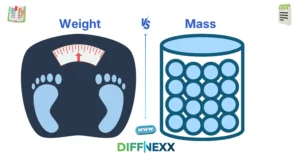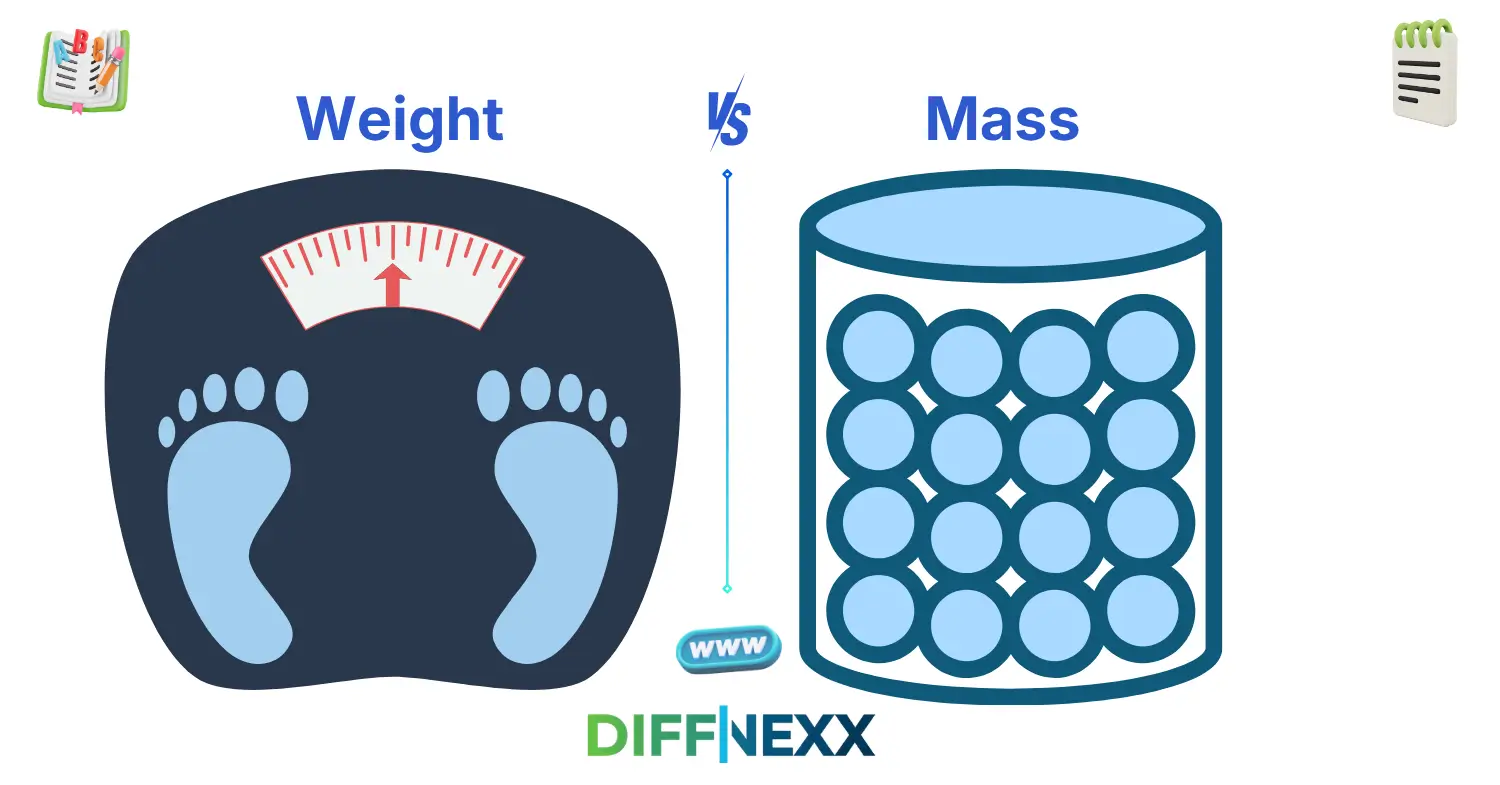
Difference between weight and mass often confuses students in science class. Imagine stepping on a weighing scale and seeing a number. You might think that number is your “mass,” but in science, it actually represents your weight.
The difference between weight and mass is simple once you understand it. Mass is the amount of matter in an object, while weight is the force acting on that mass due to gravity.
Many people use these terms interchangeably, but the difference between weight and mass is important in physics and everyday life.
Let’s explore their meanings, differences, and real-world applications in a clear and simple way.
🔑 Key Difference Between the Both
The key difference is:
- Mass is the amount of matter in an object.
- Weight is the force of gravity acting on that object.
In short, mass stays the same everywhere, but weight changes depending on gravity.
🌍 Importance – Why Their Difference Matters
Understanding the difference between weight and mass is essential for learners and professionals.
For students, it builds a strong foundation in physics. It helps them solve problems and understand scientific concepts clearly.
For professionals, especially in science, engineering, and space research, this difference is critical for accurate calculations.
In society, it helps people understand real-world phenomena, like why astronauts weigh less on the moon.
🔊 PRONUNCIATION SECTION
Weight
US: /weɪt/
UK: /weɪt/
Mass
US: /mæs/
UK: /mæs/
Now that you know how to say them, let’s understand their meanings in detail.
📚 CORE DEFINITIONS
Weight
Weight is the force with which gravity pulls an object toward Earth or another planet. It depends on both mass and gravity. The tone is scientific and measurable.
Example: A person weighs less on the Moon due to weaker gravity.
Mass
Mass is the amount of matter in an object. It remains constant regardless of location. The tone is stable and fixed.
Example: A person’s mass stays the same on Earth and the Moon.
📚 10 Clear Differences Between Weight and Mass
1. Definition Focus
Weight measures gravitational force.
Mass measures matter in an object.
- Example (Weight): Your weight changes on different planets.
- Example (Mass): Your mass stays constant everywhere.
2. Dependence on Gravity
Weight depends on gravity.
Mass does not depend on gravity.
- Example (Weight): Lower gravity reduces weight.
- Example (Mass): Mass remains unchanged.
3. Units of Measurement
Weight is measured in newtons (N).
Mass is measured in kilograms (kg).
- Example (Weight): 600 N on Earth.
- Example (Mass): 60 kg everywhere.
4. Nature
Weight is a force.
Mass is a physical property.
- Example (Weight): Force pulling downward.
- Example (Mass): Quantity of matter.
5. Measurement Tools
Weight is measured using a spring scale.
Mass is measured using a balance.
- Example (Weight): Hanging scale reading.
- Example (Mass): Laboratory balance reading.
6. Variation
Weight varies with location.
Mass remains constant.
- Example (Weight): Less on the Moon.
- Example (Mass): Same everywhere.
7. Direction
Weight has direction (toward Earth’s center).
Mass has no direction.
- Example (Weight): Always downward.
- Example (Mass): No direction involved.
8. Formula
Weight is calculated using a formula involving gravity.
Mass has no such formula; it is a basic property.
- Example (Weight): Multiply mass by gravity.
- Example (Mass): Measured directly.
9. Scientific Role
Weight is important in force calculations.
Mass is important in inertia and motion.
- Example (Weight): Calculating pressure.
- Example (Mass): Studying motion.
10. Expression Style
Weight is expressed with force values.
Mass is expressed as quantity.
- Example (Weight): “He weighs 700 N.”
- Example (Mass): “He has a mass of 70 kg.”
🎯 Why Knowing the Difference Matters
Students need this knowledge to understand physics concepts clearly. It helps in solving numerical problems and avoiding mistakes.
Professionals use this distinction in engineering, medicine, and space science. Accurate calculations depend on it.
In everyday life, understanding this difference improves general knowledge and prevents confusion.
Real-world consequences of confusion
Confusing weight with mass can lead to incorrect calculations in science and engineering. It may also cause misunderstanding in education and communication.
🧠 Why People Get Confused
Similar Usage
People use “weight” and “mass” interchangeably in daily language.
Semantic Overlap
Both relate to how heavy something feels, which creates confusion.
Context-Based Usage
In non-scientific contexts, weight often replaces mass.
Informal Influence
Media and everyday speech rarely distinguish between them.
🎭 Connotation & Emotional Tone
Connotation = the emotional meaning associated with a word.
Weight
- Neutral: Used in everyday and scientific contexts.
- Example: “Her weight changed after exercise.”
Mass
- Neutral and Technical: Used mainly in scientific discussions.
- Example: “The mass of the object is constant.”
🗣 Usage in Metaphors, Similes & Idioms (If Applicable)
- “The weight of responsibility” → Emotional burden
- “A mass of people” → Large group
Examples:
- “He felt the weight of the decision.”
- “A mass gathered in the square.”
📊 Comparison Table
| Feature | Weight | Mass |
|---|---|---|
| Meaning | Force due to gravity | Amount of matter |
| Tone | Everyday & scientific | Scientific |
| Usage | Force measurement | Quantity measurement |
| Context | Physics, daily life | Physics |
| Formality | Neutral | Formal |
⚖️ Which Is Better in What Situation?
When to Use Weight
Use weight when discussing force or gravity-related situations. For example, when talking about how heavy something feels on Earth or another planet.
When to Use Mass
Use mass when referring to the amount of matter in an object. It is best for scientific and academic contexts.
Situational Clarity
If gravity matters, use weight. If quantity matters, use mass.
Contextual Correctness
In exams and scientific writing, always use the correct term to avoid errors.
📖 Literary or Cultural References
- Book: A Brief History of Time (Science, Stephen Hawking, 1988)
- Book: Physics for Beginners (Education, various authors)
- Movie: Interstellar (USA, 2014) – explores gravity and physics
- Movie: Gravity (USA, 2013) – focuses on space conditions
❓ FAQs (10 Questions)
1. What is the main difference between weight and mass?
Mass is the amount of matter in an object, while weight is the force of gravity acting on it.
2. Does mass change with location?
No, mass remains constant everywhere.
3. Does weight change with location?
Yes, weight changes depending on gravity.
4. What unit is used for mass?
Mass is measured in kilograms (kg).
5. What unit is used for weight?
Weight is measured in newtons (N).
6. Why do people confuse weight and mass?
Because everyday language uses “weight” for both concepts.
7. Which is more important in physics?
Both are important, but they are used in different contexts.
8. Can you have mass without weight?
Yes, in zero gravity, an object has mass but no weight.
9. How is weight calculated?
Weight is calculated using the formula W = mg.
10. Is weight a force?
Yes, weight is a force caused by gravity.
🏁 CONCLUSION
The difference between weight and mass is simple yet important. Mass measures how much matter an object contains, while weight measures the force of gravity acting on it.
Although they seem similar in everyday language, they are very different in science. Mass stays constant, but weight changes with gravity.
Understanding this difference helps students learn better, professionals work accurately, and everyone communicate more clearly.
Keep exploring science concepts like this small differences often lead to big understanding!

Mira Anand is a writer at Distinly.com who focuses on storytelling, communication, and social perspective. Her work highlights subtle differences in language and meaning across cultures and communities. With a clear and empathetic voice, Mira helps readers understand how narratives shape understanding, relationships, and modern dialogue in an increasingly connected world.