Difference between 504 and IEP often comes up when a child needs extra support in school. Imagine a parent sitting with a teacher, trying to understand why their child struggles in class. They hear terms like “504 plan” and “IEP,” but the meaning is not clear.
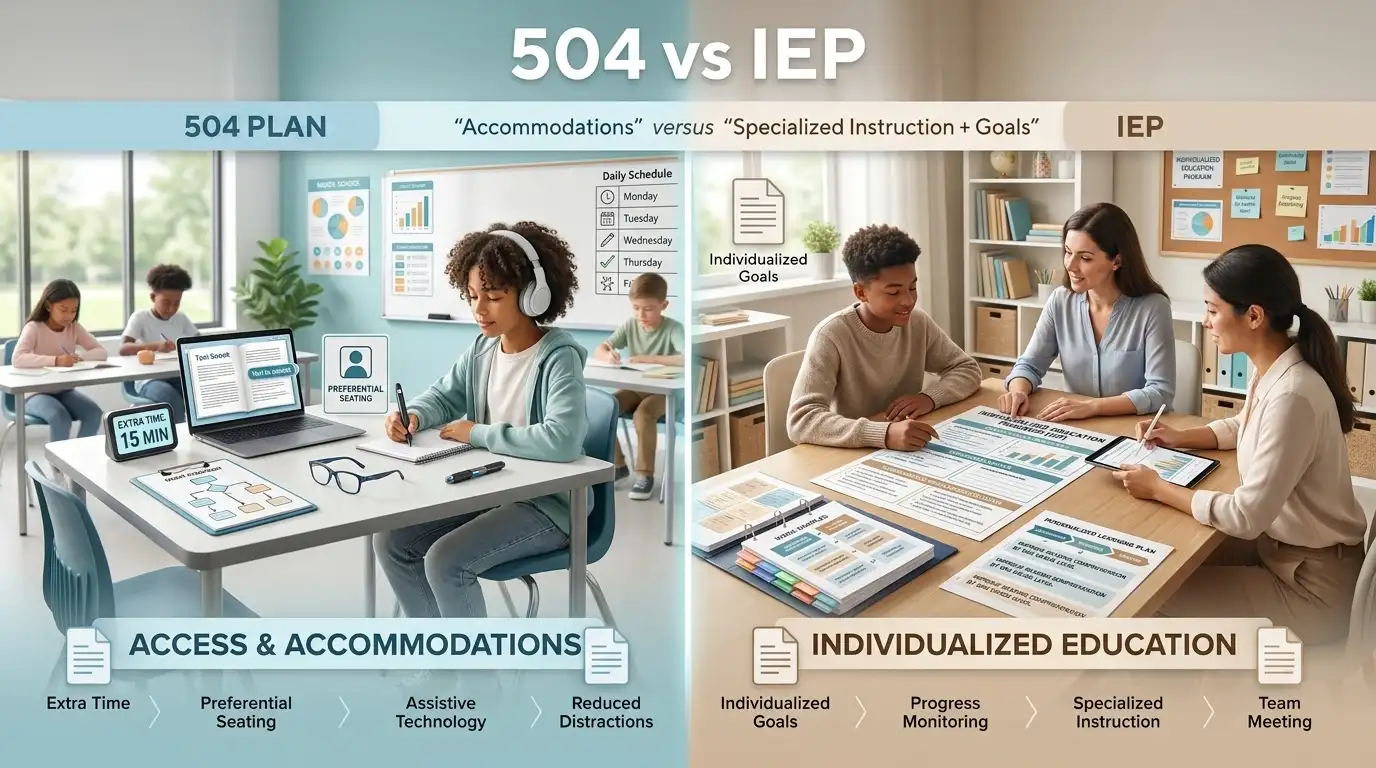
The difference between 504 and IEP lies in how schools support students with learning or physical needs. A 504 plan provides accommodations, while an IEP offers specialized instruction and services. Both aim to help students succeed, but they work in different ways.
Understanding the difference between 504 and IEP helps parents, teachers, and students make better decisions. It ensures that the child receives the right type of support.
Let’s now explore these differences step by step in a simple and clear way.
Key Difference Between the Both
The main difference is this:
A 504 plan provides equal access through accommodations, while an IEP provides individualized education with specialized instruction and goals.
Importance – Why Their Difference Matters in Society
Knowing the difference helps students get the right support. A wrong plan may not meet their needs.
For educators and experts, this knowledge ensures proper placement and teaching strategies. It improves learning outcomes.
In society, equal education is a right. Understanding these plans supports fairness, inclusion, and academic success for all learners.
🔊 Pronunciation Section
504 Plan
US: /ˌfaɪv oʊ ˈfɔːr plæn/
UK: /ˌfaɪv əʊ ˈfɔː plæn/
IEP (Individualized Education Program)
US: /ˌaɪ iː ˈpiː/
UK: /ˌaɪ iː ˈpiː/
Now that the terms sound clearer, let’s define them properly.
📚 Core Definitions
504 Plan
A 504 plan is a support plan that gives students equal access to education. It provides accommodations like extra time or seating changes. It feels flexible and less formal.
Example: A student gets extra time on tests due to attention difficulties.
IEP (Individualized Education Program)
An IEP is a detailed plan for students who need special education services. It includes goals, teaching methods, and support services. It feels structured and highly personalized.
Example: A student receives speech therapy and customized lessons.
📚 10 Clear Differences Between 504 and IEP
1. Purpose
A 504 plan ensures access. An IEP provides specialized education.
- Example (504): Extra time on exams.
- Example (IEP): Special reading program.
2. Legal Basis
A 504 plan comes from Section 504 of the Rehabilitation Act. An IEP comes from the Individuals with Disabilities Education Act (IDEA).
- Example (504): Protects equal access.
- Example (IEP): Guarantees special education services.
3. Eligibility Criteria
504 plans have broader eligibility. IEPs require specific disabilities and evaluation.
- Example (504): Mild ADHD qualifies.
- Example (IEP): Learning disability with strong impact.
4. Level of Support
504 plans offer basic support. IEPs provide intensive support.
- Example (504): Seating adjustment.
- Example (IEP): One-on-one teaching.
5. Instruction Type
504 does not change instruction. IEP modifies instruction.
- Example (504): Same lesson, different format.
- Example (IEP): Customized lessons.
6. Documentation Detail
504 plans are shorter. IEPs are detailed and structured.
- Example (504): Simple list of accommodations.
- Example (IEP): Goals, services, progress reports.
7. Team Involvement
504 plans involve fewer people. IEPs require a full team.
- Example (504): Teacher and counselor.
- Example (IEP): Teachers, specialists, parents.
8. Progress Monitoring
504 plans have limited tracking. IEPs require regular progress reports.
- Example (504): Informal updates.
- Example (IEP): Scheduled reviews.
9. Flexibility
504 plans are more flexible. IEPs follow strict guidelines.
- Example (504): Easy to adjust.
- Example (IEP): Formal review needed.
10. Educational Impact
504 supports access. IEP supports academic growth and development.
- Example (504): Helps student participate.
- Example (IEP): Improves skills and learning.
🎯 Why Knowing the Difference Matters
Students benefit when they receive the right support. A correct plan improves confidence and learning outcomes.
Professionals must understand the difference to provide proper services. It ensures compliance with education laws.
Society benefits from inclusive education. Clear understanding prevents misunderstandings and supports equal opportunities.
Real-world consequences of confusion
If a student needs an IEP but only gets a 504 plan, they may fall behind. If the opposite happens, resources may be misused.
🧠 Why People Get Confused
Similar Terms
Both are school support plans. This makes them sound similar.
Overlapping Purpose
Both aim to help students succeed in school.
Context-Based Usage
Schools sometimes use the terms casually, which creates confusion.
Informal Speech
People often say “support plan” without specifying which one.
🎭 Connotation & Emotional Tone
Connotation = the emotional meaning associated with a word.
504 Plan
- Positive: Flexible, accessible
- Neutral: Basic support plan
- Negative: Limited help
Example: “It helps, but may not be enough for complex needs.”
IEP
- Positive: Personalized, supportive
- Neutral: Structured plan
- Negative: Can feel complex
Example: “It offers strong support but requires detailed steps.”
🗣 Usage in Metaphors, Similes & Idioms
- “A 504 plan is like a ramp it helps you access the building.”
- “An IEP is like a personal guide; it walks with you step by step.”
These comparisons show the difference in support level.
📊 Comparison Table
| Feature | 504 Plan | IEP |
|---|---|---|
| Meaning | Access support plan | Special education plan |
| Tone | Flexible | Structured |
| Usage | Accommodations | Instruction + services |
| Context | Mild to moderate needs | Significant educational needs |
| Formality | Less formal | Highly formal |
⚖️ Which Is Better in What Situation?
When to Use 504 Plan
Use a 504 plan when a student needs simple support like extra time or seating changes. It works best for mild challenges.
When to Use IEP
Choose an IEP when a student needs specialized instruction or therapy. It supports deeper learning needs.
Situational Clarity
If the student can follow the standard curriculum with help, a 504 plan is enough. If not, an IEP is better.
Contextual Correctness
Always match the plan to the student’s needs. Proper evaluation ensures the right choice.
📖 Literary or Cultural References
- Book: Out of My Mind (Fiction, Sharon Draper, 2010)
Shows a student needing strong educational support, similar to an IEP. - Movie: Taare Zameen Par (India, 2007)
Highlights a child with learning difficulties who benefits from specialized teaching.
❓ FAQs
1. What is the main difference between 504 and IEP?
A 504 plan provides accommodations for access, while an IEP offers specialized instruction and services.
2. Which is better, 504 or IEP?
Neither is better. The right choice depends on the student’s needs.
3. Can a student have both?
Usually no. A student typically has either a 504 plan or an IEP, not both.
4. Is a 504 plan easier to get?
Yes, it has broader eligibility and fewer requirements than an IEP.
5. Does an IEP include goals?
Yes, IEPs include specific learning goals and progress tracking.
6. Do colleges follow 504 or IEP?
Colleges usually follow 504 accommodations, not IEPs.
7. Can a 504 plan become an IEP?
Yes, if the student’s needs increase, they may qualify for an IEP.
8. Who creates an IEP?
A team of teachers, specialists, and parents creates it.
9. Is a 504 plan legally binding?
Yes, it is protected under federal law.
10. How often are plans reviewed?
IEPs are reviewed annually, while 504 plans are reviewed as needed.
🏁 Conclusion
The difference between 504 and IEP is important for ensuring the right support in education. A 504 plan focuses on access and simple accommodations, while an IEP provides structured, personalized instruction and services.
Understanding this difference helps parents, teachers, and students make informed decisions. It ensures that every learner receives the support they truly need.
Choosing the right plan can improve confidence, performance, and future success. Keep learning about these tools and use them wisely to support inclusive education.

Ezra Hale is a thoughtful contributor to Distinly.com, where he explores philosophical ideas and the subtle differences behind everyday concepts. His writing blends logic, language, and human insight to clarify complex distinctions. Ezra encourages readers to think deeper, question assumptions, and appreciate the meaning behind words and ideas in modern discourse.