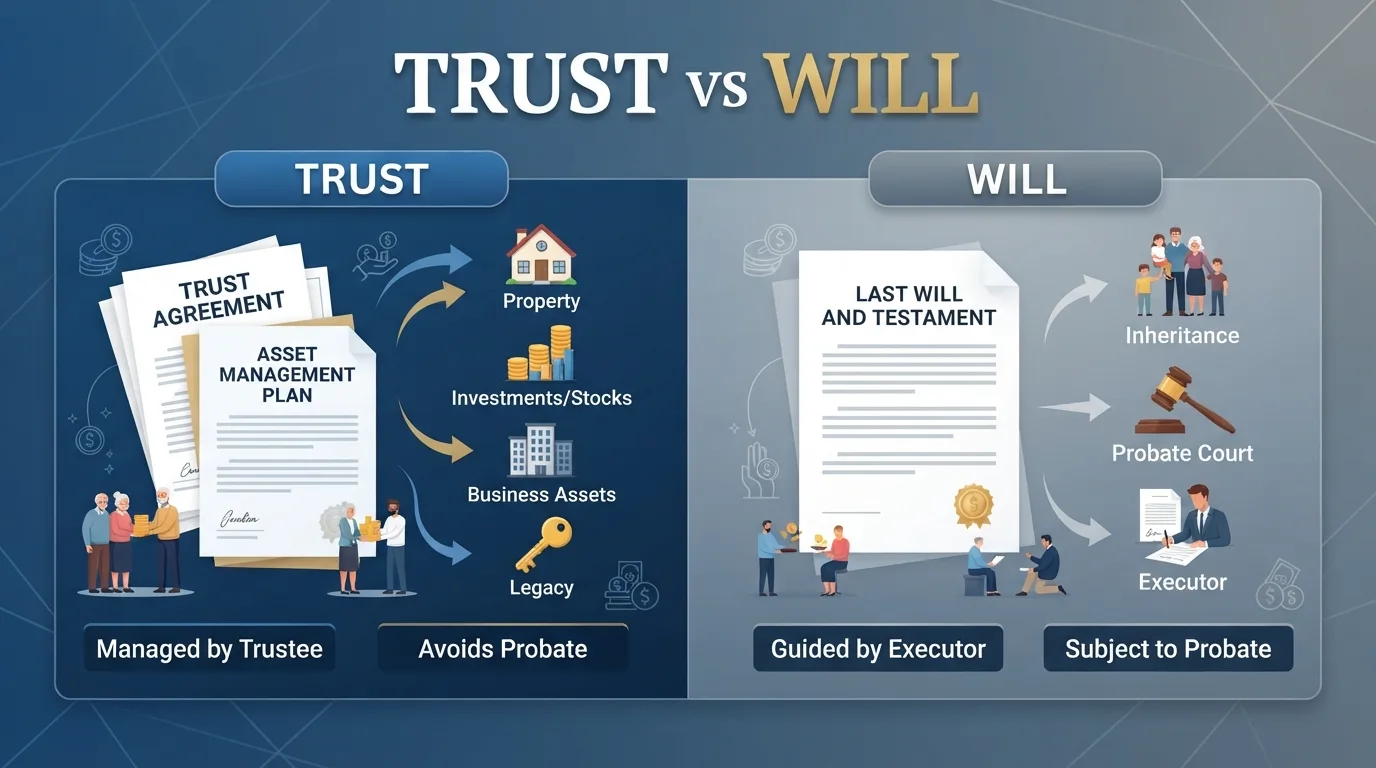
The difference between trust and will is mainly about how and when each legal tool works. A will generally takes effect after death and gives instructions for distributing property through the estate process. A trust can operate during a person’s lifetime and can continue after death, depending on its terms. A revocable living trust can also help manage assets if the person who created it becomes unable to manage them.
The difference between trust and will is not simply that one is “better” than the other. They can perform different jobs. A will can name an executor and nominate a guardian for minor children. A properly funded living trust can manage property during life and may allow covered assets to pass without probate.
The difference between trust and will also depends on what kind of trust you mean. This article focuses mainly on the revocable living trust, because that is the type most commonly compared with a will in estate-planning searches.
Important: Estate-planning rules vary by jurisdiction. The examples below describe common U.S. estate-planning concepts, not legal advice for a particular state or family.
Quick Answer
A will is a legal document that states what should happen to certain property after you die. It can name the person who will handle your estate, identify beneficiaries, and nominate guardians for minor children. The probate court generally gives the will legal effect through the probate process.
A revocable living trust is a legal arrangement created during your lifetime. You can transfer assets into the trust and usually continue managing them yourself. A successor trustee can take over management if you become incapacitated, and the trust can provide instructions for distributing or managing the property after your death.
The simplest distinction is:
Will: instructions that generally take effect at death.
Living trust: an arrangement that can manage assets during life, during incapacity, and after death.
Many estate plans use both rather than treating them as competing documents.
Trust vs. Will at a Glance
| Feature | Will | Revocable Living Trust |
|---|---|---|
| Main purpose | Gives instructions for an estate after death | Holds and manages assets during life and after death |
| Takes effect | Generally at death | During the creator’s lifetime |
| Manages assets during incapacity | No | Yes, if properly structured and funded |
| Probate | Generally involved for property controlled by the will | Properly transferred trust assets generally avoid probate |
| Privacy | Probate records may become public | Trust administration is generally more private |
| Names guardians for minor children | Yes | Generally no |
| Names an executor/personal representative | Yes | No; it names a trustee |
| Requires assets to be transferred into it | No | Yes, for the trust to control those assets |
| Can be revocable | A will can be changed while the person has legal capacity | A revocable living trust can generally be changed or revoked |
| Can continue after death | No, although it can create a testamentary trust | Yes |
| Can be used with the other | Yes | Yes |
The exact legal effect of each document depends on the document’s terms and the law where you live.
What Is a Will?
A will, formally called a last will and testament, is a legal document that expresses a person’s wishes about the distribution and administration of their estate after death.
A will can commonly:
- Name beneficiaries
- Name an executor or personal representative
- Describe how certain property should be distributed
- Nominate guardians for minor children
- Create certain trusts at death
- Provide instructions for handling remaining property
The American Bar Association explains that wills can range from simple documents to more complex arrangements and can also create trusts that begin after death.
What a will does not do
A will does not automatically control every asset you own.
Some assets can pass outside the will through mechanisms such as beneficiary designations or joint ownership with rights of survivorship. Life insurance and retirement accounts are common examples when they have valid beneficiary designations.
This is why estate planning involves more than simply writing a will.
What Is a Trust?
A trust is a legal arrangement in which a trustee holds or manages property for beneficiaries under the terms of the trust.
A trust can take many forms.
For example, there are:
- Revocable living trusts
- Irrevocable trusts
- Testamentary trusts
- Charitable trusts
- Special-purpose trusts
- Other trusts created for specific legal or financial goals
The Internal Revenue Service recognizes both trusts created during a person’s lifetime and trusts created through a will. A revocable living trust is generally created during life and can usually be changed or ended by the person who created it.
Because “trust” is such a broad term, you should not assume that every trust has the same tax, asset-protection, probate, or estate-planning effects.
The Biggest Difference: When They Work
Timing is one of the clearest differences.
A will generally works after death
A will does not normally manage your property while you are alive.
If you become unable to manage your finances, the will does not step in and manage your assets for you.
Instead, the will becomes relevant after your death, when the estate must be administered.
A living trust can work during your lifetime
A revocable living trust can exist while you are alive.
You may serve as the trustee and manage the trust property yourself. You can also name a successor trustee to take over if you become unable to manage the trust property.
This makes incapacity planning one of the major differences between a living trust and a will.
Probate: Why It Matters
Probate is the court-supervised process used to administer certain property and recognize a will.
The American Bar Association notes that probate laws vary by state and that many states have simplified procedures for some estates.
Property properly transferred to a living trust can generally pass under the trust without going through probate.
But this does not mean that every trust eliminates probate.
The key issue is whether the asset is actually held by the trust or otherwise passes outside probate.
Example
Suppose Alex creates a living trust but never transfers ownership of a house into it.
The trust document exists.
But the house may still be part of Alex’s probate estate because the house was never properly transferred to the trust.
This is why funding the trust matters.
The California Superior Court similarly explains that property held in a living trust can pass to beneficiaries without probate and recommends a pour-over will as a backup for property not transferred to the trust.
What Does “Funding a Trust” Mean?
This is one of the most important points that simple trust-versus-will articles often overlook.
Creating a trust document is only part of the process.
Funding a trust generally means transferring appropriate assets into the trust or arranging ownership so that the trust controls them according to its terms.
Depending on the asset and local law, this can involve changing ownership records or titles.
For example, a person might establish a revocable living trust and then transfer certain real estate or financial assets into the trust.
If an asset remains solely in the person’s individual name, the trust may not control that asset simply because the trust document exists.
The American Bar Association notes that property needs to be transferred to a living trust for the trust to handle it in this way.
Do You Need a Will if You Have a Trust?
Often, yes.
This is one of the most common questions about estate planning.
A living trust does not automatically make a will unnecessary.
A pour-over will can act as a backup for certain property that was not transferred to the trust during the person’s lifetime. It can direct that property into the trust after death, subject to probate and applicable law.
A will also has an important role for parents.
In many U.S. jurisdictions, a will is the document used to nominate a guardian for minor children. The trust itself generally does not replace that function.
So a common estate plan may contain:
Living trust + pour-over will + other estate-planning documents
The two documents can work together.
What Is a Pour-Over Will?
A pour-over will is designed to work alongside a living trust.
It generally says that certain assets remaining outside the trust at death should pass into the trust.
Think of it as a safety net.
For example:
- Maria creates a revocable living trust.
- She transfers her house and certain financial assets into it.
- Years later, she buys another asset but never transfers it into the trust.
- She dies while that asset remains in her individual name.
- Her pour-over will can direct that property into the trust, subject to the probate process and applicable law.
A pour-over will does not magically move assets into a trust without legal steps. Its purpose is to provide a backup instruction.
The California Superior Court specifically recommends a pour-over will alongside a living trust for this reason.
Privacy: Trust vs. Will
Privacy is another commonly discussed difference.
A will submitted to probate becomes part of a court proceeding, and probate records may be available to the public depending on state law and the specific record.
A living trust is generally administered privately rather than through the same public probate process.
However, privacy is not absolute.
Court proceedings, disputes, tax filings, and other legal requirements can create records involving a trust or its assets.
The American Bar Association notes that a living trust can avoid probate for property properly transferred to it, but also warns against treating probate avoidance as an automatic benefit in every situation.
What Happens if You Become Incapacitated?
This is an important difference that often gets less attention than probate.
A will generally does not manage your property while you are alive.
A properly structured living trust can provide a mechanism for a successor trustee to manage trust assets if you become unable to manage them yourself.
For example:
James creates a revocable living trust and names himself as trustee. He also names his daughter as successor trustee. If James later becomes unable to manage the trust property, the successor trustee may be able to step in under the trust’s terms.
The exact process depends on the trust document and applicable law.
The American Bar Association identifies lifetime asset management and incapacity planning as important functions of living trusts.
Who Handles the Estate?
A will and a trust use different roles.
Executor or personal representative
A will typically names an executor, sometimes called a personal representative, to handle the estate after death.
That person may handle tasks such as:
- Collecting estate property
- Paying valid debts
- Handling required filings
- Working through probate
- Distributing assets according to the will
The exact title varies by state.
Trustee
A trust has a trustee.
The trustee manages trust property according to the trust document.
A living trust can have the person who created it serve as the initial trustee and another person serve as successor trustee.
This difference is easy to remember:
Will → executor/personal representative
Trust → trustee
Will vs. Trust for Minor Children
Parents often need to pay special attention to this issue.
A will can nominate a guardian for minor children if both parents die or are otherwise unable to care for them.
A living trust can provide financial instructions for property held in the trust, but it generally does not replace the guardian-nomination function of a will.
For example, parents could use a will to nominate a person they want to serve as guardian while using a trust to manage money intended for their children.
The two documents can therefore solve different parts of the same planning problem.
Trust vs. Will: Cost and Maintenance
A will is often simpler to create and maintain than a living trust.
But comparing only the initial price can be misleading.
A trust may require additional work to transfer assets into it and keep ownership records aligned with the trust.
A will-based estate may instead involve probate administration after death.
The cost of probate varies by state and estate.
The American Bar Association cautions against assuming that probate is always expensive or slow and notes that many states have simplified procedures.
This means you should compare the full situation, not simply ask:
“Which document costs less?”
Consider:
- Drafting costs
- Asset-transfer costs
- Probate rules
- Estate complexity
- Number and type of assets
- Real estate ownership
- Family circumstances
- Administrative work
- Privacy concerns
Does a Trust Avoid Estate Tax?
Not automatically.
This is a major misconception.
A revocable living trust is not automatically an estate-tax avoidance tool.
The IRS explains that revocable trusts are generally treated as grantor trusts for federal tax purposes, and the assets may still be included in the grantor’s estate for federal estate-tax purposes.
Some irrevocable trusts can have different tax consequences, but those rules are much more complex.
Therefore:
Trust ≠ automatic tax savings.
The tax effect depends on the type of trust, its terms, the assets involved, and applicable federal and state law.
Can a Will Create a Trust?
Yes.
A will can contain provisions that create a testamentary trust after the person’s death.
The IRS defines a testamentary trust as a trust created by a will that begins after death when property is transferred from the decedent’s estate.
This creates an important distinction:
- Living trust: created during life.
- Testamentary trust: created through a will and begins after death.
So a will and a trust are not always separate documents.
A will can actually be the document that creates a trust.
Trust vs. Will: Common Misconceptions
“A trust completely replaces a will.”
Not necessarily.
A living trust and a will can serve different purposes. A pour-over will can provide backup instructions, and a will can nominate guardians for minor children.
“Every trust avoids probate.”
No.
A trust generally avoids probate only for property that properly passes through the trust or another probate-avoidance mechanism.
“A trust automatically saves estate taxes.”
No.
Trust taxation depends on the type of trust and its legal and tax structure. A revocable living trust is generally not an automatic estate-tax reduction strategy.
“A will controls everything I own.”
Not always.
Some assets pass through beneficiary designations, joint ownership, or other arrangements outside the will.
“A trust is only for wealthy people.”
Not necessarily.
The American Bar Association notes that the usefulness of a living trust depends on individual circumstances rather than a simple wealth threshold.
“A trust is always better than a will.”
There is no universal answer.
The appropriate estate-planning structure depends on factors such as assets, family situation, state law, privacy goals, incapacity planning, and how much probate avoidance actually matters in the particular estate.
Trust vs. Will: Which One Do You Need?
There is no single answer for everyone.
A will may be an important starting point for someone who needs to:
- State who should receive probate assets
- Name an executor
- Nominate guardians for minor children
- Create testamentary instructions
A revocable living trust may be useful for someone who wants:
- Lifetime management of trust assets
- A successor trustee to manage those assets during incapacity
- Probate avoidance for properly funded trust assets
- Greater privacy around trust administration
- Continued management or distribution of assets after death
Some people use both.
The American Bar Association specifically notes that estate planning does not follow a one-size-fits-all approach.
A Simple Example: Will Only
Suppose Emma has a relatively simple estate.
She owns a home, a bank account, and personal property. She creates a will that names her beneficiaries and an executor.
After her death, the executor follows the applicable probate process, pays valid debts and expenses, and distributes property according to the will and state law.
The will provides the instructions, while probate provides the legal process for administering the estate.
A Simple Example: Living Trust and Will
Now imagine Daniel creates a revocable living trust.
He transfers appropriate assets into the trust and names himself as trustee. His spouse becomes successor trustee.
If Daniel later becomes incapacitated, the successor trustee can potentially manage the trust property under the trust’s terms.
After Daniel dies, the successor trustee follows the trust instructions.
Daniel also has a pour-over will that serves as a backup for certain property that was not transferred to the trust and nominates a guardian for his minor child.
This example shows why a trust and a will can complement each other.
How to Think About the Difference
A useful mental model is:
A will tells the estate process what you want to happen after death.
A living trust provides a structure for holding and managing property during life and after death.
That is not a complete legal definition, but it makes the basic distinction easier to remember.
The most important question is not simply:
“Trust or will?”
It is:
“What do I need my estate plan to accomplish, and which assets and legal tools will accomplish it under the law where I live?”
Frequently Asked Questions
What is the main difference between a trust and a will?
A will generally provides instructions that take effect after death, while a living trust can operate during the creator’s lifetime and continue after death. A living trust can also provide a way to manage trust assets during incapacity.
Is a trust better than a will?
Neither is universally better. They perform different functions, and many estate plans use both. The right structure depends on the person’s assets, family circumstances, state law, and planning goals.
Do I need a will if I have a living trust?
Often, yes. A pour-over will can provide backup instructions for property that was not transferred to the trust, and a will can nominate guardians for minor children.
Does a trust avoid probate?
A properly funded living trust can generally keep the assets held by the trust out of probate. But simply creating a trust does not automatically move every asset into it.
Can a will avoid probate?
A will does not normally avoid probate. Instead, the will is generally presented to the probate court so the estate can be administered under the applicable law. Some assets can pass outside probate through other arrangements.
Can a trust be changed?
A revocable living trust can generally be changed or revoked during the creator’s lifetime, subject to its terms and applicable law. An irrevocable trust is different and may have significant restrictions on modification or revocation.
Does a trust save taxes?
Not automatically. A revocable living trust is generally treated as a grantor trust for federal tax purposes, and different trust structures have different tax consequences.
Test Your Knowledge
1. When does a typical will take effect?
A. When it is printed
B. When the person buys property
C. After the person’s death
D. When a trustee signs it
Correct answer: C. After the person’s death
2. Which person manages trust property?
A. Executor
B. Trustee
C. Guardian
D. Beneficiary
Correct answer: B. Trustee
3. What is one important function of a will for parents of minor children?
A. Setting mortgage rates
B. Naming a guardian
C. Creating a bank account
D. Avoiding every tax
Correct answer: B. Naming a guardian
4. What does “funding a trust” generally mean?
A. Paying a yearly tax
B. Transferring appropriate assets into the trust
C. Closing the trust
D. Filing a will with a court
Correct answer: B. Transferring appropriate assets into the trust
5. What is a pour-over will?
A. A will that provides backup instructions for property intended to pass into a trust
B. A trust used only for real estate
C. A document that cancels all beneficiary designations
D. A tax return
Correct answer: A. A will that provides backup instructions for property intended to pass into a trust
6. Does every trust automatically avoid probate?
A. Yes
B. Only if it is handwritten
C. No
D. Only for bank accounts
Correct answer: C. No
Conclusion
The difference between trust and will becomes much easier to understand when you focus on their jobs. A will generally provides instructions for your estate after death, while a living trust can hold and manage property during your lifetime and continue managing or distributing that property after death.
A will can also do something a living trust generally does not: nominate a guardian for minor children. A living trust, when properly funded, can provide lifetime management and may keep covered assets outside the probate process.
The two tools do not always compete. In many estate plans, they work together. Because estate and probate laws vary by state, anyone making or changing an estate plan should consider the rules that apply to their own situation and obtain advice from a qualified estate-planning professional when needed.
Suggested External Sources
- American Bar Association — Introduction to Wills — Useful for understanding wills, beneficiaries, guardianship, and trusts created through wills.
- American Bar Association — Revocable Trusts — Useful for living trusts, incapacity planning, probate, and trust management.
- American Bar Association — The Probate Process — Useful for explaining probate and why its rules differ by state.
- Internal Revenue Service — Trusts and Federal Tax Treatment — Useful for explaining revocable, irrevocable, grantor, living, and testamentary trusts.
- California Superior Court — Living Trusts — A court resource explaining living trusts, pour-over wills, and guardianship.

Mira Anand is a writer at Distinly.com who focuses on storytelling, communication, and social perspective. Her work highlights subtle differences in language and meaning across cultures and communities. With a clear and empathetic voice, Mira helps readers understand how narratives shape understanding, relationships, and modern dialogue in an increasingly connected world.