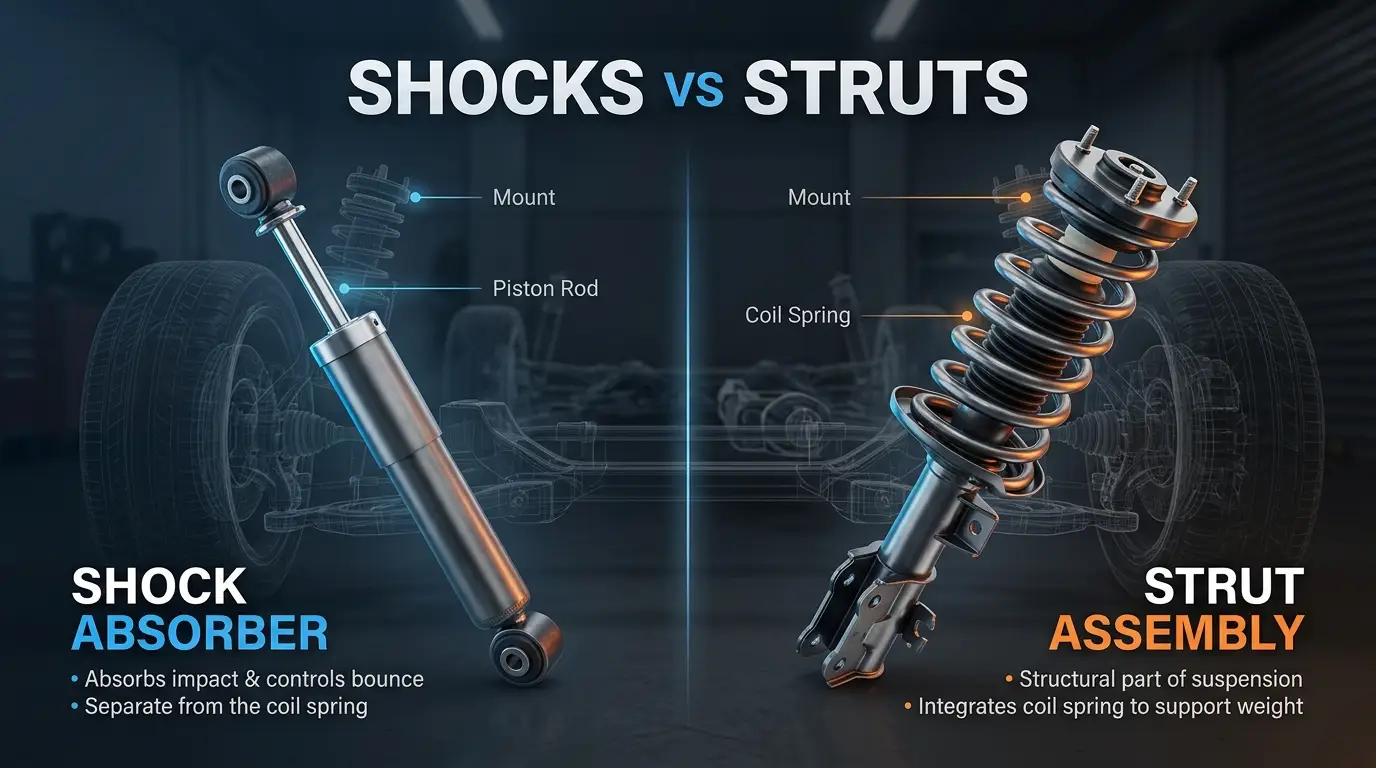
The difference between shocks and struts is their role in a vehicle’s suspension system. Both help control bouncing after bumps and keep the tires in contact with the road. However, a shock absorber mainly controls suspension movement, while a strut also serves as a structural part of the suspension and helps locate the wheel. These parts are not interchangeable.
Your car may use struts at the front and shocks at the rear, or it may use a different setup. Knowing the difference between shocks and struts can help you understand repair estimates, recognize possible suspension problems, and choose the correct replacement parts.
The difference between shocks and struts also matters because strut replacement may involve extra labor and a wheel alignment check. The right repair depends on your vehicle’s design and the condition of its suspension.
Shocks vs. Struts: Quick Comparison
| Feature | Shocks | Struts |
|---|---|---|
| Main job | Control suspension and spring movement | Control movement and provide structural support |
| Structural role | Usually not a structural suspension member | Forms a structural part of the suspension |
| Spring location | Often works with a separate spring | Often works with a spring as part of a strut assembly |
| Steering role | Does not usually act as a steering pivot | Often helps locate the wheel and supports steering geometry |
| Wheel alignment | Replacement usually does not change alignment directly | Replacement may affect alignment angles |
| Common location | Often found at the rear of some cars and at all four corners of some trucks | Common at the front of many cars; some vehicles use rear struts |
| Replacement work | Often simpler, depending on access and design | May involve more parts and labor |
| Interchangeable? | No | No |
These are general differences. The exact design of your vehicle determines how each component works and where it is fitted.
What Are Shocks on a Car?
Shocks, short for shock absorbers, are suspension parts that control the movement of the springs and wheels.
When a tire hits a pothole, the suspension spring compresses and then tries to return to its original position. Without damping, the vehicle could keep bouncing. A shock absorber resists this repeated movement and helps the suspension settle.
Shocks help your vehicle:
- Reduce bouncing after bumps.
- Keep the tires in contact with the road.
- Improve stability on uneven surfaces.
- Control body movement during braking and turning.
- Support predictable handling and ride comfort.
A conventional shock usually works with a separate spring. It controls movement but does not serve as a main structural member that locates the wheel.
How do shock absorbers work?
Most conventional shock absorbers use hydraulic fluid, often with pressurized gas, to resist movement. Inside the unit, a piston moves through fluid as the suspension compresses and extends.
The shock turns some of the suspension’s movement energy into heat. This slows repeated bouncing and helps the vehicle settle after a bump.
A shock does not stop every movement. Instead, it controls how quickly the suspension moves.
What Are Struts on a Car?
A strut is a suspension component that controls movement and also serves a structural role. Many strut designs combine a damper with a coil spring mounted around it, along with mounts and other parts.
A common example is a MacPherson strut, which helps support and locate the wheel assembly. On many vehicles, it also acts as a steering pivot.
Struts help your vehicle:
- Control bouncing and suspension movement.
- Support the suspension’s structure.
- Help locate the wheel.
- Maintain the intended steering and alignment geometry.
- Provide a mounting point for related suspension parts.
The spring supports the vehicle’s weight. The strut forms part of the structure that carries and controls suspension loads.
How do struts work?
A strut uses damping to control spring movement, much like a shock absorber. Its structural role sets it apart.
Because the strut can connect to the steering knuckle and body, removing or replacing it may affect wheel alignment. Some designs also include a spring seat, upper mount, and bearing that lets the assembly turn with the steering.
Not every strut has the exact same design. Always check the service information for your vehicle before choosing parts or planning a repair.
The Main Differences Between Shocks and Struts
1. Structure and function
The biggest difference is the role each part plays in the suspension.
A conventional shock controls movement but is not a main structural suspension member. A strut controls movement and forms part of the structure that supports and locates the wheel.
This is why you cannot simply replace a strut with a shock. The vehicle’s suspension was designed to use a specific type of component.
2. Springs and suspension design
Shocks often work beside a separate coil spring or leaf spring. The spring stores energy when the wheel moves, while the shock controls the spring’s motion.
Many strut assemblies place a coil spring around the strut. The strut and spring work together, but they perform different jobs.
A strut does not mean the spring and damper are always sold as one complete part. Depending on the vehicle, a repair may involve a complete assembly or separate components.
3. Steering and wheel alignment
A conventional shock generally does not set steering geometry. Replacing one often does not require an alignment solely because the shock was changed, although the vehicle’s condition and repair procedure still matter.
A strut often connects to the steering knuckle and helps determine wheel angles. Replacing it can change alignment settings, so a wheel alignment check is commonly recommended after strut replacement.
Incorrect alignment can cause uneven tire wear and poor handling. Follow the manufacturer’s service guidance for the exact vehicle.
4. Ride comfort and handling
Both shocks and struts help control the way a vehicle responds to bumps, turns, and braking.
Worn components can allow too much bouncing or body movement. This may reduce tire contact with the road and make the vehicle feel less stable.
Neither component works alone. Springs, tires, bushings, ball joints, and other suspension parts also affect ride comfort and handling.
5. Replacement cost and labor
Shock replacement is often less involved when the shock is separate from the spring and has easy access. Strut replacement can cost more because the strut may be connected to the steering system and may involve spring and mount components.
However, there is no single price difference that applies to every car. Costs depend on:
- Your vehicle’s make, model, and year.
- The type and quality of replacement parts.
- Whether you replace a complete assembly or individual components.
- Labor rates and access to the parts.
- Whether alignment or related repairs are needed.
Ask the repair shop to list the exact parts, labor, and alignment work in its estimate. This makes it easier to compare quotes fairly.
Does Your Car Have Shocks or Struts?
The answer depends on the suspension design, not simply on whether a component sits at the front or rear.
Some vehicles use front struts and rear shocks. Others use struts at all four corners, while some trucks and other vehicles use shocks at all four corners.
Here are practical ways to identify your setup:
- Check your owner’s manual. It may describe the suspension design or direct you to the correct service information.
- Look up the vehicle’s parts catalog. Use the exact make, model, year, and trim.
- Ask a qualified mechanic. A technician can identify the components during an inspection.
- Check the repair estimate. It should identify the part and the wheel position being serviced.
Do not assume that all front-wheel-drive cars use front struts or that all rear suspensions use shocks. Vehicle design varies.
Also, a strut and a shock may look similar because both can have a long cylindrical body. Appearance alone is not always enough to identify the part.
Signs of Bad Shocks or Struts
Shocks and struts wear over time. Their lifespan depends on road conditions, driving habits, vehicle load, and the component’s design.
Common warning signs include the following.
Excessive bouncing
If your car continues to bounce after crossing a bump, its suspension may not be controlling movement well. Worn shocks or struts are possible causes, but other suspension problems can produce similar symptoms.
Nose-diving during braking
If the front of the vehicle dips more than usual when you brake, worn damping components may be part of the problem. Normal suspension movement is expected, so a change in behavior is more important than a small amount of movement by itself.
Excessive body roll
A car that leans or sways more than usual during turns may have worn shocks or struts. Tires, springs, sway-bar links, and other parts can also affect body roll.
Uneven tire wear
Worn suspension components can contribute to uneven or scalloped tire wear. However, incorrect tire pressure, poor alignment, and worn steering parts can cause similar patterns.
Fluid leaking from a component
Oil around a shock or strut can indicate a leak. A light film may not always mean the unit has failed, so a technician should inspect the component and compare its condition with the manufacturer’s guidance.
Clunking or rattling noises
A noise over bumps may come from worn mounts, bushings, loose fasteners, ball joints, or other suspension parts. Do not assume the shock or strut itself is the cause without an inspection.
Can You Drive With Bad Shocks or Struts?
Worn shocks and struts can affect stability, steering response, tire contact, and braking performance. The level of risk depends on the severity of the wear and whether other parts are damaged.
If your vehicle bounces excessively, sways, makes new suspension noises, or handles differently, arrange an inspection soon. If you notice a sudden change in steering or braking, severe instability, or a visibly damaged suspension part, stop driving when it is safe to do so and arrange professional help.
Do not wait for a component to fail completely before having serious symptoms checked.
Should Shocks and Struts Be Replaced in Pairs?
Often, yes. Mechanics commonly recommend replacing shocks or struts in pairs across the same axle, such as both front units or both rear units.
This helps keep damping performance more consistent from one side of the vehicle to the other. Replacing only one worn unit can leave the two sides responding differently.
However, the correct repair depends on the vehicle manufacturer’s guidance, the condition of both components, and the type of damage. Ask the technician to inspect the matching component before deciding.
It is also wise to inspect related parts, such as mounts, bushings, springs, and tires, while diagnosing suspension wear.
Do Struts Need an Alignment After Replacement?
A wheel alignment check is commonly recommended after replacing a strut because the repair can affect steering and wheel angles.
The need for alignment after shock replacement depends on the suspension design and the work performed. Replacing a conventional shock often does not change alignment directly, but other repairs carried out at the same time might.
An alignment check can help confirm that the wheels meet the manufacturer’s specifications. This supports stable handling and helps reduce avoidable tire wear.
Are Shocks and Struts Interchangeable?
No. They perform related jobs, but they are not interchangeable.
A shock absorber controls suspension movement. A strut does that while also forming a structural part of the suspension. A vehicle designed for a strut needs the correct strut or approved replacement assembly.
Using the wrong part can prevent proper installation or affect suspension geometry and handling. Always verify fitment with a reliable parts catalog or a qualified technician before buying replacements.
Common Misunderstandings About Shocks and Struts
“Shocks and struts are the same part.” They both control suspension movement, but a strut also serves a structural role.
“Every car has four struts.” Some vehicles use a mix of struts and shocks, and others use a different layout.
“A strut is what holds up the entire car.” Springs support the vehicle’s weight. A strut forms part of the suspension structure and helps control and locate the wheel.
“A bouncy ride always means bad shocks.” Worn struts, springs, tires, and other suspension problems can cause similar symptoms.
“Replacing a shock or strut always fixes uneven tire wear.” Alignment, tire pressure, steering parts, and other suspension components may also need attention.
Frequently Asked Questions
1. What is the main difference between shocks and struts?
A shock absorber mainly controls spring and suspension movement. A strut also serves as a structural part of the suspension and often helps locate the wheel and support steering geometry.
2. Are shocks or struts better?
Neither is universally better. Each serves a different role in the suspension design. The correct choice is the component specified for your vehicle.
3. Do all cars have both shocks and struts?
No. A vehicle may use struts at the front and shocks at the rear, struts at all four corners, or shocks at all four corners. The design varies by model.
4. Which usually costs more to replace, shocks or struts?
Strut replacement often involves more labor and may require an alignment check, so it can cost more. Actual costs depend on the vehicle, parts, labor, and repair procedure.
5. How can I tell if my shocks or struts are worn?
Possible signs include excessive bouncing, unusual body roll, fluid leaks, uneven tire wear, and new suspension noises. These signs are not proof on their own, so an inspection can help identify the cause.
6. Should I replace shocks and struts in pairs?
Replacing matching units on the same axle is commonly recommended to keep damping performance balanced. Follow the manufacturer’s guidance and have both sides inspected.
Test Your Knowledge: Shocks vs. Struts
1. What is the main job of a conventional shock absorber?
A. Control suspension movement
B. Generate engine power
C. Control fuel pressure
D. Charge the battery
Correct answer: A. Control suspension movement
2. What makes a strut different from a conventional shock?
A. It only works on the rear wheels
B. It also serves a structural role in the suspension
C. Replaces the tires
D. It controls the engine’s speed
Correct answer: B. It also serves a structural role in the suspension
3. Which setup can a vehicle have?
A. Only four struts
B. Only four shocks
C. Front struts and rear shocks
D. All of the above
Correct answer: D. All of the above
4. Why may a wheel alignment be needed after strut replacement?
A. The repair can affect wheel alignment angles
B. The engine oil must be changed
C. The tires become larger
D. The battery loses power
Correct answer: A. The repair can affect wheel alignment angles
5. What should you do if your vehicle suddenly becomes unstable while driving?
A. Drive faster to test it
B. Ignore the change
C. Stop safely and arrange professional help
D. Replace the tires without inspection
Correct answer: C. Stop safely and arrange professional help
Conclusion
The key difference between shocks and struts is structural: both control suspension movement, but a strut also forms part of the suspension’s structure. Your vehicle’s design determines which part it needs and how replacement affects labor and alignment. If you notice bouncing, swaying, leaks, or unusual noises, have the suspension inspected before choosing replacement parts.
Recommended external link sources
Place these together in a dedicated external-sources section after the article.
- Monroe — Shocks vs. Struts
- NAPA Know How — Does My Vehicle Have Shocks or Struts?
- O’Reilly Auto Parts — The Difference Between Shocks and Struts
- Firestone Complete Auto Care — Shocks and Struts Information
- Mavis — Shocks vs. Struts: Key Differences, Symptoms, and When to Replace

Ezra Hale is a thoughtful contributor to Distinly.com, where he explores philosophical ideas and the subtle differences behind everyday concepts. His writing blends logic, language, and human insight to clarify complex distinctions. Ezra encourages readers to think deeper, question assumptions, and appreciate the meaning behind words and ideas in modern discourse.