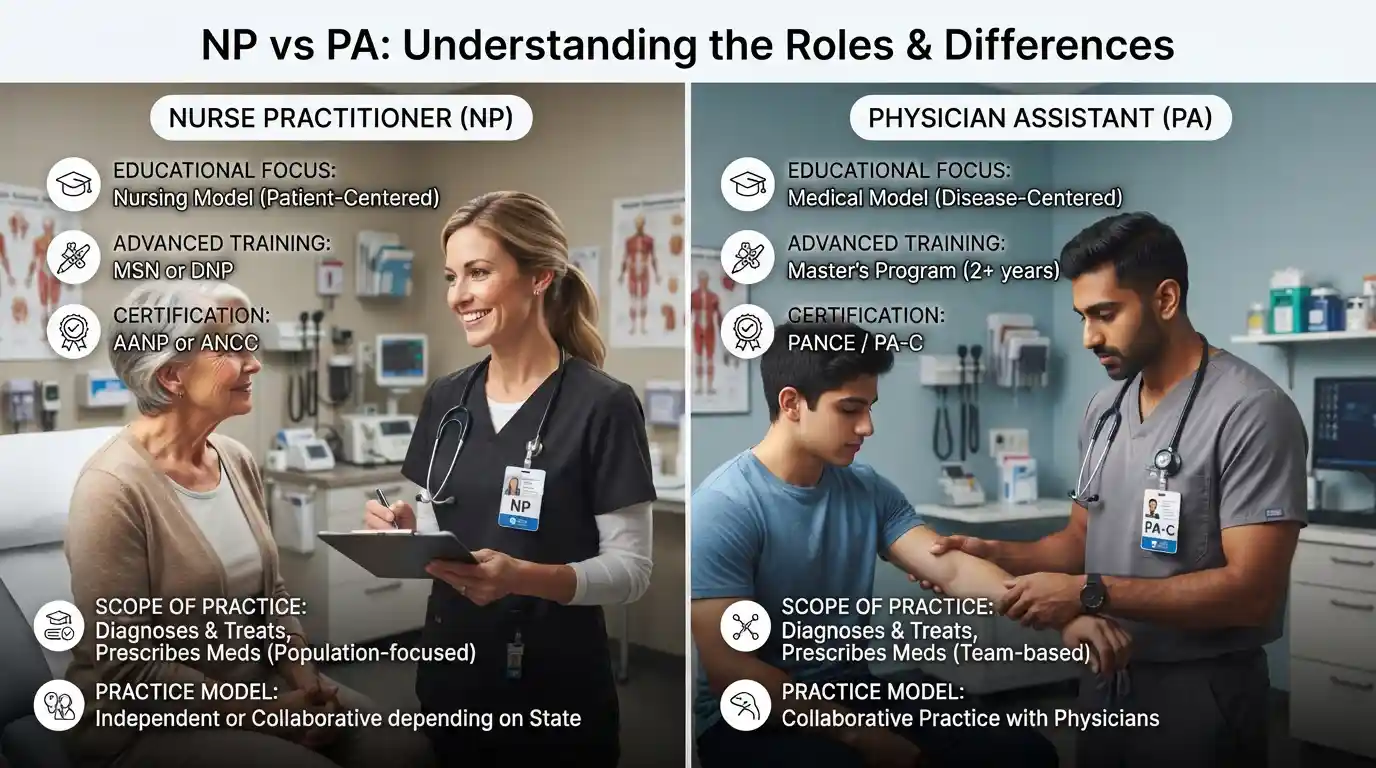
The difference between NP and PA mainly comes down to their educational models and professional pathways. An NP, or nurse practitioner, is an advanced practice registered nurse who builds on nursing education and trains around a specific patient population. A PA, now officially called a physician associate by the American Academy of Physician Associates, is a licensed clinician trained in a medical model.
The difference between NP and PA does not mean that one role simply treats patients while the other assists a doctor. Both can examine patients, diagnose conditions, develop treatment plans, order tests, and prescribe medications within the laws and rules that govern their practice. The main differences appear in education, certification, specialty structure, and state practice rules.
If you are choosing a healthcare career, understanding the difference between NP and PA can help you compare the two paths before choosing a graduate program.
NP vs. PA: Quick Answer
An NP (nurse practitioner) is an advanced practice nurse who receives graduate-level nursing education and trains in a particular population focus, such as family, pediatrics, adult-gerontology, or psychiatric mental health.
A PA (physician associate) is a graduate-level medical clinician trained through a medical education model. PAs receive broad medical training and can work across many specialties.
The simplest way to remember the difference is:
- NP: advanced nursing model + population focus
- PA: medical model + broad generalist training
- NP: builds on an RN/nursing foundation
- PA: does not require previous nursing education
- Both: diagnose, treat, order tests, and prescribe within applicable laws and practice rules
NP vs. PA Comparison Table
| Feature | Nurse Practitioner (NP) | Physician Associate (PA) |
|---|---|---|
| Full name | Nurse practitioner | Physician associate; physician assistant remains a legal title in many places |
| Educational model | Nursing model | Medical model |
| Graduate education | Master’s, post-master’s, or doctoral preparation | Master’s degree |
| Nursing background | Yes; NP education builds on nursing | No nursing license required |
| Training focus | Population-focused | Broad medical/generalist |
| Common specialties | Family, pediatrics, adult-gerontology, psychiatric mental health, women’s health, neonatal | Primary care, emergency medicine, surgery, psychiatry, pediatrics, many others |
| Certification structure | Population-focused certification | General PA certification |
| Practice authority | Varies by state | Varies by state |
| Can diagnose? | Yes, within scope | Yes, within scope |
| Can prescribe? | Yes, subject to state law | Yes, subject to state law |
| Can order tests? | Yes | Yes |
| Can perform procedures? | Depends on training and scope | Common in many specialties; depends on training and practice |
| Career flexibility | Can depend on population certification | Broad specialty mobility is a common feature |
| Main foundation | Nursing | Medicine |
The exact duties of an NP or PA depend on education, certification, experience, employer policies, and state law.
What Is an NP?
NP stands for nurse practitioner.
NPs are advanced practice registered nurses. Their education builds on nursing knowledge and develops advanced skills for assessing, diagnosing, treating, and managing patients.
The American Association of Nurse Practitioners describes NPs as advanced practice nurses with graduate education and national board certification. NP education follows a population focus, such as family/individual across the lifespan, pediatrics, adult-gerontology, neonatal care, psychiatric mental health, or women’s health.
Depending on their training and state authority, NPs may:
- Examine patients
- Diagnose illnesses
- Order and interpret diagnostic tests
- Prescribe medications
- Manage chronic conditions
- Provide preventive care
- Educate patients
- Develop treatment plans
- Refer patients to other healthcare professionals
NPs work in primary care, specialty care, hospitals, clinics, long-term care, and other healthcare settings.
How Does NP Education Work?
The NP path normally begins with nursing education and RN licensure.
Graduate NP programs then add advanced clinical knowledge to that nursing foundation. AANP states that NP education includes graduate-level preparation and clinical experiences designed around the chosen population focus.
The exact route can vary. Some programs are designed for registered nurses with a BSN, while other pathways can accommodate students entering nursing through an accelerated route.
The important point is that NP training grows out of nursing education.
What Is a PA?
PA traditionally stands for physician assistant. The American Academy of Physician Associates now uses physician associate as the profession’s official title, although the older legal title remains in use in some jurisdictions.
PAs are licensed clinicians who practice medicine in many specialties and healthcare settings.
According to the AAPA, PA education takes place at the master’s level and follows a curriculum modeled on medical school education.
PAs may:
- Take medical histories
- Perform physical examinations
- Diagnose conditions
- Order diagnostic tests
- Develop treatment plans
- Prescribe medications
- Perform procedures
- Assist with surgery
- Provide follow-up care
The exact scope depends on the PA’s education, training, experience, employer, and state regulations.
The Biggest Difference: Nursing Model vs. Medical Model
The most important educational difference is the model each profession uses.
NP: Nursing Model
NP education grows from the nursing profession.
This means the NP pathway combines advanced clinical care with nursing principles such as health promotion, disease prevention, patient education, and care across the patient’s broader health needs.
NP students also choose a population focus during their advanced education.
PA: Medical Model
PA education follows a medical model.
Students receive broad medical training that covers areas such as anatomy, physiology, pharmacology, pathology, diagnosis, and treatment. They also complete clinical rotations across multiple areas of medicine.
This broad preparation helps PAs work in many different specialties during their careers.
Neither description means that NPs do not practice medicine or that PAs do not provide patient-centered care. Both professions provide clinical care. The distinction describes how their education prepares them for that work.
NP vs. PA Education and Training
Education is one of the clearest differences between the two careers.
NP Education
An NP program requires graduate-level nursing education.
NP preparation builds on nursing education and clinical experience. Students develop advanced skills in assessment, diagnosis, treatment, pharmacology, and patient management while focusing on a specific patient population.
Most NP programs award a master’s or doctoral degree, depending on the program.
PA Education
PA programs require graduate-level education in physician assistant/associate studies.
The curriculum follows a medical model and includes broad clinical training. Students typically study many areas of medicine before completing supervised clinical rotations.
The U.S. Bureau of Labor Statistics lists a master’s degree as the typical entry-level education for PAs.
Do You Need to Be a Nurse to Become a PA?
No.
A PA does not need to first become an RN.
This creates an important difference between the two career paths. NP education builds on nursing, while PA education provides its own medical training pathway.
NP vs. PA Scope of Practice
This is one of the most misunderstood parts of the comparison.
Both NPs and PAs can provide a wide range of clinical services. However, scope of practice is not identical everywhere in the United States.
NP Practice Authority
NP practice authority varies by state.
AANP divides state NP practice environments into three broad categories:
- Full practice
- Reduced practice
- Restricted practice
In full-practice states, state law allows NPs to evaluate, diagnose, order and interpret tests, and manage treatment, including prescribing, under the authority of the state nursing board. Other states require some form of regulated collaboration or supervision.
Because state laws can change, an NP should always check the current rules of the state where they plan to practice.
PA Practice Authority
PA practice rules also vary by state.
Some states require specific collaboration or supervision arrangements. Other states have moved toward practice models that give more responsibility to PAs and determine scope at the practice level.
AAPA notes that PA scope is based on education, training, experience, and competency, while state laws determine important aspects of how PAs practice.
So it is inaccurate to assume that every NP or every PA has the same level of independence across the country.
Can Both NPs and PAs Prescribe Medication?
Yes, both professions can prescribe medications, but state laws determine the details.
An NP may prescribe medications within the authority granted by the state where they practice.
PAs can also prescribe medications within applicable state and federal rules.
Controlled substances can involve additional requirements, so a blanket statement about prescribing authority can be misleading.
If you are comparing these careers for a specific state, check the relevant state licensing board rather than relying on a national summary.
NP vs. PA Specialties
Specialization is another major difference.
Common NP Population Focuses
NP education may focus on areas such as:
- Family/individual across the lifespan
- Pediatrics
- Adult-gerontology
- Psychiatric mental health
- Neonatal care
- Women’s health
- Acute care
The exact certification options depend on the certification organization and current educational standards.
PA Specialty Options
PAs receive broad medical training and can work in many specialties.
Examples include:
- Family medicine
- Emergency medicine
- Surgery
- Orthopedics
- Dermatology
- Pediatrics
- Psychiatry
- Internal medicine
A PA does not generally earn a separate specialty license in the same way an NP earns a population-focused certification.
This can make specialty changes structurally different between the two professions.
Which Career Offers More Specialty Flexibility?
PAs often have a more generalist educational foundation, which can make movement between specialties more straightforward.
An NP’s education and certification are linked to a population focus. For example, a family NP and a psychiatric mental health NP have different population-focused preparation.
That does not mean an NP can never change specialties. It means the formal education and certification structure can affect what additional preparation is needed.
This is an important career-planning issue that many basic NP-vs-PA comparisons do not explain clearly.
NP vs. PA Daily Work
In real healthcare settings, the daily work of NPs and PAs can overlap substantially.
Both may:
- Meet with patients.
- Review medical histories.
- Perform examinations.
- Order tests.
- Interpret clinical information.
- Diagnose conditions.
- Develop treatment plans.
- Prescribe medications when authorized.
- Educate patients.
- Coordinate follow-up care.
The difference may become more visible in the setting and specialty.
For example, a PA working in surgery may perform or assist with procedures and provide perioperative care. A psychiatric NP may focus on mental health assessment and medication management.
The specialty often tells you more about the daily work than the two-letter credential alone.
NP vs. PA in Surgery
PAs commonly work in surgical settings.
The Bureau of Labor Statistics gives surgery as an example of PA practice and notes that surgical PAs may close incisions and provide care before, during, and after operations.
NPs can also work in surgical and hospital environments, but their scope and procedures depend on their education, certification, training, and applicable rules.
So it is too broad to say that PAs “do surgery” while NPs “do primary care.”
Both professions have diverse practice settings.
NP vs. PA Salary
Salary can change by specialty, location, experience, employer, and work setting.
For current U.S. data, the Bureau of Labor Statistics reports a May 2024 median annual wage of $132,050 for the combined occupational group that includes nurse practitioners, nurse anesthetists, and nurse midwives. Its current occupational profile separately identifies nurse practitioners within that group.
For physician assistants, the BLS currently reports a $135,880 median annual wage in its latest Occupational Outlook Handbook profile.
These figures should not be treated as a simple “NP vs. PA salary winner.” The NP BLS category includes three APRN occupations, while the PA figure is specific to physician assistants. Specialty and location can also change actual earnings.
For career planning, compare salary data for the specific role, specialty, location, and year you care about.
Job Outlook for NPs and PAs
Both professions have strong projected employment growth in the United States.
The BLS projects 40% growth for nurse practitioner employment from 2024 to 2034, while its current PA profile projects 21% growth for physician assistants from 2025 to 2035. These are different projection periods, so they should not be treated as a direct apples-to-apples ranking.
The broader BLS data also identifies both occupations among healthcare roles expected to experience strong demand.
This growth reflects workforce and healthcare-demand trends, but individual career prospects still depend on location, specialty, employer demand, and qualifications.
Certification and Maintaining Your Credential
NPs and PAs also follow different certification systems.
NP certification is tied to the NP’s population focus. AANP explains that NP education prepares graduates for national certification in their chosen population-focused area.
PAs use the NCCPA certification system.
NCCPA’s current certification maintenance process uses a 10-year cycle. During that cycle, board-certified PAs complete continuing medical education requirements and complete the required recertification assessment process.
This difference matters if you are comparing the long-term requirements of each profession.
NP vs. PA: Which One Fits Different Students?
Instead of asking which career is universally better, ask which educational path matches your background and goals.
An NP Path May Fit You If:
- You want to build on nursing education.
- You are already an RN.
- You value a population-focused training path.
- You are interested in nursing-based patient care.
- You have a particular NP population focus in mind.
A PA Path May Fit You If:
- You want a medical-model education.
- You do not want to become an RN first.
- You prefer broad medical training.
- You want the option to work across many specialties.
- You are interested in medical or surgical environments.
These are career-planning considerations, not rules. People enter both professions from different backgrounds and work in many different settings.
Common Mistakes About NPs and PAs
Mistake 1: Thinking a PA is a medical assistant
A physician assistant/associate is a licensed clinician with graduate-level medical education.
A medical assistant performs different clinical and administrative duties and is not the same profession.
Mistake 2: Assuming every NP can practice independently
NP practice authority varies by state.
Some states grant full practice authority, while others impose collaboration or supervision requirements.
Mistake 3: Assuming every PA works directly beside a physician
PA practice models vary by state and workplace.
AAPA notes that some jurisdictions have removed requirements for a specific physician relationship, while other jurisdictions still have collaboration or supervision rules.
Mistake 4: Thinking NPs only provide primary care
NPs work in both primary and specialty care. Their population-focused preparation includes areas such as psychiatric mental health, acute care, pediatrics, neonatal care, and adult-gerontology.
Mistake 5: Thinking PAs only work in primary care
PAs work across many specialties, including surgery, emergency medicine, pediatrics, psychiatry, and family medicine.
What Does NP Stand For?
NP stands for nurse practitioner.
An NP is an advanced practice registered nurse with graduate-level education and national certification in a population-focused area.
What Does PA Stand For?
PA has traditionally meant physician assistant.
The American Academy of Physician Associates now uses physician associate as the profession’s official title. However, the legal title has not changed everywhere, so physician assistant remains an official term in some jurisdictions.
The abbreviation PA remains the same.
Frequently Asked Questions
Is an NP higher than a PA?
No. NP and PA are different healthcare professions with different educational foundations. One is not automatically a higher level than the other.
Do NPs and PAs do the same job?
They can perform many of the same clinical tasks, including examining patients, diagnosing conditions, ordering tests, creating treatment plans, and prescribing medications where authorized. Their education and professional structures differ.
Is it faster to become a PA or NP?
It depends on your starting point. NP education builds on nursing preparation, while PA education follows a separate medical training route. Your existing degree, RN status, prerequisites, and program choice can greatly change the timeline.
Can an NP become a PA?
Yes, an NP can pursue PA education and certification, but becoming a PA requires meeting the applicable PA program and certification requirements. Being an NP does not automatically grant PA credentials.
Can a PA become an NP?
Yes, but a PA would need to complete the nursing education and licensure pathway required for NP practice. PA credentials do not automatically qualify someone to practice as an NP.
Do NPs make more money than PAs?
There is no universal answer. Pay varies by location, specialty, experience, employer, and year. Current BLS figures should be checked for the specific occupation and location rather than relying on broad online salary claims.
Can NPs and PAs prescribe controlled substances?
Both professions can have prescribing authority, but controlled-substance rules depend on federal requirements and state law. Always check the current rules for the state where the clinician practices.
Test Your Knowledge
1. What does NP stand for?
A. Nursing Physician
B. Nurse Practitioner
C. National Physician
D. Nursing Professional
Correct answer: B. Nurse Practitioner
2. What educational model does PA education primarily follow?
A. Nursing model
B. Dental model
C. Medical model
D. Public health model
Correct answer: C. Medical model
3. Does an NP need to become a registered nurse as part of the traditional nursing-based pathway?
A. Yes
B. No
C. Only for surgery
D. Only for pediatrics
Correct answer: A. Yes
4. Which statement about NP practice authority is correct?
A. Every state gives NPs identical authority
B. NPs cannot prescribe medication
C. State laws vary
D. NPs cannot diagnose patients
Correct answer: C. State laws vary
5. What is the current AAPA title for the PA profession?
A. Physician Nurse
B. Physician Associate
C. Primary Associate
D. Medical Assistant
Correct answer: B. Physician Associate
6. Which profession uses population-focused certification as a core part of its education structure?
A. NP
B. PA
C. Medical assistant
D. Registered dietitian
Correct answer: A. NP
Conclusion
The difference between NP and PA is mainly rooted in their educational foundations. NPs enter advanced practice through nursing and complete population-focused graduate education. PAs follow a medical education model that provides broad clinical preparation across specialties.
Both can provide substantial patient care. Both may diagnose, treat, prescribe, order tests, and manage patients within their authorized scope. The major distinctions involve training model, entry pathway, population or specialty structure, certification, and state practice rules.
If you are choosing between the two careers, start with your current education and the type of clinical training you want. An RN who wants to build on nursing may naturally explore NP programs, while someone seeking broad medical training without first becoming a nurse may explore PA programs. Your preferred specialty and the laws of the state where you plan to work also matter.
Suggested External Sources
- American Association of Nurse Practitioners — What Is an NP? — Useful for NP roles, population focuses, and common responsibilities.
- AANP — NP State Practice Environment — Useful for checking current state-specific NP practice authority.
- American Academy of Physician Associates — What Is a PA? — Useful for PA education, role, and the medical-model distinction.
- Bureau of Labor Statistics — Nurse Practitioners — Useful for current U.S. employment, education, wage, and outlook information.
- Bureau of Labor Statistics — Physician Assistants — Useful for current PA duties, education, wages, and employment outlook.
- NCCPA — Maintain Certification — Useful for current PA certification-maintenance requirements.

Ezra Hale is a thoughtful contributor to Distinly.com, where he explores philosophical ideas and the subtle differences behind everyday concepts. His writing blends logic, language, and human insight to clarify complex distinctions. Ezra encourages readers to think deeper, question assumptions, and appreciate the meaning behind words and ideas in modern discourse.