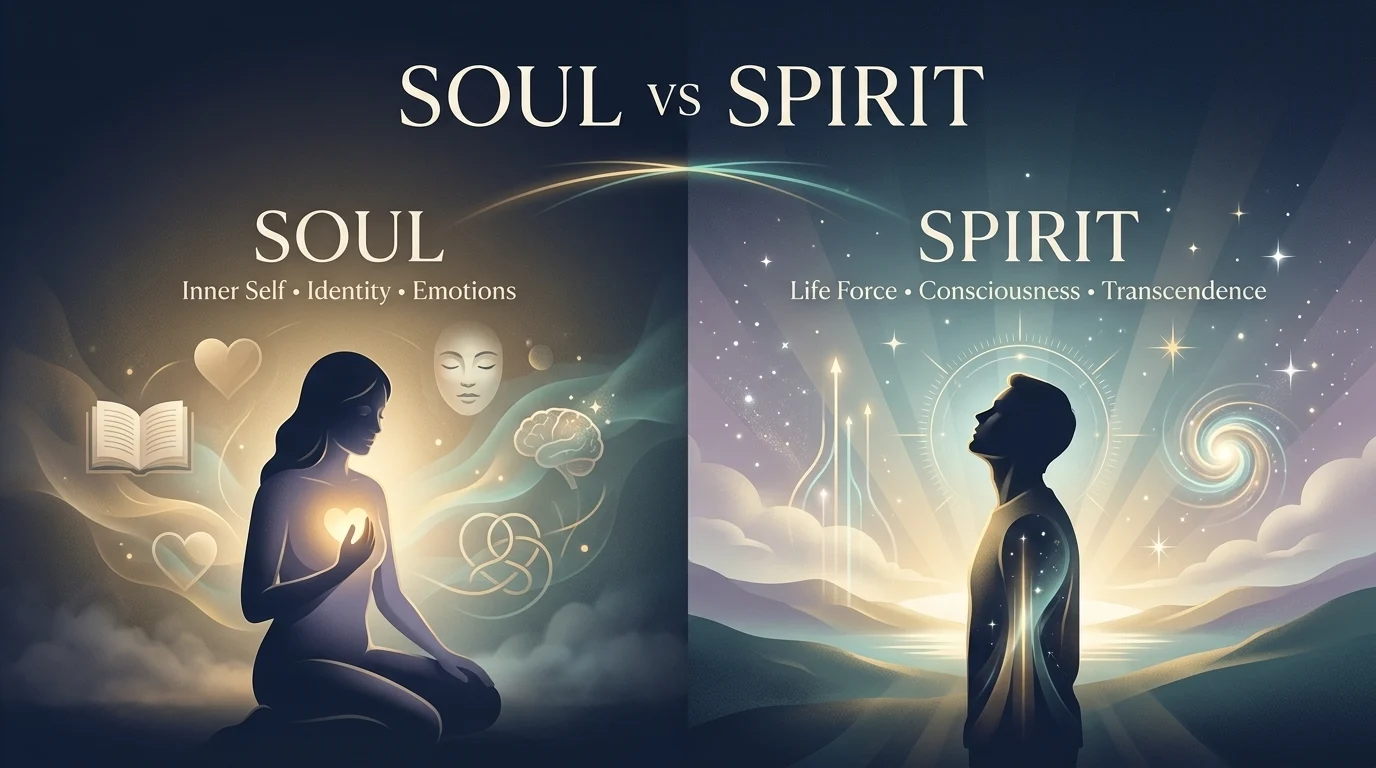
People often use soul and spirit as if they mean the same thing. In many religious, philosophical, and everyday settings, the two words point to the unseen part of a person. Yet they can carry different meanings depending on the belief system, context, and speaker.
The difference between soul and spirit is not always fixed. Some traditions treat them as separate parts of human nature, while others use them as close synonyms. This is why people search for the difference between soul and spirit when reading religious texts, discussing life after death, or trying to describe human feelings and identity.
Understanding the difference between soul and spirit can also improve your writing. The word soul often relates to a person’s inner self, emotions, or identity. The word spirit may suggest life force, courage, mood, or a connection with the divine. This guide explains their meanings, origins, spelling, common mistakes, and practical use in simple language.
Quick Answer
The soul usually refers to the inner self of a person. It may include feelings, thoughts, identity, character, and according to many beliefs the part that continues after death.
The spirit often refers to a life force, vital energy, courage, attitude, or connection with a higher power. In some religions, it is also viewed as the part of a person that relates directly to God or the spiritual world.
A simple distinction is:
- Soul: the deep inner self or personal essence.
- Spirit: the life force, energy, attitude, or divine connection.
For example:
- “Her soul was filled with peace.”
- “His spirit remained strong during the crisis.”
However, these meanings overlap. In some religious texts and ordinary conversations, soul and spirit can describe the same unseen part of a person.
The Origin of Soul and Spirit
The words soul and spirit have old histories. Both entered English through religious, philosophical, and cultural use, but they came from different language roots.
Origin of Soul
The word soul comes from Old English sāwol or sāwl. It is related to similar words in other Germanic languages. Its early meaning referred to the spiritual or immaterial part of a person.
Over time, soul developed several meanings. It could describe:
- The spiritual part of a human being
- A person’s inner character
- Emotional depth
- A person as a whole
- The central or most important part of something
For example, writers may say:
- “She put her soul into the song.”
- “The old house has a soul.”
- “He is a kind soul.”
The word is strongly connected with religion, but it is also common in poetry, music, literature, and daily speech.
Origin of Spirit
The word spirit entered English through Old French espirit and Latin spiritus. The Latin word is connected to spirare, meaning “to breathe.”
This connection is important because breath has long been linked with life. Many ancient cultures viewed breath as a sign of life or a force that leaves the body at death.
The meaning of spirit later expanded to include:
- The immaterial part of a person
- A life-giving force
- A supernatural being
- A person’s mood or attitude
- Courage and determination
- The main idea or purpose of something
For example:
- “The team showed great spirit.”
- “The spirit of the law matters.”
- “Some people believe the spirit survives death.”
Why Their Meanings Overlap
Religious and philosophical traditions have used soul and spirit in different ways. Some systems separate them, while others treat them as two words for the same inner reality.
English also allows meanings to change through literature and everyday use. As a result, there is no single definition that works in every context. The best meaning depends on the sentence, belief system, and purpose of the speaker.
Pronunciation and Part of Speech
Both words are easy to pronounce, but they do not sound alike.
- Soul: pronounced like “sohl,” rhyming with goal and whole.
- Spirit: pronounced like “SPEER-it,” with two syllables.
Both words are mainly used as nouns.
Examples:
- “The soul seeks meaning.”
- “Her spirit was cheerful.”
The word spirit can also appear in compound nouns and expressions, such as spirit level, spirit guide, team spirit, and spirit of cooperation. The word soul appears in phrases such as soul mate, soul music, poor soul, and soul-searching.
Main Differences Between Soul and Spirit
Although the words can overlap, they often emphasize different ideas.
| Point of comparison | Soul | Spirit |
|---|---|---|
| Basic meaning | Inner self or personal essence | Life force, energy, attitude, or divine connection |
| Main focus | Identity, emotions, character, and inner life | Vitality, courage, mood, or spiritual power |
| Religious use | Often linked with personal identity and life after death | Often linked with divine connection or life-giving force |
| Emotional use | Deep feelings and personal nature | Mood, courage, enthusiasm, or determination |
| Common expressions | Soul mate, soul-searching, kind soul | Team spirit, free spirit, spirit of the law |
| Can describe a group? | Less often | Yes, as in “team spirit” |
| Can describe an idea? | Sometimes, as in “the soul of the movement” | Commonly, as in “the spirit of the rule” |
1. Soul Often Refers to Personal Identity
The word soul often points to what makes a person who they are. It may describe their deepest feelings, values, hopes, and character.
Example:
“Her gentle soul made everyone feel welcome.”
Here, soul does not simply mean life. It refers to her inner nature.
2. Spirit Often Refers to Energy or Attitude
The word spirit often describes how someone faces life. A person can have a strong spirit, a joyful spirit, or a broken spirit.
Examples:
- “He kept his spirit high after the loss.”
- “The children played with great spirit.”
- “She has a free spirit.”
In these sentences, spirit means attitude, energy, or emotional strength.
3. Soul Can Suggest Deep Emotion
Writers often use soul to express strong or private feelings.
Examples:
- “The poem touched my soul.”
- “He felt a deep sadness in his soul.”
- “She sang with soul.”
The word creates a sense of emotional depth.
4. Spirit Can Suggest Courage
Spirit is common when discussing bravery, hope, and determination.
Examples:
- “The injured athlete showed a fighting spirit.”
- “The community spirit helped people recover.”
- “She refused to lose her spirit.”
Here, spirit means strength of mind or courage.
5. Spirit Can Refer to a Supernatural Being
In some contexts, spirit refers to an invisible being or supernatural presence.
Examples:
- “The story describes a forest spirit.”
- “They believe a spirit protects the place.”
- “The medium claimed to speak with a spirit.”
The word soul can also be used in religious discussions, but it is less commonly used to mean a separate supernatural being.
6. Spirit Can Mean the Main Meaning of Something
Spirit is not limited to people or religion. It can describe the central purpose or intention behind an idea, law, event, or tradition.
Example:
“The decision followed the spirit of the agreement.”
This means the decision followed the agreement’s main purpose, even if it did not follow every exact word.
The word soul can sometimes express a similar idea:
“She was the soul of the project.”
Here, soul means the central or most important part of the project.
Religious and Philosophical Differences
The difference between soul and spirit changes across religions and philosophies. It is important not to present one belief as universal.
In Some Christian Interpretations
Some Christian traditions use soul and spirit as related but distinct terms. They may describe the soul as the personal inner life and the spirit as the part that connects with God.
Other Christian teachers use the words almost interchangeably. Biblical translations and interpretations also affect how the terms are understood.
In Jewish Thought
The Hebrew Bible and later Jewish traditions use several terms for different aspects of life, breath, desire, and personhood. English translations may use soul or spirit for words that have wider meanings in Hebrew.
Therefore, a simple one-to-one translation can miss important details.
In Islamic Thought
Islamic discussions often distinguish between concepts such as nafs and ruh, although their meanings are complex and vary by context and interpretation. English translations may use soul, self, or spirit for these terms.
It is safer to explain the original religious context rather than assume that the English words have exactly the same meaning everywhere.
In Philosophy
Philosophers have debated whether the soul is:
- The mind
- Personal identity
- Consciousness
- A nonphysical substance
- The organizing principle of a living body
The word spirit may refer to reason, consciousness, freedom, or a higher part of human nature. Some philosophers use the two words differently, while others avoid them because their meanings are difficult to define.
British English vs American English Spelling
There is no meaningful British-American spelling difference between soul and spirit. Both varieties use the same spellings:
- British English: soul, spirit
- American English: soul, spirit
Their pronunciation is also broadly similar in both varieties. Accent differences may affect the exact vowel sound, but there is no major regional pronunciation contrast that changes the words.
| Word | British English | American English | Meaning |
|---|---|---|---|
| Soul | soul | soul | Inner self or personal essence |
| Spirit | spirit | spirit | Life force, attitude, energy, or divine connection |
| Souls | souls | souls | Plural of soul |
| Spirits | spirits | spirits | Plural of spirit |
Why the Spelling Stays the Same
Unlike words such as colour and color, these words do not contain a spelling pattern that differs between British and American English. Their forms became established in English long before modern regional spelling standards developed.
Which Spelling Should You Use?
You do not need to choose between British and American spellings. Use soul and spirit in every English variety.
Your main decision is not spelling. It is meaning.
Use soul when you want to emphasize:
- A person’s inner self
- Deep emotion
- Personal character
- Spiritual identity
- A person’s essential nature
Use spirit when you want to emphasize:
- Energy or life force
- Courage
- Mood or attitude
- A supernatural being
- A connection with the divine
- The main purpose of an idea or rule
For global writing, define the meaning through context. For example, “team spirit” is clearer than simply saying “team soul” because team spirit is the established expression.
Common Mistakes with Soul and Spirit
Mistake 1: Treating Them as Exact Synonyms in Every Sentence
Although the words overlap, they do not always sound natural in the same expressions.
Incorrect or unusual:
“The school has strong team soul.”
Better:
“The school has strong team spirit.”
Team spirit is the standard phrase for unity, energy, and loyalty within a group.
Mistake 2: Using Spirit When You Mean Personal Identity
Example:
“She is a kind spirit.”
This sentence is possible, but it may sound less natural if you mean that she is a kind person.
Better:
“She is a kind soul.”
The phrase kind soul is a common way to describe someone’s gentle nature.
Mistake 3: Assuming Every Religion Defines Them the Same Way
Different traditions use these words in different ways. Avoid writing:
“The soul always means the mind, and the spirit always means the body’s energy.”
This is too absolute. Religious and philosophical meanings vary.
Mistake 4: Confusing Spirit with Ghost in Every Context
A spirit can mean a ghost or supernatural being, but it can also mean courage, mood, or purpose.
Compare:
- “A spirit appeared in the old house.”
- “The team showed a strong spirit.”
The first sentence suggests a supernatural being. The second refers to attitude and energy.
Mistake 5: Using Soul Only in Religious Writing
Soul is also common in music, poetry, social media, and daily conversation.
Examples:
- “That song has soul.”
- “She is an old soul.”
- “He poured his soul into the painting.”
Mistake 6: Confusing Soul with Sole
Soul refers to the inner self or spirit. Sole can mean the bottom of a foot or shoe, or the only one.
Examples:
- “The music touched my soul.”
- “The sole of my shoe is worn.”
- “She was the sole winner.”
These words sound alike, so they are homophones, but their meanings and spellings are different.
Soul and Spirit in Everyday Examples
In Emails
Soul:
“Your message touched my soul and gave me hope during a difficult week.”
Spirit:
“Thank you for keeping the team spirit positive during the project.”
In an email, soul sounds personal and emotional. Spirit works well when discussing teamwork, morale, or shared energy.
In News Writing
Soul:
“The artist said the city’s soul inspired the new collection.”
Spirit:
“The volunteers worked in the spirit of cooperation.”
News writers often use spirit to describe public values, shared effort, or the purpose behind a policy.
In Social Media
Soul:
“This place feeds my soul.”
Spirit:
“A free spirit never stops exploring.”
Social media uses both words in expressive and emotional ways. Soul often creates a feeling of depth, peace, or personal connection. Spirit often suggests freedom, energy, or courage.
In Formal Writing
Soul:
“The novel explores the human soul through memory and loss.”
Spirit:
“The policy should be applied in the spirit of fairness.”
In formal writing, explain the intended meaning if the topic is religious or philosophical. This avoids confusion between personal belief and academic analysis.
In Daily Conversation
- “That kind soul helped me find my way.”
- “She has a cheerful spirit.”
- “The music touched my soul.”
- “He showed great spirit after the setback.”
- “The spirit of the rule is more important than a narrow reading.”
How to Remember the Difference
Use this simple memory guide:
- Soul = who you are inside
- Spirit = how your inner energy or attitude is expressed
This is not a perfect rule for every religion or philosophy, but it works well in many everyday sentences.
Ask yourself:
- Am I talking about someone’s deep identity or emotional nature? Use soul.
- Am I talking about courage, mood, energy, or attitude? Use spirit.
- Am I talking about a supernatural being? Spirit is often the better choice.
- Am I talking about the purpose behind a law or idea? Use spirit.
- Am I discussing a specific religious teaching? Check that tradition’s own definitions.
Frequently Asked Questions
1. Are soul and spirit the same thing?
Not always. Some people and religious traditions use them as synonyms, while others see them as different parts of human nature. Their meaning depends on context.
2. What is the main difference between soul and spirit?
The soul often refers to a person’s inner self, identity, or emotional nature. The spirit often refers to life force, courage, attitude, energy, or a connection with the divine.
3. Is the soul the mind?
In some philosophical or religious views, the soul is connected with the mind or consciousness. However, the two are not always treated as identical. The meaning varies by tradition.
4. Can spirit mean a ghost?
Yes. In some contexts, spirit means a ghost or supernatural being. It can also mean courage, mood, energy, or the central purpose of something.
5. Is “kind soul” correct English?
Yes. Kind soul is a natural phrase used to describe a person who is gentle, caring, or good-hearted.
6. Is “team spirit” correct English?
Yes. Team spirit is a common expression for unity, loyalty, enthusiasm, and cooperation within a group.
7. Do British and American English spell these words differently?
No. Both British and American English use the same spellings: soul and spirit.
Conclusion
The difference between soul and spirit is subtle because both words describe unseen parts of life, identity, and human experience. Their meanings often overlap, but context gives each word its special tone.
The word soul usually points to deep identity, emotion, character, or personal essence. The word spirit often suggests energy, courage, attitude, life force, or divine connection.
Neither word has one meaning that applies to every religion, philosophy, or conversation. When the subject is sensitive, focus on the belief system and explain the terms with care.
You can build confidence by practicing both words in emails, essays, and daily conversations. Choose soul for inner nature and spirit for energy or attitude, then let context guide you.

Mira Anand is a writer at Distinly.com who focuses on storytelling, communication, and social perspective. Her work highlights subtle differences in language and meaning across cultures and communities. With a clear and empathetic voice, Mira helps readers understand how narratives shape understanding, relationships, and modern dialogue in an increasingly connected world.