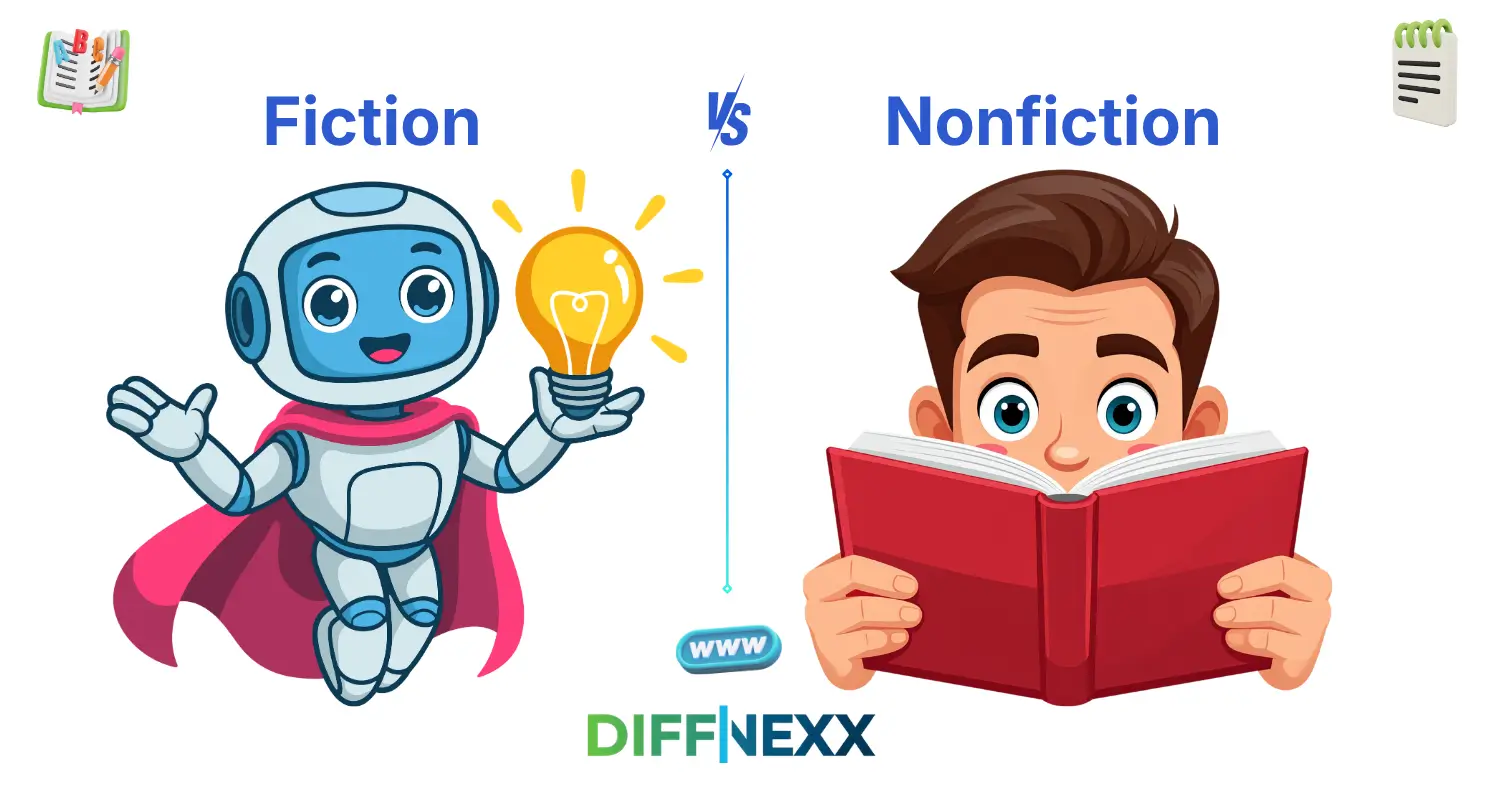
Difference between fiction and nonfiction becomes clear when you walk into a library and pick up two books one tells a magical story, while the other shares real facts about the world. Both are interesting, but they serve different purposes.
The difference between fiction and nonfiction is simple at its core. Fiction is based on imagination, while nonfiction is based on real events and facts. Still, many learners feel confused when trying to tell them apart.
Understanding the difference between fiction and nonfiction helps you read better and choose the right type of content for your needs. It also improves your writing skills.
Let’s explore both in a clear and easy way so you can fully understand their differences.
🔍 Key Difference Between the Both
The main difference is:
- Fiction is made-up or imagined stories.
- Nonfiction is based on real facts and true events.
In simple words, fiction entertains, while nonfiction informs.
🌍 Importance – Why Their Difference Matters
Knowing this difference is important for both learners and experts.
Students need it to improve reading comprehension. It helps them understand whether a text is meant to entertain or to teach facts.
Professionals like writers, journalists, and educators must clearly separate fiction from nonfiction. It ensures accuracy and credibility.
In society, this distinction helps people trust information. It prevents confusion between imagination and reality.
🔊 Pronunciation Section
Fiction
US: /ˈfɪkʃən/
UK: /ˈfɪkʃən/
Nonfiction
US: /ˌnɑːnˈfɪkʃən/
UK: /ˌnɒnˈfɪkʃən/
Now that you can pronounce them correctly, let’s define them clearly.
📚 Core Definitions
Fiction
Fiction is a type of writing based on imagination. It includes invented characters, places, and events. It often carries emotions like excitement, mystery, or romance.
Example: A story about dragons and magical worlds.
Nonfiction
Nonfiction is writing based on real facts and true information. It aims to educate or inform readers. The tone is usually factual and serious.
Example: A biography of a real person.
📊 10 Clear Differences Between Fiction and Nonfiction
1. Reality vs Imagination
Fiction is imaginary.
Nonfiction is real.
- Example for Fiction: A superhero saving the world.
- Example for Nonfiction: A history book about World War II.
2. Purpose
Fiction aims to entertain.
Nonfiction aims to inform or educate.
- Example for Fiction: A fantasy novel.
- Example for Nonfiction: A science article.
3. Emotional Intensity
Fiction often creates strong emotions.
Nonfiction focuses more on facts than emotions.
- Example for Fiction: A tragic love story.
- Example for Nonfiction: A report on climate change.
4. Structure
Fiction follows a story structure (beginning, middle, end).
Nonfiction follows logical or factual structure.
- Example for Fiction: A novel with a plot twist.
- Example for Nonfiction: A textbook chapter.
5. Characters
Fiction uses imaginary characters.
Nonfiction uses real people.
- Example for Fiction: A wizard character.
- Example for Nonfiction: A biography of a leader.
6. Language Style
Fiction uses creative and descriptive language.
Nonfiction uses clear and direct language.
- Example for Fiction: “The sky whispered secrets.”
- Example for Nonfiction: “The sky was cloudy.”
7. Flexibility
Fiction allows freedom to create anything.
Nonfiction must stick to facts.
- Example for Fiction: Time travel story.
- Example for Nonfiction: Scientific research.
8. Tone
Fiction can be emotional or dramatic.
Nonfiction is usually neutral and factual.
- Example for Fiction: Dramatic storytelling.
- Example for Nonfiction: Objective explanation.
9. Reader Expectation
Readers expect imagination in fiction.
Readers expect truth in nonfiction.
- Example for Fiction: Fantasy novel.
- Example for Nonfiction: News article.
10. Expression Style
Fiction uses storytelling techniques.
Nonfiction uses explanation and analysis.
- Example for Fiction: Dialogue between characters.
- Example for Nonfiction: Data and facts.
🎯 Why Knowing the Difference Matters
Students must know this difference to improve reading and writing skills. It helps them understand the purpose of a text.
Professionals rely on this distinction for accuracy. Writers and journalists must present facts clearly in nonfiction.
In communication, confusing fiction and nonfiction can spread misinformation. It can lead to misunderstanding and false beliefs.
Real-world consequences of confusion
If someone treats fictional content as real, it can cause confusion or wrong decisions. For example, believing a fictional story as a true event can mislead people.
🧠 Why People Get Confused
Similar Terms
Both words share the word “fiction,” which creates confusion.
Semantic Overlap
Some nonfiction uses storytelling techniques, making it feel like fiction.
Context-Based Usage
Books and media often mix both styles.
Informal Speech
People casually use the terms without understanding their meaning.
🎭 Connotation & Emotional Tone
Connotation = the emotional meaning associated with a word.
Fiction
- Positive: Creative, imaginative
- Neutral: Story-based
- Example: “Fiction inspires creativity.”
Nonfiction
- Positive: Informative, truthful
- Neutral: Fact-based
- Example: “Nonfiction teaches real knowledge.”
🗣 Usage in Metaphors, Similes & Idioms
- “His story sounds like fiction.” (means unrealistic)
- “This is not fiction, it’s reality.” (means true)
Examples:
- Fiction: “The tale felt like a dream.”
- Nonfiction: “The report showed real facts.”
📊 Comparison Table
| Feature | Fiction | Nonfiction |
|---|---|---|
| Meaning | Imaginary stories | Real facts |
| Tone | Creative | Factual |
| Usage | Entertainment | Education |
| Context | Novels, stories | Articles, reports |
| Formality | Flexible | Formal |
⚖️ Which Is Better in What Situation?
When to use Fiction
Use fiction when you want to entertain or explore creativity. It is ideal for storytelling, novels, and imaginative writing.
When to use Nonfiction
Use nonfiction when you need to inform, explain, or present facts. It is best for education and research.
Situational clarity
Choose fiction for creative expression. Choose nonfiction for real-world information.
Contextual correctness
In academic or professional settings, nonfiction is preferred. In creative writing, fiction works best.
📖 Literary or Cultural References
- Book: Harry Potter and the Sorcerer’s Stone (Fantasy, J.K. Rowling, 1997)
A famous example of fiction. - Book: The Diary of a Young Girl (Autobiography, Anne Frank, 1947)
A powerful nonfiction work. - Movie: Titanic (USA, 1997)
Mixes fiction with real historical events.
❓ FAQs
1. What is the main difference between fiction and nonfiction?
Fiction is imaginary, while nonfiction is based on real facts. This is the key difference.
2. Can fiction be based on real events?
Yes, some fiction is inspired by real events but includes imagination.
3. Is nonfiction always true?
Nonfiction is based on facts, but accuracy depends on the source.
4. Which is easier to read?
It depends on the reader. Fiction is often more engaging, while nonfiction is informative.
5. Can a book be both fiction and nonfiction?
Yes, some books blend both styles.
6. Is storytelling used in nonfiction?
Yes, but it still presents real facts.
7. Why do people prefer fiction?
Because it entertains and sparks imagination.
8. Why is nonfiction important?
It provides real knowledge and facts.
9. Are biographies fiction or nonfiction?
They are nonfiction because they tell real life stories.
10. Do schools teach both?
Yes, both are important for learning.
🏁 Conclusion
The difference between fiction and nonfiction is simple but very important. Fiction is based on imagination and creativity, while nonfiction focuses on real facts and truth.
Understanding this difference helps you become a better reader and writer. It also improves your ability to think clearly and avoid confusion.
Both forms of writing are valuable in their own way. Fiction inspires creativity, and nonfiction builds knowledge.
Keep learning and exploring both each one opens a new world of understanding.

Ezra Hale is a thoughtful contributor to Distinly.com, where he explores philosophical ideas and the subtle differences behind everyday concepts. His writing blends logic, language, and human insight to clarify complex distinctions. Ezra encourages readers to think deeper, question assumptions, and appreciate the meaning behind words and ideas in modern discourse.