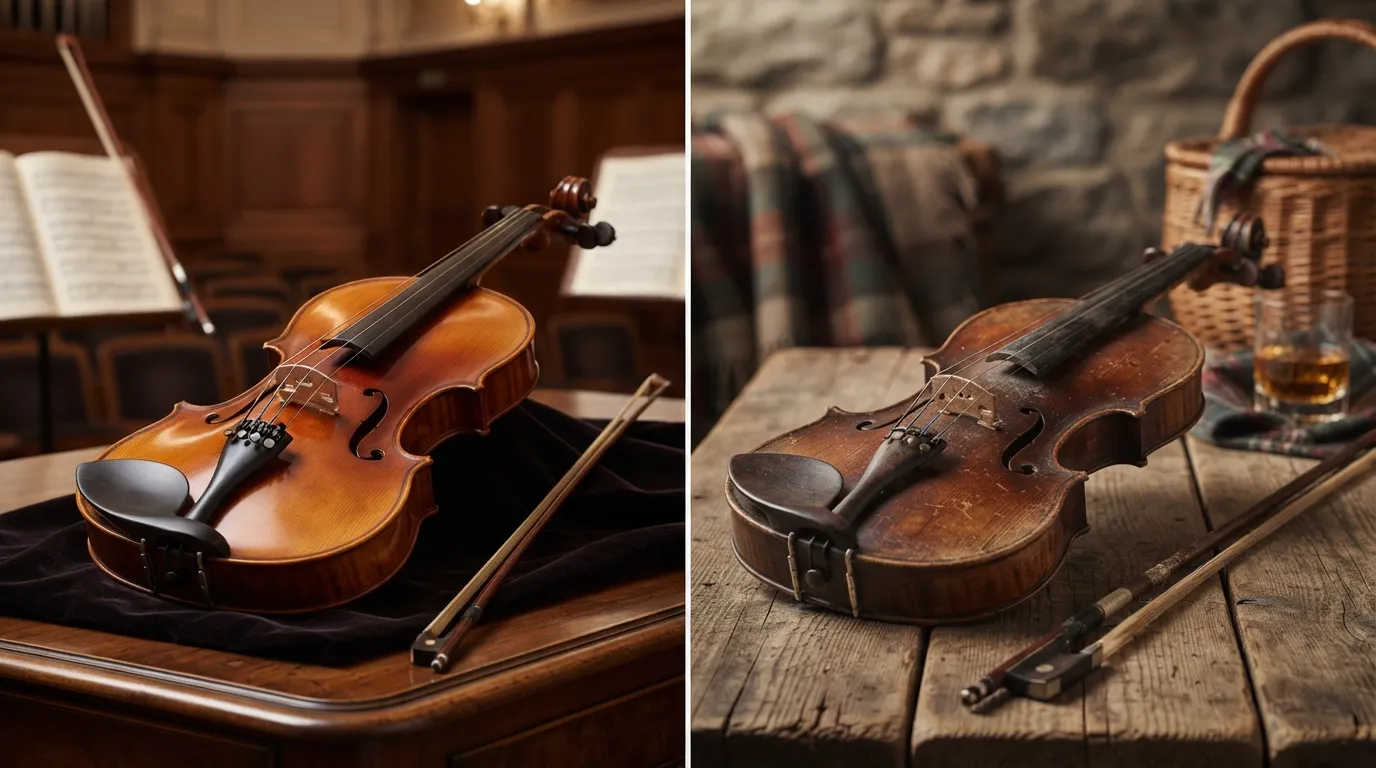
Difference between violin and fiddle often confuses people, especially when they see the same instrument used in different music styles. Imagine attending a concert one day and hearing soft classical music, then the next day enjoying lively folk tunes yet both use what looks like the same instrument.
The difference between violin and fiddle is not about the instrument itself but how it is played and the style of music. A violin is usually linked to classical music, while a fiddle is associated with folk, country, or traditional styles.
Understanding the difference between violin and fiddle helps you appreciate music more deeply. It also improves your vocabulary and cultural awareness.
Let’s explore this fascinating difference step by step.
Key Difference Between the Both
The key difference between violin and fiddle is in playing style and musical context. The instrument is the same, but “violin” is used in classical music, while “fiddle” refers to folk and traditional styles.
Importance – Why Is Their Difference Necessary to Know
Knowing the difference between violin and fiddle is useful for both learners and music lovers.
For students, it builds musical vocabulary and cultural knowledge. It helps them understand how the same instrument fits different genres.
For professionals, especially musicians and teachers, correct terminology ensures clear communication.
In society, this distinction helps people appreciate different music traditions and cultural expressions.
🔊 Pronunciation Section
Violin
US: /ˌvaɪəˈlɪn/
UK: /ˌvaɪəˈlɪn/
Fiddle
US: /ˈfɪdəl/
UK: /ˈfɪdəl/
Now that you can pronounce them correctly, let’s define each clearly.
📚 Core Definitions
Violin
A violin is a string instrument used mainly in classical music. It is played with precise technique and formal posture. The tone is elegant and refined.
Example:
“She plays the violin in an orchestra.”
Fiddle
A fiddle is the same instrument as a violin but used in folk or traditional music styles. The playing style is more relaxed and expressive. The tone feels lively and informal.
Example:
“He plays the fiddle at local festivals.”
📚 10 Clear Differences Between Violin and Fiddle
1. Musical Style 🎶
Violin is used in classical music. Fiddle is used in folk and traditional music.
- Example for Violin: “It is played in orchestras.”
- Example for Fiddle: “It is played in folk bands.”
2. Playing Technique
Violin uses strict technique. Fiddle allows more freedom.
- Example for Violin: “The posture is formal.”
- Example for Fiddle: “The style is flexible.”
3. Emotional Tone 😊
Violin sounds elegant and calm. Fiddle sounds lively and energetic.
- Example for Violin: “The music feels smooth.”
- Example for Fiddle: “The music feels fun.”
4. Formality 🎓
Violin is formal. Fiddle is informal.
- Example for Violin: “Used in concerts.”
- Example for Fiddle: “Used in casual gatherings.”
5. Learning Approach
Violin often requires formal training. Fiddle can be learned by ear.
- Example for Violin: “Students follow lessons.”
- Example for Fiddle: “Players learn by listening.”
6. Cultural Context 🌍
Violin is linked to Western classical tradition. Fiddle is linked to folk cultures.
- Example for Violin: “Used in symphonies.”
- Example for Fiddle: “Used in traditional dances.”
7. Bowing Style 🎻
Violin bowing is controlled and precise. Fiddle bowing is rhythmic and varied.
- Example for Violin: “Smooth bow strokes.”
- Example for Fiddle: “Quick and lively strokes.”
8. Music Structure
Violin music follows written compositions. Fiddle music often includes improvisation.
- Example for Violin: “Played from sheet music.”
- Example for Fiddle: “Played freely.”
9. Audience Experience 👥
Violin creates a formal listening experience. Fiddle creates a fun, interactive experience.
- Example for Violin: “Audience listens quietly.”
- Example for Fiddle: “Audience may dance.”
10. Expression Style ✍️
Violin focuses on precision. Fiddle focuses on expression and rhythm.
- Example for Violin: “Accuracy matters most.”
- Example for Fiddle: “Feeling matters most.”
🎯 Why Knowing the Difference Matters
Students benefit by understanding music genres and terminology. It helps them appreciate different styles.
Professionals need this knowledge for teaching and performing. It ensures correct communication.
In daily life, knowing the difference enhances your cultural awareness. It helps you enjoy music more deeply.
Real-world consequences of confusion
Calling a fiddle performance “violin music” may miss its cultural meaning. It can reduce appreciation of folk traditions.
🧠 Why People Get Confused
Same Instrument
Both terms refer to the same physical instrument.
Semantic Overlap
People use the words interchangeably.
Context-Based Usage
The difference depends on how the instrument is played.
Influence of Informal Speech
Media often mixes the terms without explanation.
🎭 Connotation & Emotional Tone
Connotation = the emotional meaning associated with a word.
Violin
Positive and refined. It suggests elegance and discipline.
- Example: “The violin sounds graceful.”
Fiddle
Positive and lively. It suggests fun and tradition.
- Example: “The fiddle music feels joyful.”
🗣 Usage in Metaphors, Similes & Idioms
- “Fit as a fiddle” – very healthy.
- “Play second fiddle” – take a less important role.
📊 Comparison Table
| Feature | Violin | Fiddle |
|---|---|---|
| Meaning | Classical instrument | Folk-style instrument |
| Tone | Elegant | Lively |
| Usage | Formal music | Traditional music |
| Context | Orchestras | Festivals |
| Formality | Formal | Informal |
⚖️ Which Is Better in What Situation?
When to use Violin
Use “violin” in formal or classical contexts. It fits orchestras, concerts, and academic discussions.
When to use Fiddle
Use “fiddle” in folk or traditional contexts. It suits casual and cultural settings.
Situational clarity
Choose based on music style. Classical equals violin; folk equals fiddle.
Contextual correctness
Using the correct term improves communication and respect for musical traditions.
📖 Literary or Cultural References
- Book: The Violinist’s Thumb (Science, Sam Kean, 2012) – explores science through stories.
- Movie: Fiddler on the Roof (USA, 1971) – highlights cultural and musical traditions.
❓ FAQs
1. Is a violin different from a fiddle?
No, they are physically the same instrument. The difference lies in how they are played and the style of music.
2. Why do people call it a fiddle?
The term “fiddle” is used in folk and traditional music. It reflects a more relaxed style.
3. Can a violinist play fiddle music?
Yes, a violinist can play fiddle music by adapting their style.
4. Is fiddle music easier than violin music?
Fiddle music can feel more flexible, but both require skill and practice.
5. Which term is more correct?
Both are correct. The choice depends on context and style.
🏁 Conclusion
The difference between violin and fiddle is not about the instrument itself but about how it is used. Violin represents classical music, precision, and elegance. Fiddle represents folk traditions, rhythm, and expression.
Understanding this difference helps you appreciate music more deeply. It also improves your ability to use language correctly in different contexts.
Music is not just about sound it is about culture and expression. By learning these distinctions, you connect more deeply with both.
Keep exploring, keep listening, and enjoy the beauty of music.

Mira Anand is a writer at Distinly.com who focuses on storytelling, communication, and social perspective. Her work highlights subtle differences in language and meaning across cultures and communities. With a clear and empathetic voice, Mira helps readers understand how narratives shape understanding, relationships, and modern dialogue in an increasingly connected world.