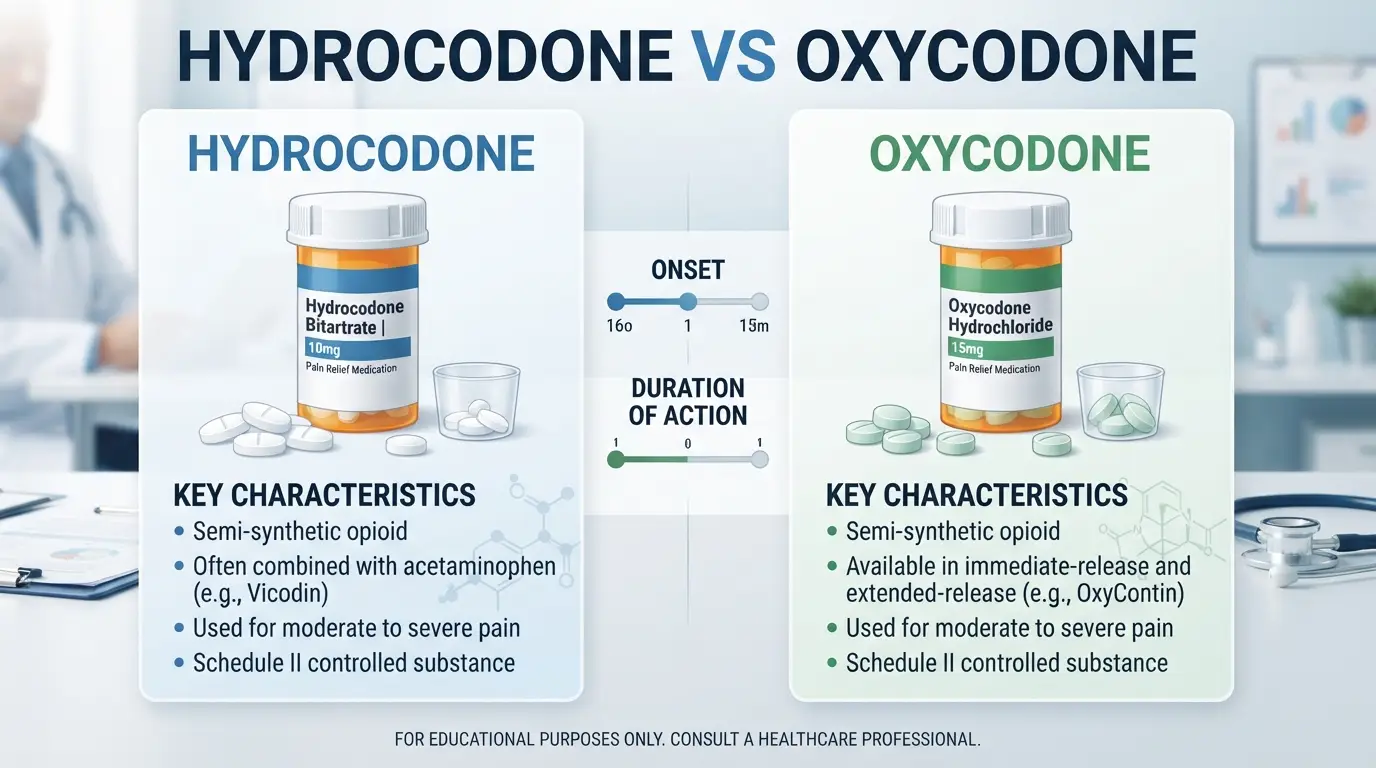
Hydrocodone and oxycodone are both prescription opioid medicines used to treat moderate to severe pain. The main difference between hydrocodone and oxycodone is their chemical structure, relative potency, available formulations, and some of their medical uses. Oxycodone is generally more potent than hydrocodone on a milligram-for-milligram basis, but that does not mean it will always provide better pain relief for every person. Recent clinical research found that the two can provide similar pain relief when used at typical doses for acute pain.
The difference between hydrocodone and oxycodone also becomes clearer when you look at combination products. Hydrocodone is often combined with acetaminophen, while oxycodone is available both alone and in combination with medicines such as acetaminophen. Both drugs can cause drowsiness, constipation, dependence, respiratory depression, and overdose, so they should be taken only as prescribed.
Hydrocodone vs. Oxycodone: Quick Answer
Both hydrocodone and oxycodone are semi-synthetic opioid analgesics. They reduce pain by changing how the brain and nervous system respond to pain.
The key differences are:
- Oxycodone is more potent per milligram than hydrocodone.
- Hydrocodone is commonly found in combination products, especially with acetaminophen.
- Oxycodone is available as a single-ingredient medicine as well as in combination products.
- Hydrocodone can also be used in certain cough medicines, while oxycodone is primarily used as a pain reliever.
- Both can cause sedation, constipation, dependence, respiratory depression, and overdose.
- Neither medicine should be switched, combined, or dose-adjusted without medical guidance.
A higher potency does not automatically make oxycodone a better choice. The right opioid, if an opioid is needed at all, depends on the patient’s condition, formulation, other medicines, risks, and treatment goals.
Comparison Table
| Feature | Hydrocodone | Oxycodone |
|---|---|---|
| Drug class | Opioid analgesic | Opioid analgesic |
| Main use | Severe pain; some formulations also treat cough | Severe pain |
| Relative potency | Lower per milligram | Higher per milligram |
| Single-ingredient forms | Available | Available |
| Combination products | Common with acetaminophen or other medicines | Common with acetaminophen or other medicines |
| Extended-release forms | Available | Available |
| Common risks | Sedation, constipation, dependence, respiratory depression | Sedation, constipation, dependence, respiratory depression |
| Can cause withdrawal | Yes | Yes |
| Overdose risk | Yes | Yes |
| U.S. controlled-substance status | Schedule II | Schedule II |
Drug availability and legal classifications can vary outside the United States. In the U.S., hydrocodone and oxycodone are controlled prescription opioids.
What Is Hydrocodone?
Hydrocodone is a semi-synthetic opioid used to relieve severe pain. Some hydrocodone combination products also have antitussive, or cough-suppressing, uses.
It works by changing the way the brain and nervous system respond to pain. Hydrocodone is available by itself in some extended-release products and also appears in combination medicines.
A familiar example is hydrocodone/acetaminophen. The opioid component is hydrocodone, while acetaminophen provides additional pain-relieving action.
This distinction matters because a person taking a hydrocodone combination product is not taking hydrocodone alone. The other ingredient can create additional risks.
For example, excessive acetaminophen exposure can cause serious liver injury.
What Is Oxycodone?
Oxycodone is also a semi-synthetic opioid analgesic. Doctors prescribe it to relieve severe pain.
Oxycodone comes in several forms, including immediate-release and extended-release products. It can also appear in combination medicines, such as oxycodone/acetaminophen.
Some people know oxycodone through brand names such as OxyContin or combination products such as Percocet. However, the brand name does not always tell you whether the medicine contains oxycodone alone or another active ingredient.
Always check the active ingredients on the prescription label.
The Biggest Difference: Potency
One of the most common questions is:
Is oxycodone stronger than hydrocodone?
On a milligram-for-milligram basis, research generally finds oxycodone to be more potent. A recent JAMA Network Open study describes oxycodone as approximately 1.5 times as potent as hydrocodone based on relative potency estimates.
However, this does not mean that oxycodone always gives better pain relief.
Clinical trials in acute pain have found that typical clinical doses of the two medicines can provide similar pain relief. The response also varies from person to person.
This is why people should not use a simple “stronger drug” rule when comparing the two.
Why Potency Can Be Misleading
Potency describes how much drug is needed to produce a particular effect.
Pain relief depends on more than potency. Doctors also consider:
- The cause and severity of pain
- The patient’s previous opioid exposure
- Other medicines
- Kidney and liver function
- Age and overall health
- The formulation being used
- Previous side effects
- Risk of misuse or overdose
Most importantly, milligram amounts of different opioids should not be compared or converted by patients on their own.
Hydrocodone and Oxycodone Have Different Origins
Both drugs belong to the opioid family, but they come from different chemical starting points.
Hydrocodone is derived from codeine-related chemistry, while oxycodone is synthesized from thebaine, a naturally occurring alkaloid found in the opium poppy.
Their chemical differences affect how the body processes them and contribute to differences in potency and drug interactions.
For everyday medical use, however, the more important distinction is not their history. It is how each medicine is formulated, prescribed, and tolerated.
Hydrocodone vs. Oxycodone for Pain
Both drugs can treat severe pain.
Doctors may prescribe an opioid after surgery, a serious injury, or for certain conditions that cause substantial pain. Prescription opioids can also be used in some cancer-related pain settings.
The important point is that neither medicine is automatically the better painkiller.
Research comparing the two in postoperative joint-replacement patients found that oxycodone has greater potency per milligram, but clinical trials have not consistently shown a meaningful pain-relief advantage when typical doses are used for acute pain.
Doctors therefore choose based on the complete clinical picture rather than potency alone.
Hydrocodone vs. Oxycodone Formulations
This is an area where many online comparisons become confusing.
Hydrocodone
Hydrocodone can be found:
- As a single-ingredient extended-release medicine
- With acetaminophen
- With ibuprofen
- In certain cough-related combination medicines
MedlinePlus lists several types of hydrocodone combination products and notes that the other ingredient can change the medicine’s purpose and risks.
Oxycodone
Oxycodone can be found:
- As a single-ingredient immediate-release medicine
- As an extended-release medicine
- With acetaminophen
- With other ingredients in certain combination products
MedlinePlus lists oxycodone combination products containing ingredients such as acetaminophen or ibuprofen.
Why the Combination Matters
Suppose two people say they are taking “hydrocodone” and “oxycodone.”
That description may not tell you the whole story.
One person could be taking hydrocodone with acetaminophen. Another could be taking oxycodone alone. A third person could be taking oxycodone with acetaminophen.
These medicines do not have identical ingredient profiles.
This is one reason you should compare the active ingredients, not just the medication’s familiar name.
Side Effects of Hydrocodone and Oxycodone
The two medicines share many opioid-related side effects.
Common effects can include:
- Drowsiness
- Dizziness
- Nausea
- Vomiting
- Constipation
- Confusion
- Sedation
- Slowed breathing
Both can also cause physical dependence and withdrawal when someone has been taking them regularly.
Serious breathing problems are a major concern with both medicines. The risk can increase when opioids are combined with alcohol, sedatives, or certain other medicines.
Which Has More Side Effects?
There is no simple rule that says hydrocodone always causes more side effects or oxycodone always causes more.
Both are opioids, so many of their major risks overlap.
A person’s response can depend on the medicine’s dose, formulation, other drugs, health conditions, and individual sensitivity.
The combination product also matters. For example, a product containing acetaminophen adds risks related to acetaminophen that do not come from the opioid itself.
Hydrocodone and Oxycodone: Dependence and Addiction
Both medicines can be habit-forming.
Prescription opioids can cause physical dependence, meaning the body adapts to regular exposure. Stopping a regularly used opioid suddenly can then cause withdrawal symptoms.
They can also lead to opioid use disorder in some people.
The CDC notes that prescription opioids carry serious risks, including addiction, overdose, and death.
This risk exists even when a person receives an opioid through a legitimate prescription. That is why treatment should include regular medical follow-up and clear instructions about how to use the medicine.
Can You Take Hydrocodone and Oxycodone Together?
You should not take hydrocodone and oxycodone together unless a healthcare professional specifically tells you to do so.
Both are opioids. Combining opioid medicines can increase opioid effects, including excessive sedation and dangerous respiratory depression.
The same concern applies to combining either opioid with alcohol or other central nervous system depressants.
If you have been prescribed one opioid and receive another prescription, tell the prescriber and pharmacist about every medicine you are taking.
Can You Switch From Hydrocodone to Oxycodone?
A healthcare professional may switch a patient from one opioid to another when there is a medical reason.
But patients should not calculate a replacement dose themselves.
Different opioids have different potencies, formulations, absorption patterns, and patient-specific risks. A safe conversion requires clinical judgment.
This is especially important with extended-release products.
Do not assume that the same number of milligrams of hydrocodone and oxycodone produces the same effect.
Hydrocodone vs. Oxycodone and Acetaminophen
This is one of the most important distinctions to understand.
Hydrocodone and oxycodone are opioid ingredients. Acetaminophen is a different type of pain reliever.
Products can combine them.
For example:
- Hydrocodone + acetaminophen = opioid plus non-opioid pain reliever
- Oxycodone + acetaminophen = opioid plus non-opioid pain reliever
If you take an opioid combination product, you must account for all active ingredients.
Taking another acetaminophen-containing medicine at the same time can unintentionally increase total acetaminophen exposure. Excessive amounts can damage the liver.
What About Overdose?
Both hydrocodone and oxycodone can cause a life-threatening opioid overdose.
Signs can include:
- Very slow, shallow, or stopped breathing
- Extreme sleepiness
- Inability to wake the person
- Very small pupils
- Slow heartbeat
- Cold or clammy skin
- Loss of consciousness
MedlinePlus advises getting emergency help immediately when someone has severe overdose symptoms. Naloxone or nalmefene can reverse life-threatening opioid effects when administered promptly.
If you suspect an overdose, treat it as an emergency rather than waiting for symptoms to improve.
Hydrocodone and Oxycodone With Alcohol
Alcohol can make opioid-related sedation and breathing problems more dangerous.
The same general concern applies to other medicines that depress the central nervous system.
Do not assume that a prescribed opioid becomes safe simply because you take it as directed if you also drink alcohol or use another sedating medicine.
Tell your doctor or pharmacist about all prescription medicines, over-the-counter medicines, supplements, and substances you use.
Pronunciation and Word Details
Hydrocodone and oxycodone are both nouns when used as medication names.
Their standard medical pronunciations are commonly represented as:
- Hydrocodone: hye-droh-KOH-dohn
- Oxycodone: OK-see-KOH-dohn
Both names refer to specific drug substances rather than general categories.
The broader category is opioid.
Common Confusions About Hydrocodone and Oxycodone
“Oxycodone is stronger, so it must work better.”
Not necessarily.
Oxycodone is more potent per milligram, but clinical pain relief depends on the drug, dose, formulation, patient, and type of pain. Studies have found similar analgesic effects at typical clinical doses in some acute-pain settings.
“Hydrocodone always contains acetaminophen.”
No.
Hydrocodone is available in some single-ingredient formulations as well as combination products.
“Oxycodone always means OxyContin.”
No.
Oxycodone is the generic drug. OxyContin is a brand associated with an extended-release oxycodone formulation.
“The two medicines can be swapped at the same dose.”
No.
Their milligram amounts are not interchangeable. Any opioid switch should follow professional medical guidance.
“Prescription opioids are safe because a doctor prescribed them.”
A prescription means the medicine has a legitimate medical use. It does not remove the risks of dependence, respiratory depression, misuse, or overdose.
Frequently Asked Questions
Is oxycodone stronger than hydrocodone?
Oxycodone is generally more potent than hydrocodone on a milligram-for-milligram basis. However, greater potency does not automatically mean better pain relief. Clinical response depends on the individual and the situation.
Are hydrocodone and oxycodone the same drug?
No. They are different semi-synthetic opioids with similar medical effects but different chemical structures, formulations, and relative potency.
Which is safer, hydrocodone or oxycodone?
Neither can be called universally safer. Both can cause serious side effects, dependence, respiratory depression, and overdose. Safety depends on the medicine, formulation, patient, dose, other medicines, and how it is used.
Can hydrocodone and oxycodone be taken together?
Only if a healthcare professional specifically directs you to do so. Combining opioids can increase the risk of excessive sedation and respiratory depression.
Does hydrocodone contain acetaminophen?
Some hydrocodone medicines contain acetaminophen, but not all hydrocodone products do. Check the active ingredients on the label.
Does oxycodone contain acetaminophen?
Some oxycodone products contain acetaminophen, while others contain oxycodone alone. The product’s active ingredients determine what else you are taking.
Can you stop hydrocodone or oxycodone suddenly?
If you have been taking an opioid regularly, do not stop it suddenly without medical advice. Sudden discontinuation can cause withdrawal symptoms.
Test Your Knowledge
1. What is the main drug class of hydrocodone and oxycodone?
A. Antibiotics
B. Opioids
C. Antihistamines
D. Antacids
Correct answer: B. Opioids
2. Which statement about potency is accurate?
A. Hydrocodone is always stronger
B. The two drugs have exactly the same potency
C. Oxycodone is generally more potent per milligram
D. Potency never differs between opioids
Correct answer: C. Oxycodone is generally more potent per milligram
3. Why can combination products be confusing?
A. They contain no active ingredients
B. They may contain an opioid plus another medicine
C. Always contain two opioids
D. They cannot cause side effects
Correct answer: B. They may contain an opioid plus another medicine
4. Which serious effect can both medicines cause?
A. Respiratory depression
B. Improved breathing
C. Permanent immunity to pain
D. Increased bone growth
Correct answer: A. Respiratory depression
5. Can the same milligram amount of hydrocodone and oxycodone be assumed to have the same effect?
A. Yes
B. Only in children
C. Only with extended-release products
D. No
Correct answer: D. No
Conclusion
The difference between hydrocodone and oxycodone is not simply that one is “stronger.” Both are prescription opioids that can treat severe pain, and both carry important risks.
Oxycodone is generally more potent per milligram, while hydrocodone is commonly found in combination products and also has certain cough-related uses. Oxycodone is available both alone and in combination formulations. The two medicines share major risks such as sedation, constipation, physical dependence, respiratory depression, and overdose.
The most important practical point is that hydrocodone and oxycodone are not interchangeable by milligram amount. If you are prescribed one and are considering a change, speak with your doctor or pharmacist rather than adjusting the medicine yourself.
Category
Health & Medical Differences
Suggested External Sources
- MedlinePlus: Hydrocodone Combination Products — Patient-focused information on uses, warnings, interactions, and overdose.
- MedlinePlus: Oxycodone Combination Products — Information on oxycodone combinations, precautions, and serious risks.
- CDC: About Prescription Opioids — Authoritative overview of prescription opioid use and risks.
- DEA: Drug Scheduling — U.S. controlled-substance scheduling information.
- JAMA Network Open: Hydrocodone vs. Oxycodone and Postoperative Pain — Recent clinical research comparing the two medicines.

Ezra Hale is a thoughtful contributor to Distinly.com, where he explores philosophical ideas and the subtle differences behind everyday concepts. His writing blends logic, language, and human insight to clarify complex distinctions. Ezra encourages readers to think deeper, question assumptions, and appreciate the meaning behind words and ideas in modern discourse.