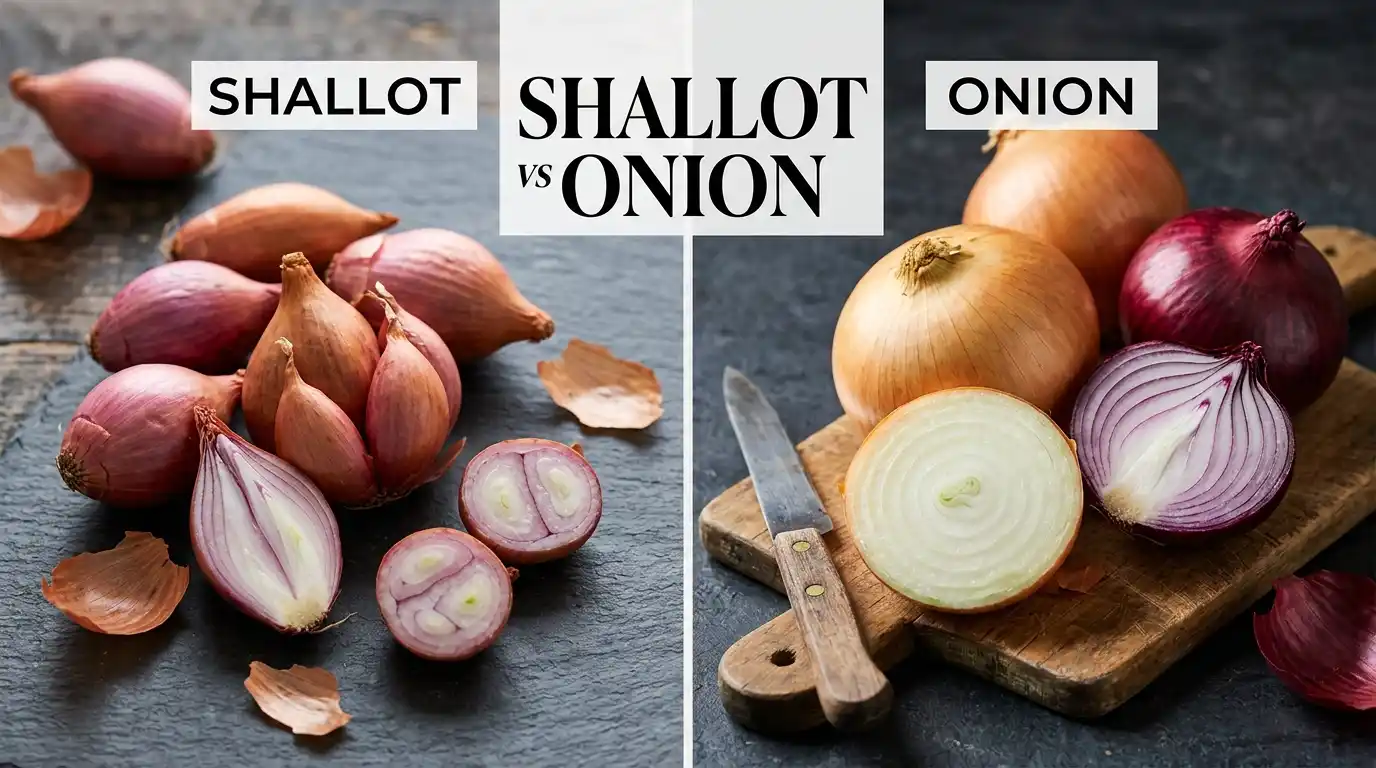
The difference between shallot and onion comes down to their size, flavor, structure, and best uses in cooking. Shallots are usually small, oval-shaped bulbs with a mild, sweet taste and a hint of garlic. Onions are generally larger and have a stronger, sharper flavor, though their taste varies by type.
Both belong to the allium family and add flavor to many meals. However, they do not always give the same result. Shallots work well in delicate sauces, salad dressings, and garnishes. Onions are a common choice for soups, stews, curries, and other dishes that need a strong flavor base.
Understanding the difference between shallot and onion can help you choose the right ingredient or make a good substitution when your recipe calls for one you do not have.
Shallot vs. Onion: Quick Comparison
| Feature | Shallot | Onion |
|---|---|---|
| Size | Usually small | Usually larger |
| Shape | Often oval or elongated | Usually round |
| Growth | Often forms clusters of bulbs | Usually forms one main bulb |
| Flavor | Mild, sweet, and aromatic | Often sharper and more pungent |
| Texture | Fine layers and a delicate texture | Firmer layers with more bulk |
| Raw uses | Dressings, salads, and garnishes | Salads, sandwiches, and salsas |
| Cooked uses | Sauces, glazes, and quick sautés | Soups, stews, curries, and roasts |
| Cost | Often more expensive per unit of weight | Usually more budget-friendly |
| Best quality | Adds delicate flavor | Adds flavor and bulk |
What Is a Shallot?
A shallot is a small bulb vegetable in the allium family. This family also includes onions, garlic, leeks, and chives.
Shallots often have thin, papery skin that may be golden, brown, pink, or reddish. Their flesh is usually white or pale purple. Many types are oval or teardrop-shaped, and they often grow in clusters.
Shallots have a delicate flavor. They taste like onions but may also have a mild garlic-like note. Their aroma can add depth to food without overpowering other ingredients.
Common Uses for Shallots
Shallots work well when a recipe needs a gentle onion flavor.
You can use them in:
- Salad dressings and vinaigrettes
- Creamy sauces and pan sauces
- Omelets and quiches
- Roasted vegetables
- Pickled vegetables
- Fried shallot toppings
- Pasta and seafood dishes
For example, finely chopped shallots can add flavor to a simple dressing made with olive oil, vinegar, and mustard. They also work well in a sauce served with chicken or fish.
What Is an Onion?
An onion is a widely used bulb vegetable with several layers inside its papery outer skin. Common types include yellow, white, and red onions. Each type has a slightly different flavor and texture.
Yellow onions often have a strong flavor when raw but become sweeter as they cook. White onions have a crisp texture and a sharp taste. Red onions are often used raw because their color and flavor work well in salads, sandwiches, and other fresh dishes.
Onions are useful when a dish needs both flavor and volume. They can form the base of a recipe or serve as a main ingredient.
Common Uses for Onions
Onions are popular in many everyday dishes, including:
- Soups and stews
- Curries and stir-fries
- Burgers and sandwiches
- Salsas and salads
- Roasted meats and vegetables
- Pasta sauces
- Caramelized onion dishes
For example, chopped yellow onion can form the base of a soup or curry. As it cooks, its sharp flavor softens and adds sweetness to the dish.
5 Main Differences Between Shallots and Onions
1. Appearance and Size
The easiest way to tell them apart is to look at their shape and size.
Shallots are usually smaller and more elongated than common onions. Their skin may have a pink, reddish, or brown tone. When cut, a shallot may reveal several small sections or fine layers.
Onions are generally larger and rounder. Their skin may be yellow, white, or red, depending on the variety. When you slice an onion, you can usually see clear rings.
Simple tip: If the bulb is small and oval, it may be a shallot. If it is larger and round, it is more likely to be an onion. Shape alone is not a perfect test because varieties differ.
2. Taste and Aroma
Shallots often taste milder, sweeter, and more delicate than common yellow or white onions. They may also have a subtle garlic-like aroma.
Onions usually have a stronger, sharper bite when raw. Their flavor changes as they cook. Heat softens their sharpness and brings out their natural sweetness.
This difference matters most when an ingredient is eaten raw or used in a delicate dish.
For example, finely minced shallots can add a gentle flavor to a vinaigrette. Raw yellow onion may give the same dressing a stronger bite.
Neither ingredient is always milder. The variety, freshness, amount used, and cooking method all affect the final flavor.
3. Texture and Cooking Behavior
Shallots have fine layers and are easy to mince into small pieces. Their delicate texture makes them useful in smooth sauces and dressings.
Onions provide more bulk. Their layers can hold their shape during cooking, depending on how they are cut and how long they cook.
Both vegetables soften and become sweeter with heat. However, finely chopped shallots can cook quickly, so watch them closely when sautéing or frying. Small pieces may brown or burn before larger onion pieces are ready.
Cooking tip: Use medium or medium-low heat when cooking finely minced shallots. Stir often, especially when preparing a sauce or garnish.
4. Best Culinary Uses
Shallots are often chosen for recipes where a delicate flavor matters. They work well in vinaigrettes, pan sauces, glazes, and seafood dishes.
Onions are useful in recipes that need a stronger flavor base or a larger amount of vegetables. They are common in soups, stews, curries, casseroles, and roasted dishes.
This does not mean you must use shallots for sauces or onions for soups. Either can work in many recipes. The main question is whether you want a delicate flavor or a stronger onion taste.
5. Price and Availability
Onions are widely used and are often less expensive per unit of weight than shallots. You can usually find several onion varieties in grocery stores and markets.
Shallots may cost more and may be harder to find in some areas. Their smaller size can also mean more peeling and chopping for the same amount of food.
If you cook in large batches, onions may be the more practical choice. If a recipe depends on a subtle shallot flavor, the extra cost may be worthwhile.
Can You Substitute Shallots for Onions?
Yes. You can replace shallots with onions in many recipes, and you can also use shallots instead of onions. However, the flavor and texture may change.
The best substitution depends on whether the ingredient is served raw, cooked briefly, or cooked for a long time.
Replacing Shallots With Onions
If your recipe calls for shallots but you only have onions, use a small amount of finely chopped onion.
For a delicate sauce or dressing, start with less onion than the recipe calls for in shallots. Taste the mixture and add more if needed. Raw onion can taste much stronger than raw shallot.
For cooked dishes, yellow onion is often a practical substitute. Chop it finely if you want it to blend into the dish.
Replacing Onions With Shallots
If you need an onion but have shallots, measure the amount you need instead of counting bulbs alone.
A rough kitchen guide is that about three small shallots may replace one small onion, but sizes vary. For better results, compare the chopped volume and adjust to taste.
Shallots can work well in sauces, sautéed vegetables, and many cooked dishes. In a large pot of soup or stew, however, you may need several shallots to provide the same volume and strength as an onion.
When Should You Avoid Substituting?
Substitution is less reliable when the ingredient plays a major role in the dish.
For example, a raw shallot vinaigrette may taste too sharp if you replace the shallot with the same amount of raw yellow onion. A large batch of caramelized onions may also have a different texture and flavor if you use shallots instead.
When the ingredient is a key part of the recipe, use the one listed if possible.
Are Shallots Healthier Than Onions?
Both shallots and onions can be part of a balanced diet. They provide fiber and various vitamins, minerals, and plant compounds.
Their exact nutrient content depends on the variety and serving size. Raw shallots may contain more calories and some nutrients per 100 grams than common raw onions, but that does not automatically make them healthier for everyone.
The amount you eat and the rest of your diet matter more than choosing one bulb vegetable over the other.
Choose shallots for their flavor when a recipe benefits from them. Choose onions when their taste, size, price, or texture better suits the meal.
Are Shallots Just Small Onions?
Not exactly. Shallots and onions are closely related members of the allium family, but they are distinct types of bulb vegetables.
Shallots often grow in clusters and tend to have a smaller, more elongated shape. Common onions usually form one larger bulb.
Their flavors also differ. Shallots often have a more delicate, sweet aroma, while common onions can have a sharper taste. Still, both vary by type, and their flavors can overlap.
The names can also cause confusion in different countries and markets. If a recipe uses an unfamiliar local name for a bulb vegetable, check its appearance and how the recipe uses it before choosing a substitute.
How to Choose and Store Shallots and Onions
Choose shallots and onions that feel firm and have dry, papery skins. Avoid bulbs with soft spots, signs of decay, or a strong unpleasant smell.
Store whole, unpeeled bulbs in a cool, dry, well-ventilated place away from direct sunlight. Keep them out of sealed containers that trap moisture.
Once cut or peeled, place the unused portion in a covered container in the refrigerator and use it promptly. Follow food-safety guidance for storage and discard any bulb that shows signs of spoilage.
Frequently Asked Questions
1. Do shallots taste like onions?
Yes. Shallots have an onion-like flavor, but they often taste sweeter and more delicate. Some also have a mild garlic-like note.
2. Which is better for cooking, shallots or onions?
Neither is always better. Shallots are useful for delicate sauces, dressings, and garnishes. Onions are practical for soups, stews, curries, and recipes that need more flavor and bulk.
3. Can I use shallots in place of red onions?
Yes, in many recipes. Shallots can replace red onions in salads, dressings, and cooked dishes, but they may have a different color, texture, and flavor. Start with a similar chopped volume and adjust to taste.
4. Do shallots make you cry like onions?
Yes. Cutting shallots can release compounds that irritate the eyes, much like cutting onions. A sharp knife and good ventilation may help reduce irritation.
5. Are shallots and green onions the same?
No. Shallots are bulb vegetables, while green onions have long green leaves and small white bases. They differ in shape, texture, and how they are used in recipes.
6. Which is cheaper, shallots or onions?
Onions are often cheaper per unit of weight because they are widely grown and sold. Prices vary by location, season, and variety.
Test Your Knowledge: Shallot vs. Onion
1. Which ingredient usually has a milder, more delicate flavor?
A. Yellow onion
B. Shallot
C. Both always taste the same
D. Garlic
Correct answer: B. Shallot
2. Which vegetable is usually larger and rounder?
A. Shallot
B. Chive
C. Onion
D. Green onion
Correct answer: C. Onion
3. Which ingredient is often a good choice for a delicate vinaigrette?
A. Shallot
B. Whole yellow onion
C. Potato
D. Cabbage
Correct answer: A. Shallot
4. Can you substitute onions for shallots in many recipes?
A. No, never
B. Yes, but the flavor may change
C. Only in desserts
D. Only when served raw
Correct answer: B. Yes, but the flavor may change
5. Why should you watch minced shallots closely while cooking?
A. They cannot soften
B. They always stay raw
C. Small pieces can brown or burn quickly
D. They turn into onions
Correct answer: C. Small pieces can brown or burn quickly
6. Which vegetable is often more practical for a large pot of soup or stew?
A. Shallot, in every case
B. Onion
C. Green onion only
D. Neither can be used
Correct answer: B. Onion
Conclusion
The main difference between shallots and onions is their flavor, size, and role in a dish. Shallots are usually smaller and more delicate, making them useful in dressings, sauces, and garnishes. Onions provide more bulk and a stronger flavor, which makes them a common choice for soups, stews, curries, and everyday cooking.
You can substitute one for the other in many recipes. Adjust the amount to match the size and flavor of the original ingredient, and taste as you cook. The best choice is the one that gives your dish the flavor and texture you want.
Suggested External Link Sources
Use these as a dedicated Sources section at the end of the published article, rather than placing links throughout the main text.
- Healthline — Shallots vs. Onions: What’s the Difference?
- Martha Stewart — What Are Shallots and How Are They Different Than Onions?
- Bon Appétit — What Is a Shallot? And How Is It Different From an Onion?
- The Kitchn — How to Swap Shallots for Onions

Mira Anand is a writer at Distinly.com who focuses on storytelling, communication, and social perspective. Her work highlights subtle differences in language and meaning across cultures and communities. With a clear and empathetic voice, Mira helps readers understand how narratives shape understanding, relationships, and modern dialogue in an increasingly connected world.