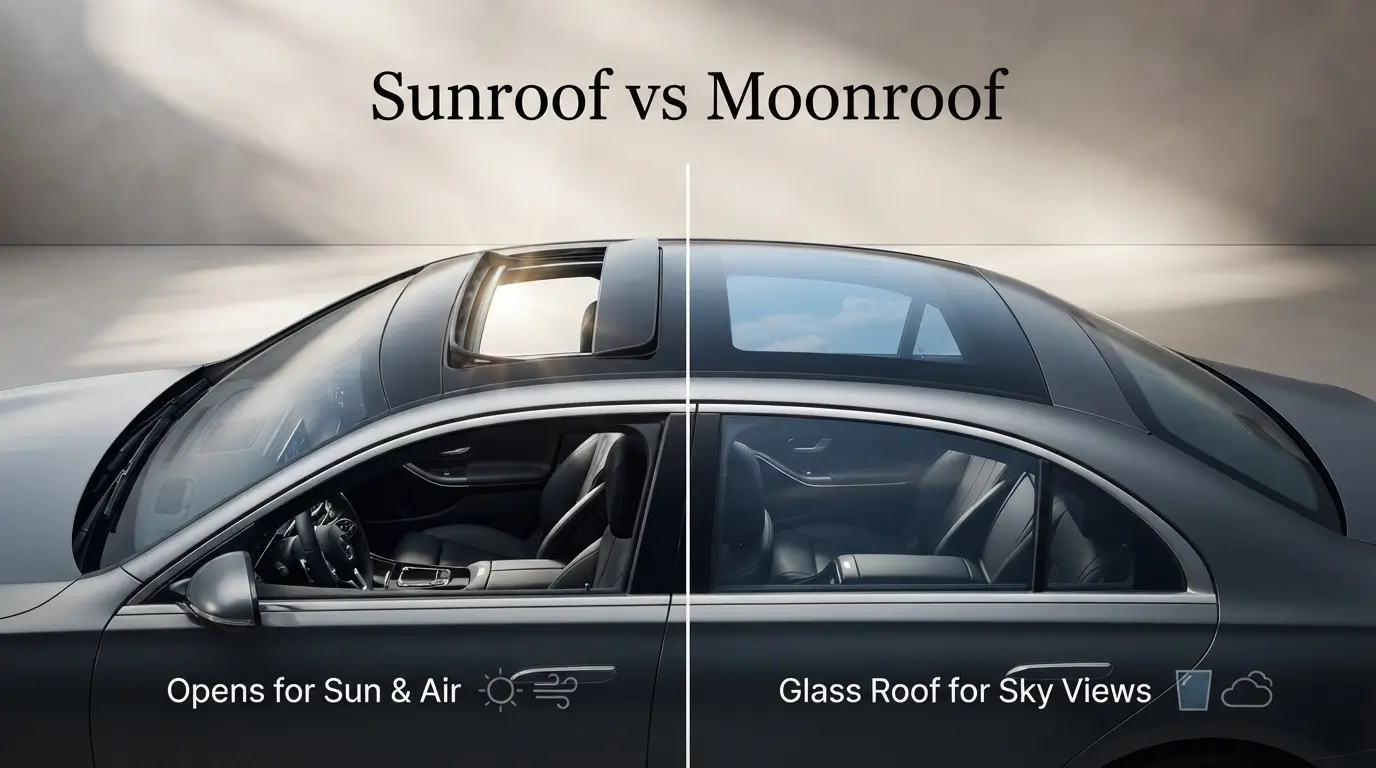
When shopping for a car, you may hear the terms sunroof and moonroof used as if they mean the same thing. They are closely related, but there is a small distinction that can matter when you are comparing vehicles, reading specifications, or deciding which roof feature you want.
The difference between sunroof and moonroof is mainly about the roof panel’s material and design. A traditional sunroof may be made from an opaque or transparent panel and can often open to let in fresh air. A moonroof is generally a glass roof panel, often tinted, that lets you see the sky even when it is closed.
Understanding the difference between sunroof and moonroof can make car research much easier. The terms are also used differently by manufacturers, so the name alone does not always tell you exactly what a vehicle has. That is why people often search for the difference between sunroof and moonroof before buying a car.
This guide explains the terms, their history, practical differences, common mistakes, and what to look for when comparing vehicles.
Difference Between Sunroof and Moonroof – Quick Answer
A sunroof is a roof opening or panel designed to provide extra light, fresh air, or both. Depending on the vehicle, it may be made from metal, glass, or another material.
A moonroof is usually a type of sunroof that uses a glass panel. It allows passengers to see the sky while the panel remains closed. Many modern moonroofs are fixed, sliding, tilting, or electrically operated.
The easiest way to remember the distinction is:
- Sunroof: A broad term for an opening or removable panel in a vehicle’s roof.
- Moonroof: Usually a glass-panel version that provides a view of the sky.
- Panoramic roof: A much larger glass roof that can extend over a significant portion of the vehicle’s cabin.
For example:
“This car has a power sunroof.”
This tells you that the vehicle has a roof panel that operates, but it does not necessarily tell you whether the panel is glass.
“This sedan has a moonroof.”
This normally suggests a glass roof panel, often tinted, that provides an overhead view.
However, modern car manufacturers do not always use these terms with strict technical consistency. A manufacturer may call a glass roof a sunroof, even though consumers often associate glass with a moonroof.
The Origin of Difference Between Sunroof and Moonroof
The two terms developed from the changing design of automobile roofs.
Sunroof is a descriptive compound word formed from sun and roof. It refers to a roof section that can provide access to sunlight, air, or an opening above the passenger compartment. The word became associated with automobiles as manufacturers introduced opening roof panels.
Moonroof is a later term associated with the idea of seeing the night sky through a glass roof. The term became particularly well known in the automotive industry after Ford introduced the Continental Mark IV with a glass roof panel marketed as a “Moonroof” in the early 1970s.
The distinction was partly a marketing development. A glass panel could provide the benefits of an open-looking roof without necessarily exposing the cabin to outside air.
This is why the terms can overlap today. Automotive technology has changed significantly, and manufacturers now offer many variations, including tilt-and-slide glass panels, fixed glass roofs, retractable roofs, and panoramic systems.
The words are also pronounced differently:
- Sunroof: SUN-roof
- Moonroof: MOON-roof
They do not rhyme perfectly because the first words have different vowel sounds, but both end with roof.
Grammatically, both sunroof and moonroof are compound nouns. They name vehicle features.
What Is a Sunroof?
A sunroof is a roof panel or opening that provides an overhead source of light and, in many designs, ventilation.
Older sunroofs could use opaque panels that matched the vehicle’s body. Modern versions are often made with glass.
Common sunroof designs include:
Pop-Up Sunroof
A pop-up sunroof tilts upward, usually from the rear edge. It provides ventilation without requiring the entire panel to slide away.
Sliding Sunroof
A sliding sunroof moves backward or forward to open part of the roof.
Tilt-and-Slide Sunroof
This type can tilt upward for ventilation and slide open for a larger opening.
Power Sunroof
A motor operates the panel. The driver or passengers can usually control it with a switch.
Because sunroof is often used as a broad term, a vehicle advertised with a sunroof may actually have a glass panel.
What Is a Moonroof?
A moonroof is generally a glass roof panel that gives passengers a view of the sky.
The panel is often tinted to reduce glare and heat. Many moonroofs also include a sliding interior shade.
A moonroof may be:
- Fixed
- Tilting
- Sliding
- Electrically operated
- Integrated into a larger panoramic roof
The key idea is that the word moonroof emphasizes the ability to see through the roof.
A moonroof does not necessarily mean that the glass itself opens. A fixed glass panel can still be called a moonroof in some automotive descriptions.
Sunroof vs Moonroof: Main Differences
| Feature | Sunroof | Moonroof |
|---|---|---|
| Basic meaning | Roof opening or panel | Usually a glass roof panel |
| Main purpose | Light and/or ventilation | Light and sky visibility |
| Glass required? | No | Usually |
| Can open? | Often, but not always | Sometimes |
| Can be fixed? | Yes, depending on design | Yes |
| Interior shade | Common on glass versions | Very common |
| Modern usage | Very broad | More specific, but varies |
| Manufacturer terminology | Common | Less consistent |
The biggest practical difference is not always operation. It is often the material and visibility of the roof panel.
British English vs American English Spelling
There is no meaningful British-versus-American spelling difference between sunroof and moonroof.
Both British and American English use:
- sunroof
- moonroof
The main differences you may encounter are related to automotive terminology rather than spelling.
| Term | British English | American English |
|---|---|---|
| Sunroof | Sunroof | Sunroof |
| Moonroof | Moonroof | Moonroof |
| Roof | Roof | Roof |
One useful regional difference is the pronunciation of roof. In many varieties of British English, roof commonly has the vowel sound found in food. In American English, roof is also commonly pronounced with that vowel, although pronunciation can vary by speaker and region.
The important point is that neither country has a different standard spelling such as sun-roof or moon-roof. The closed compounds are standard.
Which Term Should You Use?
If you are speaking generally about a vehicle’s roof panel, sunroof is usually the safer term because it is widely understood.
If you specifically mean a glass panel that lets passengers see the sky, moonroof can be more precise.
For car shopping, however, do not rely only on the name.
Check the vehicle’s actual specifications. A manufacturer may use sunroof to describe a glass panel, while another manufacturer may call a similar feature a moonroof.
For example, if you are comparing two vehicles:
Car A: “Power sunroof”
Car B: “Power moonroof”
Do not assume Car B automatically has a better or larger roof. Look at the panel size, opening mechanism, glass type, shade, and whether the front section actually opens.
Common Mistakes With Sunroof and Moonroof
Mistake 1: Assuming every sunroof is metal
Modern sunroofs are often glass.
Better understanding:
Sunroof describes the feature, not necessarily the material.
Mistake 2: Assuming every moonroof opens
A moonroof can be fixed.
Better understanding:
Moonroof usually describes a glass roof feature, but the glass does not have to move.
Mistake 3: Treating panoramic roofs and moonroofs as identical
A panoramic roof is generally much larger.
Better understanding:
A panoramic roof can be considered part of the broader family of glass roof systems, but its defining feature is its large coverage.
Mistake 4: Thinking the names always indicate different technology
Manufacturers sometimes use the terms as marketing labels.
Better understanding:
Compare the actual specifications instead of relying only on the terminology.
Mistake 5: Using “moon roof” as the standard spelling
The usual spelling is moonroof, written as one word.
Likewise, sunroof is normally written as one word.
Sunroof and Moonroof in Everyday Examples
These terms appear often in car listings, reviews, conversations, and automotive articles.
In a Car Listing
“The vehicle comes equipped with a power sunroof and interior shade.”
Here, sunroof describes the vehicle feature.
In a Car Review
“The glass moonroof makes the cabin feel more open.”
Here, moonroof emphasizes the glass and overhead view.
In Conversation
“Does this model have a sunroof?”
This is a natural way to ask about an overhead roof opening or glass panel.
In Formal Writing
“The vehicle’s optional glass roof increases the amount of natural light entering the passenger compartment.”
A formal technical description may avoid both marketing terms and describe the actual design.
On Social Media
“That new SUV looks amazing with the panoramic roof!”
In casual posts, people often use sunroof even when they technically mean a large glass roof.
Sunroof vs Moonroof vs Panoramic Roof
These terms are easy to mix up, especially when shopping for a newer vehicle.
| Roof Type | Typical Design | Main Feature |
|---|---|---|
| Sunroof | Opening or panel | Light and ventilation |
| Moonroof | Glass panel | Sky visibility |
| Panoramic roof | Large glass area | Wider overhead view |
| Fixed glass roof | Non-opening glass | Light and visibility |
| Convertible roof | Fully retractable roof | Open-air driving |
A panoramic roof can cover much more of the cabin than a traditional sunroof.
Some panoramic systems have two separate glass sections. Others have one large panel. Some open, while others remain fixed.
So if a vehicle listing says panoramic sunroof, the phrase may combine two common terms to describe a large glass roof system.
Which Is Better: Sunroof or Moonroof?
Neither is automatically better. The better choice depends on what you want from the vehicle.
A roof that opens can provide fresh air and a stronger open-air feeling.
A fixed glass roof can provide more natural light without the mechanical complexity of an opening panel.
When comparing vehicles, consider:
- Opening size
- Glass area
- Interior shade
- Ventilation
- Wind noise
- Heat protection
- Ease of operation
- Maintenance
- Headroom
- Overall vehicle design
A large glass roof can make a cabin feel brighter and more spacious. However, glass also adds weight and can allow more solar heat into the cabin if the vehicle’s glass and shade system are not designed well.
Why Do Manufacturers Use Different Names?
Automotive terminology is not always standardized in everyday marketing.
One manufacturer may call a glass roof a sunroof. Another may use moonroof. A third may market a large version as a panoramic roof.
This happens because these terms have both technical and marketing histories.
The result is simple: the name alone may not tell you everything about the feature.
If you are buying a car, look for details such as:
“Power tilt-and-slide glass roof”
That description tells you much more than simply saying:
“Moonroof.”
Search Intent and Usage
People searching for difference between sunroof and moonroof are usually trying to understand whether the two terms describe different car features.
The search may come from someone:
- Comparing new cars
- Reading a vehicle specification
- Looking at used-car listings
- Learning automotive vocabulary
- Deciding between vehicle trims
- Wondering whether a glass roof is the same as a sunroof
Search interest does not necessarily mean that people use the terms in strict technical ways. In everyday conversation, sunroof is often used as the general word for several types of vehicle roof systems.
Comparison Table: Sunroof and Moonroof
| Question | Sunroof | Moonroof |
|---|---|---|
| Is it a noun? | Yes | Yes |
| Is it a compound word? | Yes | Yes |
| Usually made of glass? | Sometimes | Usually |
| Provides natural light? | Yes | Yes |
| Provides sky visibility? | Sometimes | Usually |
| Can provide ventilation? | Often | Sometimes |
| Must it open? | No | No |
| Is the term used by car makers? | Very common | Common but less universal |
| Is spelling different in UK and US English? | No | No |
FAQs
1. Is a moonroof the same as a sunroof?
Not exactly. A moonroof is generally a type of sunroof with a glass panel. However, manufacturers often use the terms interchangeably.
2. Is a moonroof always made of glass?
In modern automotive usage, a moonroof is generally associated with glass. The exact design can vary between manufacturers and vehicle models.
3. Does a moonroof open?
Sometimes. Some moonroofs tilt or slide open, while others are fixed glass panels.
4. Is a panoramic roof a moonroof?
Not necessarily. A panoramic roof is defined mainly by its large size and cabin coverage. Some panoramic roofs may also function as moonroofs.
5. Which is better, a sunroof or moonroof?
Neither is always better. Your choice depends on whether you value ventilation, sky visibility, glass area, shade coverage, or an open-air feeling.
6. Do British and American English spell sunroof differently?
No. Both varieties normally spell it sunroof.
7. Why do car companies use both terms?
The terms have different histories, but modern manufacturers sometimes use them as marketing labels for similar glass or opening roof systems. The specifications provide a clearer description.
Conclusion
The difference between sunroof and moonroof is easier to understand when you focus on the design, not just the name. A moonroof is usually a glass type of sunroof.
Today, car makers often use these terms in flexible ways, so a “sunroof” may be glass and a “moonroof” may be fixed or opening. Always check the vehicle details.
Knowing these terms helps you compare cars with confidence and understand automotive listings without confusion. The right roof is the one that fits your needs.
Take a closer look at the roof features on your next vehicle search, and you will quickly spot the difference between the marketing name and the actual design.

Ezra Hale is a thoughtful contributor to Distinly.com, where he explores philosophical ideas and the subtle differences behind everyday concepts. His writing blends logic, language, and human insight to clarify complex distinctions. Ezra encourages readers to think deeper, question assumptions, and appreciate the meaning behind words and ideas in modern discourse.