Pho and ramen are two of the most popular noodle soups in Asia. Both are warm, filling, flavorful, and often served with meat, vegetables, herbs, and noodles. Because they look similar in a bowl, many people wonder about the difference between pho and ramen.
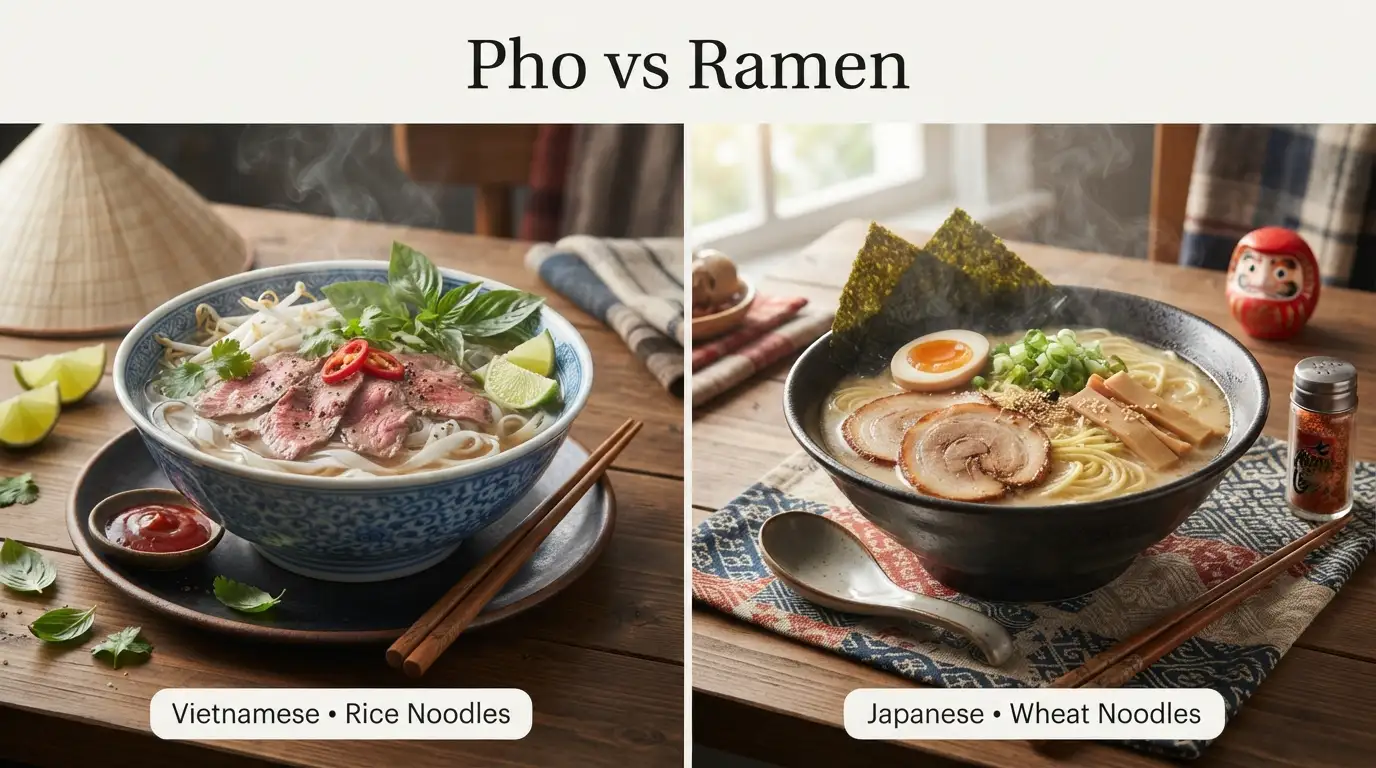
The difference between pho and ramen starts with their origins. Pho is a Vietnamese noodle soup known for its clear, fragrant broth, rice noodles, fresh herbs, and ingredients such as beef or chicken. Ramen is a Japanese noodle dish built around wheat noodles, a rich or savory broth, and toppings such as pork, eggs, seaweed, and green onions.
Understanding the difference between pho and ramen can help you choose the right dish when eating at a restaurant or exploring Asian cuisine. The two dishes may share the same basic idea a bowl of noodles and broth but their ingredients, preparation, flavors, and traditions are quite different.
This guide explains the difference between pho and ramen in simple terms, including their history, pronunciation, ingredients, cooking methods, and everyday use.
Difference Between Pho and Ramen – Quick Answer
The simplest way to understand the difference between pho and ramen is to look at their noodles, broth, toppings, and culinary origins.
Pho is a Vietnamese noodle soup. It usually uses flat rice noodles and a clear, aromatic broth. Common versions include beef pho and chicken pho. Fresh herbs, lime, bean sprouts, chili, and other additions are often served with it.
Ramen is a Japanese noodle dish. It normally uses wheat noodles and a broth that can range from light and clear to rich and creamy. Common toppings include sliced pork, boiled eggs, seaweed, bamboo shoots, mushrooms, and green onions.
| Feature | Pho | Ramen |
|---|---|---|
| Main cuisine | Vietnamese | Japanese |
| Noodles | Rice noodles | Wheat noodles |
| Typical noodles | Flat and smooth | Usually thin or curly |
| Broth | Often clear and aromatic | Can be clear, rich, creamy, or savory |
| Common meat | Beef or chicken | Pork, chicken, beef, or seafood |
| Fresh herbs | Very common | Less central |
| Lime | Common accompaniment | Not typical |
| Egg | Not essential | Very common |
| Flavor profile | Fragrant, fresh, herbal | Savory, rich, deep, or umami-focused |
So, if you want a light, fragrant soup with rice noodles and fresh herbs, pho may be the better choice. If you prefer wheat noodles with a deeper broth and toppings such as pork and egg, ramen may suit you better.
The Origin of Pho and Ramen
Pho and ramen developed in different culinary traditions, although both were influenced by broader Asian food history.
Where Did Pho Come From?
Pho is strongly associated with Vietnam, especially northern Vietnam. Its exact early history is not completely settled, and scholars have proposed different explanations for how the dish developed.
Pho emerged as a distinct Vietnamese noodle soup in the early 20th century. It later became a major part of Vietnamese food culture and spread internationally with Vietnamese communities.
The word pho is Vietnamese. Its exact etymological history is debated, so it is better not to claim one certain explanation as proven fact.
Pho also changed over time. Regional styles developed within Vietnam, with northern and southern versions often differing in broth, garnishes, sweetness, herbs, and other details.
Where Did Ramen Come From?
Ramen is associated with Japan, but its early development was influenced by Chinese-style wheat noodle dishes. The dish evolved in Japan and eventually developed into many regional styles.
The word ramen is written as ラーメン in Japanese. Its deeper linguistic history is connected to Chinese noodle traditions, but the exact route by which the modern Japanese term developed has been discussed by historians and food scholars.
Japanese ramen later developed into many recognizable styles. Examples include miso ramen, shoyu ramen, shio ramen, and tonkotsu ramen.
Unlike pho, ramen is based on wheat noodles, which gives it a different texture and flavor from rice-noodle pho.
Pronunciation of Pho and Ramen
The words pho and ramen can both cause pronunciation questions for English speakers.
How Do You Pronounce Pho?
In common English usage, pho is often pronounced approximately like “fuh.”
The Vietnamese pronunciation is more complex because Vietnamese is tonal, meaning pitch can affect meaning. English approximations do not perfectly reproduce the Vietnamese pronunciation.
For everyday English conversation, saying “fuh” will generally be understood when referring to the Vietnamese noodle soup.
How Do You Pronounce Ramen?
In English, ramen is commonly pronounced approximately:
RAH-men or RAM-en
Japanese pronunciation differs somewhat from English pronunciation. The first syllable is often closer to “rah,” while the final sound is lighter than the strong English “men.”
Neither word is normally confused with the other because they have very different sounds.
What Is Pho?
Pho is a Vietnamese noodle soup built around a flavorful broth and rice noodles.
A traditional bowl can contain:
- Flat rice noodles
- Beef or chicken
- Aromatic broth
- Onions
- Fresh herbs
- Bean sprouts
- Lime
- Chili
- Green onions
- Other regional garnishes
Beef pho, often called pho bo, is especially well known. Chicken pho, or pho ga, is another popular style.
One of the defining features of pho is the importance of its broth. Aromatic ingredients such as spices, onions, and ginger contribute to its distinctive character.
Pho is also known for its fresh accompaniments. Diners can often adjust the bowl with herbs, lime, sprouts, or chili according to personal taste.
What Is Ramen?
Ramen is a Japanese noodle dish that usually combines wheat noodles, broth, protein, and toppings.
Common ramen ingredients include:
- Wheat noodles
- Pork or chicken
- Soft-boiled egg
- Green onions
- Seaweed
- Bamboo shoots
- Mushrooms
- Corn
- Fish or seafood
- Sesame
- Seasoned oils
Ramen has many styles.
Shoyu ramen uses a soy-sauce-based seasoning.
Miso ramen gets much of its flavor from fermented soybean paste.
Shio ramen is seasoned primarily with salt.
Tonkotsu ramen is known for a rich pork-bone broth.
This variety is one reason ramen can taste very different from one restaurant to another.
Pho vs Ramen: Noodles
The noodles are one of the easiest ways to identify the difference between pho and ramen.
Pho Noodles
Pho traditionally uses rice noodles. They are usually flat, smooth, and relatively delicate.
Because they are made primarily from rice, they have a different texture from wheat-based ramen noodles.
Ramen Noodles
Ramen uses wheat noodles. They can vary in thickness, shape, length, and texture.
Many ramen noodles contain kansui, an alkaline ingredient that helps give them their familiar springy texture and yellowish appearance.
This creates a clear distinction:
Pho = rice noodles
Ramen = wheat noodles
However, noodle varieties can vary, so the appearance of a particular bowl should not be the only way you identify it.
Pho vs Ramen: Broth
Broth is another major difference.
Pho broth is often clear and aromatic. Its flavor can come from ingredients such as beef or chicken bones, onions, ginger, and spices.
Ramen broth has a much wider range. Some ramen broths are light and clear, while others are thick, creamy, oily, or intensely savory.
Tonkotsu ramen, for example, is famous for its rich pork-bone broth. Miso ramen has a deeper fermented flavor, while shoyu ramen typically has a strong soy-sauce character.
This means there is no single “ramen flavor.”
Pho also varies by recipe, but its fragrant broth and fresh garnishes remain important parts of its identity.
Pho vs Ramen: Toppings and Garnishes
The term Pho and ramen also use different topping traditions.
Pho commonly comes with fresh ingredients that add brightness and contrast. These may include:
- Thai basil
- Cilantro
- Bean sprouts
- Lime
- Fresh chili
- Sliced onions
Ramen toppings are often more substantial and include:
- Chashu pork
- Soft-boiled egg
- Nori
- Bamboo shoots
- Green onions
- Mushrooms
- Corn
A major practical difference is that fresh herbs and lime play a much bigger role in the typical pho experience, while ramen often focuses on cooked toppings and seasoned ingredients.
Pho vs Ramen: Flavor and Texture
Pho tends to offer a fragrant and fresh flavor profile.
Its broth may taste aromatic and savory without feeling as heavy as some ramen styles. Fresh herbs, lime, sprouts, and chili can add sharp, fresh notes.
Ramen can be much richer. Depending on the style, it may taste salty, savory, fermented, fatty, creamy, smoky, or intensely umami.
The noodle texture is also different.
Pho noodles are generally soft and smooth.
Ramen noodles are usually firmer and springier.
This difference in texture can be noticeable even when both dishes contain similar proteins or vegetables.
Comparison Table: Pho vs Ramen
| Category | Pho | Ramen |
|---|---|---|
| Country of association | Vietnam | Japan |
| Main noodle | Rice | Wheat |
| Noodle shape | Usually flat | Often thin, round, or wavy |
| Broth | Usually clear and aromatic | Wide range of styles |
| Common protein | Beef or chicken | Pork, chicken, seafood, others |
| Egg | Not a defining ingredient | Common topping |
| Herbs | Important | Usually less central |
| Lime | Common | Uncommon |
| Soy sauce | May appear but is not defining | Important in some styles |
| Miso | Not typical | Key ingredient in miso ramen |
| Pork-bone broth | Not typical | Central to tonkotsu |
| Eating style | Often customized with fresh garnishes | Usually assembled with prepared toppings |
British English vs American English Spelling
There is no meaningful British English versus American English spelling difference between pho and ramen.
Both British and American English use the same spellings:
- pho
- ramen
These are names for foods associated with Vietnamese and Japanese cuisine. They are not words that change spelling according to the usual British-American spelling patterns.
Pronunciation can vary between English speakers, especially because both terms come from languages with pronunciation systems that do not map perfectly onto English.
The important point is simple: you do not need a different spelling for British or American English.
Which Spelling Should You Use?
Use pho when referring to the Vietnamese noodle soup.
Use ramen when referring to the Japanese noodle dish.
For an international audience, these spellings are clear and widely recognized.
If you are writing about Vietnamese food, use the appropriate Vietnamese names when needed, such as pho bo for beef pho or pho ga for chicken pho.
For Japanese food writing, names such as shoyu ramen, miso ramen, shio ramen, and tonkotsu ramen can help readers understand the specific style.
The main goal is accuracy. Do not spell pho as “fo” or ramen as “raman.” Those forms can create confusion or refer to something else.
Common Mistakes About Pho and Ramen
Mistake 1: Thinking They Are the Same Dish
Incorrect: Pho and ramen are basically the same soup.
Better: Pho and ramen are different noodle dishes from different culinary traditions.
Mistake 2: Calling Pho a Wheat Noodle
Incorrect: Pho is made with wheat noodles.
Correct: Traditional pho uses rice noodles.
Mistake 3: Assuming All Ramen Has the Same Broth
Incorrect: Ramen always has a thick, creamy broth.
Correct: Ramen includes many broth styles, from light and clear to rich and creamy.
Mistake 4: Thinking All Pho Is Beef
Incorrect: Pho always contains beef.
Correct: Beef pho is popular, but chicken pho is also a well-known style.
Mistake 5: Thinking Ramen Always Contains Pork
Incorrect: Ramen must have pork.
Correct: Ramen can contain pork, chicken, seafood, vegetables, or other ingredients.
Mistake 6: Confusing Rice Noodles With Ramen Noodles
The noodle type is one of the easiest clues. Pho generally uses rice noodles, while ramen uses wheat noodles.
Pho and Ramen in Everyday Examples
These food names appear naturally in restaurant conversations, menus, reviews, social media posts, and travel writing.
Restaurant Example
“I ordered beef pho because I wanted something light and aromatic.”
“I chose tonkotsu ramen because I wanted a rich, savory broth.”
Social Media Example
“Trying pho for the first time today. The fresh herbs and lime were amazing.”
Travel Writing Example
“Both pho and ramen are popular noodle dishes, but their ingredients and traditions are quite different.”
Formal Writing Example
“Pho and ramen demonstrate how different culinary cultures can create distinct noodle soups from related basic concepts.”
Casual Conversation
Person A: “Should we get pho or ramen?”
Person B: “Let’s get pho. I want rice noodles and fresh herbs.”
These examples show that both words function naturally as food nouns in English.
Is Pho Healthier Than Ramen?
There is no universal answer.
The nutritional value depends on the specific recipe, portion size, broth, meat, noodles, toppings, and added sauces.
Some pho bowls may feel lighter because they often feature a clear broth, rice noodles, lean protein, and fresh vegetables or herbs.
Some ramen bowls can be richer because certain styles contain more fat, sodium, or calorie-dense toppings.
But ramen itself is not automatically unhealthy, and pho is not automatically healthy.
The best comparison depends on the exact bowls being served.
Which Is More Filling: Pho or Ramen?
This depends on the recipe and portion.
Ramen with a rich broth, pork, egg, and other toppings can be very filling. Pho can also be substantial, especially when served with a generous amount of noodles and meat.
Noodles provide much of the carbohydrate content in both dishes, while meat and other toppings add protein and fat.
If you want a lighter-feeling meal, a clear broth and fresh toppings may appeal to you. If you want something rich and hearty, a heavier ramen style may be more satisfying.
Can Pho and Ramen Be Vegetarian?
Yes.
Vegetarian and vegan versions of both dishes are widely possible.
The Vegetarian pho can use vegetable broth, tofu, mushrooms, vegetables, herbs, and rice noodles.
Vegetarian ramen can use vegetable or mushroom-based broth, wheat noodles, tofu, mushrooms, corn, seaweed, and other plant-based toppings.
However, traditional broths may contain meat, fish, or other animal products, so diners with dietary restrictions should check the ingredients.
FAQs
1. What is the main difference between pho and ramen?
The main difference is that pho is a Vietnamese noodle soup usually made with rice noodles, while ramen is a Japanese noodle dish made with wheat noodles.
2. Is pho Vietnamese or Japanese?
Pho is Vietnamese. It is one of the best-known dishes associated with Vietnamese cuisine.
3. Is ramen Chinese or Japanese?
Modern ramen is strongly associated with Japanese cuisine, although its early development was influenced by Chinese-style wheat noodle traditions.
4. Which has rice noodles, pho or ramen?
Pho traditionally uses rice noodles. Ramen uses wheat noodles.
5. Which has more toppings, pho or ramen?
Both can have many toppings, but ramen often features prepared toppings such as pork, egg, seaweed, and bamboo shoots. Pho commonly emphasizes fresh herbs, sprouts, lime, and chili.
6. Does pho contain an egg?
Egg is not a defining ingredient of traditional pho. Some modern or customized bowls may include additional ingredients, but egg is much more closely associated with ramen.
7. Is pho lighter than ramen?
Pho can feel lighter than some rich ramen styles, but this is not always true. The broth, noodles, meat, toppings, and portion size all affect the final dish.
Conclusion
Pho and ramen may look similar at first, but they come from different food traditions and use different noodles, broths, toppings, and cooking styles. Each has its own character.
Pho is known for rice noodles, aromatic broth, fresh herbs, lime, and Vietnamese culinary tradition. Ramen is known for wheat noodles, varied broths, and toppings such as pork, egg, and seaweed.
Neither dish is simply a better version of the other. Your choice depends on the flavors, textures, and meal experience you enjoy most.
Once you know the difference, try both and notice the noodles, broth, and toppings. A little practice makes these food terms easy to remember and use naturally.

Aamer Shahzad is the founder of Distinly.com, a fast-growing educational platform focused on high-intent “difference between” topics. With over 8 years of experience in English language education and analytical writing, I specialize in breaking down complex “difference between” topics into clear, structured, and easy-to-understand explanations. Distinly.com is your go-to resource for enhancing English skills and writing with confidence.
I specializes in building search-optimized, research-driven comparison content designed for clarity, authority, and long-term digital asset value.