Learning Spanish past tense can feel confusing because English often uses one simple past form for actions that Spanish divides into two main tenses. The difference between preterite and imperfect matters because each tense shows a different view of a past event. One may present an action as completed, while the other may describe an ongoing situation, a habit, or background information.
Many learners search for the difference between preterite and imperfect because both tenses can describe events that happened yesterday, last year, or long ago. The problem is not always the time of the action. It is often the speaker’s purpose. Are you showing what happened next, or are you describing what was happening?
Understanding the difference between preterite and imperfect helps you tell stories with greater accuracy. It also makes conversations, essays, emails, and reading easier. This guide explains the meaning, history, forms, common mistakes, and everyday use of both tenses in simple language.
Quick Answer
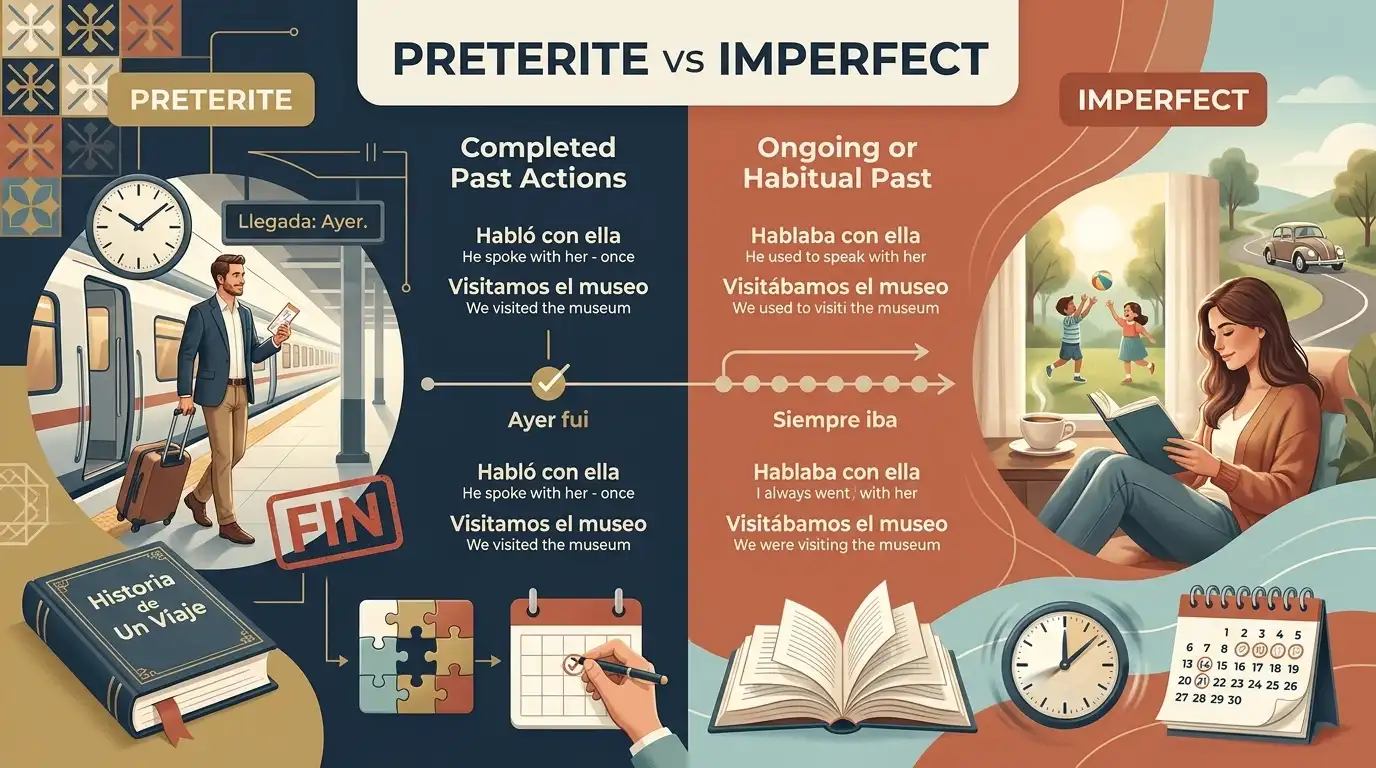
The preterite describes a past action as completed or viewed as a finished event. The imperfect describes a past action as ongoing, repeated, habitual, or part of the background.
Compare these examples:
- Ayer estudié español.
Yesterday, I studied Spanish.
The action is presented as completed. - Cuando era niño, estudiaba español.
When I was a child, I used to study Spanish.
The action was habitual or repeated.
Another example shows how the two tenses work together:
- Yo caminaba por el parque cuando empezó a llover.
I was walking through the park when it started to rain.
Here, caminaba uses the imperfect because it describes an action in progress. Empezó uses the preterite because it presents the start of the rain as a completed event.
A useful shortcut is:
- Preterite = what happened
- Imperfect = what was happening, what used to happen, or what things were like
This is a helpful guide, not an absolute rule. The speaker’s viewpoint and the meaning of the sentence always matter.
The Origin of Preterite and Imperfect
The words preterite and imperfect come from Latin-based grammar terms.
Preterite comes from a word related to the Latin praeteritus, meaning “past” or “gone by.” The term is used in grammar for a tense that presents an action as completed in the past. In Spanish, the preterite is commonly called el pretérito, although many grammar books use pretérito perfecto simple or pretérito indefinido for the same tense.
Imperfect comes from the Latin imperfectus, meaning “unfinished” or “incomplete.” In grammar, the imperfect does not necessarily mean that an action failed to finish. Instead, it shows the action from inside its progress, repetition, or background setting.
Spanish inherited these tense ideas from Latin through the development of the Romance languages. Over time, Spanish formed a system in which the preterite and imperfect express different ways of viewing past events.
The difference is therefore not mainly about two separate kinds of past time. Both tenses refer to the past. The difference is about aspect, or how the speaker presents the action:
- The preterite views an event as bounded or complete.
- The imperfect views an event as ongoing, repeated, descriptive, or incomplete in focus.
Pronunciation
The two terms are pronounced differently:
- Preterite: PRET-uh-rit or PRET-uh-reet
- Imperfect: im-PER-fikt
In Spanish, the related terms are:
- Pretérito: preh-TEH-ree-toh
- Imperfecto: eem-pehr-FEHK-toh
The words are grammar labels, not verbs. Both are nouns when used as names of verb tenses. For example:
- “The preterite describes completed actions.”
- “The imperfect often describes habits.”
The words preterite and imperfect can also work as adjectives in broader grammar discussions, as in “preterite forms” or “imperfect endings.”
How the Preterite Works
The preterite presents a past event as complete, limited, or finished. It often answers the question:
What happened?
Use the preterite for:
- Completed actions
- Comí una manzana.
I ate an apple.
- Comí una manzana.
- A series of completed events
- Llegué, abrí la puerta y entré.
I arrived, opened the door, and entered.
- Llegué, abrí la puerta y entré.
- An action with a clear beginning or end
- La película comenzó a las ocho.
The movie began at eight.
- La película comenzó a las ocho.
- A single event that interrupted another action
- Sonó el teléfono mientras dormía.
The phone rang while I was sleeping.
- Sonó el teléfono mientras dormía.
- A change in condition or state
- Se enfermó la semana pasada.
They became ill last week.
- Se enfermó la semana pasada.
Common time expressions often used with the preterite include:
- ayer — yesterday
- anoche — last night
- la semana pasada — last week
- el año pasado — last year
- una vez — once
- de repente — suddenly
- entonces — then
- hace dos días — two days ago
These expressions often suggest a completed event, but they do not automatically require the preterite. Context still controls the choice.
How the Imperfect Works
The imperfect presents a past situation without focusing on its beginning or end. It often answers questions such as:
What was happening?
What was something like?
What used to happen?
Use the imperfect for:
- Past habits and repeated actions
- Todos los veranos viajábamos al campo.
Every summer, we used to travel to the countryside.
- Todos los veranos viajábamos al campo.
- Actions in progress
- Estudiaba cuando llegaste.
I was studying when you arrived.
- Estudiaba cuando llegaste.
- Descriptions and background details
- La casa era pequeña y tenía un jardín.
The house was small and had a garden.
- La casa era pequeña y tenía un jardín.
- Age, time, weather, and physical conditions
- Eran las seis.
It was six o’clock. - Hacía frío.
It was cold. - Tenía diez años.
I was ten years old.
- Eran las seis.
- Mental, emotional, or physical states in the past
- Quería descansar.
I wanted to rest. - Estaba cansado.
I was tired.
- Quería descansar.
Common expressions often used with the imperfect include:
- siempre — always
- a menudo — often
- normalmente — normally
- cada día — every day
- todos los domingos — every Sunday
- mientras — while
- de niño — as a child
- generalmente — generally
The imperfect does not always mean that the action continued for a long time. It means the sentence focuses on the action as ongoing, repeated, or descriptive.
Preterite vs Imperfect: Side-by-Side Comparison
| Feature | Preterite | Imperfect |
|---|---|---|
| Main idea | Completed past event | Ongoing, repeated, or descriptive past situation |
| Main question | What happened? | What was happening? |
| Focus | The event as a whole | The action from inside or as background |
| Typical use | A single finished action | A habit or repeated action |
| Story function | Moves the story forward | Sets the scene |
| Common meaning | Did, went, arrived, started | Was doing, used to do, was, had |
| Example | Ayer fui al mercado. | De niño, iba al mercado. |
The same verb can appear in either tense, but the meaning may change:
- Conocí a Ana.
I met Ana.
The preterite presents the meeting as a completed event. - Conocía a Ana.
I knew Ana.
The imperfect describes an existing relationship or state.
Another pair shows a change in meaning:
- Supe la verdad.
I found out the truth. - Sabía la verdad.
I knew the truth.
With certain verbs, the preterite can describe a change or discovery, while the imperfect describes an ongoing state.
British English vs American English Spelling
There is no meaningful British English versus American English spelling difference between preterite and imperfect. Both varieties use the same spellings.
| Term | British English | American English | Meaning |
|---|---|---|---|
| Preterite | preterite | preterite | A past tense that often presents an action as completed |
| Imperfect | imperfect | imperfect | A past tense that often presents an action as ongoing, habitual, or descriptive |
The difference is not regional spelling. It is mainly a matter of grammar terminology and teaching tradition.
Some Spanish textbooks may use different labels:
- Pretérito
- Pretérito perfecto simple
- Pretérito indefinido
- Simple past
- Imperfecto
- Imperfect past
These labels may vary by country, school, or textbook, but they usually refer to the same basic tense contrast.
Which Spelling Should You Use?
Since both terms have the same spelling in British and American English, choose the form that matches your audience and textbook.
For US learners
Use preterite and imperfect if your course or Spanish textbook uses those terms. Many American Spanish programs use this pair because it clearly separates the two past-tense forms.
For UK and Commonwealth learners
The same spellings are correct. Some teachers may prefer the terms preterite, imperfect, simple past, or imperfect past, depending on the curriculum.
For international learners
Follow the vocabulary used by your teacher, exam board, or learning platform. The important point is not the label. It is knowing when Spanish speakers use each tense.
If you are writing for a broad audience, explain the terms once:
The Spanish preterite, also called the simple past, usually presents completed past events. The imperfect describes past habits, ongoing actions, and background details.
That short explanation prevents confusion.
Common Mistakes with the Difference Between Preterite and Imperfect
1. Choosing the tense only by the time expression
A learner may think ayer always requires the preterite. Often it does, but not always.
- Ayer estudié durante tres horas.
Yesterday, I studied for three hours.
The action is presented as completed. - Ayer hacía mucho frío.
Yesterday, it was very cold.
The imperfect describes the weather.
The time expression tells you when something happened. The verb tense shows how you view it.
2. Using the preterite for every past action
English often uses “was” or “did” in ways that do not map directly to Spanish.
Incorrect or unnatural in context:
- Ayer fui cansado.
Better:
- Ayer estaba cansado.
Yesterday, I was tired.
The imperfect fits because being tired is a past state, not a completed event.
3. Using the imperfect for a completed sequence
Incorrect for a simple sequence:
- Llegaba, abría la puerta y entraba.
Better:
- Llegué, abrí la puerta y entré.
I arrived, opened the door, and entered.
The preterite moves the story through separate completed actions.
4. Forgetting that descriptions usually use the imperfect
When describing a place, person, age, weather, or setting, the imperfect is often the natural choice.
- El restaurante era tranquilo.
The restaurant was quiet. - La gente hablaba en voz baja.
People were speaking quietly.
The preterite may appear when the description changes or ends:
- De repente, el restaurante se llenó.
Suddenly, the restaurant filled up.
5. Thinking imperfect means unfinished in real life
The imperfect does not always mean that the action never ended. It means the sentence does not focus on its ending.
- Vivía en Madrid cuando conocí a Carlos.
I was living in Madrid when I met Carlos.
The speaker may have stopped living there later. The imperfect simply presents the situation as background.
6. Confusing habitual action with one completed action
Compare:
- Fui al gimnasio ayer.
I went to the gym yesterday. - Iba al gimnasio todos los días.
I used to go to the gym every day.
The first sentence describes one completed visit. The second describes a repeated habit.
The Difference Between Preterite and Imperfect in Everyday Examples
In emails
When writing about a completed task, use the preterite:
Ayer terminé el informe y lo envié por correo.
Yesterday, I finished the report and sent it by email.
When describing what was happening at a certain time, use the imperfect:
Cuando recibí tu mensaje, estaba revisando el informe.
When I received your message, I was reviewing the report.
In news reports
News writing often uses the preterite to report completed events:
El equipo ganó el partido el sábado.
The team won the match on Saturday.
The imperfect may provide background:
El equipo jugaba con mucha confianza cuando comenzó la segunda mitad.
The team was playing with great confidence when the second half began.
On social media
A completed experience often uses the preterite:
Ayer visité un museo increíble.
Yesterday, I visited an amazing museum.
A mood or setting often uses the imperfect:
La ciudad estaba llena de música y luces.
The city was full of music and lights.
In formal writing
Formal reports and essays often combine both tenses:
Durante la investigación, los estudiantes recogían datos mientras el profesor observaba el proceso. Al final, presentaron sus resultados.
During the research, the students were collecting data while the teacher observed the process. In the end, they presented their results.
The imperfect creates the background. The preterite presents the completed outcome.
In personal stories
A natural story often follows this pattern:
- Imperfect for the setting.
- Preterite for the main events.
- Imperfect for ongoing actions.
- Preterite for interruptions or completed changes.
Example:
Era una tarde tranquila. Yo caminaba por la calle cuando vi a un viejo amigo. Hablamos durante una hora y después regresé a casa.
It was a quiet afternoon. I was walking down the street when I saw an old friend. We talked for an hour, and then I returned home.
A Simple Decision Guide
Ask yourself these questions before choosing a tense:
Is the action a completed event?
Use the preterite.
- Compré un libro.
I bought a book.
Was it a habit or repeated action?
Use the imperfect.
- Leía antes de dormir.
I used to read before sleeping.
Was it happening in the background?
Use the imperfect.
- Mi madre cocinaba.
My mother was cooking.
Did another event interrupt it?
Use the imperfect for the ongoing action and the preterite for the interruption.
- Cocinaba cuando llegó mi hermano.
I was cooking when my brother arrived.
Are you describing age, weather, time, or appearance?
The imperfect is usually appropriate.
- Tenía quince años.
- Hacía calor.
- Eran las nueve.
Are you showing a change, discovery, or completed result?
The preterite is often appropriate.
- Encontré mis llaves.
I found my keys. - Se puso nervioso.
He became nervous.
Frequently Asked Questions
1. What is the main difference between preterite and imperfect?
The preterite presents a past event as completed or bounded. The imperfect presents a past action as ongoing, repeated, habitual, or descriptive.
2. Can both tenses describe the same event?
Yes. The tense changes the speaker’s viewpoint.
- Estudié español.
I studied Spanish. - Estudiaba español.
I was studying Spanish or used to study Spanish.
The first focuses on a completed event. The second focuses on the activity or habit.
3. Does “yesterday” always require the preterite?
No. “Yesterday” only identifies the time. The imperfect may describe weather, feelings, or background conditions.
- Ayer fui al trabajo.
- Ayer estaba enfermo.
4. Which tense should I use for “was doing”?
The imperfect is often used for “was doing,” especially when the action was in progress.
- Escribía un correo.
I was writing an email.
If another completed event interrupts it, the interrupting event often uses the preterite:
- Escribía un correo cuando sonó el teléfono.
5. Which tense is used for past habits?
The imperfect usually describes past habits or repeated actions.
- Todos los días caminaba al colegio.
Every day, I used to walk to school.
6. Is the preterite the same as the simple past?
In many Spanish grammar lessons, yes. The Spanish preterite is often called the simple past because it commonly translates English forms such as “I went,” “she ate,” and “they arrived.”
7. How can I practice the difference between preterite and imperfect?
Write short stories with two parts. First, describe the setting with the imperfect. Then list the completed events with the preterite. Practice pairs such as estudié/estudiaba, fui/iba, and conocí/conocía.
Conclusion
The difference between preterite and imperfect becomes easier when you stop thinking only about past time. Focus on how the speaker presents the action.
Use the preterite for completed events, clear changes, and actions that move a story forward. Use the imperfect for habits, descriptions, states, and actions in progress.
Neither tense is better than the other. They work together to make Spanish stories more complete, natural, and expressive.
With steady practice, the choice will become more instinctive. Try using both tenses in emails, essays, and daily conversations until the contrast feels natural.

Ezra Hale is a thoughtful contributor to Distinly.com, where he explores philosophical ideas and the subtle differences behind everyday concepts. His writing blends logic, language, and human insight to clarify complex distinctions. Ezra encourages readers to think deeper, question assumptions, and appreciate the meaning behind words and ideas in modern discourse.