Choosing a hair-color technique can feel confusing when two options seem to create almost the same result. Balayage and highlights can both make hair look lighter, brighter, and more dimensional, but they are not the same technique.
The difference between balayage and highlights mainly comes down to how the color is applied and how the finished hair looks. Balayage is a freehand technique in which a colorist paints lighter color onto selected sections of hair. Traditional highlights usually involve taking specific strands or sections and lightening them in a more structured pattern.
Understanding the difference between balayage and highlights can help you explain exactly what you want at a salon. It can also make it easier to choose between a soft, blended look and a brighter, more defined result.
The difference between balayage and highlights is not simply about which style looks better. Your natural hair color, desired brightness, maintenance routine, budget, hair condition, and personal style can all affect the better choice.
Difference Between Balayage and Highlights – Quick Answer
The easiest way to remember the difference is:
Balayage = hand-painted, blended color.
Highlights = selected strands or sections of hair are lightened in a more structured way.
Balayage comes from French and refers to a sweeping action. In hair coloring, the colorist typically paints the lightener or color onto sections of hair using freehand strokes. Merriam-Webster defines balayage as a technique for creating highlights or lowlights by painting freehand with long, sweeping strokes.
Highlights are a broader hair-coloring concept. A highlight is a lighter strip or section of hair compared with the surrounding hair.
Balayage example
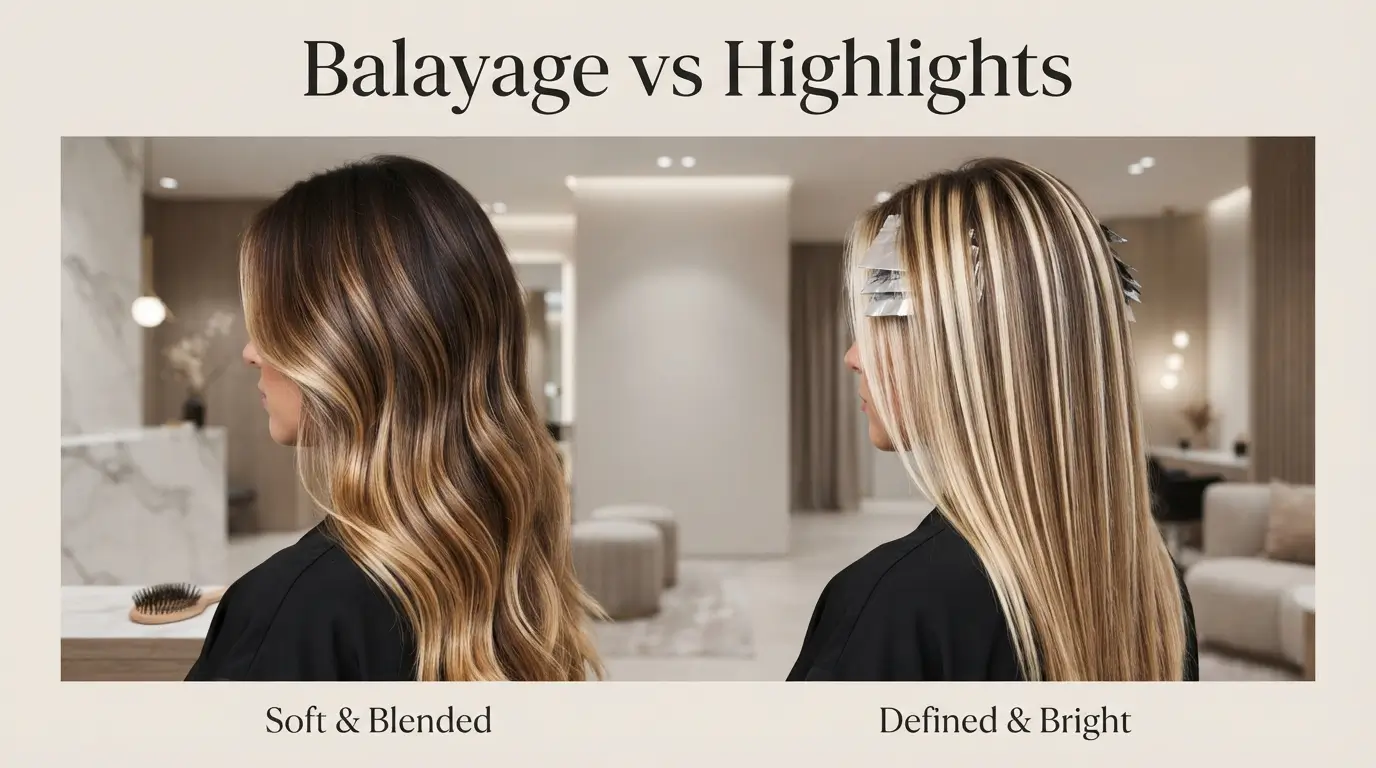
Imagine medium-brown hair with soft caramel pieces that become lighter toward the middle and ends. The transitions are blended, and the natural base remains visible.
That is the kind of result commonly associated with balayage.
Highlights example
Imagine evenly placed lighter strands running from closer to the roots through the lengths of the hair.
That is closer to the traditional highlight approach.
One important point is that balayage can actually create highlights. The terms are not always opposites. Balayage describes a technique, while highlights describe a type of lighter hair effect.
The Origin of Balayage and Highlights
The two terms have very different linguistic histories.
Where does balayage come from?
Balayage is a French borrowing. Merriam-Webster traces it to French balayage, literally “sweeping,” from balayer, meaning to sweep or clean by sweeping.
The word therefore makes sense when you consider the movement used in the technique. A stylist paints color onto the hair with sweeping, freehand strokes rather than treating every strand as part of a rigid pattern.
Merriam-Webster records the first known English use of balayage in 1972 and notes that the hair technique was developed in France during the 1970s.
The deeper origin of the French balai family is more complicated. Merriam-Webster notes connections with older French forms and Celtic vocabulary for broom plants, while also explaining that some details of the deeper etymology remain uncertain.
So it is safest to say that balayage is a French borrowing meaning “sweeping,” while its ultimate linguistic history is more complex.
Where does highlight come from?
Highlight is an English compound formed from high + light.
The word has several meanings in English. As a noun in hairdressing, a highlight is a narrow strip of hair made lighter than the surrounding hair.
The hair-color meaning fits the broader idea of making something visually stand out through increased lightness or brightness.
Unlike balayage, highlight is not a French hairdressing term. It is an established English word that developed additional specialized uses, including hair coloring.
How Are Balayage and Highlights Pronounced?
The two terms are pronounced differently.
Balayage
A common English pronunciation is approximately:
BAH-lee-ahzh
Merriam-Webster gives the pronunciation /ˈbä-lē-ˌäzh/.
The final sound is similar to the “zh” sound heard in words such as measure.
Highlights
Highlights is pronounced:
HIGH-lights
The word uses the ordinary pronunciation of highlight.
Cambridge gives highlight as /ˈhaɪ.laɪt/ in both British and American English.
Are balayage and highlights synonyms?
Not exactly.
A stylist can create highlights using a balayage technique. That is why you may hear phrases such as:
balayage highlights
The phrase is not contradictory. It can mean highlights created through the balayage method.
Balayage vs Highlights: Technique
The biggest practical difference is how the color is placed.
Balayage technique
Balayage generally involves freehand painting.
The colorist chooses sections of hair and applies lightener or color by hand. The placement can be adjusted according to the client’s haircut, face shape, natural color, and desired result.
The technique often creates:
- Soft transitions
- Natural-looking dimension
- Brighter ends
- Less obvious lines
- A blended grow-out
The exact result depends heavily on the stylist’s technique and the desired color.
Traditional highlight technique
Traditional highlights are usually more structured.
A stylist separates selected strands or sections and lightens them according to a planned pattern. Foils are commonly associated with traditional highlighting, although not every highlight service uses exactly the same method.
This can create:
- Brighter strands
- More visible contrast
- Greater uniformity
- A lighter overall appearance
- More controlled placement
Cambridge defines hair highlights as narrow strips of hair that have been made lighter than the surrounding hair.
Which Looks More Natural?
If your main goal is a soft, blended appearance, balayage is often the more suitable choice.
Because color can be painted onto selected areas rather than placed in uniform strands, the result can look more gradual.
For example:
Dark brown roots → medium brown → caramel → lighter ends
The transitions can be designed to appear soft.
Traditional highlights can also look natural. A skilled stylist can choose fine sections and subtle tones. But highlights may produce a more defined pattern of lighter strands.
So it is not accurate to say that all balayage looks natural and all highlights look obvious.
Technique, color choice, placement, hair texture, and stylist skill all matter.
Which Gives More Brightness?
Traditional highlights may be a better choice when you want a noticeably brighter overall result.
Because the stylist can lighten a larger number of selected strands in a structured pattern, highlights can create strong brightness throughout the hair.
Balayage often focuses brightness in specific areas, especially through the lengths and ends.
However, balayage can also be very bright. The final result depends on how much hair is lightened and how much contrast you want.
Which Requires More Maintenance?
Maintenance depends on the exact technique and placement.
Balayage maintenance
Balayage is often attractive to people who want a softer grow-out.
If the natural root area is left relatively untouched, the transition between new growth and colored hair may be less obvious.
This can make balayage feel lower-maintenance.
But “low-maintenance” does not mean “no maintenance.” Color can still fade, become brassy, or need refreshing.
Highlight maintenance
Traditional highlights can require more regular upkeep when they are placed close to the roots.
As your natural hair grows, the contrast between the natural root and lightened strands can become more noticeable.
A person who wants consistently bright roots may therefore need regular salon appointments.
Which Is Better for Different Hair Types?
There is no universal winner.
Fine hair
Both techniques can add the appearance of dimension to fine hair.
A carefully placed color pattern can make hair appear more textured and visually full.
However, excessive lightening can weaken hair, so the condition of the hair matters more than simply choosing balayage or highlights.
Thick hair
Both techniques can work well on thick hair.
Highlights can create an even distribution of brightness, while balayage can emphasize the movement of layers and the shape of the haircut.
Curly hair
Balayage can be useful for emphasizing the natural movement of curls because color placement can follow the shape and flow of the hair.
Highlights can also work beautifully on curly hair when the placement is planned around the curl pattern.
The stylist should consider how the hair looks both wet and dry.
British English vs American English Spelling
There is no meaningful British-American spelling difference between balayage and highlights.
Both British and American English use:
- balayage
- highlight
- highlights
The words are spelled the same in both varieties.
There can be differences in broader hairdressing vocabulary and salon terminology from one country or salon to another, but balayage itself does not have a separate standard British and American spelling.
| Term | British English | American English |
| balayage | balayage | balayage |
| highlight | highlight | highlight |
| highlights | highlights | highlights |
| hair color | hair colour | hair color |
The last row shows a genuine regional spelling difference, but it is not a difference between balayage and highlights.
Which One Should You Choose?
Choose balayage if you want:
- A softer appearance
- Blended color
- Dimension through the lengths
- A less obvious root transition
- A customized freehand result
Choose highlights if you want:
- More noticeable brightness
- Defined lighter strands
- Consistent placement
- Brightness closer to the roots
- A more traditional highlighted effect
You can also combine techniques.
For example, someone might choose balayage through the lengths and add face-framing highlights around the front.
The best choice depends on your natural hair, previous color treatments, desired shade, maintenance preferences, and the result you show your stylist.
Common Mistakes About Balayage and Highlights
Mistake 1: Thinking balayage and highlights are completely separate
They can overlap.
Correction: Balayage is a coloring technique, while highlights describe lighter pieces or sections of hair.
Mistake 2: Assuming balayage always starts away from the roots
Not necessarily.
Balayage can be customized, and a stylist may place color relatively close to the roots depending on the desired effect.
Mistake 3: Assuming highlights always use foils
Foils are strongly associated with traditional highlighting, but “highlights” describes the result rather than one single application method.
Mistake 4: Thinking balayage means one specific color
Balayage describes the technique, not one fixed shade.
You can have blonde balayage, caramel balayage, copper balayage, brunette balayage, and many other variations.
Mistake 5: Thinking balayage never needs maintenance
All chemically lightened or colored hair can need care.
Toners, glosses, conditioning treatments, and occasional color refreshes may be useful depending on the service.
Mistake 6: Choosing a technique without showing a reference photo
Words can mean different things to different people.
A photo gives your stylist a much clearer idea of your desired brightness, placement, tone, and contrast.
Balayage and Highlights in Everyday Examples
These terms are common in salon conversations, beauty articles, social media, and appointment requests.
In a salon conversation
“I’d like soft balayage with a few brighter pieces around my face.”
This tells the stylist you want blended color with extra brightness around the face.
In a text message
“I’m thinking about getting highlights before the wedding.”
This simply means the person wants lighter pieces added to the hair.
On social media
“Her new caramel balayage looks so natural.”
Here, balayage refers to both the technique and, commonly in everyday usage, the resulting color pattern.
In a beauty article
“Traditional highlights create defined lighter strands, while balayage uses freehand color placement.”
This is a clear comparison because it separates the application technique from the resulting effect.
Balayage vs Highlights: Comparison Table
| Feature | Balayage | Highlights |
| Main idea | Freehand color technique | Lighter strands or sections |
| Application | Usually painted by hand | Often placed in a structured pattern |
| Appearance | Soft and blended | Defined and brighter |
| Root effect | Often softer | Can be more noticeable |
| Grow-out | Often less obvious | Can be more visible |
| Brightness | Concentrated and graduated | Can be distributed throughout |
| Customization | Highly customizable | Also customizable |
| Maintenance | Often lower-maintenance | May need more frequent upkeep |
| Can overlap? | Yes | Yes |
| Best known for | Natural dimension | Defined brightness |
Can You Have Balayage and Highlights Together?
Yes.
This is one of the most important points to understand.
Balayage and highlights are not mutually exclusive.
A stylist can use different techniques during the same appointment.
For example, a client might receive:
- Balayage through the mid-lengths
- Face-framing highlights
- A root shadow
- A toner or gloss
The goal is to create the desired overall color rather than follow a rigid label.
When booking a service, it is therefore better to explain the look you want rather than rely only on one word.
FAQs
1. What is the main difference between balayage and highlights?
Balayage is mainly a freehand coloring technique. Highlights are lighter sections or strands of hair. Balayage can be used to create highlights.
2. Is balayage better than highlights?
Neither is automatically better. Balayage may suit someone who wants soft, blended color, while highlights may suit someone who wants brighter and more defined strands.
3. Which lasts longer, balayage or highlights?
Balayage can have a softer grow-out when the natural root area is preserved, so it may appear fresh for longer. Actual maintenance depends on placement, color, hair growth, and personal preference.
4. Is balayage less damaging than highlights?
Neither technique is automatically harmless. Both may involve lightening the hair, and the potential damage depends on the products, processing, hair condition, and application.
5. Can balayage look like highlights?
Yes. Balayage can create lighter pieces that look like highlights. The main distinction is how the color is applied.
6. Are balayage highlights expensive?
Pricing varies by salon, stylist, hair length, amount of product, location, and the complexity of the service. There is no single standard price.
7. Should I get balayage or highlights for a natural look?
Balayage is often chosen for a soft, blended appearance, but finely placed highlights can also look very natural. Your desired result matters more than the label alone.
Conclusion
The difference between balayage and highlights is mainly about technique and placement. Balayage uses freehand color, while highlights create lighter strands or sections.
Balayage often gives a soft, blended effect, while traditional highlights can offer brighter and more defined pieces. Both can create beautiful dimension.
There is no single best choice for everyone. Your hair color, condition, goals, and preferred maintenance routine should guide the decision.
Before your next salon visit, save a few reference photos and discuss your goal clearly. A good consultation can help you choose the right technique with confidence.

Aamer Shahzad is the founder of Distinly.com, a fast-growing educational platform focused on high-intent “difference between” topics. With over 8 years of experience in English language education and analytical writing, I specialize in breaking down complex “difference between” topics into clear, structured, and easy-to-understand explanations. Distinly.com is your go-to resource for enhancing English skills and writing with confidence.
I specializes in building search-optimized, research-driven comparison content designed for clarity, authority, and long-term digital asset value.