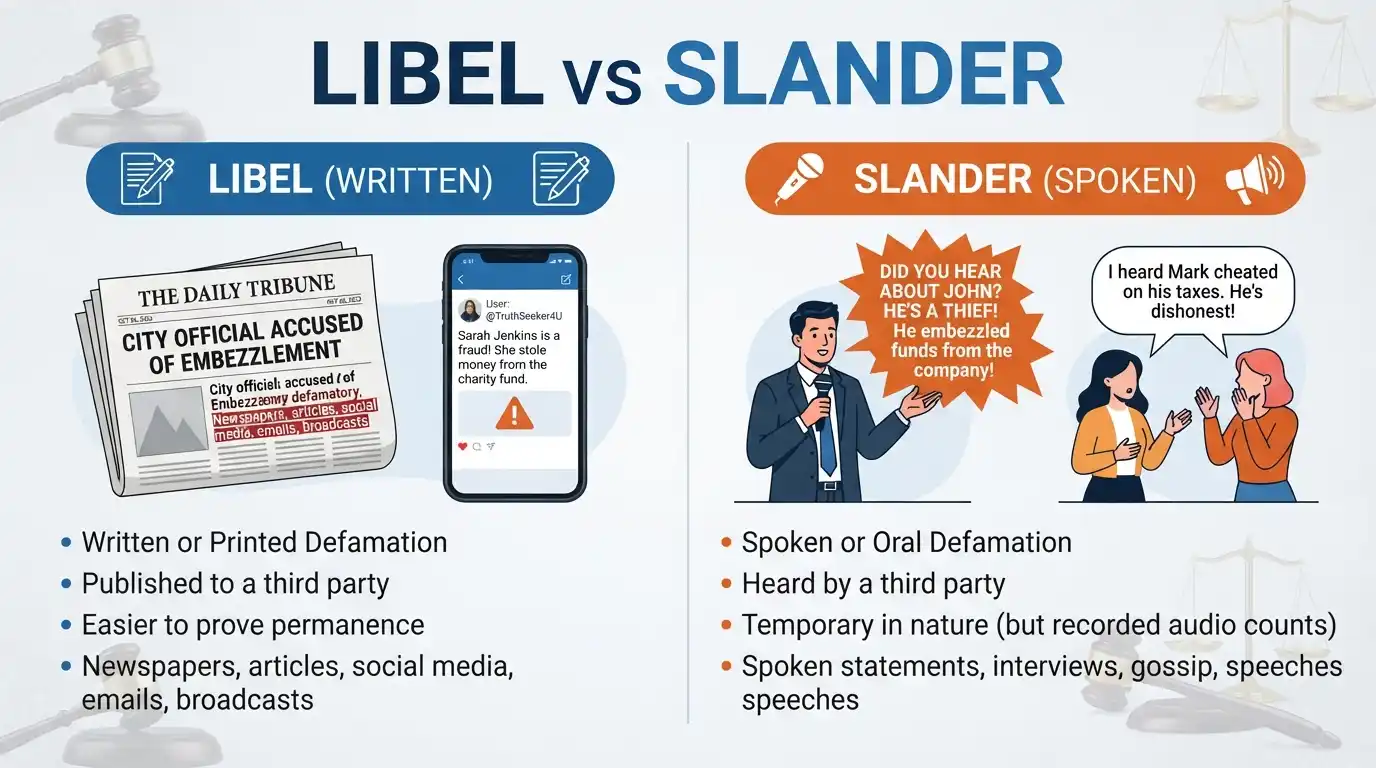
The difference between libel and slander mainly comes down to how a defamatory statement is communicated. Libel generally involves a defamatory statement in written, printed, pictured, or otherwise recorded or fixed form. Slander generally refers to defamatory spoken statements. Both are forms of defamation, which is the broader legal concept involving statements that harm another person’s reputation.
The difference between libel and slander becomes less simple in the digital age. A social media post is generally treated as libel because it creates a written or recorded publication. A casual spoken accusation may be slander. But podcasts, livestreams, videos, broadcasts, voice recordings, and other digital communications can blur the traditional line. The exact legal treatment depends on the jurisdiction and the facts.
Understanding the difference between libel and slander also requires knowing what defamation actually means. A false statement is not automatically defamatory. Courts may also consider whether the statement presents a fact, reaches a third person, is legally unprotected, and causes legally recognized harm.
Libel vs. Slander: Quick Answer
Here is the simplest way to remember the distinction:
- Libel: Defamation expressed in written, printed, pictured, or generally fixed/recorded form.
- Slander: Defamation expressed through spoken communication.
- Defamation: The broader legal category that can include both libel and slander.
For example, if someone publishes a false article claiming that a person stole money, the statement may constitute libel if the legal requirements are met.
If someone makes the same false accusation aloud to other people, it may constitute slander.
However, simply making a false or insulting statement does not automatically create legal liability. Defamation law considers issues such as falsity, publication, fault, harm, privilege, and whether the statement is an actionable assertion of fact.
Libel and Slander Compared
| Feature | Libel | Slander |
|---|---|---|
| Basic form | Written, printed, pictured, or otherwise fixed/recorded | Usually spoken |
| Broader category | Defamation | Defamation |
| Example | False newspaper article or social media post | False accusation spoken at a meeting |
| Usually leaves a record? | Yes | Often no |
| Can digital media complicate the classification? | Yes | Yes |
| Must the statement generally concern another person? | Yes | Yes |
| Must the statement generally reach someone else? | Yes | Yes |
| Are opinions always protected? | No automatic rule; context matters | No automatic rule; context matters |
| Does the law vary by jurisdiction? | Yes | Yes |
The table describes the general U.S. distinction. Defamation law varies significantly between jurisdictions, so the legal result for a particular statement can differ by location.
What Is Defamation?
Defamation is the broader legal concept behind both libel and slander.
In general U.S. law, a defamation claim commonly involves a false statement presented as fact, communication of that statement to a third party, the required level of fault, and reputational harm or another legally recognized form of damage. The exact elements vary by state.
This means that the words libel and slander describe the form of communication, while defamation describes the broader legal wrong.
A simple way to picture the relationship is:
Defamation → Libel or Slander
Libel and slander are therefore not two completely separate areas of law. They are traditional forms of defamatory communication.
What Is Libel?
Libel generally refers to defamatory material expressed in a written, printed, pictured, or otherwise fixed form.
Examples can include:
- A newspaper article
- A magazine article
- A defamatory letter
- A false business review
- A social media post
- A blog post
- A defamatory image or caption
- Certain recorded or broadcast communications
The legal definition is broader than simply “something written on paper.” Cornell’s Legal Information Institute describes libel as defamation expressed through print, writing, pictures, signs, or other communication embodied in physical form.
Example of Libel
Imagine someone posts:
“Alex stole money from the company.”
If the statement is false, presented as a factual claim, published to other people, and satisfies the other legal requirements for defamation, it could potentially be libel.
The fact that someone posted it online does not automatically make it defamatory. The surrounding facts and applicable law still matter.
What Is Slander?
Slander generally refers to defamatory communication that is spoken.
For example, suppose a person tells several coworkers:
“Alex stole money from the company.”
If the statement is false and the other legal requirements are satisfied, the statement could potentially constitute slander.
Slander can occur in settings such as:
- Workplace conversations
- Meetings
- Public gatherings
- Speeches
- Face-to-face conversations
- Certain oral broadcasts
Cornell’s Legal Information Institute defines slander as a false statement, usually made orally, that defames another person.
The Biggest Difference Between Libel and Slander
The traditional distinction is the form of communication.
Libel is generally fixed or recorded
A written article, printed document, social media post, or other lasting publication can fall under libel.
Slander is generally spoken
A statement made orally and not preserved in a fixed form traditionally falls under slander.
This distinction developed before modern digital communication. Today, many communications do not fit neatly into the old categories.
A podcast, livestream, online video, or broadcast may contain spoken words, but it also creates a recorded or widely distributed communication. Courts may therefore analyze such situations differently depending on the jurisdiction and the medium.
Is Social Media Libel or Slander?
A defamatory written social media post is generally treated as libel rather than slander.
For example:
“This restaurant uses spoiled meat and lied about it.”
If the statement is false and otherwise meets the requirements of a defamation claim, the written post could raise a libel issue.
The same principle can apply to:
- Facebook posts
- X posts
- Instagram captions
- Blog comments
- Online reviews
- Forum posts
- Digital newsletters
- Emails
Modern defamation law does not always rely on a simple “keyboard versus voice” test, however. Courts can consider the permanence and nature of the communication.
What About Podcasts and Videos?
This is one of the areas where the old distinction becomes less clear.
Suppose someone makes a false accusation during a podcast.
The statement is spoken, but it is also recorded and distributed to an audience.
The same issue can arise with:
- YouTube videos
- Livestreams
- Recorded interviews
- Television broadcasts
- Radio broadcasts
- Voice recordings
Some legal authorities note that technology has blurred the traditional distinction between libel and slander. Courts may look at the permanence, recording, distribution, and applicable jurisdiction rather than applying a simple written-versus-spoken rule.
So, saying “anything spoken is always slander” is too broad for modern communication.
What Must Be Proven in a Defamation Claim?
The exact requirements depend on the jurisdiction, but several concepts appear repeatedly in U.S. defamation law.
1. A False Statement of Fact
A statement generally must involve a factual assertion that can be shown to be false.
For example:
“Jordan stole $10,000 from the company.”
That is a factual allegation.
By contrast:
“I dislike Jordan’s management style.”
That is more clearly an expression of opinion.
But the distinction is not always obvious. Courts may examine whether an apparently opinion-based statement implies an objectively verifiable fact. The U.S. Supreme Court addressed this issue in Milkovich v. Lorain Journal Co.
2. Communication to a Third Person
The statement generally must reach someone other than the person being discussed.
For example, if someone sends a defamatory statement to another person about you, that communication may satisfy the publication element.
Publication in defamation law does not necessarily mean publication in a newspaper. It generally means communication to a third party.
3. The Required Level of Fault
The required level of fault depends on the circumstances.
For some private plaintiffs, state law may allow a negligence standard. Public officials and public figures can face constitutional requirements involving actual malice in certain circumstances.
Importantly, legal actual malice has a specific meaning. It generally refers to knowledge that a statement was false or reckless disregard for whether it was true or false. It does not simply mean that the speaker disliked the person.
4. Legally Recognized Harm
A plaintiff generally must establish reputational harm or another legally recognized form of damage, although rules concerning presumed damages and particular categories of defamatory statements vary by jurisdiction.
Libel Per Se and Slander Per Se
You may also encounter the phrase defamation per se.
Some jurisdictions recognize categories of statements that are considered so inherently damaging that the plaintiff may not need to prove specific economic loss in the same way required for other claims.
Examples traditionally include false accusations involving:
- Serious criminal conduct
- Certain serious diseases
- Serious sexual misconduct
- Professional incompetence or misconduct
The exact categories and legal consequences vary by jurisdiction.
The traditional terms libel per se and slander per se describe forms of libel or slander that fall within such recognized categories.
Do not assume that every defamatory statement automatically qualifies. The applicable law matters.
Is an Opinion Libel or Slander?
An opinion is not automatically protected just because the speaker uses words such as:
“I think…”
or
“In my opinion…”
Courts may ask whether the statement can reasonably be understood as asserting an actual fact that could be proven true or false.
The U.S. Supreme Court’s decision in Milkovich v. Lorain Journal Co. rejected a blanket rule that simply labeling something an “opinion” always protects it from a defamation claim.
For example:
Clearly subjective:
“I think this restaurant is terrible.”
Potentially factual:
“I think this restaurant uses expired meat.”
The second statement may imply a factual claim that can be tested.
Context remains important.
Truth as a Defense
A fundamental issue in defamation law is whether the challenged statement is false.
A statement that is substantially true generally cannot form the basis of a traditional defamation claim merely because the person dislikes the statement.
That does not mean every dispute about truth is simple. The precise legal standards, burden of proof, and treatment of substantial truth vary by jurisdiction.
The key distinction is that defamation law is not designed to punish every negative statement. The law must also account for freedom of speech and expression.
Privilege Can Also Matter
Some statements receive legal protection because of the circumstances in which they are made.
For example, certain statements made in judicial or legislative proceedings may receive forms of privilege. Qualified privileges can also apply in specific situations, depending on the jurisdiction.
Cornell’s Legal Information Institute notes that privileges can prevent liability even when a statement might otherwise satisfy elements of a defamation claim.
This is one reason you should not decide whether a statement is legally defamatory by looking at the words alone.
Common Mistakes About Libel and Slander
Mistake 1: “Any false statement is libel.”
Not necessarily.
The statement generally must meet several legal requirements before it becomes actionable defamation.
Mistake 2: “Slander means any rude comment.”
No.
A rude, offensive, or unpleasant comment is not automatically slander. The legal requirements for defamation still matter.
Mistake 3: “Libel only happens in newspapers.”
No.
Modern libel can involve websites, social media, online reviews, emails, and other forms of fixed communication.
Mistake 4: “Everything spoken is slander.”
Not always.
Recorded and broadcast communications can complicate the traditional distinction. Courts may focus on the nature and permanence of the communication.
Mistake 5: “Calling something an opinion makes it legally safe.”
No.
A statement presented as an opinion may still create a defamation issue if it implies a provably false factual claim.
Mistake 6: “You can always sue if someone harms your reputation.”
Not necessarily.
Defamation law contains requirements involving falsity, publication, fault, harm, privileges, constitutional protections, and other jurisdiction-specific rules.
Libel vs. Slander in Different Countries
The basic written-versus-spoken distinction is widely taught in English, but the legal rules are not universal.
United States
In the United States, defamation law is largely governed by state law, subject to constitutional protections. States can differ in their definitions, defenses, damages rules, limitation periods, and other requirements.
United Kingdom
UK law also recognizes libel and slander, but its statutory framework differs from U.S. law.
For example, the UK’s Limitation Act 1980 provides a one-year limitation period for actions involving libel or slander in England and Wales, subject to the legislation and applicable circumstances.
The UK’s legal framework has also changed over time, so older explanations may not accurately describe current law.
Other Countries
Other countries can use different definitions and legal procedures. Some jurisdictions also regulate online defamation under specific cybercrime or communications laws.
Therefore, a general article can explain the language and broad concepts, but a person dealing with a real dispute should check the law where the statement was made and where legal action would occur.
Libel and Slander: Legal vs. Everyday Use
People often use libel and slander casually.
For example:
“That comment was slander.”
In everyday conversation, the speaker may simply mean that someone said something harmful or untrue.
Legal use is more precise.
A court must consider the applicable law and the facts before determining whether a statement constitutes actionable defamation.
This difference between everyday and legal usage is important because not every false, rude, or embarrassing statement creates a successful legal claim.
Pronunciation and Word Forms
Libel and slander are both nouns and can also function as verbs.
- Libel — noun: a defamatory written or fixed statement; verb: to publish defamatory material.
- Slander — noun: spoken defamation; verb: to make defamatory spoken statements.
Common pronunciations are:
- libel: /ˈlaɪbəl/
- slander: /ˈslændər/
The words also have different historical roots. Libel comes through Anglo-French and Middle English from Latin libellus, meaning a little book or writing. Slander entered English through Middle English and Anglo-French forms related to scandal or disgrace.
Libel vs. Slander: Easy Memory Trick
A simple memory aid is:
Libel = lasting language.
Slander = spoken statement.
The first part works well because libel traditionally involves communication preserved in some fixed form.
For slander, remember that the word traditionally describes defamatory speech.
This is only a memory aid, not a complete legal test. Modern communication can blur the distinction.
Frequently Asked Questions
Is libel written and slander spoken?
Generally, yes. Libel traditionally refers to defamatory communication in written or fixed form, while slander generally refers to spoken defamatory communication. Modern recorded and digital media can make the classification more complicated.
Is a social media post libel or slander?
A written social media post is generally analyzed as libel rather than slander. The precise legal classification and liability still depend on the jurisdiction and facts.
Can an opinion be libel or slander?
An opinion is not automatically actionable. Courts may examine whether the statement is actually an assertion of fact that can be proven true or false. Simply adding “in my opinion” does not automatically settle the issue.
Do you have to prove that someone lost money?
Not always. The rules concerning damages vary by jurisdiction. Certain categories of defamation may allow presumed damages, while other claims may require proof of specific harm.
Can you be sued for repeating someone else’s defamatory statement?
Potential liability for republication depends on the jurisdiction, circumstances, and applicable defenses. Repeating a statement does not automatically make it legally safe simply because someone else said it first.
Is libel worse than slander?
The law does not provide a universal answer that one category is always “worse.” Libel has traditionally been treated differently because fixed statements can remain available and spread widely, but modern technology has blurred that distinction. The legal consequences depend on the jurisdiction and facts.
How long do you have to sue for libel or slander?
There is no single worldwide deadline. Limitation periods vary by jurisdiction. For example, England and Wales generally apply a one-year limitation period to libel and slander actions under section 4A of the Limitation Act 1980, subject to the statute’s rules. U.S. deadlines vary by state.
Test Your Knowledge
1. What is the traditional distinction between libel and slander?
A. Libel is criminal, while slander is civil
B. Libel is generally written or fixed, while slander is generally spoken
C. With libel, opinions may be involved, whereas slander concerns facts.
D. Libel applies only to businesses
Correct answer: B
2. What is the broader legal category that includes libel and slander?
A. Contract
B. Negligence
C. Defamation
D. Copyright
Correct answer: C
3. Which statement is most likely to raise a factual defamation issue?
A. “I dislike his music.”
B. “Her presentation was boring.”
C. “He stole company money last month.”
D. “I prefer another restaurant.”
Correct answer: C
4. What does publication generally mean in defamation law?
A. Printing a statement in a newspaper only
B. Communicating the statement to a third party
C. Registering the statement with a court
D. Posting it anonymously
Correct answer: B
5. Why can podcasts and livestreams complicate the libel-slander distinction?
A. They cannot contain defamatory statements
B. They combine spoken communication with recording and distribution
C. These are always legally protected.
D. They are always classified as slander
Correct answer: B
6. Does saying “in my opinion” automatically protect a statement?
A. Yes
B. Only online
C. Only if the speaker is anonymous
D. No
Correct answer: D
Conclusion
The difference between libel and slander is traditionally based on the form of communication. Libel generally involves defamatory material in written, printed, pictured, or other fixed form, while slander generally involves defamatory speech. Both fall under the broader concept of defamation.
Modern communication makes the distinction less rigid. Social media posts, online reviews, emails, videos, podcasts, broadcasts, and livestreams can raise questions that the traditional written-versus-spoken rule does not fully answer. Courts may consider the medium, permanence, context, publication, and applicable law.
Most importantly, not every false, rude, or negative statement is legally defamatory. The applicable jurisdiction may require proof of falsity, publication, fault, harm, and other elements. Because defamation law can vary substantially, anyone dealing with a real legal dispute should check the law that applies to that specific situation.
Category
Finance & Legal Differences
Suggested External Link Sources
- Cornell Legal Information Institute — Defamation — Useful for the general elements of defamation, constitutional considerations, privileges, and jurisdictional differences.
- Cornell Legal Information Institute — Libel — Helpful for the definition and legal background of libel.
- Cornell Legal Information Institute — Slander — Useful for explaining spoken defamation and damages.
- FindLaw — Elements of Libel and Slander — Covers common elements and the role of context.
- UK Legislation — Limitation Act 1980 — Useful for UK readers researching limitation periods for libel and slander.

Aamer Shahzad is the founder of Distinly.com, a fast-growing educational platform focused on high-intent “difference between” topics. With over 8 years of experience in English language education and analytical writing, I specialize in breaking down complex “difference between” topics into clear, structured, and easy-to-understand explanations. Distinly.com is your go-to resource for enhancing English skills and writing with confidence.
I specializes in building search-optimized, research-driven comparison content designed for clarity, authority, and long-term digital asset value.