Have you ever typed realizing or realising and stopped because both forms looked right? You are not alone. This spelling difference often causes confusion because realizing and realising mean exactly the same thing.
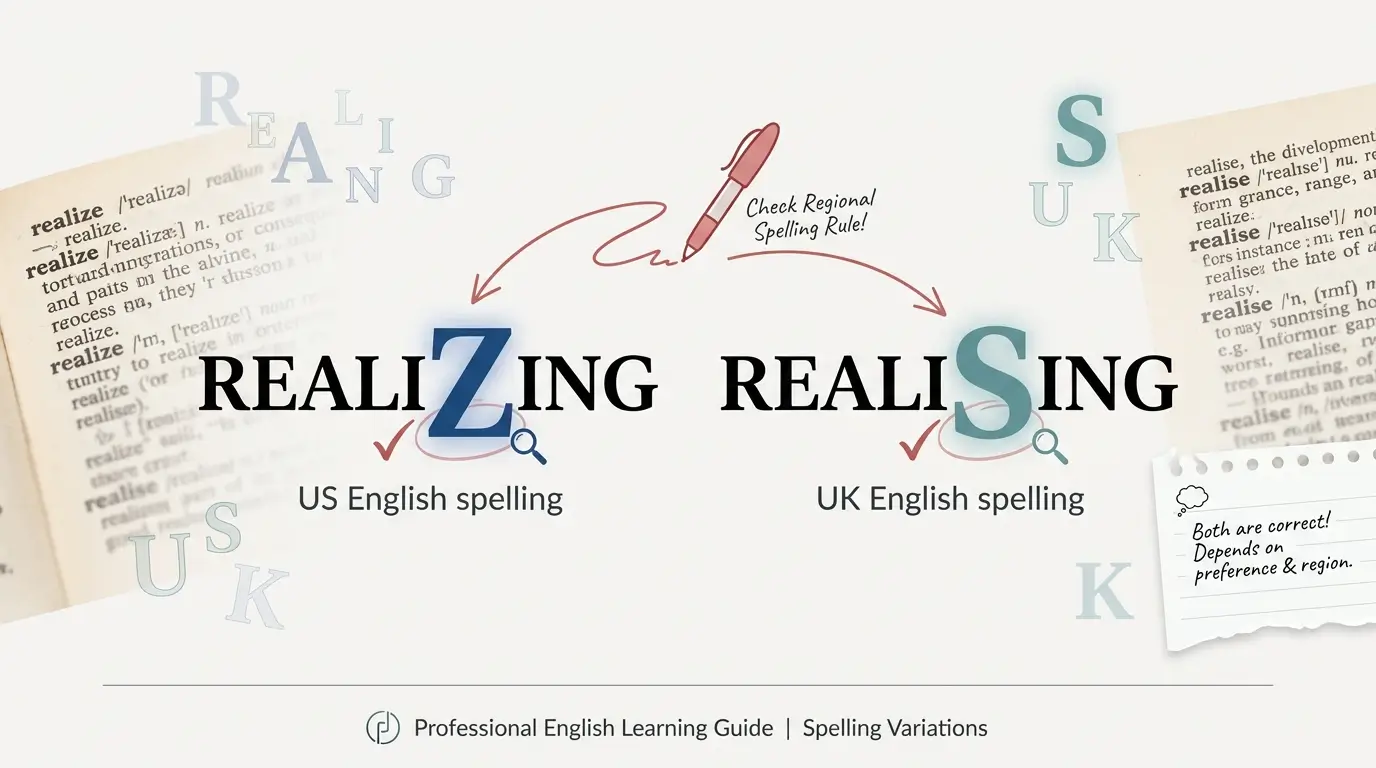
The main difference is regional spelling preference, not meaning. Realizing is the usual spelling in American English, while realising is very common in British English and other varieties that follow British spelling.
If you are writing for an American audience, realizing is the safest choice. If your audience uses British English, realising is widely accepted. However, there is an important detail: British English also accepts realizing, especially in styles that prefer the -ize spelling.
Understanding this small difference can help you write better emails, essays, articles, and professional documents. In this guide, we will explain realizing or realising, their meaning, pronunciation, history, spelling rules, common mistakes, and everyday use.
Quick Answer
Realizing and realising are two spellings of the same word.
Both mean becoming aware of something, understanding something, or making something real, depending on the context.
Examples:
- I am realizing how important this lesson is.
- I am realising how important this lesson is.
The meaning does not change.
The main difference is spelling preference:
| Spelling | Common usage |
|---|---|
| Realizing | American English; also accepted in British English |
| Realising | British English and many British-style varieties |
So, neither spelling is simply “wrong.”
If you are following American English, use realizing.
If you are following a British English style that uses -ise, use realising.
The most important rule is to stay consistent. Do not switch between realizing and realising in the same piece of formal writing without a good reason.
The Origin of Realizing or Realising
To understand realizing or realising, it helps to look at the base word real.
The word real has a long history and ultimately traces back to Latin realis, meaning “real” or “relating to things.” The Latin noun res, meaning “thing” or “matter,” is also part of its deeper history.
English later developed the verb realize from real with the suffix -ize. The verb came to mean making something real and later developed the important sense of becoming aware of or understanding something.
For example:
I suddenly realized the answer.
Here, the person did not make something physically real. Instead, they became aware of the answer.
The spelling realise uses -ise instead of -ize. This is largely a matter of English spelling tradition and regional preference.
The difference is similar to other pairs such as:
- organize / organise
- recognize / recognise
- apologize / apologise
- realize / realise
There is one useful point to remember: British English is not completely limited to -ise. The -ize spelling is also an established British form, and some British dictionaries and style systems prefer or accept it.
Therefore, saying “British English always uses -ise” would be inaccurate.
Why Do the Spellings Differ?
The two spellings developed within different spelling traditions.
American English generally uses -ize in words such as realizing.
British English has two established patterns. Many British writers use -ise, giving realising, while some use -ize.
This means the spelling difference does not create two different English words.
It is similar to choosing between other regional spellings. The word, meaning, and grammar remain the same.
Realizing or Realising: Pronunciation
Realizing and realising are pronounced the same in standard English varieties.
The spelling changes from z to s, but the sound does not normally change.
The word has four syllables:
re-al-iz-ing
The main stress falls on the third syllable, the same part that appears in the base verb realize/realise.
The important sound is the /z/ sound in the middle of the word.
This may seem surprising because realising contains the letter s. Here, the s represents a z sound, not an s sound.
So:
- realizing → z sound
- realising → also z sound
Do not pronounce the s in realising as a strong /s/ sound simply because it is written with the letter s.
What Part of Speech Is Realizing or Realising?
Realizing and realising are forms of the verb realize/realise.
More specifically, they are the present participle and can also function as a gerund, depending on the sentence.
As a present participle
It can form part of a continuous verb phrase:
She is realizing the truth.
He is realising how difficult the task is.
Here, the word helps form the present continuous tense.
As a gerund
It can act like a noun:
Realizing the truth changed his decision.
In this sentence, the whole activity of becoming aware is the subject.
Base forms
The basic forms are:
- realize — American spelling
- realise — British spelling
- realizing — American form
- realising — British-style form
The spelling difference follows the same pattern from the base verb.
British English vs American English Spelling
This is where realizing or realising becomes especially useful.
American English normally uses -ize:
- realize
- realizing
- realized
- realization
British English uses both -ise and -ize, although -ise is very common in general British usage.
For the -ise pattern, you get:
- realise
- realising
- realised
- realisation
The following table makes the difference easier to see.
| Meaning | American English | British English -ise style |
|---|---|---|
| Base verb | realize | realise |
| -ing form | realizing | realising |
| Past form | realized | realised |
| Noun | realization | realisation |
| Meaning | Same | Same |
| Pronunciation | Same | Same |
An Important British English Detail
It would be incorrect to say that realising is the only correct British spelling.
British English also uses realizing.
Some British publications and dictionaries use -ize spellings because the suffix has a long history in English and because -ize can reflect the structure of the word more clearly.
Other British writers prefer -ise, which is very familiar in British writing.
Therefore:
American English: realizing is the normal choice.
British English: realising and realizing can both be found.
This is why the choice is mainly about style and consistency, not correctness.
Which Spelling Should You Use?
Your audience should guide your choice.
If You Write for American Readers
Choose realizing.
For example:
I am realizing that I need more practice.
This spelling fits standard American English.
It also matches related forms such as realize, realized, and realization.
If You Write for British Readers
You can use either realising or realizing, depending on the style guide or spelling system you follow.
If your writing normally uses:
- organise
- recognise
- apologise
then realising will usually create better spelling consistency.
If your style uses:
- organize
- recognize
- apologize
then realizing fits naturally.
If You Write for a Global Audience
Either spelling can work.
The most important thing is consistency.
If your website follows American English, use realizing throughout.
If it follows British English with -ise spellings, use realising.
Do not change spelling simply because one form looks more familiar to you.
Common Mistakes with Realizing or Realising
Several mistakes can happen when writers are unsure about these spellings.
1. Thinking They Have Different Meanings
This is the most common misunderstanding.
Realizing and realising have the same meaning.
Incorrect idea:
Realizing means understanding, but realising means something else.
Correct idea:
Both forms mean the same thing.
The difference is spelling preference.
2. Using the Wrong Spelling for a Required Style
Some schools, employers, publishers, or websites follow a particular style.
If your assignment requires American English, realizing is the better choice.
If your publication follows British -ise spelling, choose realising.
3. Mixing the Two Forms
Consider this sentence:
I am realizing the problem, but she is realising the same thing.
There is no grammatical error here, but the spelling is inconsistent if both people are writing within the same variety of English.
A cleaner version would be:
I am realizing the problem, but she is realizing the same thing.
Or, in an -ise style:
I am realising the problem, but she is realising the same thing.
4. Writing “Realizeing”
A common spelling mistake is adding -ing incorrectly.
Incorrect:
realizeing
Correct:
realizing
The final e is dropped before -ing.
The same rule applies to the British spelling:
realise → realising
Not:
realiseing
5. Confusing Realizing With Realising in Pronunciation
The different letters can make learners think the words sound different.
They normally do not.
The s in realising represents the same z sound heard in realizing.
Realizing or Realising in Everyday Examples
Seeing both forms in real sentences makes the difference easier to remember.
In Emails
American style:
I am realizing that we need to change the meeting time.
British -ise style:
I am realising that we need to change the meeting time.
Both sentences are correct.
In News Writing
American spelling:
The team is realizing the importance of early preparation.
British spelling:
The team is realising the importance of early preparation.
The meaning remains unchanged.
In Social Media
You might write:
I’m realizing how fast this year has gone.
Or:
I’m realising how fast this year has gone.
Both are natural. Your spelling choice depends on the English variety you normally use.
In Formal Writing
American:
Students are realizing that regular practice improves their writing.
British:
Students are realising that regular practice improves their writing.
Again, the grammar and meaning are identical.
In Personal Writing
I am slowly realizing what the experience taught me.
Or:
I am slowly realising what the experience taught me.
Both sound natural and express the same idea.
Realizing vs Realising: Side-by-Side Comparison
Here is the simplest way to remember the difference.
| Feature | Realizing | Realising |
|---|---|---|
| Basic verb | realize | realise |
| Meaning | Becoming aware or understanding | Becoming aware or understanding |
| Part of speech | Verb form | Verb form |
| Form | Present participle/gerund | Present participle/gerund |
| Main spelling tradition | American English | British English and other British-style usage |
| British English | Accepted | Very common |
| American English | Standard choice | Usually avoided in standard American writing |
| Pronunciation | Same | Same |
| Meaning difference | None | None |
The key point is simple: the spelling changes, but the word does not.
Is Realizing or Realising More Correct?
Neither spelling is universally “more correct.”
Realizing is the standard choice in American English.
Realising is a common British spelling, while realizing is also accepted in British English.
The correct choice depends on the English variety and style you are following.
For formal writing, consistency matters more than choosing one form as universally superior.
If your document uses organization, recognize, and apologize, then realizing fits that spelling system.
If it uses organisation, recognise, and apologise, then realising fits better.
Realizing or Realising and Search Intent
People who search for realizing or realising are often trying to solve a spelling question quickly.
They may be:
- Writing an essay
- Checking an email
- Editing a professional document
- Learning British or American English
- Writing for an international audience
- Unsure why dictionaries show different spellings
Search interest in a spelling pair does not mean one form is automatically more correct. It often shows that learners and writers want to understand regional spelling differences.
For this pair, the useful answer is not simply “use the one with Z” or “use the one with S.” The better answer is to understand the spelling system behind each choice.
FAQs
1. Is realizing or realising correct?
Both are correct spellings. Realizing is standard in American English, while realising is common in British English. British English can also use realizing.
2. Do realizing and realising mean the same thing?
Yes. They have the same meaning and are forms of the same verb. The difference is spelling, not meaning.
3. Is realizing American or British English?
Realizing is the usual American spelling. It is also accepted in British English, where some writers and style guides prefer -ize spellings.
4. Is realising only British English?
It is strongly associated with British English and is widely used in British-style spelling. However, several Commonwealth varieties also use -ise spellings.
5. Do realizing and realising sound the same?
Yes. They are normally pronounced the same. The s in realising represents a z sound in this word.
6. Should I use realizing or realising in an essay?
Follow your required English style. Use realizing for American English. If your essay follows British -ise spelling, use realising.
7. Is “realise” wrong in American English?
Realise is not the normal spelling in standard American English. American writers generally use realize and realizing. If you are writing in American English, keep the -ize pattern.
Conclusion
Realizing and realising are not different words. They share the same meaning, grammar, and pronunciation. The main difference is the spelling tradition behind each form.
American English normally uses realizing, while British English often uses realising. British English also accepts the -ize form, so context and style matter.
Once you understand this pattern, the choice becomes easy. Match the spelling to your audience, then keep the same style throughout your writing.
Keep practicing both forms in emails, essays, and daily conversations. The more you see them, the more natural the choice will feel.

Ezra Hale is a thoughtful contributor to Distinly.com, where he explores philosophical ideas and the subtle differences behind everyday concepts. His writing blends logic, language, and human insight to clarify complex distinctions. Ezra encourages readers to think deeper, question assumptions, and appreciate the meaning behind words and ideas in modern discourse.