When drivers hear freeway and highway, the two words can seem interchangeable. In everyday American English, they often are. Yet the terms do not always describe exactly the same kind of road. This is why people search for the difference between freeway and highway when reading road signs, planning trips, or learning American English.
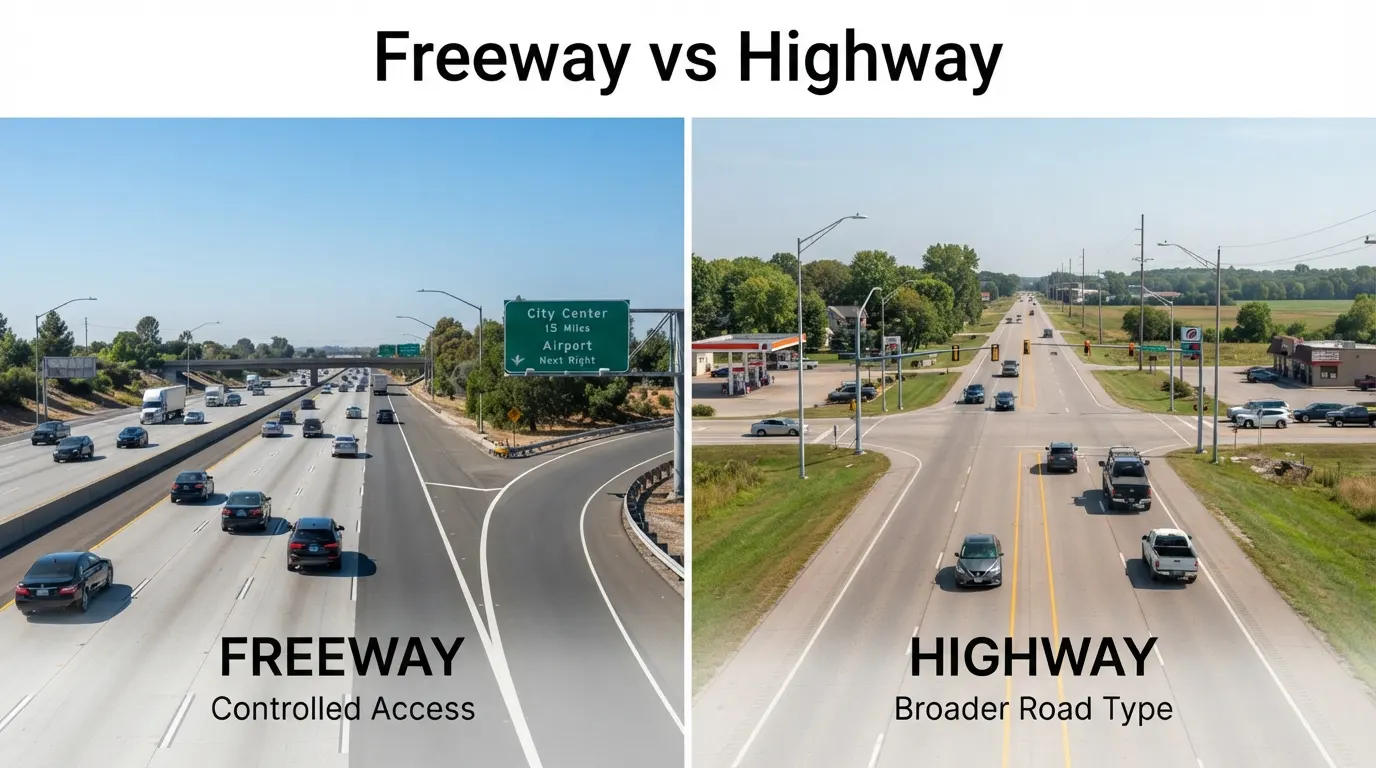
The basic idea is simple: highway is the broader term, while freeway usually refers to a highway designed with fully controlled access. A highway can be a major road connecting cities and towns without meeting the strict design features of a freeway.
The difference between freeway and highway can also change with location. In the United States, freeway has a fairly specific transportation meaning, while highway is used more broadly. In other English-speaking countries, people may use terms such as motorway, expressway, or dual carriageway instead.
Understanding the difference between freeway and highway makes road vocabulary much easier. It also helps you avoid assuming that every highway has ramps, controlled entrances, and no traffic lights.
Difference Between Freeway and Highway – Quick Answer
A highway is generally a major public road, especially one intended for longer-distance travel. A freeway is a type of highway with full control of access.
In transportation terminology used in the United States, a freeway is a divided highway where access is controlled. The Federal Highway Administration describes a freeway as a divided highway with full control of access.
This means a freeway normally has:
- No ordinary traffic lights
- No direct driveways from nearby properties
- Entry and exit through designated ramps
- Separate directions of travel
- Grade-separated crossings rather than ordinary intersections
A highway may have some of these features, but it does not necessarily have all of them.
Simple rule:
Every freeway can be considered a highway, but not every highway is a freeway.
For example, a two-lane road connecting two towns may be called a highway. A large divided road with ramps and controlled entrances can be called a freeway.
| Feature | Highway | Freeway |
|---|---|---|
| Meaning | Broad term for a major public road | Specific type of controlled-access highway |
| Access | May be controlled or uncontrolled | Fully controlled |
| Traffic lights | May have them | Normally none on the mainline |
| Driveways | May connect directly | Direct property access is restricted |
| Intersections | May occur | Typically replaced by interchanges |
| Lanes | Can have two or many | Usually divided with multiple lanes |
| Toll | May or may not charge | Not necessarily toll-free |
| Relationship | General category | Type of highway |
One important point: freeway does not necessarily mean free of tolls. The transportation meaning refers to access control. Merriam-Webster also lists both controlled-access and toll-free senses of freeway.
The Origin of Freeway and Highway
The words freeway and highway have very different histories.
The Origin of Highway
Highway is an old English word. Merriam-Webster records its first known use as before the 12th century.
The word developed from Old English hēahweġ, meaning a main road or road between towns. It combines an old form related to high with way.
The older meaning of high in this compound was not simply about physical height. It could carry the idea of something main, important, or principal.
Over time, highway became a general word for an important public road.
The Origin of Freeway
Freeway is much newer.
Merriam-Webster gives 1926 as its first known use in the modern sense.
The Federal Highway Administration credits American urban planner and lawyer Edward M. Bassett with coining the term freeway for a controlled-access urban facility.
The word combines:
- free + way
The idea was connected to a road where traffic could move freely without the interruptions associated with ordinary streets and intersections.
Historical sources also show that terms such as freeway and thruway became established around the same period as modern high-speed road systems developed.
So, unlike highway, freeway is a relatively modern transportation term.
Pronunciation of Freeway and Highway
The two words have a similar ending but different first sounds.
Freeway
Freeway: FREE-way
IPA: approximately /ˈfriːˌweɪ/
The first part sounds like free.
Example:
“We took the freeway downtown.”
Highway
Highway: HIGH-way
IPA: approximately /ˈhaɪˌweɪ/
The first part sounds like high.
Example:
“The highway connects the two cities.”
Because both words end in -way, English learners sometimes focus on the ending and miss the important distinction between free- and high-.
Both are nouns.
What Is a Highway?
A highway is a broad term for a major public road or main route.
The exact meaning can depend on the country and context. Merriam-Webster defines highway as a public way, especially a main direct road.
A highway may be:
- Two lanes
- Four lanes
- Divided
- Undivided
- Rural
- Urban
- Controlled-access
- Partly controlled-access
This wide range is why highway is a broader category.
For example, imagine a two-lane road connecting two small towns. It has one lane in each direction and several intersections. It may still be officially or commonly called a highway.
Now imagine a six-lane divided road connecting major cities. It has entrance ramps, exit ramps, overpasses, and no ordinary intersections. That road can also be a highway—but more specifically, it is a freeway.
What Is a Freeway?
A freeway is a high-speed road with controlled access.
The Federal Highway Administration describes a freeway as a divided highway with full control of access and multiple lanes for traffic.
Controlled access means drivers cannot simply enter the road from every nearby street or driveway.
Instead, access is provided through designated points, usually ramps.
For example:
Local street → entrance ramp → freeway
and later:
Freeway → exit ramp → local street
This arrangement allows through traffic to move without regular stop signs or traffic lights on the freeway itself.
A freeway may still experience heavy traffic. The word does not promise that traffic will always move quickly.
That is an important distinction.
Freeway vs Highway: Access Control
Access control is probably the most useful concept for understanding the difference.
A conventional highway may have:
- Traffic lights
- Stop signs
- Driveways
- Side streets
- Businesses along the road
- At-grade intersections
A freeway is designed to limit these interruptions.
Instead of turning directly into a gas station from the main road, for example, a driver may need to leave the freeway through an exit ramp and use a separate local road.
The goal is to give through traffic greater efficiency and reduce conflicts between vehicles entering, leaving, crossing, or turning.
Federal highway guidance distinguishes a freeway from an expressway partly by the degree of access control: a freeway has full control, while an expressway has partial control.
Freeway vs Highway: Traffic Lights and Intersections
This is another easy clue.
A typical freeway does not have ordinary traffic lights on its mainline.
Instead, roads pass over or under the freeway using interchanges.
A highway can have conventional intersections.
For example:
Highway: Drive straight → traffic light → turn left.
Freeway: Drive straight → exit ramp → turn onto another road.
This difference is not about the road being “better.” It is mainly about how access and traffic movement are designed.
Freeway vs Highway: Speed and Lanes
Freeways are generally designed for efficient movement over longer distances. They commonly have multiple lanes in each direction and separated opposing traffic.
However, it is not accurate to say that every highway has a low speed limit or that every freeway has a particular speed limit.
Speed limits depend on local laws, road design, traffic conditions, and jurisdiction.
Similarly, lane count alone does not determine whether a road is a freeway.
A road’s access control and design matter more than simply counting lanes.
Are All Freeways Highways?
In the broad sense, yes.
A freeway is a specialized form of highway.
Think of the relationship this way:
Road → Highway → Freeway
But these categories are not always used as strict everyday labels.
Someone might simply say:
“Take the highway.”
Even if the road they mean is technically a freeway.
Likewise, people may call a freeway a highway because highway is a familiar general term.
This overlap is one reason the difference between freeway and highway can seem confusing.
Is Every Highway a Freeway?
No.
This is the most important distinction.
A highway can have:
- Traffic lights
- Direct property access
- Ordinary intersections
- Two lanes
- Local businesses
- Pedestrian crossings
A freeway generally does not allow these forms of direct access along the mainline.
So:
Highway = broader category
Freeway = controlled-access type of highway
That simple distinction will help in most American English contexts.
British English vs American English Spelling
There is no spelling difference between freeway and highway in British and American English.
Both varieties spell the words:
- freeway
- highway
The bigger difference is usage.
In American English, freeway is a common term for a controlled-access road.
In British English, motorway is the usual term for the type of high-speed, controlled-access road that Americans commonly call a freeway.
The word highway also exists in British English, but its everyday meaning and use can differ from American usage.
This is therefore mainly a regional vocabulary difference, not a spelling difference.
| Meaning | American English | British English |
|---|---|---|
| Controlled-access high-speed road | Freeway | Motorway |
| Broad term for major public road | Highway | Highway |
| Spelling of freeway | Freeway | Freeway |
| Spelling of highway | Highway | Highway |
For international writing, it is often useful to specify the regional term when road terminology matters.
Which Term Should You Use?
Your choice depends on your audience.
For American English
Use freeway when referring specifically to a controlled-access road.
Example:
“Take the freeway north for about 20 miles.”
Use highway when speaking more generally.
Example:
“The highway connects several towns.”
For British English
Motorway is usually the more natural word for a controlled-access road of this kind.
Example:
“We joined the motorway after leaving the city.”
Highway remains a valid English word, but it does not function as a direct everyday equivalent of the American freeway in every context.
For Global English
If your audience is international, make the meaning clear.
For example:
“The freeway, or motorway, is closed for construction.”
That approach prevents regional vocabulary from causing confusion.
Common Mistakes With Freeway and Highway
Mistake 1: Treating Every Highway as a Freeway
Incorrect idea: Every major highway has controlled access.
Correction: A highway is a broad category. A freeway is a specific controlled-access type.
Mistake 2: Thinking Freeway Means No Traffic
The word freeway does not mean traffic is always free-flowing.
Freeways can experience:
- Rush-hour congestion
- Accidents
- Road construction
- Weather-related delays
Mistake 3: Thinking Freeway Always Means Toll-Free
The word can be interpreted as toll-free in some dictionary usage, but modern transportation terminology primarily focuses on controlled access.
Do not assume that every road called a freeway is automatically toll-free.
Mistake 4: Using Motorway and Freeway as Universal Synonyms
They are broadly comparable in many contexts, but usage depends on region.
American English: freeway
British English: motorway
Mistake 5: Assuming a Four-Lane Road Is Automatically a Freeway
Lane count does not decide everything.
Access control, intersections, and road design are also important.
Freeway and Highway in Everyday Examples
These words appear often in travel writing, news reports, and directions.
In Travel Writing
“The highway offers a scenic route between the two towns.”
“Drivers can reach the city by taking the freeway.”
For News Writing
“Officials closed part of the highway after an accident.”
“Construction will temporarily reduce lanes on the freeway.”
In Directions
“Get on the freeway and take the third exit.”
“Stay on the highway until you reach the next town.”
In Formal Writing
“Freeways are designed to provide controlled access and uninterrupted movement for through traffic.”
These examples show why context matters. Highway can describe a broad class of major roads, while freeway gives the reader more specific information about road design.
Freeway vs Highway: A Simple Memory Trick
If you often confuse these terms, remember:
Highway = broad term
Freeway = controlled-access highway
Think of a freeway as a special kind of highway.
A highway may have traffic lights and direct entrances. A freeway generally uses ramps and interchanges to control access.
That distinction is more useful than trying to memorize every road type.
FAQs
1. What is the main difference between freeway and highway?
A highway is a broad term for a major public road. A freeway is a type of highway with fully controlled access.
2. Is a freeway the same as a highway?
Not exactly. A freeway is a type of highway, so the terms overlap, but highway has a broader meaning.
3. Does a freeway have traffic lights?
Normally, a freeway’s mainline does not have ordinary traffic lights. Interchanges and ramps are used to manage entrances, exits, and crossings.
4. Are all highways freeways?
No. Many highways have intersections, traffic lights, driveways, or other forms of direct access.
5. Is a freeway always toll-free?
No. The term primarily describes controlled access. Whether a road charges a toll depends on the specific facility and jurisdiction.
6. What do British people call a freeway?
In British English, motorway is generally the usual term for a high-speed controlled-access road of this type.
7. Is highway an American word?
No. Highway is an old English word that predates modern American English. Its modern usage varies by region. Merriam-Webster records the word as being in use before the 12th century.
Conclusion
The difference between freeway and highway is easier once you remember that a freeway is a specific kind of highway. Highways are broader, while freeways have controlled access.
Freeways use ramps, interchanges, and separated traffic to support uninterrupted travel. Highways may use these features, but they can also have normal intersections and direct access.
American English commonly uses freeway, while British English often uses motorway for a comparable road. The spelling itself does not change.
Once you understand the distinction, road signs and travel conversations become much easier to follow. Practice these terms in everyday sentences and keep building your vocabulary.

Ezra Hale is a thoughtful contributor to Distinly.com, where he explores philosophical ideas and the subtle differences behind everyday concepts. His writing blends logic, language, and human insight to clarify complex distinctions. Ezra encourages readers to think deeper, question assumptions, and appreciate the meaning behind words and ideas in modern discourse.