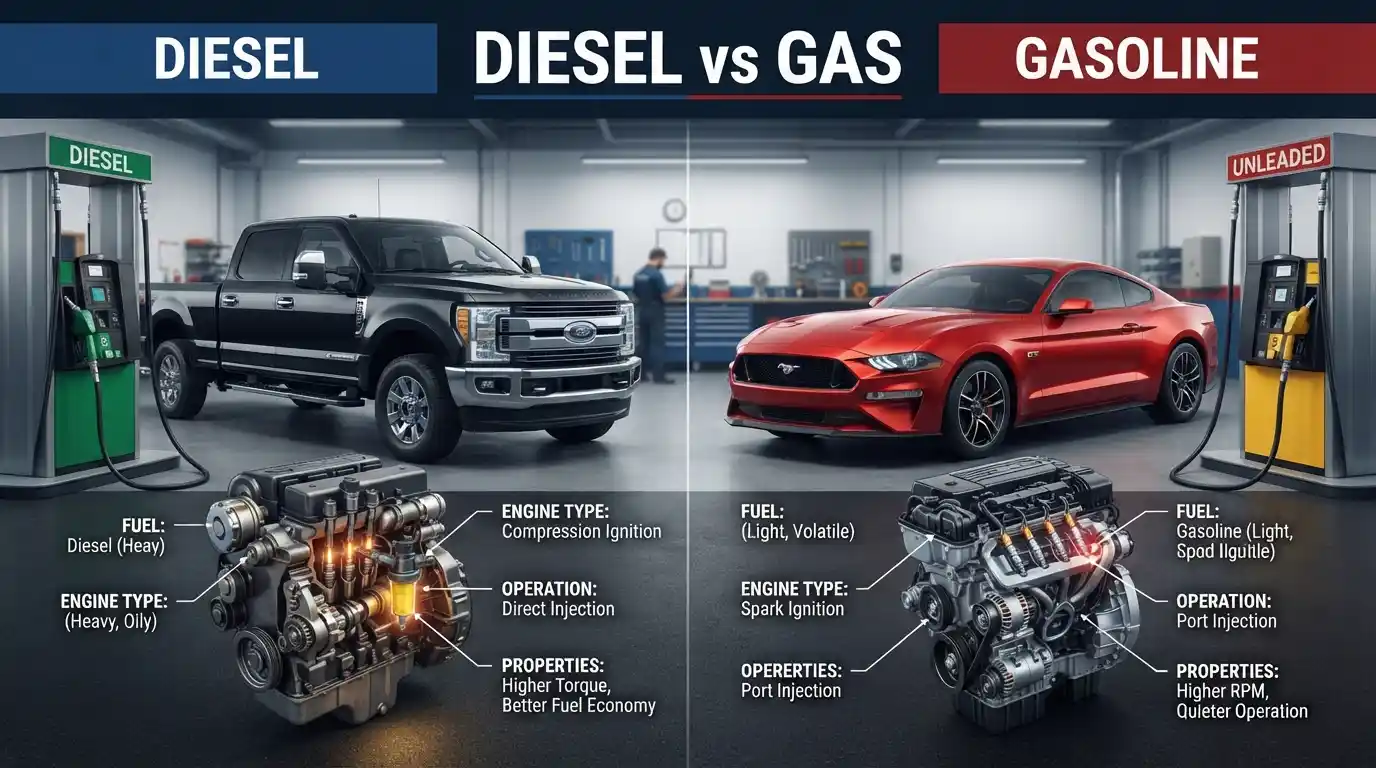
If you are wondering about the difference between diesel and gas, the main point is simple: diesel fuel and gasoline are different fuels designed for different types of engines. Diesel engines use compression ignition, while most gasoline engines use spark ignition. Diesel fuel is also denser and contains more energy per gallon than gasoline.
The difference between diesel and gas affects much more than what you put into the fuel tank. It changes how the engine starts, how it produces power, how efficiently it uses fuel, and what kind of vehicle it suits.
The difference between diesel and gas also explains why a diesel pickup can feel very different from a gasoline car, even though both use internal combustion engines.
Diesel vs Gas – Quick Answer
The biggest difference is how the fuel burns inside the engine.
A gasoline engine usually mixes gasoline with air and uses a spark plug to ignite the mixture. A diesel engine compresses air until it becomes very hot, then injects diesel fuel into that hot air. The fuel ignites because of the heat created by compression.
Here is the basic comparison:
| Feature | Diesel | Gasoline |
|---|---|---|
| Fuel type | Diesel fuel | Gasoline |
| Common U.S. term | Diesel | Gas |
| Ignition | Compression ignition | Spark ignition |
| Spark plugs | Not used for normal combustion | Used |
| Fuel density | Higher | Lower |
| Energy per gallon | Higher | Lower |
| Typical strength | Torque and efficiency | Quick response and broad passenger-car use |
| Common vehicles | Heavy-duty trucks, some SUVs, vans | Cars, SUVs, trucks, motorcycles |
| Fuel characteristic | Less volatile | More volatile |
| Fuel rating | Cetane relates to ignition quality | Octane relates to knock resistance |
The exact behavior varies by engine design, vehicle weight, gearing, emissions equipment, and driving conditions.
What Is Diesel?
Diesel is a petroleum-based fuel made from heavier fractions produced during crude-oil refining. Compared with gasoline, diesel has a higher boiling range, higher density, and different combustion characteristics.
Diesel fuel is designed for compression-ignition engines.
In a typical diesel engine, the engine first draws in air. The piston then compresses that air. Compression raises the air temperature. Near the end of the compression stroke, fuel injectors spray diesel into the hot compressed air.
The diesel fuel then ignites without a traditional spark plug.
Modern diesel vehicles also use sophisticated fuel-injection and emissions-control systems. Some use equipment such as diesel particulate filters and systems that reduce nitrogen oxide emissions.
What Is Gas?
In American English, gas commonly means gasoline, especially when people talk about cars.
Gasoline is a lighter and more volatile petroleum fuel than diesel. Refineries produce gasoline and diesel from different portions and mixtures of hydrocarbons found in crude oil.
Most gasoline engines use spark ignition.
The engine draws in air and fuel, compresses the mixture, and then uses a spark plug to start combustion. The expanding gases push the piston down, creating mechanical energy that eventually reaches the wheels.
This design allows gasoline engines to operate at relatively high engine speeds and makes them common in passenger cars and many light-duty vehicles.
Diesel vs. Gas: How the Engines Work
The fuel itself is only half the story. The engine must be designed around that fuel.
Gasoline engine
A typical gasoline engine follows this basic process:
- Air and gasoline enter the cylinder.
- The piston compresses the mixture.
- A spark plug ignites it.
- Combustion pushes the piston down.
- The crankshaft converts that movement into rotation.
The spark controls when combustion begins.
Diesel engine
A typical diesel engine works differently:
- The cylinder draws in air.
- The piston compresses the air strongly.
- Compression raises the air temperature.
- The injector sprays diesel into the hot air.
- The diesel ignites from the heat.
The key distinction is spark ignition versus compression ignition. The U.S. Department of Energy describes diesel vehicles as using compression-ignited injection systems, while most gasoline vehicles use spark-ignited systems.
Why Diesel Engines Usually Make More Torque
Diesel engines are well known for strong low-speed torque.
Torque is the twisting force produced by an engine. It matters when a vehicle needs to move a heavy load, climb a hill, or tow a trailer.
Diesel engines use high compression and are commonly designed with components that can handle high cylinder pressures. Their operating characteristics make them especially useful in heavy-duty vehicles.
That does not mean every diesel engine has more horsepower than every gasoline engine.
Horsepower and torque measure different things, and modern gasoline engines can produce very high power. Vehicle gearing, turbocharging, engine size, and overall design also matter.
A better rule is:
Diesel engines are often chosen for strong pulling performance and efficiency, while gasoline engines are widely used where quick response, lower complexity, and everyday passenger use matter.
Which Is More Fuel Efficient: Diesel or Gas?
Diesel engines generally achieve better fuel economy than comparable gasoline engines. One reason is that diesel fuel contains more energy per unit of volume, while diesel engines also use compression ignition and often operate with high efficiency.
The U.S. Department of Energy’s Alternative Fuels Data Center lists one gallon of diesel as containing about 113% of the energy in a gasoline-gallon equivalent, reflecting diesel’s higher energy density.
However, fuel economy is not determined by fuel alone.
A large diesel truck may consume more fuel than a small gasoline sedan even if the diesel engine is more efficient. Vehicle weight, aerodynamics, tire choice, gearing, load, speed, and driving style all affect fuel consumption.
So it is better to compare similar vehicles and similar driving conditions rather than assume every diesel vehicle will use less fuel than every gasoline vehicle.
Diesel vs. Gas: Octane and Cetane Are Not the Same
One common mistake is to treat diesel’s fuel rating as if it were the same as gasoline’s octane rating.
It is not.
Gasoline uses octane ratings
Gasoline is commonly sold in grades such as regular, mid-grade, and premium. These grades are distinguished by octane ratings.
Octane measures a fuel’s resistance to engine knock.
Diesel uses cetane
Diesel fuel uses cetane as an important measure of ignition quality.
Cetane relates to how readily diesel fuel ignites under compression.
In simple terms:
- Octane: important for gasoline’s resistance to unwanted ignition.
- Cetane: important for diesel’s ignition behavior.
This difference reflects the different combustion systems used by the two engine types.
Can You Put Diesel in a Gas Car?
No. A gasoline engine is not designed to run on diesel fuel.
Diesel has different physical and combustion properties from gasoline. Putting the wrong fuel into a vehicle can cause starting problems, poor running, fuel-system problems, or other damage depending on the vehicle and how much wrong fuel entered the system.
The same warning applies in reverse.
What happens if gasoline goes into a diesel vehicle?
Gasoline can interfere with the lubrication and fuel-system characteristics that diesel systems depend on. Modern high-pressure diesel fuel systems are particularly sensitive to fuel quality and contamination.
What happens if diesel goes into a gasoline vehicle?
Diesel does not behave like gasoline in a gasoline engine. The engine may fail to start or may run poorly if the wrong fuel enters the system.
If you accidentally use the wrong fuel, do not keep driving to see what happens. Stop safely and check the vehicle manufacturer’s instructions or contact a qualified roadside or repair service.
This is one of the most important practical differences between diesel and gas because the two fuels are not interchangeable.
Is Diesel More Expensive Than Gas?
Fuel prices change with location, taxes, refinery conditions, crude-oil prices, supply, demand, and season.
In the United States, the U.S. Energy Information Administration reports that diesel has generally cost more than regular gasoline since September 2004, although prices can vary by time and location.
The pump price alone does not tell you which fuel costs less to use.
A diesel vehicle may travel farther on a given amount of fuel, but the vehicle itself may have a higher purchase price or different maintenance needs. A gasoline vehicle may have lower ownership costs in some situations.
For a real-world comparison, consider:
- Purchase price
- Fuel economy
- Fuel price
- Annual mileage
- Maintenance
- Insurance
- Repair costs
- Towing or hauling needs
- How long you plan to keep the vehicle
Diesel vs. Gas for Towing and Heavy Loads
Diesel engines have a long history in heavy-duty transportation.
Their strong torque characteristics and efficient operation make diesel power useful for applications such as:
- Heavy-duty pickup trucks
- Commercial trucks
- Delivery vehicles
- Buses
- Construction equipment
- Agricultural machinery
Gasoline engines can also tow and haul. Modern gasoline trucks can produce substantial torque and towing capacity.
The important point is that vehicle design matters as much as fuel type. A specific gasoline truck may have a higher towing rating than a specific diesel truck, so always check the manufacturer’s rating for the exact vehicle.
Diesel vs. Gas for Everyday Driving
For ordinary commuting, both can work well.
Gasoline vehicles remain common in passenger transportation because gasoline engines can provide responsive performance and are available across a wide range of vehicle sizes.
Diesel can make more sense for drivers who regularly travel long distances or carry heavy loads, depending on the vehicle and local fuel costs.
For someone who mostly makes short city trips, the advantages of a diesel powertrain may not always outweigh its added complexity and ownership considerations.
There is no universal fuel choice that fits every driver.
Diesel vs. Gas in Cold Weather
The terms Diesel fuel and gasoline also behave differently in cold conditions.
Diesel fuel can experience cold-weather flow problems, which is why diesel fuel specifications and winter fuel practices matter in colder regions. Modern diesel vehicles use systems and fuel strategies designed to manage these conditions.
Gasoline remains more volatile and behaves differently at low temperatures.
This is one reason climate and driving conditions can matter when comparing the two fuels.
Are Diesel Engines Cleaner Than Gas Engines?
This question needs a careful answer.
Neither fuel can simply be called “clean” or “dirty” in every context. Modern gasoline and diesel vehicles use emissions-control technology, and the pollutants they produce can differ.
Diesel engines can produce nitrogen oxides and particulate matter, so modern diesel vehicles often use additional aftertreatment systems to control these pollutants.
Gasoline engines also produce pollutants, including nitrogen oxides, carbon monoxide, and unburned hydrocarbons.
The environmental impact of a particular vehicle depends on its engine technology, emissions controls, fuel, vehicle size, driving pattern, and regulatory standards.
That makes broad statements such as “diesel is always cleaner” or “gas is always cleaner” misleading.
Diesel and Gas: Key Similarities
Despite their differences, diesel and gasoline systems share several basic features.
Both:
- Use petroleum-based fuels in many conventional applications.
- Power internal combustion engines.
- Convert chemical energy into mechanical energy.
- Use pistons and cylinders in common engine designs.
- Produce exhaust gases.
- Require regular maintenance.
- Can use turbocharging in modern vehicles.
- Can power cars, trucks, and other vehicles.
The biggest difference is not that one is an engine and the other is fuel.
Diesel and gasoline are fuels, while diesel and gasoline engines are the machines designed to burn those fuels.
That distinction clears up much of the confusion around this topic.
Diesel vs. Gas Comparison at a Glance
| Category | Diesel | Gasoline |
|---|---|---|
| Fuel | Diesel | Gasoline |
| Engine type | Compression ignition | Spark ignition |
| Main ignition source | Heat from compressed air | Spark plug |
| Fuel density | Higher | Lower |
| Energy per gallon | Higher | Lower |
| Typical strength | Strong torque | Responsive power delivery |
| Common use | Heavy-duty and long-distance applications | Passenger and light-duty vehicles |
| Fuel rating | Cetane | Octane |
| Volatility | Lower | Higher |
| Misfueling | Cannot safely substitute for gasoline | Cannot safely substitute for diesel |
| Emissions technology | Often includes particulate and NOx controls | Uses emissions-control systems |
| Fuel price | Varies by market | Varies by market |
Common Mistakes About Diesel and Gas
Mistake 1: “Diesel is just stronger gasoline.”
It is not.
Diesel and gasoline have different physical and chemical properties and work with different combustion systems.
Mistake 2: “Diesel always gets better mileage.”
Diesel engines often achieve better fuel economy, but vehicle size and driving conditions can change the result.
Mistake 3: “Diesel always makes more horsepower.”
Not necessarily.
Diesel engines are especially known for torque. Horsepower depends on the complete engine and vehicle design.
Mistake 4: “Octane tells you how good diesel fuel is.”
Octane is primarily associated with gasoline’s resistance to knock. Diesel fuel uses different measures, including cetane, to describe ignition quality.
Mistake 5: “Gas and gasoline always mean the same thing worldwide.”
In American English, gas commonly means gasoline. In other contexts, “gas” can mean a gaseous fuel such as natural gas.
That distinction matters when reading information from different countries.
What Does “Gas” Mean in This Context?
In the phrase difference between diesel and gas, “gas” normally means gasoline, especially in American automotive English.
It does not normally mean natural gas.
That matters because natural gas is a completely different fuel. Vehicles designed for compressed natural gas (CNG) use a different fuel system and storage method. The U.S. Department of Energy treats natural gas vehicles as a separate vehicle category.
So:
- Diesel = diesel fuel
- Gas = usually gasoline in U.S. automotive speech
- Natural gas = a different fuel altogether
British vs. American Usage
The word gas is especially common in American English for gasoline.
In British English, petrol is the usual term.
So an American driver might say:
“I need to get gas.”
A British driver is more likely to say:
“I need to get petrol.”
The fuel itself is still gasoline.
Diesel is used in both American and British English, although local fuel terminology and pump labeling can vary.
Test Your Knowledge
1. How does a typical diesel engine ignite its fuel?
A. With a spark plug
B. With compressed-air heat
C. By using a battery spark
D. With an electric motor
Correct answer: B. With compressed-air heat
2. Which fuel generally has higher energy density per gallon?
A. Gasoline
B. Diesel
C. Ethanol
D. Hydrogen
Correct answer: B. Diesel
3. What does an octane rating mainly describe?
A. Diesel viscosity
B. Gasoline’s resistance to knock
C. Engine oil thickness
D. Fuel tank size
Correct answer: B. Gasoline’s resistance to knock
4. Which rating is associated with diesel ignition quality?
A. Octane
B. Cetane
C. Watt
D. Volt
Correct answer: B. Cetane
5. Can gasoline and diesel normally be used interchangeably?
A. Yes
B. Only in older vehicles
C. No
D. Only on highways
Correct answer: C. No
6. Which type of engine is commonly associated with heavy-duty towing?
A. Diesel
B. Electric only
C. Steam
D. Two-stroke gasoline only
Correct answer: A. Diesel
Frequently Asked Questions
Is diesel the same as gas?
No. In American automotive language, gas usually means gasoline. Diesel is a separate fuel with different properties and a different combustion system.
Which is better, diesel or gas?
It depends on the vehicle and how you use it. Diesel can offer strong torque and good fuel economy, while gasoline vehicles are widely used for passenger driving and can have lower ownership complexity. Compare the specific vehicles rather than fuel types alone.
Does diesel get better mileage than gas?
Diesel engines generally offer better fuel economy than comparable gasoline engines. However, vehicle weight, engine design, driving conditions, and load all affect actual mileage.
Why does diesel have more torque?
Diesel engines commonly use high compression and are designed around combustion characteristics that support strong torque, especially at lower engine speeds. Vehicle gearing and turbocharging also affect torque.
Can a diesel car use gasoline?
No. A diesel vehicle should use the fuel specified by its manufacturer. Gasoline can cause serious problems in a diesel fuel system.
Can a gas car use diesel?
No. Gasoline engines are designed for gasoline. Diesel fuel does not provide the combustion behavior required by a typical gasoline engine.
Is gas cheaper than diesel?
Prices vary by country, region, taxes, season, and market conditions. In the United States, diesel has generally been more expensive than regular gasoline since 2004, but the difference changes over time.
Conclusion
The difference between diesel and gas comes down to both the fuel and the engine designed to use it. Diesel is denser, contains more energy per gallon, and powers compression-ignition engines. Gasoline is lighter and more volatile and normally powers spark-ignition engines.
Diesel vehicles often make strong torque and can provide good fuel economy, which helps explain their use in heavy-duty trucks and other demanding applications. Gasoline remains widely used in passenger vehicles because of its broad range of applications and responsive engine characteristics.
The most useful rule is simple: use only the fuel specified for your vehicle. When comparing diesel and gas vehicles, look beyond the pump price and consider fuel economy, vehicle purpose, maintenance, load, driving conditions, and total ownership costs.
Suggested External Sources
- U.S. Department of Energy – Alternative Fuels Data Center — Useful for explaining how diesel vehicles and compression-ignition systems work.
- U.S. Department of Energy – Fuel Properties Comparison — Useful for energy-density comparisons between gasoline and diesel.
- U.S. Environmental Protection Agency – Advanced Gasoline and Diesel Vehicles — Useful for fuel characteristics and emissions context.
- U.S. Energy Information Administration – Diesel Fuel Glossary — Useful for authoritative definitions of diesel fuel and diesel-engine operation.
- U.S. Energy Information Administration – Gasoline and Diesel Fuel Prices — Useful for current U.S. fuel-price data and historical comparisons.

Aamer Shahzad is the founder of Distinly.com, a fast-growing educational platform focused on high-intent “difference between” topics. With over 8 years of experience in English language education and analytical writing, I specialize in breaking down complex “difference between” topics into clear, structured, and easy-to-understand explanations. Distinly.com is your go-to resource for enhancing English skills and writing with confidence.
I specializes in building search-optimized, research-driven comparison content designed for clarity, authority, and long-term digital asset value.