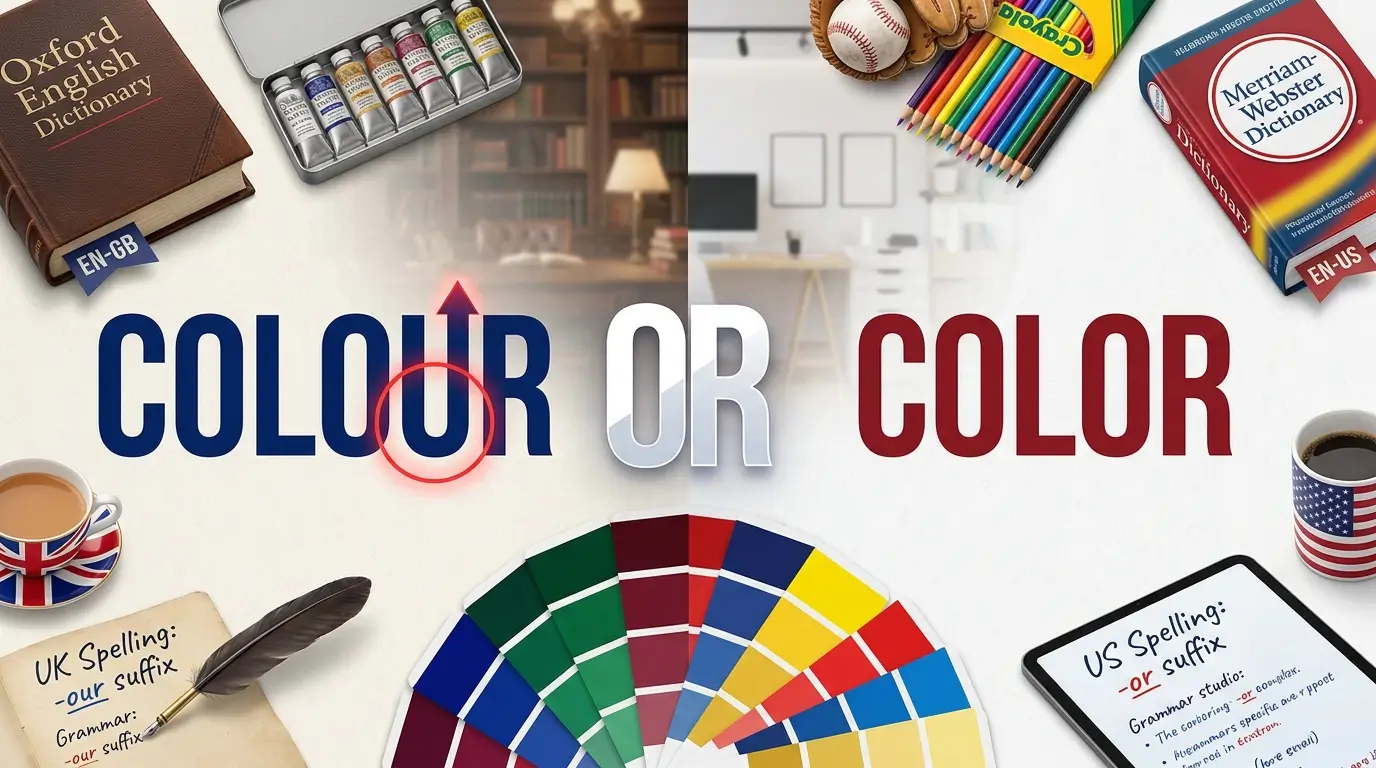
Language can change by crossing a border. One of the clearest examples is colour or color. Both words mean exactly the same thing, but their spelling depends mainly on the variety of English you use.
If you write colour, you are using the traditional spelling found in British English and many other English-speaking regions. If you write color, you are using the standard American English spelling. Neither is a spelling mistake when used in the right regional context.
People often search for colour or color because they see both forms online, in books, software, school materials, and international communication. The question is simple: Which one should you use?
The answer depends on your audience. Colour or color is not a difference in meaning. It is mainly a difference in spelling. The same rule affects words such as favourite/favorite, honour/honor, and behaviour/behavior.
Understanding colour or color can help you write more consistently and avoid unnecessary corrections. In this guide, you will learn the origin, pronunciation, regional spelling rules, common mistakes, and practical examples.
Quick Answer
Colour and color have the same meaning. The main difference is regional spelling.
- Colour = British English and many other varieties of English
- Color = American English
- Both are nouns and verbs.
- Both have the same basic meaning.
- The pronunciation is essentially the same.
- Neither spelling is universally “more correct.”
For example:
My favorite color is blue.
This is standard American English.
My favourite colour is blue.
This is standard British English.
The meaning does not change.
The difference becomes important when you are writing for a specific audience. An American reader expects color, while a British reader normally expects colour.
As a noun
Colour/color can describe the appearance produced by light:
The wall is a bright color.
The wall is a bright colour.
It can also have other meanings:
She added color to the story.
She added colour to the story.
As a verb
The word can also mean to add or change color:
Please color the picture.
Please colour the picture.
Again, the meaning is unchanged.
The Origin of Colour or Color
The spelling difference has a long history. Colour and color ultimately come from the same word family.
English received the word through Old French, where forms related to color were used. Those French forms came from Latin color, meaning color or appearance.
English spelling was not always fixed in the way it is today. Words could appear in different forms during earlier periods. The spelling with -our became established in British English, while American English later favored the shorter -or form in several words of French origin.
The American spelling is strongly associated with the influence of Noah Webster, whose dictionaries promoted spelling reforms in the United States. Webster favored simpler or more regular spellings in several cases, including color instead of colour.
This does not mean that Webster invented the word color. The shorter spelling had historical use before his dictionaries. His work helped establish and popularize spelling preferences in American English.
The same pattern can be seen in:
- colour → color
- honour → honor
- labour → labor
- favour → favor
- neighbour → neighbor
However, not every word ending in British -our changes in American English. Some words have different histories or follow other spelling patterns.
Part of speech
Colour/color can be used as both a noun and a verb.
As a noun:
Red is a strong color.
As a verb:
She will color the drawing.
In British English:
Red is a strong colour.
She will colour the drawing.
The spelling changes, but the grammatical role does not.
How Do Colour and Color Sound?
Colour and color are pronounced the same in standard British and American usage apart from normal accent differences.
The final spelling -our does not create an extra spoken syllable.
colour
KUL-er
Give feedback
color
KUL-er
Give feedback
The main difference you will notice is in writing, not speech.
This is why colour or color can be confusing for English learners. If someone says the word aloud, there is normally no clue about which spelling they would choose.
British English vs American English Spelling
This is a genuine regional spelling difference.
British English: Colour
British English normally uses:
- colour
- coloured
- colouring
- colourful
- colourless
Examples:
The colour of the car is unusual.
She coloured the picture.
It is a very colourful design.
American English: Color
American English normally uses:
- color
- colored
- coloring
- colorful
- colorless
Examples:
The color of the car is unusual.
She colored the picture.
It is a very colorful design.
Comparison table
| Meaning | British English | American English |
|---|---|---|
| Basic noun | colour | color |
| Past-tense verb | coloured | colored |
| -ing form | colouring | coloring |
| Adjective | colourful | colorful |
| Without color | colourless | colorless |
| Colorful appearance | colourful | colorful |
| Color scheme | colour scheme | color scheme |
The important point is consistency. If you choose British English, use colour and related British spellings throughout your article. If you choose American English, use color consistently.
Why Does British English Use “-our”?
The -our spelling reflects the history of English and its French influence.
Words that entered English through French often developed spellings that reflected French forms. British spelling retained -our in several common words.
American English later adopted a number of shorter -or forms.
This is one reason the difference is not simply a random spelling choice. It reflects the separate development of English varieties over time.
Still, it is important not to assume that every British -our word must have an American -or equivalent. English spelling has many exceptions and historical details.
For everyday writing, the useful rule is simply:
British English → colour
American English → color
Which Spelling Should You Use?
Your audience should guide your choice.
If you write for Americans
Use color.
What is your favorite color?
Using colour in an American-focused article may look unusual, especially if the rest of the article follows British spelling.
If you write for British readers
Use colour.
What is your favourite colour?
This is the standard British form.
If you write for Commonwealth audiences
Colour is generally the safer choice in varieties such as British-based English used in many Commonwealth settings.
However, English usage differs across countries, so local style guides can sometimes matter.
If your audience is global
Either spelling can work, but consistency is important.
For an international website, choose one variety as your main editorial style. Then use it throughout the site.
If your site primarily targets American searchers, color may be the natural choice.
If your content follows British English, use colour.
What about SEO?
Search engines can understand that colour and color refer to the same concept. The bigger issue is user expectations and regional targeting.
If your article is specifically about the spelling difference, using both forms naturally is useful. If you are writing a normal article for one region, follow that region’s spelling consistently.
Do not fill an article with repeated versions simply to target both keywords. Natural writing is better.
Common Mistakes with Colour or Color
1. Treating one spelling as universally correct
Incorrect idea:
Color is correct, and colour is wrong.
That is false.
Color is standard American English.
Colour is standard British English and is also used in other English varieties.
2. Mixing spelling systems
A common problem is using American and British spellings in the same piece.
For example:
My favorite colour is green.
This mixes favorite with colour.
It is not always grammatically wrong, but it creates an inconsistent regional style.
For British English, write:
My favourite colour is green.
For American English, write:
My favorite color is green.
3. Assuming pronunciation changes
The spelling changes, but the word is not normally pronounced as two different words.
A speaker does not need to pronounce an extra sound because of the u in colour.
4. Confusing “colored” and “colouring”
The related forms must also follow the chosen spelling system.
British:
The artist coloured the image.
American:
The artist colored the image.
British:
Colouring books are popular.
American:
Coloring books are popular.
5. Changing spelling without considering your audience
A writer may switch from color to colour simply because a British reader is mentioned.
You usually do not need to change your entire writing style for one reader. Instead, follow the style guide or regional audience for the document.
Everyday Examples
In emails
American English:
Please confirm which color you would like for the new design.
British English:
Please confirm which colour you would like for the new design.
Both emails are correct.
In school writing
American:
The artist uses color to create a calm mood.
British:
The artist uses colour to create a calm mood.
Students should follow the spelling style expected by their school, teacher, or exam system.
In news writing
A British publication may write:
The new building has a striking red colour.
An American publication would normally write:
The new building has a striking red color.
The editorial style of the publication determines the spelling.
On social media
Social media often contains both forms because people from different countries communicate on the same platforms.
You might see:
I love this color!
or:
I love this colour!
Neither tells you that the writer made a spelling mistake.
In formal writing
Formal writing should follow one consistent English variety.
British style:
The study examined the effect of colour on visual attention.
American style:
The study examined the effect of color on visual attention.
The important quality is consistency.
Colour vs Color: Side-by-Side Comparison
| Feature | Colour | Color |
|---|---|---|
| Meaning | Color | Colour |
| Main variety | British English | American English |
| Part of speech | Noun and verb | Noun and verb |
| Pronunciation | Same basic pronunciation | Same basic pronunciation |
| Historical family | Latin/French/English | Latin/French/English |
| Common adjective | colourful | colorful |
| Past-tense verb | coloured | colored |
| Common in US writing | No | Yes |
| Common in UK writing | Yes | No |
| Meaning difference | None | None |
Simple examples
| British English | American English |
|---|---|
| favourite colour | favorite color |
| bright colour | bright color |
| colour scheme | color scheme |
| coloured paper | colored paper |
| colourful image | colorful image |
| colour palette | color palette |
When Should You Use Colour and Color Together?
If your article is specifically comparing the two spellings, it makes sense to use both:
Colour or color: Which spelling should you choose?
But in ordinary writing, you usually do not need both forms.
Choose the spelling that matches your intended English variety.
For example, a British article can consistently use:
colour, favourite, organise, centre
An American article can consistently use:
color, favorite, organize, center
There are many other differences between British and American English, but you should follow the style rules relevant to your project rather than trying to mix both systems.
FAQs
1. Is “colour” or “color” correct?
Both are correct. Colour is the standard British English spelling, while color is the standard American English spelling.
2. Is colour British or American?
Colour is primarily the British English spelling. It is also used in several other English varieties influenced by British spelling conventions.
3. Is color British or American?
Color is the standard American English spelling. It is the shorter -or form used in American English.
4. Do colour and color have different meanings?
No. They have the same basic meaning. The difference is spelling, not meaning.
5. Is “colour” more correct than “color”?
No. Neither is universally more correct. Each is standard in a different regional variety of English.
6. Why does British English have a “u” in colour?
The -our spelling reflects historical English and French spelling influence. American English adopted and standardized shorter -or forms in several words.
7. Should I use colour or color in an international article?
Choose one main English variety and stay consistent. If your audience is mainly American, use color. If you follow British English, use colour.
Conclusion
Colour or color is a spelling difference, not a difference in meaning. Both words are correct, and the best choice depends on the English variety you are using.
Use colour for British English and color for American English. The same regional pattern appears in words such as favourite/favorite and honour/honor.
The most important rule is consistency. Pick the spelling that fits your readers, then keep the same style across your emails, essays, and articles.
Once you know the pattern, colour or color becomes easy. Practice both forms in daily writing, and your English will feel more natural and confident