The age difference between two people is easy to understand in theory, but calculating it can become tricky when their birthdays fall on different days or months. A simple subtraction of birth years does not always give the exact answer.
People search for the age difference between two people for many reasons. They may want to compare the ages of siblings, calculate the gap between partners, understand the difference between a parent and child, or compare the ages of famous people. The question can also appear in schoolwork, forms, family records, and everyday conversations.
Knowing the age difference between two people means knowing how much time separates their dates of birth. The result can be expressed in years, months, and days. In casual conversation, whole years are often enough. For an exact answer, however, you need the complete birth dates.
This guide explains the age difference between people in simple terms. It covers the basic calculation, exact date method, common mistakes, spelling and grammar, everyday examples, and practical ways to describe an age gap clearly.
Quick Answer
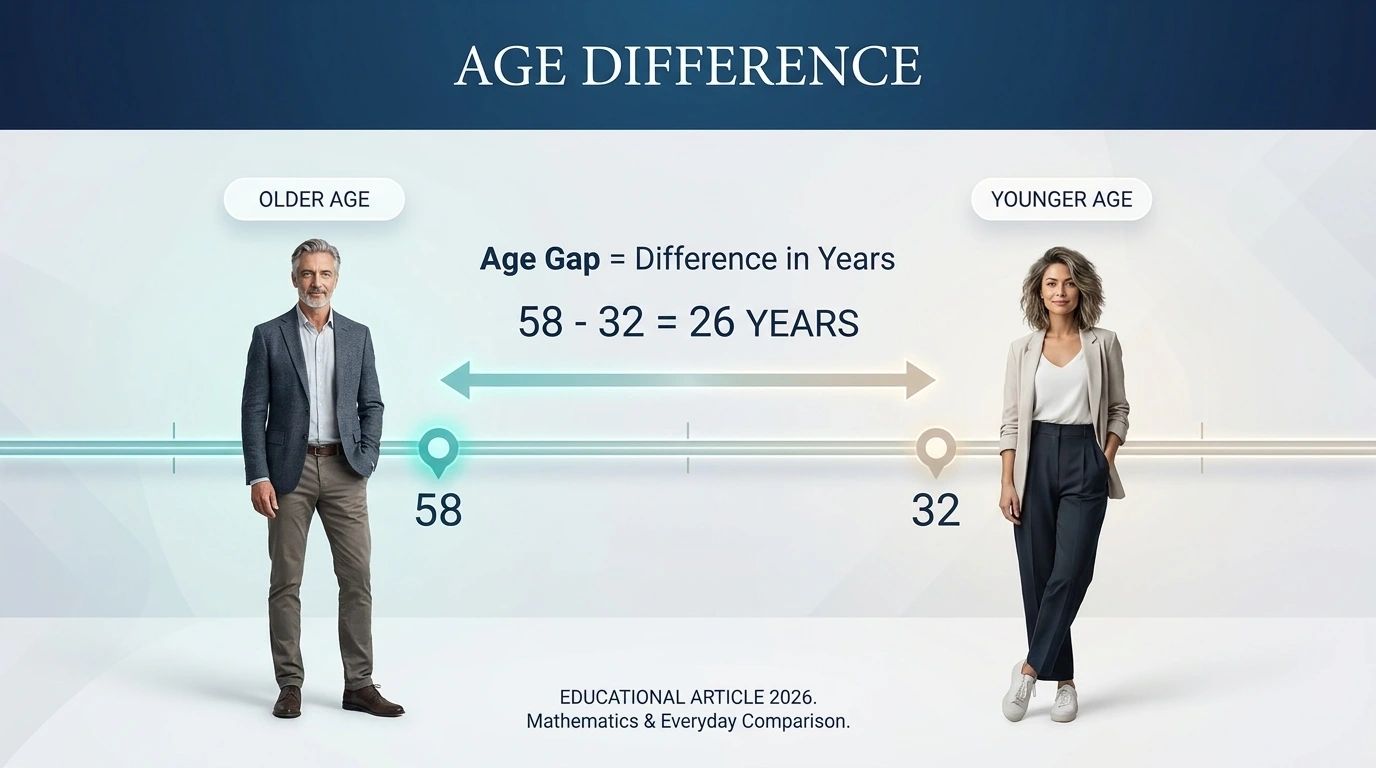
The age difference between two people is the amount of time separating their dates of birth.
For a basic calculation, subtract the younger person’s birth year from the older person’s birth year.
For example:
- Person A was born in 1995.
- Person B was born in 2002.
- 2002 − 1995 = 7 years
So, their age difference is approximately 7 years.
However, this answer is exact only when their birthdays are on the same date or when the question only asks for a year-based comparison.
Consider these birthdays:
- Person A: January 10, 1995
- Person B: July 10, 2002
The exact difference is 7 years and 6 months.
Now consider:
- Person A: December 20, 1995
- Person B: January 5, 2002
The birth years differ by seven, but the actual age difference is only 6 years and 16 days.
This is why a full birth date gives a more accurate result than year subtraction alone.
Simple Formula
For a rough age gap:
Older birth year − younger birth year = approximate age difference
For an exact age gap, compare the complete dates of birth.
The Origin of “Age Difference Between”
The phrase age difference between is not a single word with one historical origin. It is a modern English phrase made from several ordinary words: age, difference, and between.
Origin of Age
The word age has a long history in English. It came into Middle English from Old French aage, which developed from Latin aetaticum, related to aetas, meaning “age” or “period of life.”
In modern English, age can refer to:
- How long a person has lived
- A particular stage of life
- A historical period
- The length of time something has existed
Examples include:
- “What is your age?”
- “Children of school age”
- “The digital age”
Origin of Difference
Difference comes through Middle English and Old French from Latin differentia, meaning a distinction or difference. It is related to Latin differre, meaning “to differ” or “to carry apart.”
Today, difference refers to the way two or more things are not the same.
Examples:
- “There is a big difference between the two methods.”
- “The difference is only two years.”
Origin of Between
The word between is an old English word related to the idea of being in the middle or separating two things.
In modern English, between normally introduces two people, things, places, or points being compared or connected.
For example:
- “The difference between 20 and 30 is 10.”
- “The age difference between the brothers is three years.”
Why the Phrase Has No Special Spelling Variation
Unlike words such as color/colour, the phrase age difference between does not have a British-American spelling difference.
The words remain:
age difference between
in both British and American English.
The phrase is simply a grammatical combination of common English words.
Pronunciation
The words are pronounced differently and are not normally confused because they sound alike.
- age has one syllable.
- difference has two syllables.
- between has two syllables.
The phrase is normally spoken as a natural sequence rather than as one fixed expression.
Parts of Speech
The main words in the phrase have different grammatical roles:
| Word | Part of speech | Basic function |
|---|---|---|
| Age | Noun | Describes how long someone or something has existed |
| Difference | Noun | Describes the amount or nature of separation |
| Between | Preposition | Connects the two people or things being compared |
In the sentence “The age difference between the sisters is four years,” age modifies difference, while between introduces the two people being compared.
How to Calculate the Age Difference
There are several ways to calculate an age gap. The best method depends on how accurate the answer needs to be.
1. Subtract the Birth Years
This is the fastest method.
Suppose one person was born in 1988 and another in 1996.
1996 − 1988 = 8
The birth years are eight years apart.
This method works well when the question asks for a general age gap or when the birthdays are the same.
2. Compare the Full Birth Dates
For an exact answer, compare the complete dates.
Suppose:
- Older person: March 15, 1990
- Younger person: September 20, 1997
The difference is not exactly eight years. It is 7 years, 6 months, and 5 days.
This method is useful for official records, detailed age calculations, and situations where months and days matter.
3. Calculate the Current Age First
Sometimes you know the current ages rather than the birth dates.
For example:
- Person A is 42.
- Person B is 35.
The apparent age difference is 7 years.
However, if their birthdays have not occurred at the same point in the year, their exact age difference may be slightly different when measured by birth dates.
4. Use Months for Babies and Young Children
For very young children, saying that one child is “1 year older” may hide a useful detail.
For example:
- Child A is 18 months old.
- Child B is 11 months old.
Their difference is 7 months.
Parents, doctors, childcare professionals, and educators may use months because small age differences matter more during early development.
5. Use Years and Months for Adults When Precision Matters
For adults, people usually round age to whole years in normal conversation.
But a precise comparison can include months and days.
For example:
“They are six years and four months apart.”
This gives the reader a clearer picture than simply saying:
“They are six years apart.”
Age Difference vs Age Gap
The phrases age difference and age gap are closely related, but they can have slightly different tones.
Age difference is neutral and factual. It simply describes how far apart two ages are.
Age gap is also common, especially when discussing relationships, families, or generations.
Compare:
- “The age difference between the sisters is three years.”
- “The couple has a 12-year age gap.”
Both are natural.
In formal writing, age difference may sound more neutral. In everyday conversation, age gap is very common.
British English vs American English Spelling
There is no meaningful spelling difference between British and American English for age, difference, or between.
| Expression | British English | American English |
|---|---|---|
| Age | age | age |
| Difference | difference | difference |
| Between | between | between |
| Age difference | age difference | age difference |
| Age gap | age gap | age gap |
The phrase uses the same spelling in both varieties.
There is also no important British-American pronunciation difference that changes the meaning of the phrase. Individual speakers may have different accents, but the vocabulary remains the same.
Common Mistakes with “Age Difference Between”
Mistake 1: Using Only Current Ages for an Exact Answer
Someone may say:
“She is 25 and he is 30, so they are exactly five years apart.”
That may be fine for casual conversation, but the exact birth-date difference could be slightly less or more than five years.
Better:
“They are about five years apart.”
Use about when the full birth dates are unknown.
Mistake 2: Confusing Age Difference with Birth-Year Difference
A seven-year difference between birth years does not always mean exactly seven years between birthdays.
For example, someone born late in 2000 and someone born early in 2007 have birth years seven years apart, but their actual age difference is less than seven years.
Mistake 3: Saying “Difference of Age Between”
The phrase difference of age between is understandable, but it is not the most natural modern phrasing.
Prefer:
“The age difference between them is six years.”
Mistake 4: Using “Between” for More Than Two Items
Between is most commonly used when comparing two people or things.
For several people, English can also use among, depending on the meaning.
For example:
“The age difference between the two brothers is four years.”
When discussing a group, you might instead say:
“There was a wide range of ages among the participants.”
Mistake 5: Assuming an Age Gap Is Always Negative
An age difference is simply a measurement. It does not automatically tell you whether a relationship, friendship, or family situation is good or bad.
The meaning depends on context.
Mistake 6: Forgetting the Hyphen in “Five-Year Age Difference”
When an age expression comes before a noun, it usually works as a compound adjective.
Correct:
“They have a five-year age difference.”
Correct:
“It is a five-year-old child.”
But after the noun, the structure changes:
“The child is five years old.”
Age Difference Between People in Everyday Examples
In Emails
Age differences can appear in polite or factual communication.
“Could you please confirm the age difference between the two participants?”
Or:
“The age difference between the children should be considered when arranging the activity.”
In professional emails, keep the wording neutral and avoid unnecessary personal comments.
In News Writing
News articles may compare the ages of public figures, athletes, political leaders, or people involved in major events.
Example:
“The two athletes have an age difference of four years.”
Another natural version is:
“The athletes are four years apart in age.”
The second version can sound smoother when repeated comparisons appear in the same article.
In Social Media
People often use shorter, informal wording:
“What’s the age gap between them?”
Or:
“They’re eight years apart!”
Social media often favors age gap and years apart because both are short and easy to understand.
In Formal Writing
Academic or professional writing may require exact dates.
Example:
“The age difference between the participants was calculated from their recorded dates of birth.”
This is clearer than estimating ages from appearance or stated age alone.
In Family Conversations
People commonly use simple expressions:
- “My sister is three years older than me.”
- “We’re five years apart.”
- “There is a ten-year age gap between them.”
- “My father is 30 years older than I am.”
These forms are usually more natural than repeatedly saying “age difference.”
Useful Alternatives to “Age Difference Between”
You do not always need to repeat the same phrase.
| Expression | Best use |
|---|---|
| Age difference between | Neutral and direct |
| Age gap between | Casual and common |
| Years apart | Natural everyday speech |
| Difference in age | Formal or neutral |
| Older by | Direct comparison |
| Younger by | Direct comparison |
| Age disparity | Formal, often for larger gaps |
| Difference in years | General comparison |
For example:
“What is the age difference between them?”
can become:
“How many years apart are they?”
Both sentences ask essentially the same question.
When Does Age Difference Matter?
An age difference can matter more in some situations than others.
For siblings, a two-year difference may be useful when discussing childhood development, school grades, or family planning.
Afive-year difference often has little practical meaning by itself, for adults.
For relationships, the important issues may include maturity, life goals, financial independence, communication, and shared expectations while for children and teenagers, age can have greater importance because physical, emotional, educational, and legal stages can change quickly.
This is why an age gap should always be considered in context rather than treated as a complete description of a relationship.
Frequently Asked Questions
1. What is the easiest way to calculate the age difference?
Subtract the older birth year from the younger birth year for a quick estimate. For an exact answer, compare the complete dates of birth.
2. Is age difference the same as age gap?
Usually, yes. Both describe the amount of time separating two people’s ages. Age gap is often more informal, while age difference sounds more neutral.
3. How do I calculate an exact age difference?
Put both dates of birth in chronological order and count the complete years first, followed by the remaining months and days.
4. Does a one-year birth-year difference always mean a one-year age difference?
No. If the birthdays occur on different dates, the exact difference can be less or more than one full year.
5. What is the correct phrase: “age difference between” or “difference of age between”?
Age difference between is the more natural modern expression. For example, “What is the age difference between them?”
6. Is “years apart” the same as age difference?
It usually expresses the same idea in everyday English. “They are six years apart” means their ages differ by about six years.
7. Is there a British or American spelling difference?
No. Age, difference, and between are spelled the same in British and American English.
Conclusion
The age difference between two people is the amount of time separating their births. For quick answers, birth years work well, but full dates give the most precise result.
A small age gap can matter in childhood, while the same gap may have little practical meaning between adults. Context always gives an age difference its real meaning.
In everyday English, “age difference,” “age gap,” and “years apart” are all useful. Choose the phrase that best fits your audience, tone, and level of precision.
Practice these expressions in emails, essays, and daily conversations. Once you understand the date calculation, describing age differences becomes simple, clear, and natural.

Aamer Shahzad is the founder of Distinly.com, a fast-growing educational platform focused on high-intent “difference between” topics. With over 8 years of experience in English language education and analytical writing, I specialize in breaking down complex “difference between” topics into clear, structured, and easy-to-understand explanations. Distinly.com is your go-to resource for enhancing English skills and writing with confidence.
I specializes in building search-optimized, research-driven comparison content designed for clarity, authority, and long-term digital asset value.