Have you ever stopped while writing and wondered whether the correct word is baler or bailer? These two words look almost identical, and they are pronounced the same in standard English. Yet they describe very different things.
The confusion usually comes from the letters a and i in the middle of each word. Baler is connected to bale and usually refers to a machine or person that makes bales. Bailer, on the other hand, comes from bail and can refer to a person who removes water from a boat or container. It can also refer to someone who posts bail for another person, depending on context.
Understanding baler or bailer is especially useful in agriculture, boating, law, manufacturing, and technical writing. A spelling mistake can change the entire meaning of a sentence.
This guide explains baler or bailer in simple language. You will learn their meanings, origins, pronunciation, grammar, regional usage, common mistakes, and practical examples. By the end, choosing between baler or bailer should be much easier.
Baler or Bailer – Quick Answer
The easiest way to remember the difference is to look at the base word.
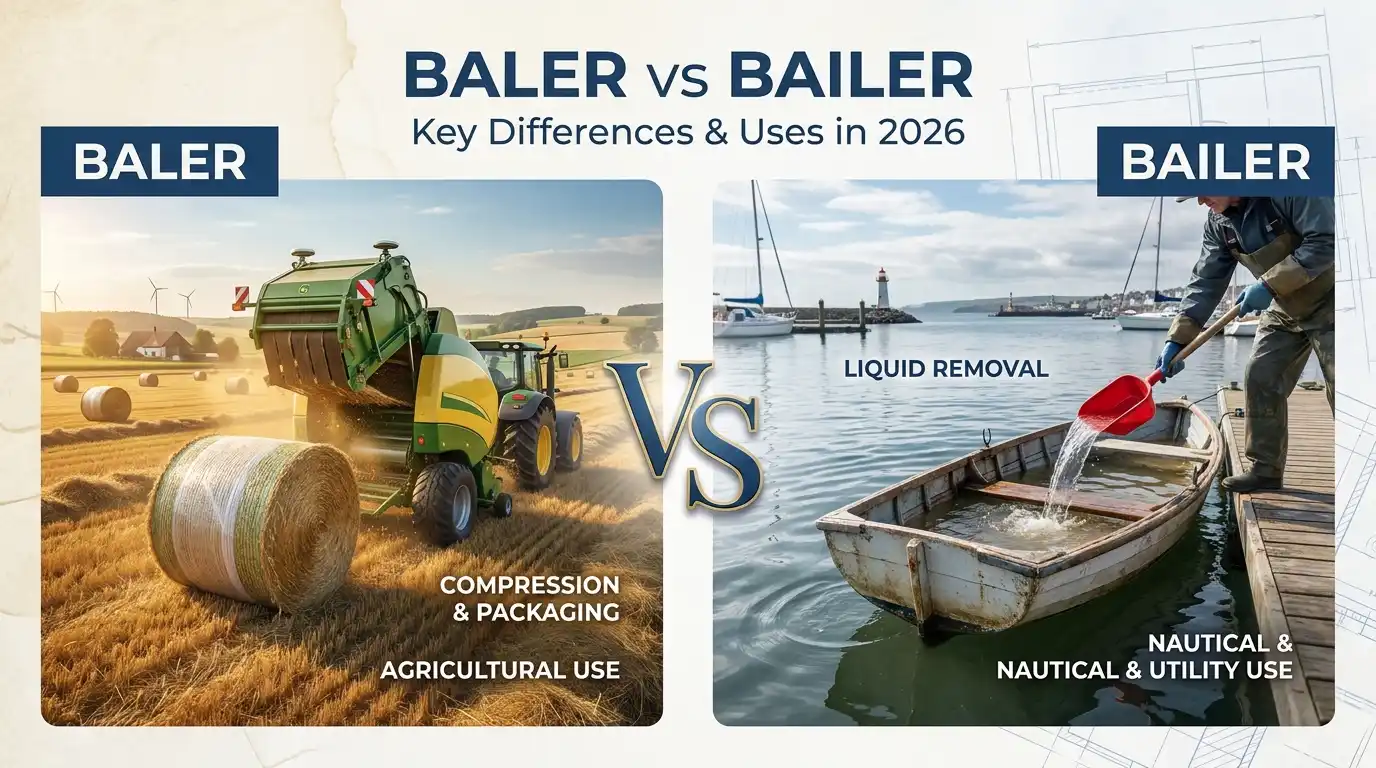
Baler comes from bale. A baler is usually a machine that makes bales, especially bales of hay, straw, cotton, paper, or other material.
Bailer comes from bail. It can describe someone or something that bails, especially someone who removes water from a boat or container. In legal contexts, it can also refer to a person who provides bail for someone who has been arrested.
Baler
Baler is primarily a noun.
It commonly means:
- a machine that compresses material into bales
- a person who makes or handles bales, in appropriate contexts
Examples:
“The farmer bought a new hay baler.”
“The baler compresses straw into compact bundles.”
The most common modern meaning is the agricultural or industrial machine.
Bailer
Bailer is also a noun.
It can refer to:
- a person who removes water from a boat
- a person or device that bails out liquid
- in legal contexts, a person who provides bail or acts as a surety
Examples:
“The sailor used a bucket as a bailer.”
“The bailer helped remove water from the damaged boat.”
The exact meaning depends on context.
The quick memory rule
Think:
Baler → bale → bundle
Bailer → bail → remove water or provide bail
That simple connection prevents most spelling mistakes.
The Origin of Baler or Bailer
Although baler and bailer look and sound similar, they developed from different base words.
The origin of “baler”
The word baler is built from the verb bale, meaning to pack or bundle something into bales.
Etymonline records baler as a noun meaning “machine that makes bales,” dating from 1888. It identifies the word as an agent noun formed from bale.
The noun bale, meaning a large bundle or package, is much older. Etymonline traces it to Middle English and ultimately to Old French bale, with possible Germanic connections. The verb bale, meaning to pack into bales, is recorded from the 18th century.
This gives us a straightforward word-building pattern:
bale → bale + -r → baler
The ending -er commonly creates nouns for people or things that perform an action.
For example:
- bake → baker
- farm → farmer
- drive → driver
- bale → baler
In modern English, baler is especially common in agriculture and industry because machines are designed to compress materials into manageable bales.
The origin of “bailer”
Bailer comes from the verb bail, not from bale.
One meaning of bail is to remove water from a boat or container. Etymonline traces this sense to a noun meaning a small wooden bucket, recorded in Middle English, and connects it with nautical French and Medieval Latin forms associated with carrying water.
The legal word bail, meaning security given to obtain the release of an arrested person, has a different historical development from the water-removal sense. Etymonline traces that legal sense through Old French to Latin, while noting that the ultimate origin is uncertain.
This means bailer can arise from different uses of the verb bail.
For example:
bail → bailer
A person who bails water can be called a bailer.
The spelling therefore preserves the connection to the base word:
- bale → baler
- bail → bailer
That is the most important historical and spelling distinction.
How Do Baler and Bailer Sound?
In standard English, baler and bailer are generally pronounced the same.
They are commonly pronounced approximately like:
/ˈbeɪlər/
Both contain the long a sound found in words such as day and make, followed by the unstressed ending found in words such as teacher and worker.
Because the two words are normally homophones, hearing them does not tell you which spelling is intended.
You have to use context.
Compare:
“The farmer repaired the baler.”
and:
“The sailor grabbed the bailer.”
When spoken aloud, the words may sound identical. On the page, however, the extra i in bailer signals its connection with bail.
This is why spelling becomes especially important in technical, legal, agricultural, and professional writing.
British English vs American English Spelling
There is no meaningful British-versus-American spelling difference between baler and bailer.
Both British and American English use:
- baler for a machine or person connected with making bales
- bailer for someone or something connected with bailing
The main issue is not regional spelling. It is the different base word and meaning.
| Word | British English | American English | Main meaning |
|---|---|---|---|
| baler | Baler | Baler | Machine/person making bales |
| bailer | Bailer | Bailer | Person/device that bails |
| Pronunciation | Usually same | Usually same | Homophones |
| Spelling difference | None | None | Meaning determines spelling |
Why do people confuse them?
The two words have the same basic pronunciation, and their spellings differ by only one letter.
The relationship is easier to see when you look at their roots:
Baler → bale
Bailer → bail
This distinction is more important than whether you are writing for a British or American audience.
A regional note about “bail”
The verb bail has several established meanings in English. It can mean removing water, while bail in legal language relates to securing someone’s release from custody.
These meanings exist across major varieties of English, although specific legal practices and terminology can differ between jurisdictions.
Therefore, do not treat baler and bailer as British and American variants. They are separate English words in both varieties.
Which Spelling Should You Use?
Your choice depends entirely on the meaning you want.
Use “baler” for agricultural machinery
If you are talking about a machine that produces bales, choose baler.
Correct:
“The hay baler stopped working.”
“We need to service the baler before harvest.”
“The new baler produces tightly packed straw bales.”
This is the most common context for baler.
You may also encounter:
- hay baler
- round baler
- square baler
- cotton baler
- paper baler
- straw baler
Use “bailer” for removing water
If you mean someone or something that removes water or another liquid, use bailer.
Example:
“The crew used a manual bailer to remove water.”
The word is particularly understandable in boating and maritime contexts.
Use “bailer” in the legal sense when appropriate
Because bail also has a legal meaning, bailer can refer to a person associated with providing bail or acting as a surety.
However, legal terminology can vary by jurisdiction. If you are writing a formal legal document, use the terminology preferred by the relevant legal system rather than assuming that every English-speaking jurisdiction uses the same label.
Common Mistakes with Baler or Bailer
1. Writing “bailer” for a hay machine
Incorrect:
“The farmer bought a new hay bailer.”
Correct:
“The farmer bought a new hay baler.”
A hay machine makes bales, so the correct word is baler.
2. Writing “baler” for someone removing water
Incorrect:
“The sailor used a baler to remove water.”
Correct:
“The sailor used a bailer to remove water.”
The action is bail, so the noun is bailer.
3. Forgetting the base word
This is the most useful error-prevention technique.
Ask yourself:
Is the word connected to bale?
Use baler.
Is it connected to bail?
Use bailer.
4. Assuming the extra “i” is optional
It is not.
Baler and bailer are different words.
You cannot add or remove the i based only on personal spelling preference.
5. Confusing “bailer” with “bailor”
Legal English creates another possible spelling issue.
Bailor is a different word used in legal contexts, especially in the law of bailment. It should not automatically be treated as another spelling of bailer.
This distinction matters in formal legal documents.
6. Relying only on pronunciation
Because baler and bailer are generally homophones, saying the word aloud will not solve the spelling problem.
Instead, identify the meaning first.
Baler or Bailer in Everyday Examples
Agriculture
The agricultural meaning is where baler is most familiar.
“The baler collected the cut hay and compressed it into large bales.”
“The farmer checked the baler before starting the harvest.”
“A broken baler can delay fieldwork.”
Here, baler clearly comes from bale.
Boating
In a boating context, bailer is connected with removing water.
“The crew kept a bailer nearby in case water entered the boat.”
“He used a small bailer to empty the canoe.”
The word makes sense because the person or object is associated with the action bail.
Emails
In an agricultural business email:
“The baler is ready for inspection, but the belt needs replacing.”
In a boating email:
“Please bring an extra bailer for the trip.”
The surrounding nouns make the intended meaning easy to understand.
News writing
A farming article might say:
“The damaged baler caused delays during the harvest.”
A marine report might say:
“The crew used a bailer after water entered the small vessel.”
In both cases, the spelling should reflect the specific action or object.
Social media
Informal posts may use either word depending on the subject:
“Our new baler is finally ready for the season!”
or:
“Always keep a bailer on a small boat.”
The words may be pronounced alike, but the written context separates them.
Formal writing
In technical or professional documents, precision matters even more.
For example:
“The baler compresses agricultural waste into compact bales.”
This sentence identifies a specific machine and its function.
Similarly:
“The emergency bailer was stored near the cockpit.”
This identifies equipment used for removing water.
Side-by-Side Comparison
| Feature | Baler | Bailer |
|---|---|---|
| Base word | Bale | Bail |
| Main part of speech | Noun | Noun |
| Main meaning | Machine/person that makes bales | Person/device that bails |
| Common field | Agriculture, recycling, industry | Boating, water removal, law |
| Typical example | Hay baler | Boat bailer |
| Pronunciation | Usually /ˈbeɪlər/ | Usually /ˈbeɪlər/ |
| Homophone? | Yes | Yes |
| Related verb | Bale | Bail |
| Related noun | Bale | Bail |
| British spelling | Baler | Bailer |
| American spelling | Baler | Bailer |
Word-family comparison
| Base word | Derived word | Example |
|---|---|---|
| bale | baler | “The baler made compact hay bales.” |
| bale | baling | “Baling began before sunset.” |
| bail | bailer | “The bailer removed water.” |
| bail | bailing | “Bailing continued for an hour.” |
This table gives you a practical way to remember the spelling.
How to Remember Baler or Bailer Easily
A visual memory trick can make the distinction much easier.
Remember “baler” with “bale”
Imagine a field filled with large round hay bales.
The machine that creates those bales is a baler.
Bale → Baler
Remember “bailer” with “bail”
Now imagine a small boat filling with water.
Someone needs to bail the water out.
That person or tool can be called a bailer.
Bail → Bailer
The extra i in bailer helps you connect it to bail.
This method is more reliable than trying to memorize the two spellings separately.
Is a Baler Only Used for Hay?
No. Although baler is strongly associated with agriculture, the word can refer to machines used to compress many types of material into bales.
Depending on the industry, balers can be used with materials such as:
- hay
- straw
- cotton
- paper
- cardboard
- recyclable materials
The exact type of baler depends on the material and the equipment design.
So the general meaning is broader than simply “hay machine.” The core idea is making or compressing material into bales.
Is a Bailer a Person or a Machine?
It can be either, depending on context.
A bailer may be a person who removes water from a boat or container. It can also refer to an implement or device used for that purpose.
For example:
“The sailor was the bailer during the emergency.”
and:
“The boat had a manual bailer.”
The context tells the reader whether bailer refers to a person or an object.
This is another reason to identify the base verb bail first.
Why Does One Letter Change the Meaning?
English contains many word pairs where a small spelling difference creates a completely different word.
In baler and bailer, the difference is especially easy to understand because each spelling points to a different root:
Baler → bale → make a bale
Bailer → bail → remove water or provide bail
The pronunciation does not help because the two words are normally homophones.
This is a common feature of English. Spelling often preserves word history even when pronunciation changes over time.
That is why a strong vocabulary habit is to ask:
“What base word is this word built from?”
For baler, the answer is bale.
For bailer, the answer is bail.
FAQs
1. What is the difference between baler and bailer?
A baler is usually a machine that makes bales from materials such as hay, straw, cotton, or paper. A bailer is someone or something that bails, especially by removing water.
2. Is a hay baler or hay bailer correct?
Hay baler is correct. The machine produces bales of hay, so the word is formed from bale.
3. Are baler and bailer pronounced the same?
Yes. They are generally pronounced as homophones in standard English, commonly with the pronunciation /ˈbeɪlər/.
4. What is a bailer on a boat?
A bailer can be a person or device used to remove water from a boat. Small boats may carry a manual bailer for emergency water removal.
5. Is baler a noun or a verb?
Baler is normally a noun. It names a machine or, in suitable contexts, a person that makes or handles bales.
6. Is bailer a noun or a verb?
Bailer is a noun. It is formed from the verb bail and can refer to someone or something that performs the action.
7. How can I remember the difference between baler and bailer?
Connect each word to its base word: baler → bale → bundle, while bailer → bail → remove water or provide bail. This makes the spelling easier to remember.
Conclusion
Baler or bailer is easy to separate when you focus on the base word. A baler makes bales, while a bailer performs an action linked to bail.
Both words usually sound the same, so pronunciation cannot reliably show which spelling you need. Context and meaning must guide your choice.
Remember the simple link: baler belongs with bale, and bailer belongs with bail. That one rule can prevent most spelling errors in everyday writing.
Keep practicing these words in emails, essays, and daily conversations. With a little attention to meaning, the correct spelling will soon feel natural and automatic.

Aamer Shahzad is the founder of Distinly.com, a fast-growing educational platform focused on high-intent “difference between” topics. With over 8 years of experience in English language education and analytical writing, I specialize in breaking down complex “difference between” topics into clear, structured, and easy-to-understand explanations. Distinly.com is your go-to resource for enhancing English skills and writing with confidence.
I specializes in building search-optimized, research-driven comparison content designed for clarity, authority, and long-term digital asset value.