Choosing between mater or matter can be confusing because the two words look almost identical. They differ by only one letter, but their meanings, grammatical roles, and uses are very different. Knowing the difference can help you avoid spelling mistakes in emails, essays, schoolwork, and professional writing.
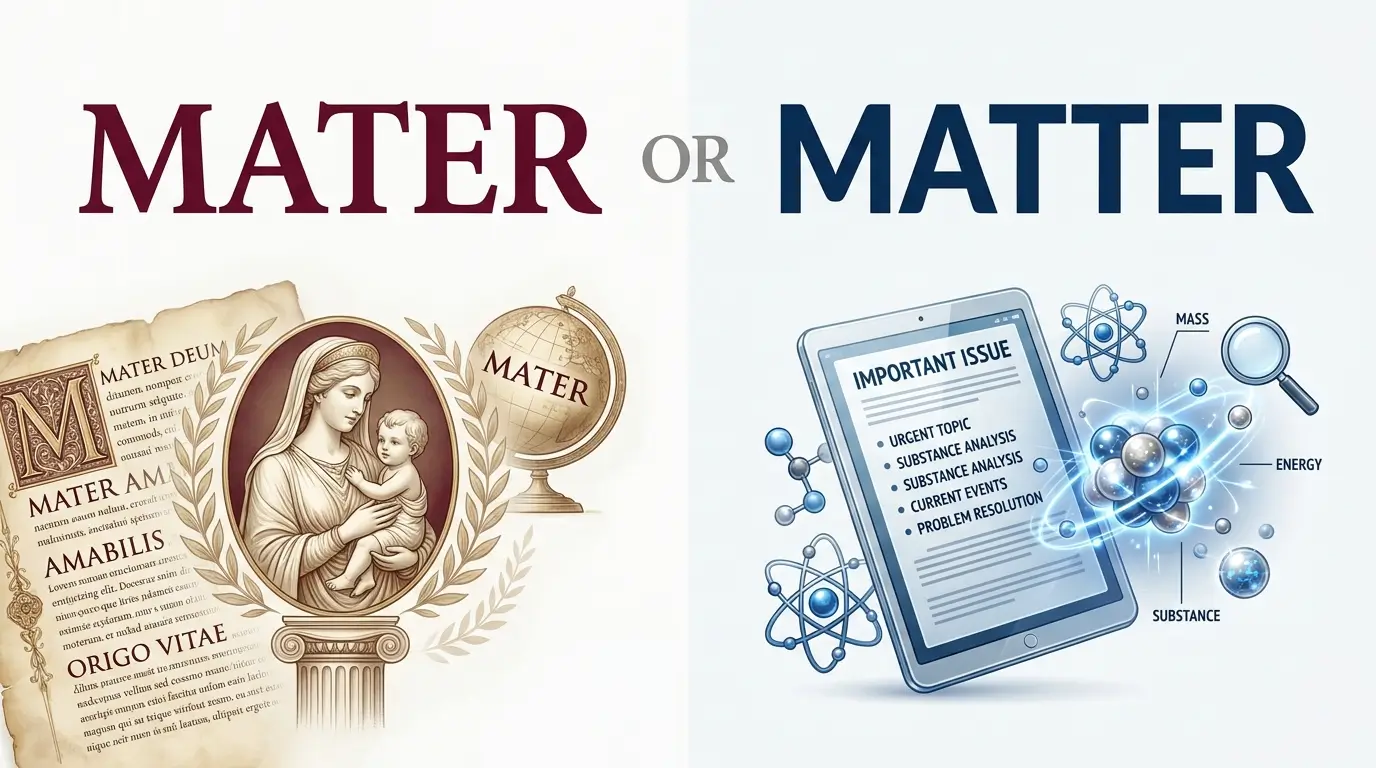
The word mater is an old-fashioned or humorous English noun meaning “mother,” especially in British usage. It comes directly from Latin māter, meaning “mother.” You may also see it in expressions such as alma mater, which refers to the school, college, or university a person attended.
Matter, on the other hand, is a common English word with several meanings. It can refer to a subject, issue, problem, or physical substance. It can also be a verb meaning “to be important.”
So, when deciding between mater or matter, first ask what you want to say. If you mean “mother,” mater may be correct. If you mean an issue, substance, concern, or importance, matter is usually the word you need.
Quick Answer
The quickest way to remember mater or matter is this:
- Mater = mother, usually in old-fashioned, humorous, or British usage.
- Matter = a subject, issue, problem, physical substance, or something that is important.
Mater
Mater is a noun. It means “mother” and is mainly associated with old-fashioned or humorous British English. Cambridge labels it “UK old-fashioned or humorous,” while Oxford describes it as old-fashioned British English.
Example:
I wrote to my mater after arriving at university.
Today, this word can sound playful, formal, dated, or deliberately British.
Matter
Matter can be a noun or a verb.
As a noun, it can mean an issue, subject, situation, problem, or physical substance.
We need to discuss this matter tomorrow.
Water is a form of matter.
As a verb, matter means “to be important.”
Your opinion matters to me.
Cambridge confirms that matter works as both a noun and a verb and has several common grammatical patterns.
The simple rule
If you can replace the word with mother, use mater only when that old-fashioned or humorous style is intended.
If you mean issue, subject, substance, problem, or importance, use matter.
| Word | Main meaning | Part of speech | Example |
| mater | Mother | Noun | His mater sent him a letter. |
| matter | Issue or subject | Noun | We discussed the matter. |
| matter | Physical substance | Noun | Matter has physical properties. |
| matter | Be important | Verb | Your opinion matters. |
The Origin of Mater or Matter
Although mater and matter look closely related, their histories are different in English.
Origin of mater
Mater comes from Latin māter, meaning “mother.” English adopted the word as a somewhat specialized term rather than replacing the everyday word mother. Cambridge and Oxford both identify its Latin origin.
The English word is chiefly associated with British informal, old-fashioned, or humorous speech. Collins describes it as British public-school slang and dates its English use to the late sixteenth century.
The Latin word also appears in familiar expressions such as:
- alma mater — a person’s school, college, or university
- maternal — relating to a mother
- dura mater — the tough outer membrane surrounding the brain and spinal cord
In these expressions, mater is connected with its Latin meaning rather than the casual English use of “mother.”
Origin of matter
The history of matter is more complex.
Merriam-Webster traces the noun and verb to Middle English matere, from Anglo-French and ultimately Latin materia, meaning matter or physical substance. Its first known English use as a noun is placed in the 13th century.
Latin materia originally referred to material or substance, including the woody part of a tree. Etymological sources connect it with Latin mater, meaning “mother,” in the sense of origin or source. The semantic development eventually produced the English meanings associated with material, substance, subject, issue, and concern.
This history explains an interesting point: mater and matter have a distant historical connection through Latin, but modern English speakers should not treat them as spelling variants of the same word.
Why does matter have two t’s?
The spelling matter developed through Middle English and French forms before reaching modern English. The double t is part of the established English spelling.
Mater, in contrast, preserves the spelling of the Latin-derived English word.
So:
mater ≠ matter
They are separate words with different modern meanings.
Pronunciation of Mater and Matter
Pronunciation is another useful way to distinguish mater or matter.
In standard British pronunciation, mater is commonly pronounced with a long “ay” sound, while matter has the short vowel found in words such as cat. Cambridge gives mater as /ˈmeɪ.tə(r)/ and matter as /ˈmæt.ə(r)/ in UK English.
In simple learner terms:
- mater → sounds roughly like “MAY-ter”
- matter → sounds roughly like “MAT-er”
American pronunciation can vary more with mater. Dictionaries record pronunciations including forms beginning with an “may” sound and a pronunciation closer to “mah-ter.”
Matter is generally easy to recognize because of its short vowel.
The two words therefore should not normally be treated as homophones.
British English vs American English Spelling
There is an important regional difference in usage, but not a major spelling difference.
Matter is spelled matter in both British and American English.
Mater is also spelled mater in both varieties when it is used as the English noun meaning “mother.” However, the word is much more strongly associated with British, old-fashioned, humorous, or informal usage. Cambridge labels it UK old-fashioned or humorous.
| Feature | British English | American English |
| Mother, old-fashioned | mater | mater, but less common |
| Standard word for mother | mother | mother |
| Issue or subject | matter | matter |
| Physical substance | matter | matter |
| Verb meaning “be important” | matter | matter |
| Spelling of matter | matter | matter |
| Spelling of mater | mater | mater |
There is no useful rule such as “mater is British spelling and matter is American spelling.” That would be incorrect.
Instead, the key difference is meaning and usage.
For everyday modern English, speakers in both varieties normally use mother, not mater, when referring to a parent.
Which Spelling Should You Use?
Your choice depends on what you mean and who will read your writing.
Use mater when you mean “mother”
Choose mater if you intentionally want an old-fashioned, humorous, literary, or culturally British tone.
For example:
His mater was waiting for him at home.
This sentence is grammatically possible, but mother would sound much more natural in ordinary modern English.
You may also need mater in established Latin expressions:
She returned to her alma mater.
Use matter for everyday modern meanings
Use matter when you mean:
- an issue
- a subject
- a concern
- a problem
- physical substance
- importance
Examples:
This is an important matter.
Does it matter if I arrive late?
Scientists study matter and energy.
Advice for students
Students should normally use matter when they mean an issue or subject.
If they mean a parent, mother is usually safer than mater unless the exercise specifically asks about the word mater.
Advice for professional writers
In business emails, reports, and formal documents, use matter for an issue or subject.
We need to resolve this matter before Friday.
Avoid mater unless the context deliberately calls for an old-fashioned or humorous tone.
Advice for global English users
If your audience is international, remember:
mother is clearer than mater when you mean a parent.
Matter is the standard choice for issues, subjects, concerns, and importance.
Common Mistakes
Because the words differ by only one letter, spelling mistakes are easy.
Mistake 1: Using mater for an issue
Incorrect:
This is an important mater.
Correct:
This is an important matter.
An issue or concern is a matter, not a mater.
Mistake 2: Using matter for mother
Incorrect:
His matter called him yesterday.
Correct:
His mother called him yesterday.
If you are using the old-fashioned word, you could write:
His mater called him yesterday.
However, mother is much more natural in ordinary modern English.
Mistake 3: Confusing alma mater with alma matter
The established expression is:
alma mater
Not:
alma matter
Alma mater traditionally refers to the school, college, or university that someone attended.
Mistake 4: Adding an extra t to mater
Incorrect:
My matter lives in London.
If you intentionally mean “my mother” in the old-fashioned sense:
My mater lives in London.
Mistake 5: Treating mater as the normal word for mother
Although mater is a real English word, it is not the standard everyday replacement for mother.
Compare:
My mother is visiting.
This is neutral and natural.
My mater is visiting.
This may sound humorous, old-fashioned, or deliberately British.
Everyday Examples
Understanding the words in real sentences is one of the best ways to remember them.
In emails
Matter:
I am writing regarding an important matter concerning your account.
Here, matter means an issue or subject.
Mater:
My mater will be joining us for dinner.
This is grammatically possible but has a distinctly old-fashioned or humorous tone.
In news writing
Matter:
Officials are investigating the matter.
News writing commonly uses matter for an issue or situation.
Mater would be unusual unless a person’s speech, title, quotation, or historical context made it relevant.
In social media
You may see playful uses such as:
Mum says no, but perhaps my mater will change her mind!
Here, mater can create a humorous old-fashioned voice.
In a normal post, however, mom, mum, or mother would usually be more natural.
In formal writing
Matter is common:
The committee will review the matter next week.
This matter requires further investigation.
Mater is much less common and should not be used simply as a more formal version of mother.
In academic writing
Matter can have a scientific meaning:
Matter is composed of particles.
It can also refer to a topic:
The paper examines the subject matter of the novel.
The word mater is uncommon in ordinary academic prose except in Latin-derived terms or specific historical contexts.
Side-by-Side Comparison
| Feature | Mater | Matter |
| Meaning | Mother | Issue, subject, substance, importance |
| Main part of speech | Noun | Noun and verb |
| Modern everyday use | Limited | Very common |
| Tone | Old-fashioned, humorous, British | Neutral and standard |
| British usage | Recognized, especially in older/humorous contexts | Very common |
| American usage | Recognized but less common | Very common |
| Pronunciation | Usually begins with “may” sound | Begins with short “a” sound |
| Example | Her mater sent a letter. | We discussed the matter. |
| Common phrase | alma mater | no matter, as a matter of fact |
The simplest distinction is:
Mater = mother
Matter = issue, substance, or importance
Frequently Asked Questions
Is mater another spelling of matter?
No. Mater and matter are different words. Mater can mean “mother” in old-fashioned or humorous British English, while matter has meanings such as issue, substance, and importance.
Is mater a British word?
It is strongly associated with British usage. Cambridge describes it as UK old-fashioned or humorous, and Oxford identifies it as old-fashioned British English.
Is mater formal or informal?
It is generally old-fashioned, humorous, or informal rather than standard neutral English. In most modern situations, mother is the better choice.
What does matter mean in English?
Matter can be a noun meaning an issue, subject, problem, or physical substance. As a verb, it means “to be important.”
Is “alma matter” correct?
No. The established expression is alma mater. It refers to the school, college, or university a person attended.
Are mater and matter pronounced the same?
No. They normally have different vowel sounds. Mater commonly begins with an “ay” sound, while matter has the short vowel heard in words such as cat.
Which word should I use in an email?
Use matter when you mean an issue or subject. Use mother rather than mater when referring to a parent unless you intentionally want an old-fashioned or humorous tone.
Conclusion
The difference between mater or matter becomes simple once you focus on meaning. Mater can mean mother, while matter refers to an issue, substance, or importance.
Although the spellings look similar, these words serve different purposes. Mater has an old-fashioned British flavor, while matter is common in everyday English.
Remember the key rule: mater = mother, and matter = issue, substance, or importance. This small spelling clue can prevent many mistakes.
Keep practicing these words in emails, essays, and daily conversations. The more you use them in context, the more natural the difference will feel.

Aamer Shahzad is the founder of Distinly.com, a fast-growing educational platform focused on high-intent “difference between” topics. With over 8 years of experience in English language education and analytical writing, I specialize in breaking down complex “difference between” topics into clear, structured, and easy-to-understand explanations. Distinly.com is your go-to resource for enhancing English skills and writing with confidence.
I specializes in building search-optimized, research-driven comparison content designed for clarity, authority, and long-term digital asset value.