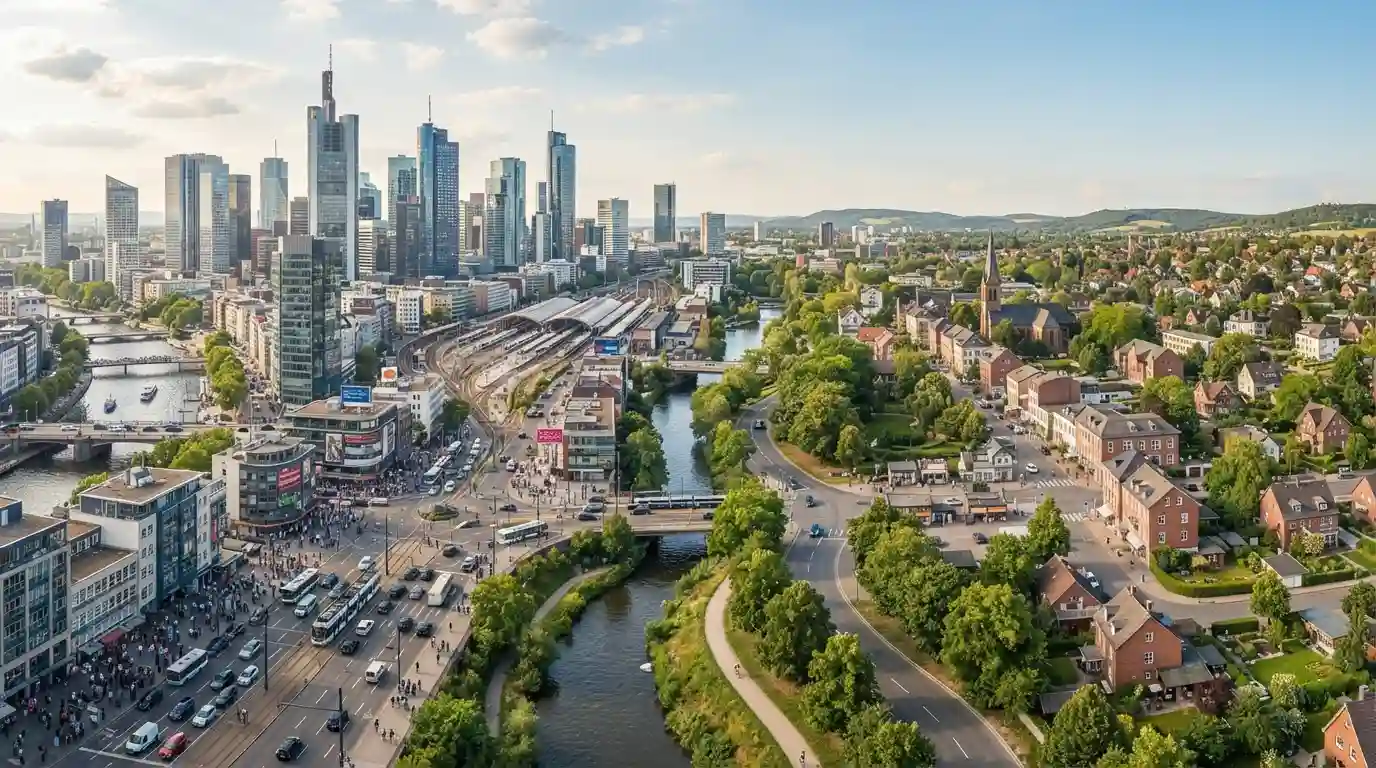
Choosing between a city or town can seem easy until you try to define exactly what separates the two. Is a town simply a smaller city? Does population decide the difference? Can a place be called a city even if it has fewer people than a large town?
These questions make city or town a useful search phrase for students, travelers, writers, researchers, and anyone trying to describe a place accurately. The answer is not always based on population alone. The meaning can depend on geography, local government, history, legal status, and the country being discussed.
In everyday English, a city usually suggests a larger and more developed urban settlement, while a town usually suggests a smaller settlement. But there is no single worldwide population number that automatically turns a town into a city.
The distinction can also vary between British and American English. In the United States, the legal meaning of a city, town, village, or similar place can depend on state law. In the United Kingdom, the status of a city has historically involved formal recognition rather than simple population size.
Understanding these differences helps you choose the right word in conversation, writing, travel content, and formal descriptions.
City or Town – Quick Answer
A city is generally a large or important urban settlement, while a town is generally a smaller settlement.
However, there is no universal rule saying:
“A place becomes a city when it reaches a certain population.”
That idea is too simple.
For example, a large town can have more residents than a small city. A place may also have official city status because of its history or legal designation.
What is a city?
A city is a noun used for a large or significant urban settlement.
Examples:
London is a city.
New York City is a major city.
The city has a large public transport network.
The adjective urban is often used when talking about city environments.
What is a town?
A town is also a noun. It usually describes a settlement that is smaller than a city but larger or more developed than a village in many common classifications.
Examples:
She lives in a small town.
The town has a busy market.
We stopped in a coastal town.
The exact boundary between a town and a city depends on the country and context.
The simplest comparison
| Term | General meaning |
|---|---|
| City | Larger or officially recognized urban settlement |
| Town | Generally smaller urban settlement |
| Population | Can help describe size but does not always decide status |
| Legal status | Can matter greatly |
| Meaning worldwide | Varies by country |
So if someone asks, “Is it a city or town?”, the best answer may require more than knowing the population.
The Origin of City or Town
The words city and town have different linguistic histories.
The origin of city
City comes through Old French cite or related forms from Latin civitas, meaning citizenship, community of citizens, or the body of citizens.
The Latin word is related to civis, meaning citizen.
This history connects the word city not only with a physical settlement but also with the organized community living within it.
English developed its modern form through French influence after the Norman Conquest and later changes in English pronunciation and spelling.
The origin of town
Town has a Germanic history.
It comes from Old English tun, meaning an enclosure, farmstead, estate, or settlement. It is related to words in other Germanic languages that refer to an enclosed place or settlement.
Over time, its meaning developed toward the modern idea of a town or populated settlement.
This history is interesting because town originally had a broader sense than the modern idea of a medium-sized urban place.
Why do city and town have different meanings?
Their meanings developed through different historical paths.
City became strongly connected with organized urban communities and civic life.
Town developed from a Germanic word associated with an enclosed place or settlement.
Modern English then shaped both words according to changing patterns of settlement and government.
There is no single historical event that created the worldwide modern city-versus-town distinction. Different countries developed their own systems.
Pronunciation of City or Town
City and town are easy to distinguish when spoken.
City
In standard pronunciation, city is approximately:
SIT-ee
IPA:
/ˈsɪti/
The first syllable has the short i sound found in sit.
Town
Town is approximately:
TOWN
IPA:
/taʊn/
The vowel sound is similar to the sound in how or now.
Plural forms
The plurals are regular:
city → cities
town → towns
Notice that city changes its ending when pluralized:
one city
two cities
This happens because English changes the final y to i before adding -es.
Part of Speech: City vs Town
Both city and town are primarily countable nouns.
City as a noun
Paris is a beautiful city.
The city attracts millions of visitors.
You can use articles with singular forms:
a city
the city
The plural is:
cities
Town as a noun
It is a quiet town.
The town has several historic buildings.
The plural is:
towns
Both words can also appear in compound expressions.
Examples include:
city center
city life
city government
town center
town hall
town council
The exact meaning of these compounds can vary by country.
British English vs American English Spelling
There is no major spelling difference between British and American English for city or town.
Both varieties use:
city
and:
town
The bigger difference is how local governments and settlement categories are defined.
British English
In the United Kingdom, city status is a formal status granted by the Crown. A place does not simply become a city because it passes a particular population threshold.
This means that historical or constitutional status can matter.
American English
In the United States, terminology can vary significantly by state and local government.
A municipality may be called a city, town, village, borough, or another term depending on the state’s legal system.
Therefore, American English does not have one nationwide rule that defines every city and town.
Comparison table
| Feature | British English | American English |
|---|---|---|
| Spelling of city | city | city |
| Spelling of town | town | town |
| City status | Formal status can matter | Often determined by state/local law |
| Population alone | Not a universal test | Not a universal national test |
| Town meaning | Varies by context | Varies by state and locality |
| Spelling difference | None | None |
So this is not a British-versus-American spelling issue. It is mainly a difference in terminology, government systems, and local classification.
Which Spelling Should You Use?
The spelling is simple: use city and town in both British and American English.
Your bigger decision is which word accurately describes the place.
For British audiences
If you are writing about a UK location, check its official status when that detail matters.
Do not assume that population alone determines whether a place is officially a city.
For American audiences
Check the local or state classification when legal status matters.
A place called a town in one state may have a different legal structure from a town in another state.
For global audiences
Use the ordinary meaning unless official status is important.
For example:
We visited a small town near the mountains.
This is clear without needing a legal definition.
If you are writing factual travel or geographic content, however, official terminology is worth checking.
Common Mistakes with City or Town
Mistake 1: Assuming every large settlement is a city
Size does not always determine official status.
A settlement can be large but still officially classified as a town.
Mistake 2: Assuming every city is larger than every town
This is not universally true.
Some cities have relatively small populations, while some towns are much larger.
Mistake 3: Thinking “city” and “urban area” mean exactly the same thing
They can overlap, but they are not identical concepts.
An urban area can describe a built-up area that may cross administrative boundaries.
A city can refer to a legally or historically defined municipality.
Mistake 4: Writing “citys”
The correct plural of city is:
cities
Not:
citys
Mistake 5: Confusing “town” with “downtown”
Town is a settlement.
Downtown usually refers to the central or business part of a city or town, especially in North American English.
Mistake 6: Assuming “town” always means rural
A town can be busy, densely built, and economically active. It does not automatically mean a rural village.
City or Town in Everyday Examples
In emails
You might write:
I will be staying in a small town near Manchester.
Or:
Our office is located in the city center.
The best word depends on the place you are describing.
In news writing
News reports often use both terms:
The city announced a new transport plan.
Residents of the nearby town attended the meeting.
The choice may reflect official names and administrative boundaries.
In social media
The words are common in travel and lifestyle posts:
City or town? Where would you rather live?
I love the energy of city life.
Small-town weekends are the best.
Here, the terms can also express lifestyle preferences rather than strict geographic classifications.
In formal writing
Formal writing may need greater precision.
Instead of:
This town has a population of millions.
you should verify whether town is the official classification.
Similarly, if a location has formal city status, using city is usually more precise.
In travel writing
Travel content often uses both words naturally:
The historic town is known for its old market.
The nearby city offers museums, restaurants, and public transport.
Travel writers should be careful not to change official place classifications simply to make descriptions sound more dramatic.
City vs Town: Key Differences
| Feature | City | Town |
|---|---|---|
| General size | Usually larger | Usually smaller |
| Population | Often higher | Often lower |
| Density | Often more dense | Often less dense |
| Services | Usually extensive | Usually more limited |
| Public transport | Often extensive | May be more limited |
| Employment | Diverse industries | Often fewer major sectors |
| Buildings | More large-scale development | Often smaller-scale development |
| Government | Often formal municipal structure | Varies by location |
| Legal definition | Varies by country | Varies by country |
| Lifestyle | Often faster-paced | Often quieter |
| Universal definition | No | No |
These are general tendencies, not strict laws.
A town can have excellent public transport. A small city can have a quiet atmosphere. A city can also contain neighborhoods that feel very much like small towns.
Is a City Always Bigger Than a Town?
No.
This is one of the most important points.
In everyday speech, people often expect cities to be larger than towns. But official city status and population size are not always directly connected.
Some places have city status because of historical, legal, or administrative reasons.
In other places, local law may use the terms differently.
For this reason, avoid statements such as:
Every settlement with more than 100,000 people is a city.
There is no worldwide population threshold that works everywhere.
A better statement is:
Cities are generally larger urban settlements, but the legal and official definition varies by country and locality.
City or Town for Lifestyle Choices
The phrase city or town is also common when people compare places to live.
City living
City life may offer:
- More employment options
- Larger shopping areas
- More restaurants
- Universities and cultural institutions
- Extensive public transportation
- Greater population density
But cities can also have:
- Higher living costs
- More traffic
- More noise
- Less private space
Town living
Town life may offer:
- A quieter environment
- Smaller communities
- Shorter local journeys
- Lower population density
- Easier access to nearby rural areas
But some towns may have:
- Fewer specialist services
- Fewer major employers
- Less public transportation
- Fewer entertainment options
Neither is automatically better.
The best choice depends on work, family, budget, transport, and personal preferences.
How “City or Town” Changes by Country
The most important lesson is that settlement terms are not globally standardized.
One country may use population thresholds. Another may use legal status. Another may rely on historical classifications.
Some places also use categories such as:
- Village
- Municipality
- Borough
- District
- Township
- Metropolitan area
- Urban area
These terms can overlap in everyday speech but may have very different legal meanings.
If you are writing about a particular location, use that country’s official classification when accuracy matters.
7 FAQs About City or Town
1. What is the main difference between a city and a town?
A city is generally a larger or formally recognized urban settlement, while a town is generally smaller. However, the exact definition varies by country.
2. Is a town smaller than a city?
Usually, but not always. Population alone does not determine official status everywhere.
3. What population makes a town a city?
There is no universal population number. Different countries and local governments use different rules.
4. Is city a noun or adjective?
City is primarily a noun.
New York is a city.
It can also appear before another noun in compounds such as city center.
5. Is town a noun?
Yes. Town is a countable noun.
The town is quiet.
Its plural is towns.
6. Is there a British or American spelling difference between city and town?
No. Both British and American English spell them city and town. Differences mainly concern legal and local classification.
7. Can a town be bigger than a city?
Yes. A town can have a larger population than a place that officially has city status. Official classification and population size do not always match.
Conclusion
City or town is not always a simple size question. Population matters, but history, law, government, and local usage can shape the official meaning too.
Both city and town are common English nouns, and their spelling is the same in British and American English. The real difference is context.
For everyday writing, use the word that naturally describes the place. For formal or geographic writing, check the location’s official status before making a claim.
Once you understand that settlement labels vary, this comparison becomes much clearer. Practice using city and town in real sentences to make your English more natural and precise.

Mira Anand is a writer at Distinly.com who focuses on storytelling, communication, and social perspective. Her work highlights subtle differences in language and meaning across cultures and communities. With a clear and empathetic voice, Mira helps readers understand how narratives shape understanding, relationships, and modern dialogue in an increasingly connected world.