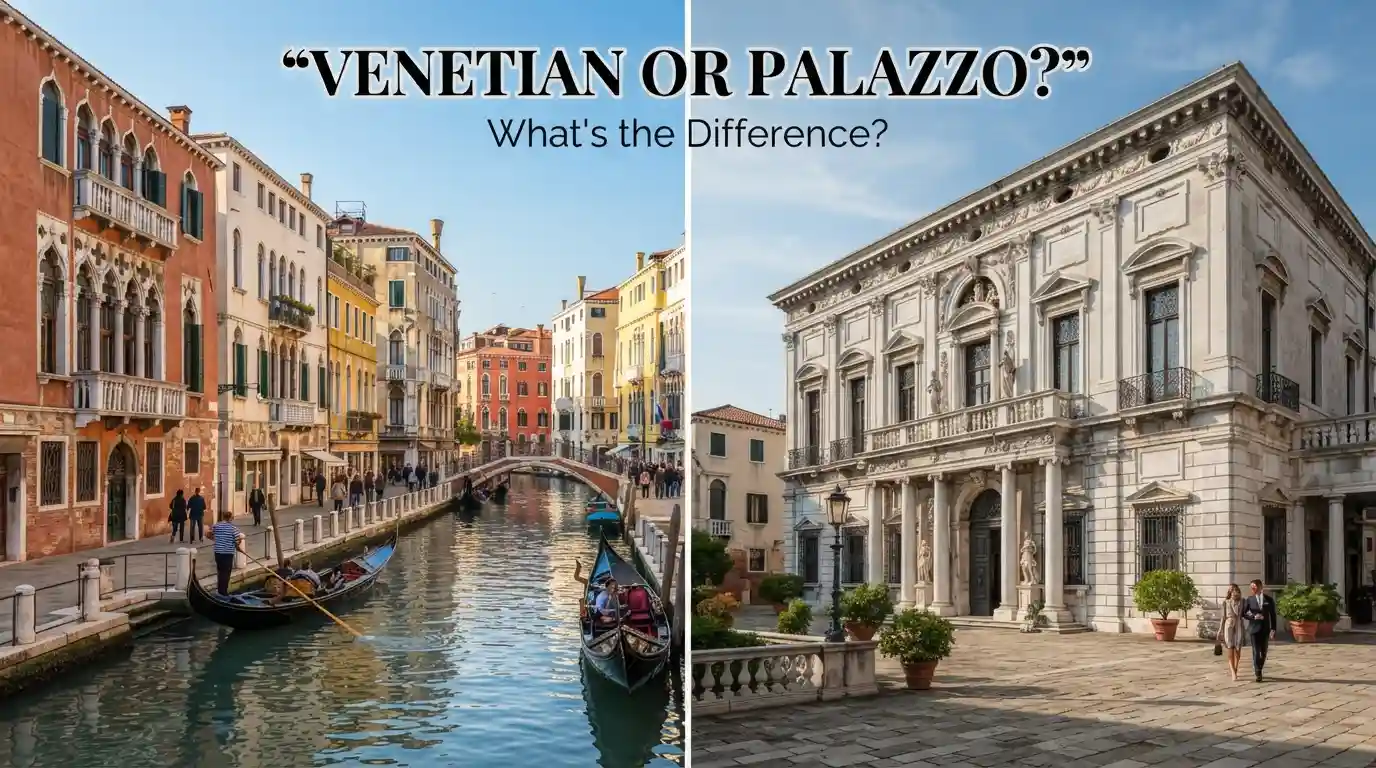
Venetian or palazzo can be confusing because the two words often appear together in fashion, travel, architecture, and lifestyle content. You may see phrases such as Venetian style, Venetian palazzo, or palazzo pants and wonder whether Venetian and palazzo describe the same thing.
They do not.
The key difference is grammatical and semantic. Venetian is mainly an adjective. It describes something connected with Venice, its people, culture, history, or style. Palazzo is an Italian noun that means palace or a grand building. In fashion, palazzo pants refers to a style of wide-leg trousers.
This distinction becomes especially useful when reading fashion descriptions. A product called a Venetian palazzo may be describing a palazzo-style garment with a Venetian theme, color, print, or inspiration. It does not mean that Venetian is another word for palazzo.
This guide explains venetian or palazzo in simple terms, including meaning, pronunciation, origins, grammar, fashion usage, regional English, common mistakes, and practical examples.
venetian or palazzo – Quick Answer
Venetian
The term “Venetian” describes something connected with Venice, the Italian city.
It is usually an adjective:
Venetian architecture is famous for its distinctive history.
She bought a Venetian-style mask.
It can also be a noun when referring to a person from Venice:
The Venetian described the city’s traditions.
Palazzo
Palazzo is an Italian word used in English as a noun. It means a palace or a large, impressive building. Collins gives palazzo the meanings “palace” and “any large, stately building.”
For example:
We visited an old Venetian palazzo.
Here, Venetian describes the palazzo.
The structure is:
Venetian = adjective
palazzo = noun
This is the easiest way to remember the difference.
What about palazzo pants?
In fashion, palazzo pants are wide-leg trousers with a loose, flowing shape. Fashion sources describe them as wide-leg trousers that create a fluid silhouette.
So:
Venetian = describes a connection with Venice
Palazzo = means a palace or, in “palazzo pants,” identifies a fashion style
A phrase such as Venetian palazzo therefore combines two different ideas rather than giving two spellings for the same thing.
The Origin of Venetian or Palazzo
The two words have very different histories.
The origin of Venetian
Venetian is formed from Venice, the name of the Italian city, with the English adjective-forming ending -ian.
It means something associated with Venice.
The word can describe:
- People
- Art
- Architecture
- History
- Culture
- Food
- Fashion
- Design
- Language or dialect
For example:
Venetian art
means art associated with Venice.
Likewise:
Venetian architecture
means architecture associated with Venice.
The word is therefore descriptive. It tells you where something comes from or what it is connected with.
The origin of palazzo
Palazzo comes into English from Italian. Collins traces it to Latin palatium, meaning “palace.”
The Italian plural is palazzi.
In English, palazzo is used for a large, impressive building or palace. It is especially useful when discussing Italian architecture.
For example:
The museum occupies a historic palazzo.
The word can also appear in proper names and descriptions of grand buildings.
Why does palazzo appear in fashion?
The connection between palazzo and fashion comes from the name palazzo pants.
The term describes trousers with a broad, flowing shape. The style gives the legs a dramatic, elegant appearance, which fits the luxurious association of the word palazzo. Modern fashion sources commonly use palazzo pants for this wide-leg style.
However, it is important not to confuse the fashion meaning with the original Italian noun.
A palazzo is fundamentally a building or palace.
Palazzo pants is a later fashion expression.
Pronunciation of Venetian or Palazzo
These words are pronounced differently.
Venetian
Venetian is commonly pronounced approximately:
veh-NEE-shun
The main stress falls on the middle syllable.
In English pronunciation, the final part sounds similar to “shun.”
Example:
Venetian art
Sounds roughly like:
veh-NEE-shun art
Palazzo
Palazzo is commonly pronounced approximately:
puh-LAHT-soh
The zz has a sound similar to ts in many English pronunciations.
Italian pronunciation is closer to:
pa-LAHT-tso
The English pronunciation can vary slightly.
Are Venetian and palazzo pronounced similarly?
No.
They are easy to distinguish when spoken:
Venetian → veh-NEE-shun
Palazzo → puh-LAHT-soh
The bigger source of confusion is not pronunciation. It is meaning and context.
Venetian vs Palazzo: What Is the Actual Difference?
The most important difference is their grammatical function.
Venetian is usually an adjective
An adjective describes a noun.
For example:
Venetian glass
Here, Venetian describes the type or origin of the glass.
Venetian architecture
Here, Venetian describes the architecture.
Venetian fashion
Here, Venetian describes the style or influence.
You can think of Venetian as answering:
“What is it related to?”
The answer is:
Venice.
Palazzo is a noun
A noun names a thing.
The palazzo was built around a large courtyard.
Here, palazzo names the building.
It can also be modified by an adjective:
The Venetian palazzo has ornate windows.
In this sentence:
- Venetian = adjective
- palazzo = noun
This is a perfect example of how the words work together.
Palazzo in fashion
The meaning changes slightly when the word appears in:
palazzo pants
Here, palazzo forms part of a compound fashion term.
The pants are characterized by a very wide, flowing leg. Fashion references continue to use palazzo pants for this silhouette.
So palazzo can refer to a building by itself, while palazzo pants refers to a garment style.
Venetian or Palazzo in Fashion
This is where the keyword venetian or palazzo can create the most confusion.
Venetian is not a standard synonym for palazzo pants.
A clothing brand may use Venetian as part of a product name, color name, print name, or style description.
For example, current fashion listings use names such as Venetian Palazzo for wide-leg trousers. One retailer describes a product specifically as “Venetian Palazzo pants,” showing how the two terms can be combined in a product name.
Another fashion listing uses Venetian Red as the color name for a box-pleated palazzo garment.
This shows an important point:
Venetian does not define the garment’s basic shape.
The word palazzo does.
If a product is called Venetian Palazzo, Venetian may indicate the design theme, naming, inspiration, or color, while palazzo describes the garment style.
What are palazzo pants?
Palazzo pants are generally:
- Wide-legged
- Loose-fitting
- Flowing
- Often high-waisted
- Made from fabrics that drape well
They may be worn casually or for formal occasions depending on the fabric and styling.
Therefore:
Palazzo pants = a type of wide-leg trousers
not:
Venetian pants = another name for palazzo pants
The latter would be too broad and could be misleading.
British English vs American English Spelling
There is no meaningful British-versus-American spelling difference between Venetian and palazzo.
Both British English and American English use:
- Venetian
- palazzo
- palazzo pants
The spelling does not change simply because the reader is American or British.
| Term | British English | American English |
| Venetian | Venetian | Venetian |
| Palazzo | palazzo | palazzo |
| Venetian palazzo | Venetian palazzo | Venetian palazzo |
| Palazzo pants | palazzo pants | palazzo pants |
| Plural of palazzo | palazzos or palazzi | palazzos or palazzi |
English dictionaries recognize palazzos as an English plural, while the Italian plural palazzi is also used. Collins lists both plural forms.
Is Venetian a British or American spelling?
No.
Venetian is the standard English form in both varieties.
Is palazzo an American spelling?
No.
It is an Italian loanword used in English.
Therefore, this is not a case like:
colour vs color
or:
trousers vs pants
The spellings Venetian and palazzo remain the same in British and American English.
Which Spelling Should You Use?
Because these words have different meanings, choosing one is less about regional spelling and more about what you are trying to say.
Use Venetian when you mean “related to Venice”
Examples:
Venetian architecture attracts visitors from around the world.
She loves Venetian glass.
The restaurant has a Venetian-inspired interior.
Use palazzo when referring to a palace or grand Italian building
Example:
The gallery is located inside a historic palazzo.
Use palazzo pants for the fashion style
Example:
She wore black palazzo pants with a fitted blouse.
Use Venetian palazzo when both descriptions apply
Example:
The historic Venetian palazzo overlooks the canal.
Here, Venetian tells us about the building’s connection with Venice.
Palazzo tells us what type of building it is.
For global writers
The same basic advice works for US, UK, and international audiences.
Do not change Venetian to another spelling.
Do not change palazzo based on the reader’s country.
Instead, choose the word according to its meaning.
Common Mistakes with Venetian or Palazzo
Mistake 1: Treating Venetian and palazzo as synonyms
Incorrect:
Venetian is another word for palazzo.
Correct:
Venetian describes something associated with Venice, while palazzo means a palace or grand building.
Mistake 2: Calling all wide-leg pants Venetian
Incorrect:
These are Venetian pants because they have wide legs.
Better:
These are palazzo pants.
A wide-leg silhouette is commonly described as palazzo pants.
Mistake 3: Assuming every palazzo is Venetian
A palazzo is an Italian term for a palace or grand building.
A building can be called a palazzo without being in Venice.
Venetian palazzo specifically adds the connection with Venice.
Mistake 4: Confusing palazzo with a place name
Palazzo is an Italian common noun meaning palace. It can appear in the names of particular buildings, but the word itself does not name Venice.
Mistake 5: Using Venetian as a noun when an adjective is needed
Awkward:
We admired the Venetian building style.
Better:
We admired the Venetian architectural style.
Here, Venetian modifies architectural style.
Mistake 6: Assuming palazzo always means clothing
It does not.
A palazzo can be a building.
Palazzo pants is the clothing term.
The surrounding words determine the meaning.
Mistake 7: Assuming the words have different UK and US spellings
They do not.
Both varieties use Venetian and palazzo.
Venetian or Palazzo in Everyday Examples
In emails
If discussing architecture:
The tour includes a visit to a historic Venetian palazzo.
Here, both words are useful because they provide different information.
If discussing clothing:
I recommend the black palazzo trousers for the evening event.
Here, palazzo describes the clothing style.
In news writing
A travel article might say:
The visitors explored a historic Venetian palazzo overlooking the Grand Canal.
A fashion article might say:
Wide-leg palazzo pants are being styled with fitted tops and tailored jackets.
These examples show the two meanings clearly.
On social media
A fashion post could say:
Loving these flowing palazzo pants for summer.
A travel post could say:
The beauty of this Venetian palazzo is incredible.
The first uses palazzo as part of a fashion term.
The second uses Venetian as an adjective describing a building.
In formal writing
A history paper might say:
Venetian palazzi played an important role in the architectural character of the city.
Here, palazzi is the Italian plural of palazzo.
A fashion report might say:
Palazzo trousers create a wide, flowing silhouette.
Both uses are grammatically and semantically different.
Venetian vs Palazzo: Side-by-Side Comparison
| Feature | Venetian | Palazzo |
| Basic meaning | Related to Venice | Palace or grand building |
| Main part of speech | Adjective | Noun |
| Origin | From Venice | Italian palazzo |
| Language source | English formation from Venice | Italian |
| Pronunciation | veh-NEE-shun | puh-LAHT-soh |
| Fashion use | Describes a theme, inspiration, or name | Forms “palazzo pants” |
| Architecture | Describes things connected with Venice | Names a grand building |
| Example | Venetian architecture | historic palazzo |
| Can they be combined? | Yes | Yes |
| Example together | Venetian palazzo | — |
| British spelling | Venetian | palazzo |
| American spelling | Venetian | palazzo |
| Synonyms | Venetian-style, Venetian-inspired | palace, grand building |
| Main confusion | Mistaken for a garment type | Mistaken as a synonym for Venetian |
The clearest sentence to remember is:
A Venetian palazzo is a palazzo associated with Venice.
That one example shows exactly how the two words relate.
FAQs
1. What is the difference between Venetian and palazzo?
Venetian describes something connected with Venice. Palazzo is an Italian noun meaning a palace or grand building. They are not synonyms.
2. Are Venetian pants the same as palazzo pants?
Not necessarily. Palazzo pants are a recognized wide-leg trouser style. Venetian may appear in a product name or describe a design, color, or Venetian inspiration.
3. What does palazzo mean in fashion?
In palazzo pants, the term refers to a style of trousers with a very wide, flowing leg.
4. What does Venetian mean?
Venetian means related to Venice, its people, culture, history, or characteristic style.
5. Is palazzo an Italian word?
Yes. Palazzo is Italian and means a palace or large, impressive building. Its history can be traced to Latin palatium.
6. What is the plural of palazzo?
Both palazzos and the Italian plural palazzi are used in English. Collins lists both forms.
7. Is Venetian palazzo correct English?
Yes. Venetian palazzo is a natural combination when you mean a palazzo associated with Venice. Venetian modifies palazzo, so the phrase means essentially “a palazzo connected with Venice.”
Conclusion
The difference between Venetian or palazzo is simple once their roles are clear. Venetian describes a connection with Venice, while palazzo names a palace or grand building.
In fashion, palazzo also appears in palazzo pants, a wide-leg trouser style. Venetian may be added to describe a theme, name, color, or inspiration.
There is no special British or American spelling difference here. Both varieties use Venetian and palazzo, so meaning and context should guide your choice.
Use these words carefully in articles, emails, travel writing, and fashion content. A little practice will make the distinction natural and easy to remember.

Mira Anand is a writer at Distinly.com who focuses on storytelling, communication, and social perspective. Her work highlights subtle differences in language and meaning across cultures and communities. With a clear and empathetic voice, Mira helps readers understand how narratives shape understanding, relationships, and modern dialogue in an increasingly connected world.