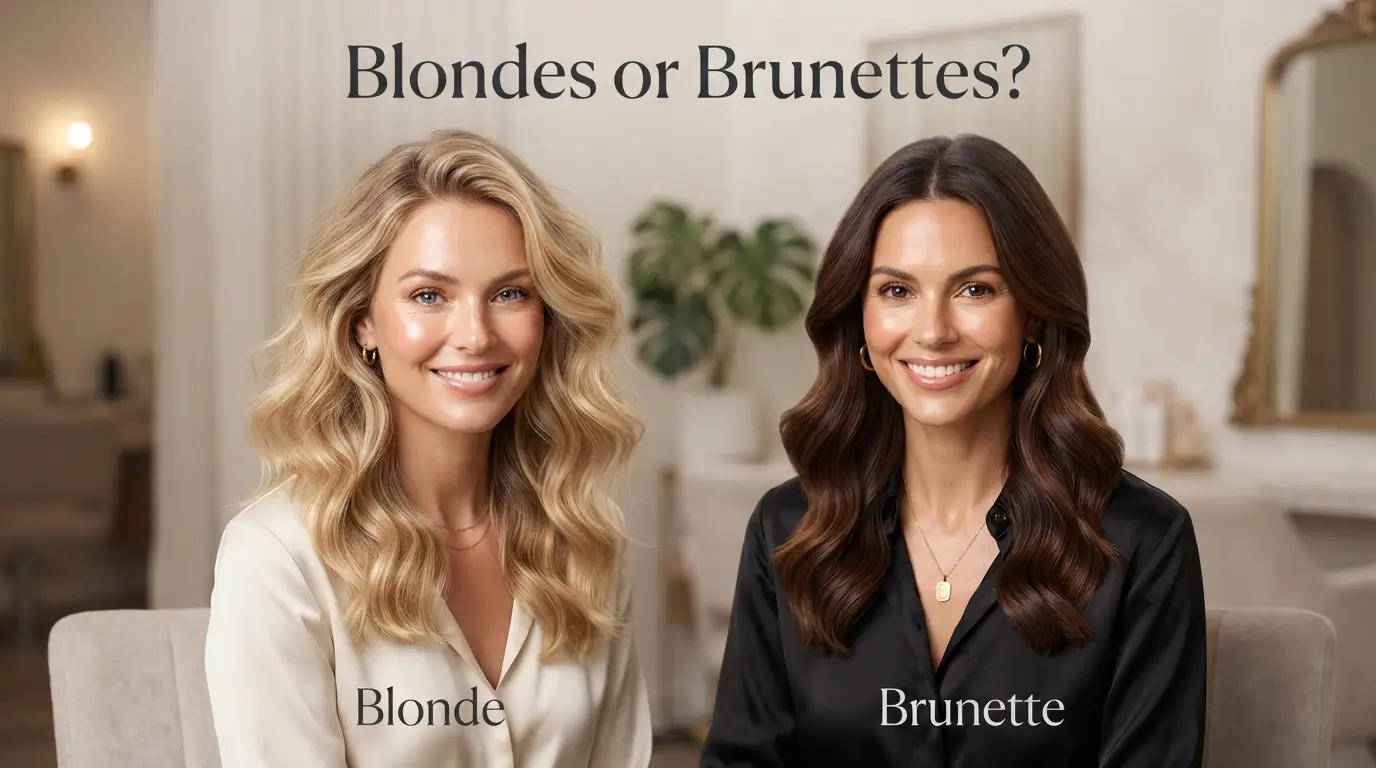
The choice between blondes or brunettes often appears in conversations about hair color, beauty, fashion, celebrities, and personal style. But the phrase can also raise an English-language question: what exactly do blonde and brunette mean, and are they used in the same way?
Both words describe hair color and can also refer to people who have that hair color. Blonde generally refers to hair that ranges from pale yellow to golden or light brown. Brunette generally refers to someone with dark brown hair. Cambridge lists both blonde and brunette as nouns and adjectives, although their usage patterns are not completely identical.
The words also have different histories. Blonde entered English through French and has an uncertain deeper origin, while brunette comes from French and ultimately relates to a Germanic word for brown.
Understanding these differences helps you choose the right word in everyday conversation, articles, emails, social posts, and formal writing.
Blondes or Brunettes – Quick Answer
Both terms Blondes and brunettes refer to people with different hair colors.
Blondes are people with blonde or blond hair, usually ranging from pale yellow to golden or light golden-brown shades.
Brunettes are people with dark brown hair.
For example:
The salon is popular with both blondes and brunettes.
Here, blondes and brunettes are plural nouns referring to people.
You can also use the words as adjectives:
She has blonde hair.
He has dark brunette hair.
There is one important usage point. Blonde and brunette can both describe hair, but brunette is especially common as a noun referring to a person. Blonde is also commonly used as a noun, particularly for a woman or girl, although modern English also uses blond as a noun and adjective.
Cambridge notes that blonde can be a noun for a person with pale yellow or gold hair and that blond is also used. It also notes that brunette can function as both a noun and an adjective.
What does “blonde” mean?
Blonde describes a pale yellow, golden, or light hair color.
Examples:
She has blonde hair.
The blonde woman entered the room.
Her hair is naturally blonde.
What does “brunette” mean?
Brunette usually describes dark brown hair or a person with dark brown hair.
Examples:
She is a brunette.
The brunette actress changed her hairstyle.
She has beautiful brunette hair.
Cambridge defines brunette as a person, especially a woman or girl, with dark brown hair and also uses it as an adjective for dark brown hair.
The Origin of Blondes or Brunettes
Although blonde and brunette are now common English words, both have strong connections with French.
The origin of blonde
The English word blonde came through French. Etymonline identifies it as the feminine form of blond and traces blond to Old French blont, meaning fair or blond. The deeper origin is uncertain. It may be connected to a Germanic source, but the exact history is not settled.
The English word blond appeared in English in the late 15th century. The French feminine form blonde was later reintroduced into English, which helps explain why English developed both blond and blonde.
This French influence is important because it explains why English has two closely related spellings.
Historically, blonde retained the French-looking feminine ending. In modern English, however, usage is more flexible than a simple masculine-versus-feminine rule.
Cambridge lists blonde and blond as alternative forms and notes that blonde is commonly used for women and girls in particular.
The origin of brunette
Brunette also entered English through French.
Etymonline dates the adjective to the 1660s and traces it to French brunette, the feminine form of brunet. The French word relates to brun, meaning brown, and ultimately has a West Germanic and Proto-Germanic background.
The noun brunette, meaning a woman with dark hair or a dark complexion, developed in English in the early 18th century.
The history therefore looks roughly like this:
blonde → French blond/blonde → earlier European source of uncertain origin
brunette → French brunette → French brun → Germanic brown-related word
The two words are therefore similar in modern meaning but do not come from exactly the same linguistic path.
Pronunciation of Blondes or Brunettes
Blonde and brunette are pronounced differently.
Blonde is commonly pronounced approximately:
blɑːnd — American English
blɒnd — British English
Cambridge gives these pronunciation differences for American and British English.
A simple pronunciation guide is:
blonde: “blond”
The final e does not create an extra syllable.
Brunette is pronounced approximately:
/bruˈnet/
It sounds roughly like:
broo-NET
Cambridge gives /bruˈnet/ for both American and British pronunciation.
The plural forms are straightforward:
blonde → blondes
brunette → brunettes
The endings are pronounced with a final z sound in normal speech.
Part of Speech: Blonde vs Brunette
Both blonde and brunette can be used as nouns and adjectives, but their usage deserves some attention.
Blonde as a noun
When used as a noun, blonde can refer to a person with blonde hair.
The blonde is waiting outside.
I spoke to a blonde at the event.
However, referring to someone simply as “the blonde” can sometimes sound impersonal. In respectful modern writing, a woman with blonde hair or a blonde woman may be more suitable depending on context.
Blonde as an adjective
As an adjective, blonde describes hair, a person, or sometimes a color.
blonde hair
a blonde woman
blonde highlights
blonde wood
Cambridge also lists blond as an alternative form.
Brunette as a noun
Brunette is very commonly used as a noun for a person, especially a woman or girl, with dark brown hair.
She is a brunette.
The actress is a famous brunette.
Brunette as an adjective
It can also describe hair or appearance:
brunette hair
a brunette actress
a brunette hairstyle
Cambridge explicitly lists brunette as both a noun and adjective.
British English vs American English Spelling
There is a genuine regional difference involving blond and blonde, although it is more complicated than saying that one form is strictly British and the other is strictly American.
In both British and American English, blonde is widely used. Blond is also recognized in both varieties.
Cambridge notes that blond and blonde are alternative forms. Its entries also indicate that blonde is generally used for women and girls, while blond can be used more broadly, particularly for men and boys in American usage.
Brunette, however, does not have a comparable British-American spelling difference.
| Word | British English | American English | Main use |
| blonde | ✓ | ✓ | Blonde hair/person |
| blond | ✓ | ✓ | Alternative form for blonde |
| brunette | ✓ | ✓ | Dark brown-haired person/hair |
| blondes | ✓ | ✓ | Plural of blonde |
| brunettes | ✓ | ✓ | Plural of brunette |
For a global audience, blonde and brunette are both widely understood.
If you are writing specifically for an American audience, you may encounter blond more often when referring to males or when using the word as a general adjective. Cambridge’s American English information reflects this distinction.
Which Spelling Should You Use?
For most general English writing, blonde and brunette are safe and widely understood choices.
For American English
American English commonly uses blonde for women and girls and blond more often for men and boys.
Examples:
She is blonde.
He is blond.
You can also find blonde used more generally.
For British English
British English commonly uses blonde as well, and blond is also recognized.
For example:
She has blonde hair.
He has blond hair.
There is no need to treat blonde as an exclusively American or British form.
For global English
If your audience is international, choose the form that best matches your publication style and keep your usage consistent.
For a general article, blonde and brunette are clear and familiar terms.
Common Mistakes with Blondes or Brunettes
Mistake 1: Writing “blondes” incorrectly
The correct plural is:
blondes
Not:
blonde’s
An apostrophe is not needed to make a plural.
Mistake 2: Writing “brunette’s” for the plural
Incorrect:
There were several brunette’s at the event.
Correct:
There were several brunettes at the event.
The apostrophe would normally indicate possession, not a simple plural.
Mistake 3: Assuming blonde and brunette are interchangeable
They are not.
Blonde refers to light-colored hair.
Brunette generally refers to dark brown hair.
Mistake 4: Treating blonde as the only correct spelling
Blond is also a legitimate English form. Cambridge lists blond and blonde as alternative forms.
Mistake 5: Using brunette for every dark hair color
Brunette generally means brown hair. Very dark or black hair may be described with terms such as black-haired or raven-haired, depending on context.
Mistake 6: Assuming the words describe personality
Words such as blonde and brunette describe hair color. They do not tell you anything reliable about a person’s intelligence, personality, behavior, or character.
Blondes or Brunettes in Everyday Examples
In emails
You might write:
The client with blonde hair will arrive at 3 p.m.
Or:
Please ask the brunette customer to speak with the manager.
However, in professional communication, identifying someone by their role, name, or other relevant detail may be more appropriate than focusing on hair color.
In news writing
A news article might describe someone as:
a blonde woman
or:
a brunette woman
The description may be used when hair color is relevant to identifying someone.
Good journalism should avoid unnecessary descriptions that do not help the reader understand the story.
In social media
The words are common in fashion and beauty content:
Blonde or brunette? Which look do you prefer?
Thinking about going from brunette to blonde.
Blonde highlights can create a lighter appearance.
She recently switched from blonde to brunette hair.
In beauty writing
Beauty articles often use both terms:
Blonde hair can range from warm golden shades to cooler pale tones.
Brunette hair can range from light brown to deep chocolate shades.
The terms are useful when discussing hair color, dyeing, highlights, and styling.
In formal writing
For formal writing, the best choice depends on context.
Instead of:
The blonde gave a speech.
You might write:
The blonde-haired speaker gave a speech.
Or, if the person’s identity is known:
Sarah gave a speech.
The second option is usually clearer and more professional.
Blondes or Brunettes: Comparison Table
| Feature | Blondes | Brunettes |
| Singular | blonde | brunette |
| Plural | blondes | brunettes |
| Main meaning | People with blonde hair | People with brown hair |
| Hair color | Pale yellow to golden/light brown | Brown, often dark brown |
| Noun | Yes | Yes |
| Adjective | Yes | Yes |
| Pronunciation | /blɑːnd/ US; /blɒnd/ UK | /bruˈnet/ |
| Alternative spelling | blond | brunet is less common |
| Common context | Hair, beauty, appearance | Hair, beauty, appearance |
The words are opposites only in a broad hair-color sense. There are many shades between blonde and brunette, including light brown, dark blonde, and mixed shades.
A modern term such as bronde is also used for hair that combines brown and blonde areas. Cambridge defines bronde as an informal term for a hair color combining brown with some blonde areas.
Are Blondes or Brunettes More Common?
The answer depends on how hair color is defined and how populations are measured. Natural hair color varies widely across the world, and simple categories such as “blonde” and “brunette” do not capture every shade.
It is therefore better not to make unsupported claims about which group is universally more common.
Search interest in blondes or brunettes can also reflect different intentions. Some people search the phrase because they are comparing hair colors. Others may be interested in beauty, dating discussions, celebrities, fashion, hair dye, or cultural stereotypes.
Search interest should not be confused with actual population numbers or real-world prevalence.
FAQs
1. What is the difference between a blonde and a brunette?
A blonde generally has pale yellow, golden, or light-colored hair, while a brunette generally has brown or dark brown hair.
2. Is “blondes” the plural of “blonde”?
Yes. Blondes is the regular plural form.
One blonde
Two blondes
Do not use an apostrophe to make the plural.
3. Is “brunettes” the plural of “brunette”?
Yes.
One brunette
Two brunettes
Brunette’s would normally indicate possession rather than a simple plural.
4. Is “blond” or “blonde” correct?
Both are legitimate forms. Blonde is especially common when referring to a woman or girl, while blond is often used more broadly or for men and boys, particularly in American English. Cambridge recognizes both forms.
5. Is brunette only used for women?
Historically and in common dictionary usage, brunette is strongly associated with women or girls. For a male, brunet exists, although it is much less common in everyday English. In modern writing, a man with brown hair is often a more natural description.
6. Do blonde and brunette describe hair or people?
They can do both.
As adjectives:
blonde hair
brunette hair
As nouns:
She is a blonde.
She is a brunette.
The exact usage depends on the sentence.
7. Which is better: blondes or brunettes?
There is no universally correct answer because blondes and brunettes simply describe different hair colors. Personal preference, fashion, and individual style determine which look someone prefers.
Conclusion
Blondes or brunettes is a simple comparison of two common hair-color terms. Blonde refers to light hair, while brunette generally describes brown or dark brown hair.
Both words can work as nouns and adjectives, but their usage is not exactly identical. Understanding their grammar helps you write about hair color with greater accuracy.
Their histories are also interesting. Both entered English through French, but their deeper origins differ, and blonde has a less certain etymological background.
Whether you are writing an article, email, social post, or everyday message, use these words naturally and avoid stereotypes. Practice them in real sentences to build confident English.

Aamer Shahzad is the founder of Distinly.com, a fast-growing educational platform focused on high-intent “difference between” topics. With over 8 years of experience in English language education and analytical writing, I specialize in breaking down complex “difference between” topics into clear, structured, and easy-to-understand explanations. Distinly.com is your go-to resource for enhancing English skills and writing with confidence.
I specializes in building search-optimized, research-driven comparison content designed for clarity, authority, and long-term digital asset value.