Tonne or ton looks like a simple spelling question, but the two words can describe different weights. That difference matters when you are reading product labels, shipping documents, engineering specifications, news reports, or international measurements.
The main source of confusion is that ton does not have one universal value. In modern English, it can refer to different units depending on the measurement system being used. A tonne, however, has a fixed metric value: 1,000 kilograms.
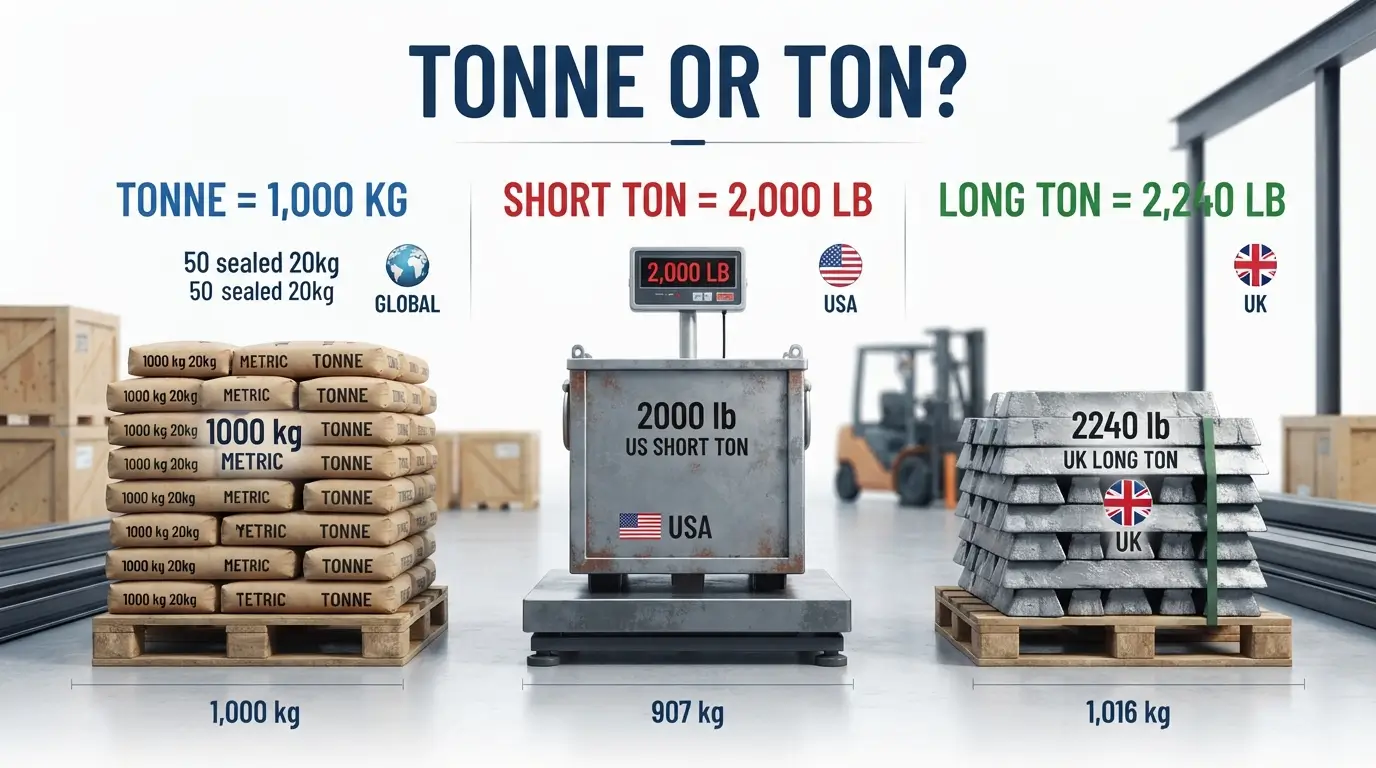
A metric tonne is also equal to 1,000,000 grams and about 2,204.62 pounds. By contrast, a US short ton equals exactly 2,000 pounds, while a UK long ton equals exactly 2,240 pounds.
The spelling can also provide a useful clue. Tonne is the standard spelling for the metric unit in English. Ton is used for several non-metric units, including the US short ton and UK long ton.
This guide explains tonne or ton in simple terms, including their meanings, origins, pronunciation, regional usage, conversions, common mistakes, and practical examples.
Tonne or Ton – Quick Answer
The short answer is:
A tonne = 1,000 kilograms.
A ton can mean different amounts depending on the system.
Here is the basic comparison:
| Unit | Exact value |
| 1 metric tonne | 1,000 kg |
| 1 US short ton | 2,000 lb |
| 1 US short ton | 907.18474 kg |
| 1 UK long ton | 2,240 lb |
| 1 UK long ton | 1,016.0469088 kg |
So, tonne and ton are not always the same measurement.
For example:
The truck is carrying 5 tonnes of material.
This normally means:
5,000 kilograms.
But:
The truck is carrying 5 tons.
The exact weight is unclear unless the measurement system is known.
In a US context, 5 tons often means 5 short tons, or 10,000 pounds.
In a historical British context, 5 tons may refer to 5 long tons, or 11,200 pounds.
Why does this matter?
The difference may seem small in everyday conversation, but it can become important when large quantities are involved.
For example, confusing one short ton with one tonne creates a difference of more than 92 kilograms for every unit.
That can matter in:
- Shipping
- Construction
- Engineering
- Manufacturing
- Agriculture
- Mining
- International trade
- Scientific writing
When precision matters, always identify the unit clearly.
The Origin of tonne or ton
The words ton and tonne are historically related.
Where did ton come from?
The English word ton has a long history and is related to older words referring to a large container or cask.
Merriam-Webster traces ton to Middle English and Old English forms, with its history connected to words for a large container or cask. Over time, the word became associated with a unit of weight.
The exact historical development is more complex than simply saying that a ton originally meant a particular number of pounds. Different ton standards developed in different places and periods.
That history helps explain why ton can still refer to different units today.
Where did tonne come from?
Tonne is a metric unit name borrowed from French tonne.
The metric tonne was established as part of the metric system and represents exactly 1,000 kilograms.
The spelling with -ne helps distinguish the metric unit from the various units called ton.
This distinction is particularly useful in international writing.
For example:
50 tonnes of steel
clearly indicates the metric unit.
By contrast:
50 tons of steel
requires the reader to determine which ton is intended.
Why do tonne and ton have different spellings?
The spelling difference helps distinguish the metric tonne from traditional or customary tons.
This is especially important because the metric system defines a tonne precisely as 1,000 kilograms, while the word ton has historically been used for more than one unit.
Therefore:
tonne → metric system
ton → short ton, long ton, or another specified ton
The words are related, but modern measurement systems give them different technical roles.
Pronunciation of tonne and ton
Unlike some confusing word pairs, tonne and ton are normally pronounced the same.
Both sound like:
tun
A simple pronunciation guide is:
- ton: tun
- tonne: tun
In the International Phonetic Alphabet, the common pronunciation is approximately /tʌn/ in many varieties of English.
The extra -ne in tonne is therefore silent.
This creates an important writing problem:
You can hear someone say:
“ten ton”
and you cannot determine from the sound alone whether they mean ten tonnes, ten short tons, or ten long tons.
The surrounding context must provide the answer.
That is why careful technical writing should not rely on pronunciation.
Instead, write the complete unit:
10 tonnes
or:
10 US short tons
or:
10 UK long tons
when precision is important.
Tonne vs Ton: What Is the Actual Difference?
The key difference is the measurement system.
Tonne
A tonne is a metric unit.
It is exactly:
1 tonne = 1,000 kilograms
Because the kilogram is the SI base unit of mass, the tonne is widely used alongside the metric system.
You may see tonnes in:
- International shipping
- European trade
- Scientific and engineering documents
- Environmental reports
- Agriculture
- Manufacturing
- Global statistics
Short ton
The short ton is the ton commonly used in the United States.
It equals:
2,000 pounds
In kilograms:
1 short ton = 907.18474 kg
Therefore, one short ton is lighter than one metric tonne.
Long ton
The long ton, also called the imperial ton, equals:
2,240 pounds
In kilograms:
1 long ton = 1,016.0469088 kg
Therefore, a long ton is slightly heavier than a metric tonne.
Simple comparison
Think of the three units this way:
Short ton → 907.18 kg
Tonne → 1,000 kg
Long ton → 1,016.05 kg
The tonne sits between the short ton and long ton.
British English vs American English Spelling
There is a genuine regional difference in how ton is commonly understood, but tonne itself is not simply a British spelling of ton.
In both British and American English, tonne refers to the metric unit of 1,000 kilograms.
The main difference concerns the traditional ton.
In modern US usage, ton generally means the short ton, equal to 2,000 pounds.
In British usage, ton historically referred to the long ton, equal to 2,240 pounds, although the metric tonne is now widely used in Britain.
| Term | British English | American English |
| tonne | 1,000 kg | 1,000 kg |
| ton | Traditionally 2,240 lb | Generally 2,000 lb |
| Long ton | 2,240 lb | Recognized as a specified unit |
| Short ton | Recognized as a specified unit | 2,000 lb |
| Metric ton | Often understood as tonne | Often used for 1,000 kg |
Important point about “metric ton”
American English often uses the phrase metric ton for 1,000 kilograms.
This means:
metric ton = tonne = 1,000 kg
However, tonne is the internationally standardized spelling for the metric unit.
For technical or international writing, tonne can remove ambiguity.
Which Spelling Should You Use?
The best choice depends on your audience.
For international writing
Use tonne when you mean exactly 1,000 kilograms.
Example:
The factory produces 20,000 tonnes of cement each year.
This is clear and internationally recognizable.
For American readers
If you are writing for a US audience, ton normally refers to the short ton.
Example:
The machine can lift two tons.
If the exact measurement matters, you can write:
The machine can lift two US short tons.
For metric measurements, use:
2 metric tons
or:
2 tonnes
For British readers
British readers may understand ton as an imperial long ton in older or specific contexts. Modern British writing also commonly uses metric units.
If you mean 1,000 kilograms, write:
2 tonnes
This avoids confusion.
For scientific and technical writing
Do not leave the unit ambiguous when precision matters.
Instead of:
The material weighs 100 tons.
write:
The material has a mass of 100 tonnes.
Or specify the exact customary unit:
The material weighs 100 US short tons.
Clear units make technical writing safer and easier to understand.
Common Mistakes with tonne or ton
Mistake 1: Assuming every ton equals 1,000 kg
This is one of the biggest errors.
A tonne is 1,000 kg.
A US short ton is only about 907.18 kg.
A UK long ton is about 1,016.05 kg.
Mistake 2: Treating tonne as a British spelling of ton
This is not correct.
Tonne specifically identifies the metric unit.
Ton can refer to different customary units.
Mistake 3: Using “ton” in international documents without defining it
A reader may not know whether you mean:
- metric tonne
- US short ton
- UK long ton
When accuracy matters, specify the unit.
Mistake 4: Thinking tonne and ton are pronounced differently
They are normally pronounced the same.
The difference is primarily visible in writing.
Mistake 5: Assuming the spelling tells you everything
Seeing ton does not always tell you which ton is intended.
Context matters.
A US engineering document may use ton for short tons. A historical British document may use it for long tons.
Mistake 6: Confusing mass and weight in technical writing
In everyday English, people often use “weight” for how heavy something is.
In technical contexts, however, mass and weight are different physical quantities.
A tonne is technically a unit of mass.
This distinction matters in science and engineering.
Tonne or Ton in Everyday Examples
In emails
A shipping company might write:
The shipment contains 25 tonnes of raw material.
A US business might write:
The shipment contains 25 tons of material.
For an international audience, the first version is clearer if the intended unit is metric.
In news writing
A news report may say:
The country exported thousands of tonnes of grain last year.
An American report may use:
The company shipped thousands of tons of grain.
The writer’s measurement system determines the meaning.
In social media
You might see:
We just recycled one tonne of plastic!
Here, the metric unit is clear.
A US user might instead write:
We recycled two tons of plastic!
In casual writing, the unit may be understood from the audience and location.
In formal writing
A technical report should avoid unnecessary ambiguity:
The facility processed 12,500 tonnes of waste.
This is more precise than:
The facility processed 12,500 tons of waste.
If the latter is used, the document should establish which ton is intended.
In construction
A contractor might say:
We need five tonnes of gravel.
In a US project, someone might say:
We need five tons of gravel.
These statements are not necessarily equal. The exact unit depends on the measurement convention being used.
Tonne or Ton Conversion Table
| Amount | Metric tonnes | US short tons | UK long tons |
| 1 tonne | 1 | 1.10231 | 0.984207 |
| 5 tonnes | 5 | 5.51156 | 4.92103 |
| 10 tonnes | 10 | 11.0231 | 9.84207 |
| 20 tonnes | 20 | 22.0462 | 19.6841 |
| 50 tonnes | 50 | 55.1156 | 49.2103 |
| 100 tonnes | 100 | 110.231 | 98.4207 |
These figures show why the unit should be identified when large quantities are involved.
For quick reference:
1 tonne = 1,000 kg
and
1 tonne ≈ 2,204.62 lb
1 US short ton ≈ 907.18 kg
and
1 UK long ton ≈ 1,016.05 kg
FAQs About tonne or ton
1. Is a tonne the same as a ton?
Not always. A tonne is exactly 1,000 kilograms. A ton can mean a short ton or long ton, depending on the measurement system.
2. How many kilograms are in a tonne?
There are exactly 1,000 kilograms in one tonne.
3. How many kilograms are in a US ton?
A US short ton equals exactly 907.18474 kilograms.
4. How many kilograms are in a UK ton?
A UK long ton equals exactly 1,016.0469088 kilograms.
5. Is tonne British or American?
Tonne is used in both British and American English for the metric unit. American English also commonly uses metric ton for the same 1,000-kilogram unit.
6. Are tonne and ton pronounced the same?
Yes. They are normally pronounced “tun.” The spelling difference is not normally reflected in the pronunciation.
7. Should I use tonne or ton?
Use tonne when you mean exactly 1,000 kilograms. Use ton when the relevant measurement system clearly defines it, such as a US short ton or a specified UK long ton.
Conclusion
The simplest way to remember tonne or ton is to connect tonne with the metric system. One tonne always equals 1,000 kilograms.
The word ton is less precise because it can describe different units. In the US, it usually means a short ton, while historical British usage includes the long ton.
For global, scientific, or technical writing, naming the exact unit is the safest choice. It prevents errors and makes your meaning clear.
Once you learn this difference, writing about large measurements becomes much easier. Practice the terms in reports, emails, and daily examples to make them feel natural.

Ezra Hale is a thoughtful contributor to Distinly.com, where he explores philosophical ideas and the subtle differences behind everyday concepts. His writing blends logic, language, and human insight to clarify complex distinctions. Ezra encourages readers to think deeper, question assumptions, and appreciate the meaning behind words and ideas in modern discourse.