A quiet pond and a wide lake may look similar, but they are not always the same. Both are bodies of standing water, both support plants and animals, and both can be beautiful places to visit. The confusion begins because there is no single worldwide rule that separates a pond from a lake.
People often search for the difference between pond and lake because size seems like the obvious answer. A lake is usually larger, while a pond is usually smaller. However, size alone does not settle every case. Depth, sunlight, water temperature, plant growth, local naming traditions, and scientific definitions can also matter.
Understanding the difference between pond and lake helps students, travelers, writers, and nature lovers describe freshwater environments more accurately. It also explains why one place may be called a pond on a map even when it seems larger than another place called a lake.
This guide explores the difference between pond and lake in simple language. It covers their meaning, origin, spelling, physical features, common mistakes, and practical examples so you can use both words with confidence.
Quick Answer
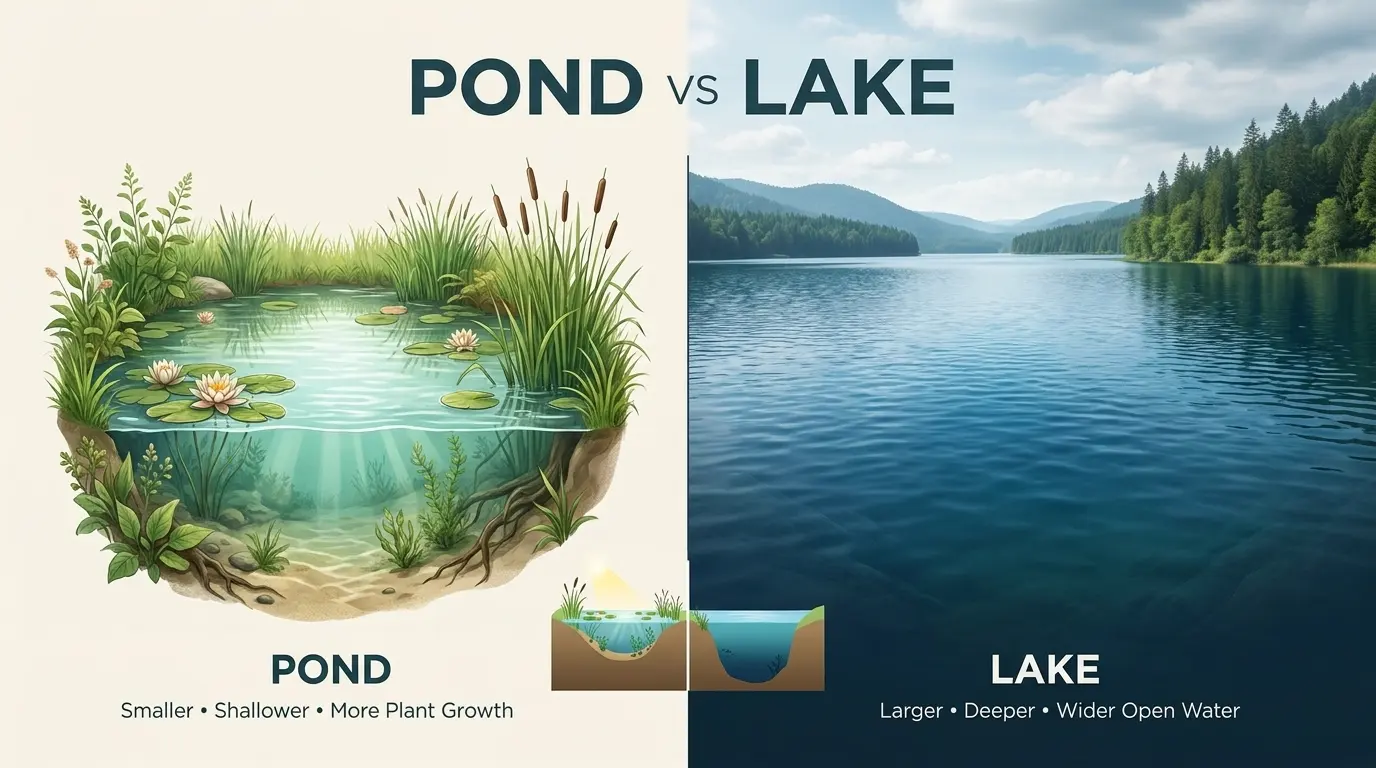
A pond is usually a smaller and shallower body of standing water. A lake is usually larger and deeper, although the exact boundary between the two is not fixed.
A pond often allows sunlight to reach much or all of its bottom. This can support many rooted water plants across the area. A lake may have deeper sections where sunlight cannot reach the bottom, creating different zones of temperature, light, and plant life.
| Feature | Pond | Lake |
|---|---|---|
| Usual size | Smaller | Larger |
| Usual depth | Shallower | Deeper |
| Sunlight | Often reaches much of the bottom | May not reach the deepest areas |
| Plant growth | Aquatic plants may grow across much of the water | Plants may be concentrated near the edges |
| Water temperature | Often changes more quickly | May form separate temperature layers |
| Waves | Usually small or limited | Can produce larger waves |
| Definition | Often based on local use and physical traits | Often based on local use and physical traits |
These are general patterns, not strict laws. Some ponds are quite large, and some lakes are small. The words may also depend on local history and tradition.
The Origin of Pond and Lake
The word pond comes from Middle English pond or ponde. It is related to the Old English word pund, which referred to an enclosed place or enclosure. Over time, the word became associated with a small body of water, especially one formed or enclosed for a particular purpose.
The word lake has a different history. It comes from Middle English lake, from Old French lac, and ultimately from Latin lacus, meaning “lake,” “pond,” or “basin.” This history shows that the word has long been used for a body of inland water.
The terms developed through everyday use rather than from one universal scientific measurement. People named bodies of water based on appearance, location, size, local custom, and practical use. As a result, the words do not have one exact boundary that applies everywhere.
Pronunciation
The two words are easy to pronounce and do not sound alike:
- Pond: rhymes with “bond”
- Lake: rhymes with “make”
Their pronunciation is usually not the source of confusion. The main difficulty is their meaning and the lack of a strict dividing line.
Parts of Speech
Both pond and lake are usually used as countable nouns.
Examples:
- We visited a pond near the school.
- The town has three lakes.
- Ducks were swimming in the pond.
- The lake attracts many visitors.
They can also act as nouns in compound words:
- pond water
- pond life
- lake shore
- lake water
- lake district
The related adjectives are:
- pond-like
- lake-like
- lacustrine, a formal adjective meaning related to lakes
- pond-based, when describing something connected with a pond
What Is a Pond?
A pond is a body of standing water that is usually smaller and shallower than a lake. It may form naturally or be created by people.
Natural ponds can develop in low areas where rainwater, groundwater, or runoff collects. artificial ponds may be built for farming, gardening, wildlife, fishing, decoration, or water storage.
Because ponds are often shallow, sunlight may reach most of the bottom. This allows rooted plants to grow in many areas. Common pond life includes:
- algae
- reeds
- water lilies
- insects
- frogs
- turtles
- ducks
- small fish
- microorganisms
Ponds can be temporary or permanent. A seasonal pond may fill during rainy months and dry out during a hot or dry season. A permanent pond usually holds water throughout the year, although its level may change.
A pond does not have to be perfectly round or completely natural. It may be surrounded by grass, trees, gardens, farmland, or buildings.
What Is a Lake?
A lake is a body of standing or slow-moving inland water surrounded partly or fully by land. Lakes are usually larger and deeper than ponds, but their size can vary greatly.
Lakes may form through several natural processes, including:
- glacial movement
- volcanic activity
- tectonic changes
- river blockage
- landslides
- melting ice
- changes in drainage patterns
Some lakes are also artificial. Reservoirs created by dams are often called lakes, although they may be described as reservoirs in technical contexts.
Lakes can contain several ecological zones. Shallow edge areas may support reeds and other plants. Open water may contain fish and plankton. Deep areas may receive little sunlight and may have lower oxygen levels at certain times of the year.
Large lakes can also develop waves caused by wind. Their water temperature may change more slowly than pond water. In deep lakes, warmer and colder layers may form during certain seasons.
The Main Physical Differences Between Ponds and Lakes
1. Size
Size is the most common way people distinguish ponds from lakes. A pond is generally smaller, while a lake is generally larger.
However, no single size limit works in every country or scientific system. One community may call a body of water a pond, while another may call a similar body a lake.
2. Depth
Ponds are usually shallow enough for sunlight to reach much of the bottom. Lakes often have deeper sections where sunlight cannot reach.
Depth affects water temperature, oxygen levels, plant growth, and the types of animals that can live there.
3. Light
In a shallow pond, sunlight can reach the bottom across much of the water. This encourages the growth of rooted plants.
In a deeper lake, light may only reach the upper layers. Plants are often more common near the shore, where the water is shallow.
4. Temperature
Pond water may warm and cool quickly because the water is shallow. Weather can affect the entire pond within a short time.
A deep lake may develop layers with different temperatures. The surface can be warmer than the deeper water, especially during summer.
5. Waves and movement
Most ponds have small waves, although strong winds can still disturb their surface. Larger lakes can develop noticeable waves that affect boats, shorelines, and erosion.
Both ponds and lakes are usually classified as standing-water systems. This separates them from rivers and streams, where water flows in a clear direction.
6. Plant growth
Ponds often support more widespread plant growth because sunlight reaches much of the bottom. Lakes may have dense plant growth near the shore but less growth in deep open water.
This is not always true. Nutrient levels, pollution, water clarity, climate, and invasive species can change plant growth in either environment.
7. Water chemistry
Both ponds and lakes may contain freshwater, but their chemistry can differ. Ponds may show faster changes in oxygen, temperature, and nutrient levels. Lakes often have more stable conditions in deeper water.
Some ponds and lakes are salty or brackish. The words do not always guarantee that the water is fresh.
Why There Is No Exact Universal Boundary
Many people expect a scientific rule such as “a pond is less than one acre, and a lake is more than one acre.” In reality, such rules are not universal.
Different regions, agencies, textbooks, and researchers may use different criteria. Some definitions focus on surface area. Others consider depth, light penetration, water circulation, or whether aquatic plants can grow across the bottom.
Local names also matter. A small body of water may be called a lake because of history or tradition. A large body may be called a pond because it was originally built as a farm pond or ornamental pond.
For this reason, it is safer to say:
A pond is generally smaller and shallower than a lake, but the exact distinction depends on local usage and scientific context.
British English vs American English Spelling
There is no meaningful British English versus American English spelling difference between pond and lake. Both varieties use the same spellings.
| Word | British English | American English | Meaning |
|---|---|---|---|
| Pond | pond | pond | A usually small body of standing water |
| Lake | lake | lake | A usually larger body of inland water |
The words may have slightly different local associations, but their spelling remains the same. British and American speakers generally understand both terms in the same way.
Some related expressions may vary by region:
- lake shore and lakeshore
- lake side and lakeside
- pond side and pondside
In common writing, lakeside is usually written as one word when used as an adjective or noun. Lakeshore is also commonly written as one word in American English, while lake shore may appear in British or general descriptive writing. These are style preferences, not changes to the core words.
Which Spelling Should You Use?
Use pond and lake in both British and American English. There is no need to change the spelling for a US, UK, Commonwealth, or global audience.
For formal writing, choose the word that best fits the physical setting:
- Use pond for a small, shallow, enclosed body of water.
- Use lake for a larger or deeper inland body of water.
- Use the official local name when describing a named place.
If a place is officially called a lake, keep that name even if it seems small. Proper names follow local tradition rather than a universal size rule.
For scientific or academic writing, define your terms if the distinction matters. For example:
In this study, ponds refer to shallow standing-water bodies where sunlight reaches most of the bottom.
This approach avoids confusion when different sources use the terms differently.
Common Mistakes with the Difference Between Pond and Lake
1. Assuming every pond is artificial
Not all ponds are made by people. Many ponds form naturally through rainfall, groundwater, melting snow, or changes in the land.
Better understanding:
- A pond may be natural or artificial.
- A decorative garden pond is artificial.
- A woodland pond may be natural.
2. Assuming every lake is huge
Some lakes are small. The word does not always describe a massive body of water.
A better rule is that lakes are usually larger or deeper than ponds in the same local context.
3. Treating size as the only difference
Size is useful, but depth, light, temperature, plant growth, and local naming also matter.
A shallow body of water may function more like a pond even if its surface area is large.
4. Using “river” for any body of water
A pond or lake usually holds standing water. A river or stream has flowing water.
Incorrect:
- We went boating on the river, but the water had no current and was surrounded by land.
Better:
- We went boating on the lake.
5. Believing ponds cannot have fish
Many ponds support fish. Their size does not prevent them from being healthy habitats.
Ponds may contain carp, bass, minnows, catfish, or other fish, depending on the region and water conditions.
6. Assuming all lakes are freshwater
Many lakes are freshwater, but some contain salty or mineral-rich water. The word lake describes the type of water body, not its exact chemistry.
The Difference Between Pond and Lake in Everyday Examples
In emails
We will meet beside the pond behind the office.
The team plans to visit the lake during the field trip.
The word pond suggests a smaller nearby water feature. Lake suggests a larger natural or recreational setting.
In news reports
Heavy rain caused the pond to overflow near the village.
Strong winds created large waves on the lake.
News writing often uses details such as flooding, waves, fishing, boating, or water levels to show the setting.
On social media
A peaceful morning by the pond.
Sunset views across the lake.
Both words can create a calm outdoor image, but lake often suggests a wider view, while pond may suggest a quiet, intimate place.
In formal writing
The researchers measured water temperature at several points in the lake.
The school created a small pond to support local wetland species.
In academic writing, the word should match the study’s definition. If the terms are important to the research, explain how they are being used.
In travel writing
The walking trail passes a small pond surrounded by trees.
Visitors can kayak across the lake and explore the nearby shoreline.
The choice of word helps readers imagine the scale and activities associated with the place.
A Simple Way to Remember the Difference
Use this memory guide:
- Pond: smaller, shallower, often plant-filled
- Lake: larger, deeper, often has open-water zones
You can also remember the story function of each word:
- A pond often appears in descriptions of gardens, farms, parks, wetlands, and small natural habitats.
- A lake often appears in descriptions of boating, fishing, beaches, mountains, tourism, and large landscapes.
Still, these are common patterns rather than strict rules. A pond can be beautiful and large, and a lake can be small and quiet.
Frequently Asked Questions
1. What is the main difference between a pond and a lake?
A pond is usually smaller and shallower, while a lake is usually larger and deeper. However, there is no universal size limit that separates them.
2. Is a pond always smaller than a lake?
Usually, but not always. Local naming traditions and different scientific definitions can create exceptions.
3. Can a pond be natural?
Yes. Ponds can form naturally through rainfall, groundwater, melting snow, or changes in the land. They can also be built by people.
4. Can a lake be artificial?
Yes. Reservoirs and other artificial water bodies are sometimes called lakes, especially when they resemble natural lakes in size and use.
5. Are ponds always shallow?
Ponds are generally shallow compared with lakes, but some ponds may have deeper areas. The term does not guarantee one exact depth.
6. Do lakes always have waves?
Not always. Small lakes may be calm, but larger lakes can develop waves when wind moves across their surface.
7. Which word should I use in formal writing?
Use the official name of the water body when one exists. Otherwise, use pond for a generally smaller, shallower body and lake for a generally larger or deeper one. Define the terms if scientific precision is important.
Conclusion
The difference between pond and lake is mainly a matter of size, depth, light, and local naming. A pond is usually smaller and shallower, while a lake often has deeper open water.
Both habitats support plants, animals, and important natural processes. Their value does not depend on their size, and even a small pond can support a rich community of life.
Because no universal rule separates every pond from every lake, context matters. Local names, scientific definitions, and physical features may all affect the correct description.
Once you understand these patterns, you can use both words with confidence. Practice them in emails, essays, travel writing, and daily conversations to make your descriptions clearer.

Aamer Shahzad is the founder of Distinly.com, a fast-growing educational platform focused on high-intent “difference between” topics. With over 8 years of experience in English language education and analytical writing, I specialize in breaking down complex “difference between” topics into clear, structured, and easy-to-understand explanations. Distinly.com is your go-to resource for enhancing English skills and writing with confidence.
I specializes in building search-optimized, research-driven comparison content designed for clarity, authority, and long-term digital asset value.