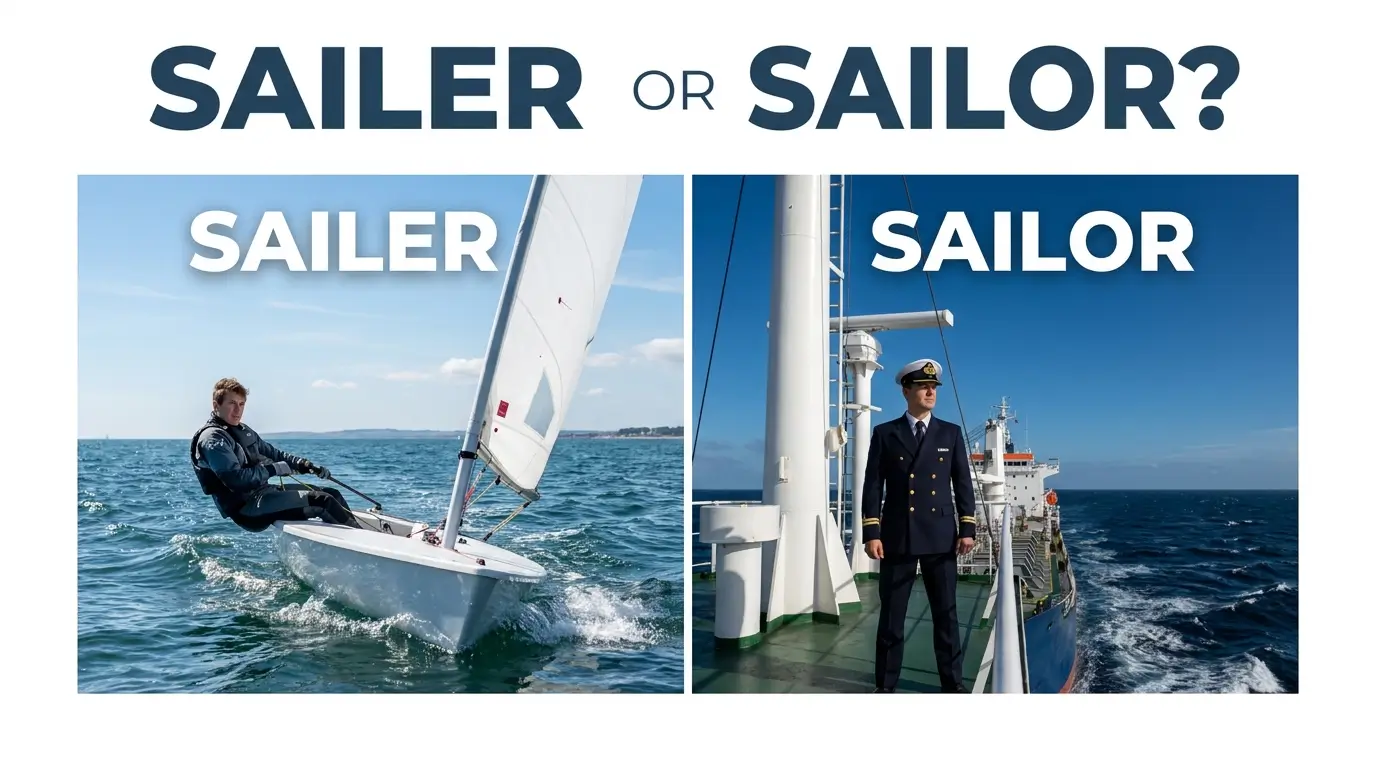
At first glance, sailer or sailor may look like a simple spelling choice. The two words sound the same in many varieties of English, and both are connected to the verb sail. However, they do not have exactly the same modern meaning or use.
The word sailor is the standard English word for a person who works on a ship, serves as a non-officer member of a ship’s crew, or takes part in sailing as a sport. It is the normal spelling you should use when referring to a person.
The word sailer is also a real English word, but it is much less common. It generally refers to a ship or boat, especially one considered in terms of how well or how fast it sails. Dictionaries give examples such as a good sailer and a swift sailer.
This makes sailer or sailor a useful word pair to understand. The difference is not simply a spelling mistake. Both forms have a history, but modern English strongly prefers sailor when talking about a person.
Quick Answer
The short answer is:
- Sailor = a person who works on or operates a boat or ship.
- Sailer = a ship or boat, especially one described by its sailing ability.
Sailor
Sailor is a noun. It refers to a person who works on a ship or takes part in sailing. Cambridge defines a sailor as someone who works on a ship, especially someone who is not an officer, and also uses the word for people who participate in sailing as a sport.
Examples:
The sailor returned to port after a long voyage.
She became a skilled sailor at a young age.
Several sailors were working on the deck.
In modern English, sailor is the normal choice when the subject is a person.
Sailer
Sailer is also a noun, but it usually refers to a vessel.
Merriam-Webster defines sailer as a ship or boat, especially one with particular sailing qualities.
Examples:
The yacht is a fast sailer.
The old schooner was considered a good sailer.
They were looking for a reliable sailer for long trips.
Here, sailer describes the boat rather than the person operating it.
The easiest rule
Remember this simple distinction:
Person → sailor
Boat or ship → sailer
So:
He is a skilled sailor.
But:
His yacht is a fast sailer.
This rule will help you avoid the most common spelling error.
The Origin of Sailer or Sailor
The two words have closely connected histories because both developed from the verb sail. However, their modern spelling and usage developed differently.
Origin of sailer
Sailer is an old formation built from sail + -er. The suffix -er can create a noun referring to someone or something associated with an action.
Historical dictionaries trace sailer to Middle English forms such as sailer, sayler, and saylere. Collins gives its origin as Middle English and dates the word to roughly 1350–1400.
Historically, sailer could refer to one who sails, but it also developed a specialized use for a ship or vessel considered according to its sailing performance.
That older meaning survives today in phrases such as:
a fast sailer
a good sailer
a poor sailer
In these expressions, the word describes the vessel’s sailing qualities.
Merriam-Webster lists sailer as a noun and records its first known use in the 15th century.
Origin of sailor
The history of sailor is especially interesting because sailer came first as a spelling.
Etymological sources trace sailor to around 1400, when sailer meant “one who sails.” The spelling with -o- became established during the 16th century. Etymonline suggests that the change may have been influenced by words such as tailor, and it may also have helped distinguish the person-related sense from the word sailer referring to a thing that sails.
This means that modern sailor is not simply an unrelated word. It developed from an earlier sailer form.
Over time, sailor became the established spelling for a person who sails or works at sea.
Today, dictionaries treat sailor as the standard word for a person. Cambridge and Merriam-Webster both define it in terms of people who work or sail on boats and ships.
Why are the spellings different?
The difference developed historically rather than from a modern British-versus-American spelling rule.
The spelling sailor became established for the person.
The spelling sailer remains in use for a vessel, especially when discussing its sailing characteristics.
So the distinction is mainly one of modern meaning and established spelling, not a simple regional spelling preference.
How Do You Pronounce Sailer and Sailor?
Sailer and sailor are normally pronounced the same.
Cambridge gives sailor as approximately /ˈseɪ.lər/ in American English and /ˈseɪ.lə(r)/ in British English.
Sailer is also pronounced approximately the same way.
A simple learner guide is:
sailer → “SAY-ler”
sailor → “SAY-ler”
Because the words sound alike, context is especially important when listening to them.
For example, if someone says:
“He is a sailor.”
You understand that sailor refers to a person.
If someone says:
“That boat is a fast sailer.”
The surrounding words show that sailer refers to the vessel.
This is one reason learners often confuse the spellings when writing.
The pair can therefore be treated as homophones in ordinary pronunciation, even though their spellings and meanings differ.
British English vs American English Spelling
There is no major British-versus-American spelling difference between sailer and sailor.
Both British and American English use:
- sailor for a person
- sailer for a ship or boat described by its sailing qualities
Collins gives the same basic distinction in both British and American entries for sailer. Its British entry defines the word as a vessel with particular sailing characteristics, while its American entry gives the same general vessel-related meaning.
Likewise, Cambridge gives sailor in both British and American English for a person who works on or sails boats and ships.
| Feature | British English | American English |
| Person who sails | sailor | sailor |
| Ship/boat with sailing qualities | sailer | sailer |
| Standard spelling for a person | sailor | sailor |
| Standard spelling for vessel sense | sailer | sailer |
| Main pronunciation of sailor | /ˈseɪ.lə(r)/ | /ˈseɪ.lɚ/ |
| Regional spelling difference | None | None |
The pronunciation of the final unstressed syllable can vary because British and American accents treat the r differently, but this does not create a spelling difference.
Therefore, do not assume that sailer is the British spelling and sailor is the American spelling. That would be incorrect.
Which Spelling Should You Use?
Your choice depends mainly on what you are describing.
If you mean a person, use sailor
This is the most important rule.
The sailor repaired the rope.
She works as a sailor on a cargo ship.
The young sailor learned how to navigate.
In modern standard English, sailor is the natural spelling for the person.
If you mean a boat, sailer can be correct
Use sailer when you are talking about a vessel’s ability or manner of sailing.
The yacht is an excellent sailer.
They bought a fast sailer for coastal trips.
This use is less common in everyday conversation than sailor, so some readers may not recognize it immediately.
For American readers
Use sailor when referring to a person.
If you are writing about boats, sailer is a legitimate dictionary word, particularly when discussing performance or sailing characteristics.
For British and Commonwealth readers
The same basic rule applies.
Use sailor for the person and sailer for the vessel-related sense.
Do not change the spelling simply because your audience uses British English.
For global English
If you are writing for an international audience, sailor is the safest choice when you mean a person.
If you mean a boat, consider whether sailing vessel, sailboat, or another clearer term would make the sentence easier to understand.
For example:
The boat is a good sailer.
This is correct, but:
The boat sails very well.
may be clearer for general readers.
Common Mistakes
Because the two words sound alike, writers often choose the wrong spelling.
Mistake 1: Using sailer for a person
Incorrect:
My brother is a sailer.
Better:
My brother is a sailor.
When referring to a person who sails or works on a ship, sailor is the standard spelling.
Mistake 2: Using sailor for a boat
Incorrect in the vessel-specific sense:
This yacht is a fast sailor.
Better:
This yacht is a fast sailer.
Here, the yacht itself is being described according to its sailing performance.
Mistake 3: Assuming sailer is always wrong
This is another common error.
Sailer is a real dictionary word. Merriam-Webster defines it as a ship or boat with particular sailing qualities.
So:
a fast sailer
can be correct.
It simply has a narrower and less common use than sailor.
Mistake 4: Treating the pair as British and American variants
Incorrect assumption:
British = sailer
American = sailor
This is not a valid regional spelling rule.
The difference is primarily about meaning and established usage.
Mistake 5: Writing sailer when discussing a sailor’s job
Incorrect:
The sailer joined the crew last year.
Correct:
The sailor joined the crew last year.
The person is the sailor.
Everyday Examples
Seeing the words in different contexts makes the distinction easier to remember.
In emails
Suppose you are writing about a person who works at sea:
We are pleased to welcome Daniel, an experienced sailor, to the team.
Here, sailor refers to a person.
If you are discussing a boat:
The new yacht is a remarkably stable sailer.
Here, sailer refers to the yacht’s sailing qualities.
In news writing
A news article might say:
A sailor was rescued after the vessel encountered rough seas.
The word sailor identifies a person.
A technical or maritime article could say:
The new yacht is a fast sailer designed for offshore racing.
Here, sailer describes the boat.
On social media
A sailing enthusiast might write:
Proud to be a sailor after completing my first ocean crossing!
That is the standard personal use.
A boat owner might post:
This little yacht is a fantastic sailer in light winds.
Here, sailer describes the boat.
In formal writing
Sailor is common in formal writing when referring to maritime workers:
The report recognizes the contributions of every sailor aboard the vessel.
Sailer can appear in technical or descriptive writing about vessels:
The vessel is considered a capable sailer in coastal conditions.
In historical writing
Older texts may use sailer in ways that differ from modern everyday usage. Historical dictionaries show that sailer could refer to a person who sails, while sailor eventually became the more common spelling for the person-related meaning.
This is important when reading older books or historical documents. A form that looks unusual today may still reflect an older stage of English.
Side-by-Side Comparison
| Feature | Sailer | Sailor |
| Part of speech | Noun | Noun |
| Main modern meaning | A ship or boat, especially one considered by sailing ability | A person who sails or works on a ship |
| Refers to a person? | Rare/obsolete in this sense | Yes |
| Refers to a vessel? | Yes | No, not in the standard person-related sense |
| Pronunciation | Usually /ˈseɪlər/ | Usually /ˈseɪlər/ |
| British spelling | sailer | sailor |
| American spelling | sailer | sailor |
| Commonness | Less common | Very common |
| Example | The yacht is a good sailer. | The sailor repaired the sail. |
| Easy memory | Vessel | Person |
A useful memory trick
Think:
Sailor = person
Sailer = thing that sails
The -or spelling is the one you should remember for the person.
The -er spelling can describe the vessel itself.
Another helpful clue is the sentence:
The sailor sails the sailer.
This is grammatically possible, although it sounds deliberately constructed. The sailor is the person, while the sailer is the vessel.
Frequently Asked Questions
Is “sailer” a correct English word?
Yes. Sailer is a legitimate noun. Modern dictionaries define it mainly as a ship or boat, especially one considered in terms of its sailing ability.
Is sailor or sailer correct for a person?
Sailor is the standard modern spelling for a person who works on or sails a boat or ship. Cambridge and Merriam-Webster both use this form.
Are sailer and sailor pronounced the same?
Yes, they are normally pronounced the same in standard English. Both are commonly pronounced with the vowel sound in say, followed by an unstressed syllable.
Is sailer a British spelling of sailor?
No. Sailer is not simply a British spelling of sailor. Both words exist in British and American English, but their meanings and uses differ.
What does “a good sailer” mean?
A good sailer is a ship or boat that has good sailing qualities. It may sail efficiently, handle well, or perform well under the conditions being discussed.
Why is sailor spelled with “or”?
The spelling developed historically from earlier sailer forms. Etymological evidence indicates that the -or spelling became established during the 16th century, possibly influenced by words such as tailor and by a need to distinguish the person-related meaning.
Can I use sailer in everyday writing?
You can, but only when you mean the vessel-related sense. For most everyday writing about a person who sails, use sailor. If your audience may not know the word sailer, a clearer phrase such as sailing vessel may be better.
Conclusion
The difference between sailer or sailor is easier than it first appears. Sailor is the standard word for a person, while sailer usually describes a boat’s sailing ability.
Both words are connected to sail, and their histories explain why the spellings developed differently. Today, meaning should guide your choice.
Remember the simple rule: sailor = person, while sailer = vessel. Since they sound alike, checking the meaning before writing can prevent a spelling mistake.
Keep practicing these words in emails, essays, and daily conversations. With a few real examples, the difference will soon feel natural and easy to remember.

Aamer Shahzad is the founder of Distinly.com, a fast-growing educational platform focused on high-intent “difference between” topics. With over 8 years of experience in English language education and analytical writing, I specialize in breaking down complex “difference between” topics into clear, structured, and easy-to-understand explanations. Distinly.com is your go-to resource for enhancing English skills and writing with confidence.
I specializes in building search-optimized, research-driven comparison content designed for clarity, authority, and long-term digital asset value.