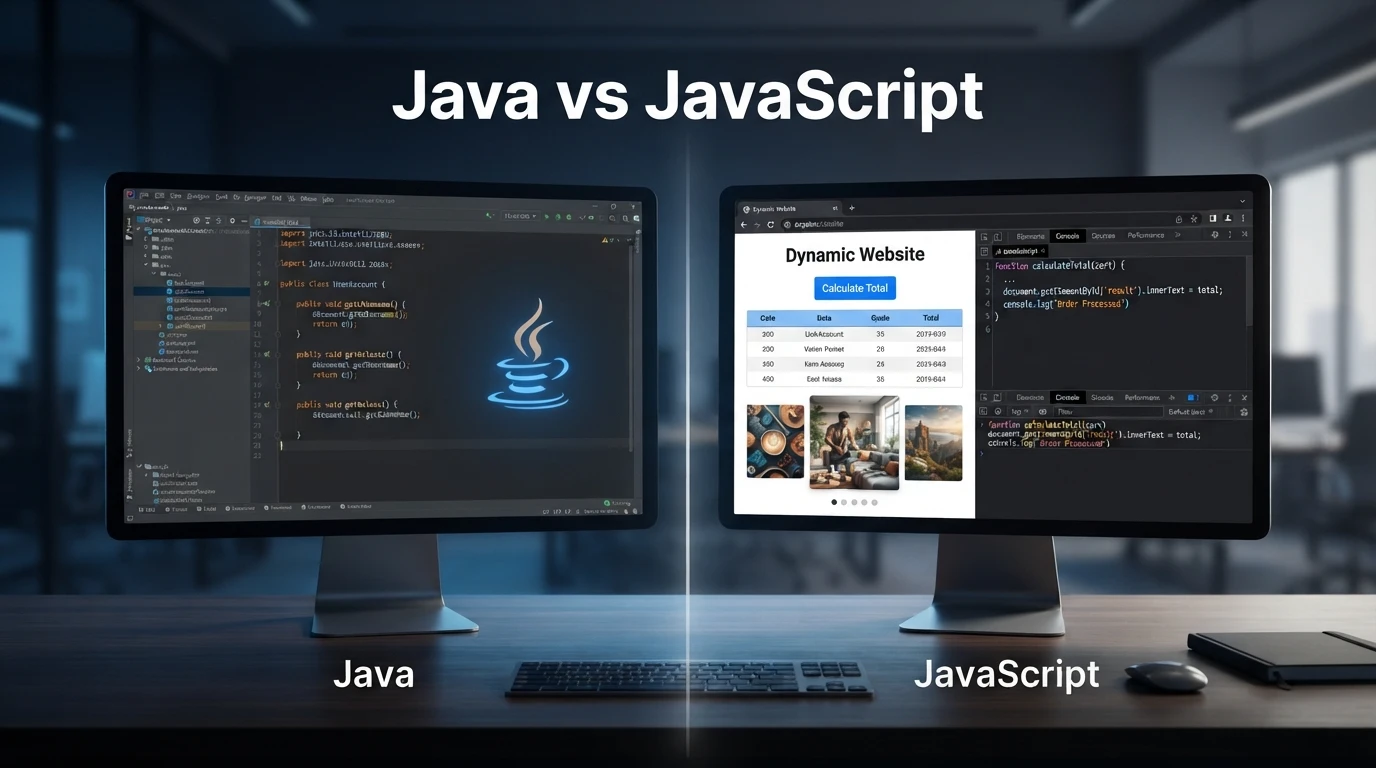
Difference between java and javascript is one of the most common questions for beginners in programming. Imagine you start learning coding and see both names, they sound almost the same. It feels confusing right away.
The difference between java and javascript is actually very important. Even though their names look similar, they are completely different programming languages with different uses and features.
Many learners assume they are related or that one is a version of the other. But understanding the difference between java and javascript helps you choose the right language for your goals.
Let’s break it down in a simple and clear way so you can understand both easily.
🔍 Key Difference Between the Both
The main difference is:
- Java is a general-purpose programming language used for building applications.
- JavaScript is mainly used for making websites interactive.
In simple words, Java builds software, while JavaScript adds life to websites.
🌍 Importance – Why Their Difference Matters
Understanding this difference is very important for learners and professionals.
For students, it helps in choosing the right language to learn. It also avoids confusion when starting programming.
For developers and IT professionals, using the correct language improves efficiency. Each language is designed for different tasks.
In society, technology runs everything from apps to websites. Knowing the right tool helps create better digital solutions.
🔊 Pronunciation Section
Java
US: /ˈdʒɑːvə/
UK: /ˈdʒɑːvə/
JavaScript
US: /ˈdʒɑːvəskrɪpt/
UK: /ˈdʒɑːvəskrɪpt/
Now that you can say them correctly, let’s understand what they mean.
📚 Core Definitions
Java
Java is a high-level, object-oriented programming language used to build applications like mobile apps, desktop software, and backend systems. It is known for its stability and performance.
Example: Android apps are often built using Java.
JavaScript
JavaScript is a scripting language mainly used to create interactive elements on websites. It runs in web browsers and makes pages dynamic.
Example: A button that shows a message when clicked uses JavaScript.
📊 10 Clear Differences Between Java and JavaScript
1. Type of Language
Java is a programming language.
JavaScript is a scripting language.
- Example for Java: Used to build full applications.
- Example for JavaScript: Used inside web pages.
2. Usage Area
Java is used for apps, games, and backend systems.
JavaScript is used for websites and web apps.
- Example for Java: Banking software.
- Example for JavaScript: Interactive website forms.
3. Execution
Java runs on the Java Virtual Machine (JVM).
JavaScript runs in web browsers.
- Example for Java: Requires installation.
- Example for JavaScript: Runs instantly in browser.
4. Syntax Complexity
Java has strict and complex syntax.
JavaScript has flexible and simpler syntax.
- Example for Java: Requires full structure.
- Example for JavaScript: Easier to start coding.
5. Speed
Java is generally faster for large applications.
JavaScript is fast for web-based tasks.
- Example for Java: Handles large systems efficiently.
- Example for JavaScript: Loads quickly on web pages.
6. Object-Oriented Features
Java is strictly object-oriented.
JavaScript is flexible and supports multiple styles.
- Example for Java: Uses classes and objects.
- Example for JavaScript: Uses objects and functions.
7. Compilation
Java is compiled before running.
JavaScript is interpreted during execution.
- Example for Java: Needs compilation step.
- Example for JavaScript: Runs instantly.
8. Platform Independence
Java runs on any platform with JVM.
JavaScript runs in browsers on any device.
- Example for Java: Cross-platform apps.
- Example for JavaScript: Works on all browsers.
9. Security
Java is more secure for backend systems.
JavaScript has more risks in browsers.
- Example for Java: Used in secure systems.
- Example for JavaScript: Needs careful handling.
10. Learning Curve
Java is harder for beginners.
JavaScript is easier to learn first.
- Example for Java: Requires understanding of concepts.
- Example for JavaScript: Beginner-friendly.
🎯 Why Knowing the Difference Matters
Students must know this difference to choose the right programming path. It helps avoid wasting time learning the wrong language.
Professionals need this knowledge to build the right tools. Using Java instead of JavaScript (or vice versa) can lead to poor results.
In communication, using correct terms shows technical understanding. It also helps in interviews and teamwork.
Real-world consequences of confusion
If a company hires a Java developer for web frontend tasks, the project may fail. Similarly, misunderstanding skills can affect career growth.
🧠 Why People Get Confused
Similar Names
Both names start with “Java,” which creates confusion.
Semantic Overlap
Both are programming languages, so people assume they are related.
Context-Based Usage
Both are used in tech discussions, often together.
Informal Speech
People casually shorten names, increasing confusion.
🎭 Connotation & Emotional Tone
Connotation = the emotional meaning associated with a word.
Java
- Positive: Powerful, professional
- Neutral: Enterprise language
- Example: “Java is used in serious applications.”
JavaScript
- Positive: Flexible, creative
- Neutral: Web language
- Example: “JavaScript makes websites interactive.”
🗣 Usage in Metaphors, Similes & Idioms
These terms are rarely used in idioms, but appear in comparisons:
- “Java is the engine, JavaScript is the design.”
- “Java builds the structure, JavaScript adds life.”
Examples:
- Java runs the system behind the app.
- JavaScript controls what users see.
📊 Comparison Table
| Feature | Java | JavaScript |
|---|---|---|
| Meaning | Programming language | Scripting language |
| Tone | Professional | Creative |
| Usage | Apps, backend | Web interaction |
| Context | Software development | Web development |
| Formality | Formal | Semi-formal |
⚖️ Which Is Better in What Situation?
When to use Java
Use Java for building large applications, backend systems, and Android apps. It is strong and reliable for complex projects.
When to use JavaScript
Use JavaScript for websites and web apps. It makes pages interactive and user-friendly.
Situational clarity
Choose Java for system-level work and JavaScript for web-level tasks.
Contextual correctness
If you are working on a website, use JavaScript. If you are building software, use Java.
📖 Literary or Cultural References
- Book: Head First Java (Programming Guide, Kathy Sierra, 2005)
A beginner-friendly guide to learning Java. - Movie: The Social Network (USA, 2010)
Shows the importance of programming and web development.
❓ FAQs
1. Is Java the same as JavaScript?
No, they are completely different languages with different uses.
2. Which is easier to learn?
JavaScript is easier for beginners.
3. Can Java replace JavaScript?
No, both serve different purposes.
4. Is JavaScript only for websites?
Mostly yes, but it is also used in server-side development.
5. Is Java still popular?
Yes, Java is widely used in enterprise systems.
6. Can I learn both?
Yes, many developers learn both languages.
7. Which is better for jobs?
Both have good job opportunities.
8. Do they have the same syntax?
No, their syntax is different.
9. Can Java run in a browser?
Not directly like JavaScript.
10. Why do they have similar names?
JavaScript was named for marketing reasons.
🏁 Conclusion
The difference between java and javascript is clear when you look at their purpose and usage. Java is used for building strong applications, while JavaScript is used to create interactive websites.
Although their names are similar, they are not the same. Each has its own strengths and role in the tech world.
Understanding this difference helps you choose the right path in programming. It also improves your technical knowledge and communication.
Keep learning step by step every concept brings you closer to mastering technology.

Aamer Shahzad is the founder of Distinly.com, a fast-growing educational platform focused on high-intent “difference between” topics. With over 8 years of experience in English language education and analytical writing, I specialize in breaking down complex “difference between” topics into clear, structured, and easy-to-understand explanations. Distinly.com is your go-to resource for enhancing English skills and writing with confidence.
I specializes in building search-optimized, research-driven comparison content designed for clarity, authority, and long-term digital asset value.