Look at a world map and you will see huge areas of blue water marked with names such as the Pacific Ocean, Atlantic Ocean, Mediterranean Sea, and Caribbean Sea. But what makes one an ocean and another a sea?
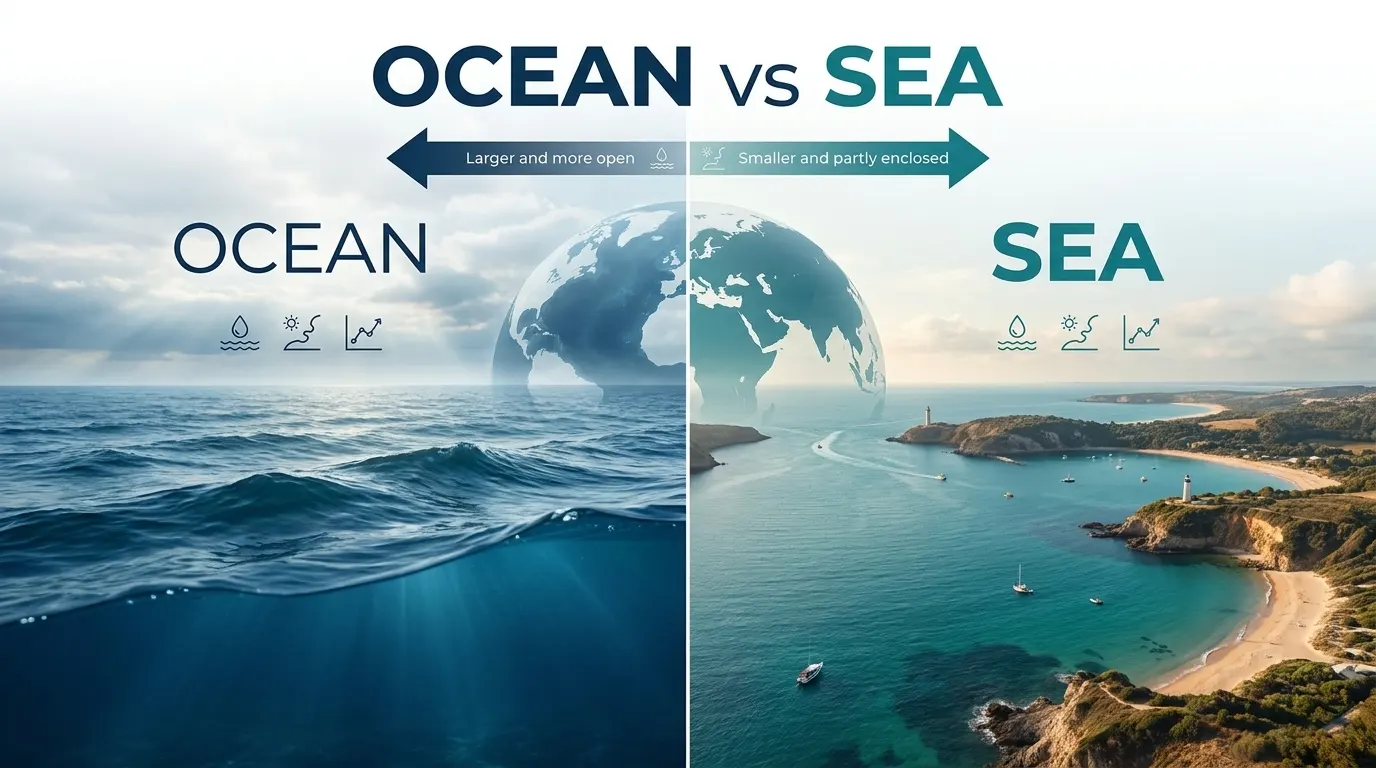
The difference between ocean and sea is not simply size. Oceans are the largest continuous bodies of salt water on Earth, while seas are generally smaller parts of the ocean that are partly enclosed by land. Still, the boundary is not always exact.
People often search for the difference between ocean and sea because everyday speech can make the two words seem interchangeable. A person may say they are going to “the sea,” while a map may identify that same broad region as part of an ocean system.
Understanding the difference between ocean and sea helps with geography, travel writing, science, and everyday English. In this guide, we will look at their meanings, origins, spelling, common mistakes, examples, and the cases where the distinction is less clear.
Quick Answer
The simplest explanation is:
An ocean is a major, very large body of salt water that forms part of Earth’s global ocean system. A sea is generally a smaller body of salt water that is partly enclosed by land and connected to an ocean.
For example:
- The Pacific Ocean is an ocean.
- The Mediterranean Sea is a sea.
- The Caribbean Sea is a sea.
- The Indian Ocean is an ocean.
- The North Sea is a sea.
A simple way to picture it
Think of the ocean as the larger water system and a sea as a smaller, named section that is often more closely surrounded by land.
However, this is a useful general rule, not an absolute law. Some geographic names contain “Sea” even when their physical setting does not perfectly match the usual definition.
For example, the Sargasso Sea is unusual because it is not enclosed by land in the same way as many other seas. It is defined largely by ocean currents.
So, size, location, connection to the ocean, and geography all matter.
The Origin of Ocean and Sea
The words ocean and sea are both very old English words with long histories.
The origin of ocean
The English word ocean ultimately comes through French and Latin from Greek ōkeanós, the ancient name associated with the great body of water thought to surround the known world.
The Greek term became Oceanus in Latin and later developed through several languages before reaching English as ocean.
Today, ocean refers to one of Earth’s major divisions of salt water or to the world’s interconnected ocean system.
The word is a noun:
The ocean covers a vast part of Earth’s surface.
It can also appear before another noun:
Ocean currents affect climate.
The origin of sea
Sea is an old Germanic word. It is related to words found in several Germanic languages, including Old English sǣ.
Its history is much older than modern scientific geography. The word has long been used for large bodies of salt water and, in some contexts, for waters near a coast.
Like ocean, sea is normally a noun:
The sea was calm this morning.
It can also be used before another noun:
Sea water contains dissolved salts.
Why the words developed differently
The two words came into English through different linguistic histories and have developed somewhat different geographical meanings.
Modern geography gives us a useful distinction, but ordinary language has never followed a perfectly strict boundary. Names were shaped by history, exploration, local usage, and tradition.
That is why some named “seas” may look different from the typical definition of a sea.
Pronunciation
The two words are easy to distinguish when spoken.
- ocean: roughly “OH-shun”
- sea: “see”
They are not homophones.
The pronunciation of sea is especially simple for English learners because it sounds exactly like the word see.
For example:
I can see the sea.
The spelling and meaning are different, but the pronunciation is the same.
British English vs American English Spelling
There is no meaningful British-American spelling difference between ocean and sea.
Both varieties use:
- ocean
- sea
The words have the same spelling in British English and American English.
Comparison table
| Word | British English | American English |
|---|---|---|
| Ocean | ocean | ocean |
| Sea | sea | sea |
| Oceans | oceans | oceans |
| Seas | seas | seas |
There is no need to change the spelling based on whether you are writing for readers in the United States, the United Kingdom, or other English-speaking regions.
The main differences you may notice involve geographical naming conventions, not the spelling of the words themselves.
For example, a particular body of water has an official or widely accepted name, and that name should normally be preserved.
Which Spelling Should You Use?
Use ocean and sea in the same way for US, UK, Commonwealth, and global audiences.
The important point is to use the correct geographical name.
For example:
The Pacific Ocean is the largest ocean.
Do not change the name based on regional spelling.
When writing for a global audience, simple sentences work best:
The Mediterranean Sea is connected to the Atlantic Ocean.
This sentence clearly shows the relationship between the two terms.
If you are writing about geography, science, or travel, always check the accepted name of a specific body of water rather than creating your own version.
Common Mistakes with Ocean and Sea
1. Thinking every sea is completely surrounded by land
This is one of the most common misunderstandings.
Many seas are partly enclosed by land, but not all fit that picture perfectly.
The Sargasso Sea, for example, is identified by ocean currents rather than a surrounding coastline.
Better rule: A sea is usually a smaller part of the ocean system, often partly enclosed by land, but exceptions exist.
2. Thinking an ocean is simply a very large sea
In casual speech, people sometimes use the words loosely. In geography, however, oceans are the major divisions of Earth’s global ocean.
Better:
The Atlantic is an ocean, while the Caribbean is a sea.
3. Assuming all seas are smaller than every ocean
Size is useful, but it is not the only factor.
Names and geographic history also matter. A named sea does not always fit a simple size-based formula.
4. Confusing “sea” with “coast”
The sea is the body of water.
The coast is the land along the edge of that water.
Correct:
We walked along the coast and looked out at the sea.
5. Treating “sea level” as the same thing as the surface of one particular sea
Sea level is a reference used in geography and measurement. It does not mean the level of one specific sea at one specific location.
6. Writing “ocean” when referring to a named sea
If you are talking about the Mediterranean, write:
Mediterranean Sea
rather than:
Mediterranean Ocean
The accepted geographical name matters.
7. Assuming the distinction is always exact
Natural geography does not always fit simple categories.
Some bodies of water have historical names that do not perfectly match a modern textbook definition. This is normal and does not make the names incorrect.
Difference Between Ocean and Sea in Everyday Examples
The words appear in many types of everyday writing.
In emails
A travel email might say:
We are staying near the sea for a week and plan to visit several coastal towns.
A more specific message might say:
Our hotel overlooks the Mediterranean Sea.
Both are natural, but the second gives a specific geographical name.
In news writing
A news report might say:
A storm is moving across the Atlantic Ocean.
Another report could say:
Strong winds are affecting coastal areas around the North Sea.
News writing normally uses the official geographical name when discussing a specific location.
On social media
People often use sea in a relaxed way:
Nothing beats watching the sea at sunset.
Or:
I finally saw the Pacific Ocean!
The first focuses on the experience. The second identifies a specific ocean.
In formal writing
Scientific and academic writing needs greater precision:
Ocean circulation moves heat around the planet and influences climate.
A geography paper might state:
The Mediterranean Sea is a semi-enclosed sea connected to the Atlantic Ocean through the Strait of Gibraltar.
In everyday conversation
You might hear:
“Are you going to the beach?”
The beach is the shore area.
“Yes, we’re going to the sea.”
Here, sea refers broadly to the body of salt water.
You might also hear:
“I have always wanted to see the Pacific Ocean.”
Here, ocean identifies one of Earth’s major ocean divisions.
Ocean vs Sea: Side-by-Side Comparison
| Feature | Ocean | Sea |
|---|---|---|
| General size | Usually much larger | Usually smaller |
| Geographic role | Major division of Earth’s ocean system | Usually a smaller part of an ocean |
| Relationship to land | Often bordered by continents | Often partly enclosed by land |
| Salt water | Yes | Usually yes |
| Connection | Forms the global ocean system | Usually connected to an ocean |
| Example | Pacific Ocean | Mediterranean Sea |
| Spelling in US English | ocean | sea |
| Spelling in UK English | ocean | sea |
| Can naming be complex? | Yes | Yes, especially with historical names |
The five oceans
Modern geography commonly recognizes five named oceans:
- Pacific Ocean
- Atlantic Ocean
- Indian Ocean
- Southern Ocean
- Arctic Ocean
These oceans are parts of one interconnected global ocean system.
Examples of seas
There are many named seas around the world, including:
- Mediterranean Sea
- Caribbean Sea
- North Sea
- Black Sea
- Red Sea
- Arabian Sea
- Baltic Sea
Their physical features vary. Some are strongly enclosed by land, while others are more open to the surrounding ocean.
Why Are Some Seas Different From Others?
The word sea does not describe one perfectly uniform physical shape.
Some seas are almost enclosed by land. Others are broad areas connected openly to an ocean. Some names developed because of historical use rather than a modern scientific classification.
This is why a simple statement such as “a sea is always smaller than an ocean and completely surrounded by land” can be misleading.
A better definition is:
A sea is generally a named body of salt water that forms part of the global ocean and is often partly enclosed by land.
This definition leaves room for geographic exceptions.
Ocean water and sea water
There is also no basic chemical rule that makes “ocean water” and “sea water” completely different substances.
Both are salt water within Earth’s connected marine system.
Their local conditions can differ because of:
- Temperature
- Depth
- Freshwater input
- Evaporation
- Ocean currents
- Local climate
- Distance from land
So the distinction is mainly geographical and naming-based, not a simple difference in the water itself.
Frequently Asked Questions
1. What is the main difference between an ocean and a sea?
An ocean is one of the major divisions of Earth’s global ocean system. A sea is generally a smaller part of that system and is often partly enclosed by land.
2. Is a sea smaller than an ocean?
Usually, yes. Seas are generally smaller than oceans, but size alone does not explain every geographical name.
3. Is the Mediterranean Sea an ocean?
No. The Mediterranean Sea is a sea. It is connected to the Atlantic Ocean through the Strait of Gibraltar.
4. Is the Sargasso Sea surrounded by land?
No. The Sargasso Sea is unusual because its boundaries are defined by ocean currents rather than a surrounding coastline.
5. Are oceans and seas both salt water?
Generally, yes. Both are part of Earth’s marine salt-water system, although local water conditions can vary.
6. Which is deeper, an ocean or a sea?
Oceans generally contain the deepest parts of Earth’s marine environment, but individual seas can also have considerable depth. Depth alone is not the defining difference.
7. Are ocean and sea spelled differently in British and American English?
No. Both British and American English use ocean and sea with the same spelling. The main differences concern geographical names and local usage, not these words.
Conclusion
The difference between ocean and sea is mainly about geography, scale, and how bodies of water are defined and named. Oceans form the major global divisions of salt water.
Seas are generally smaller parts of the ocean system and are often partly enclosed by land. Yet geography has exceptions, so size alone is not enough.
Both words have ancient linguistic histories, and neither has a special British or American spelling. The real skill is using each term with the right context.
Keep practicing ocean and sea in emails, essays, and daily conversations. Clear word choices make geography easier to understand and explain.

Aamer Shahzad is the founder of Distinly.com, a fast-growing educational platform focused on high-intent “difference between” topics. With over 8 years of experience in English language education and analytical writing, I specialize in breaking down complex “difference between” topics into clear, structured, and easy-to-understand explanations. Distinly.com is your go-to resource for enhancing English skills and writing with confidence.
I specializes in building search-optimized, research-driven comparison content designed for clarity, authority, and long-term digital asset value.