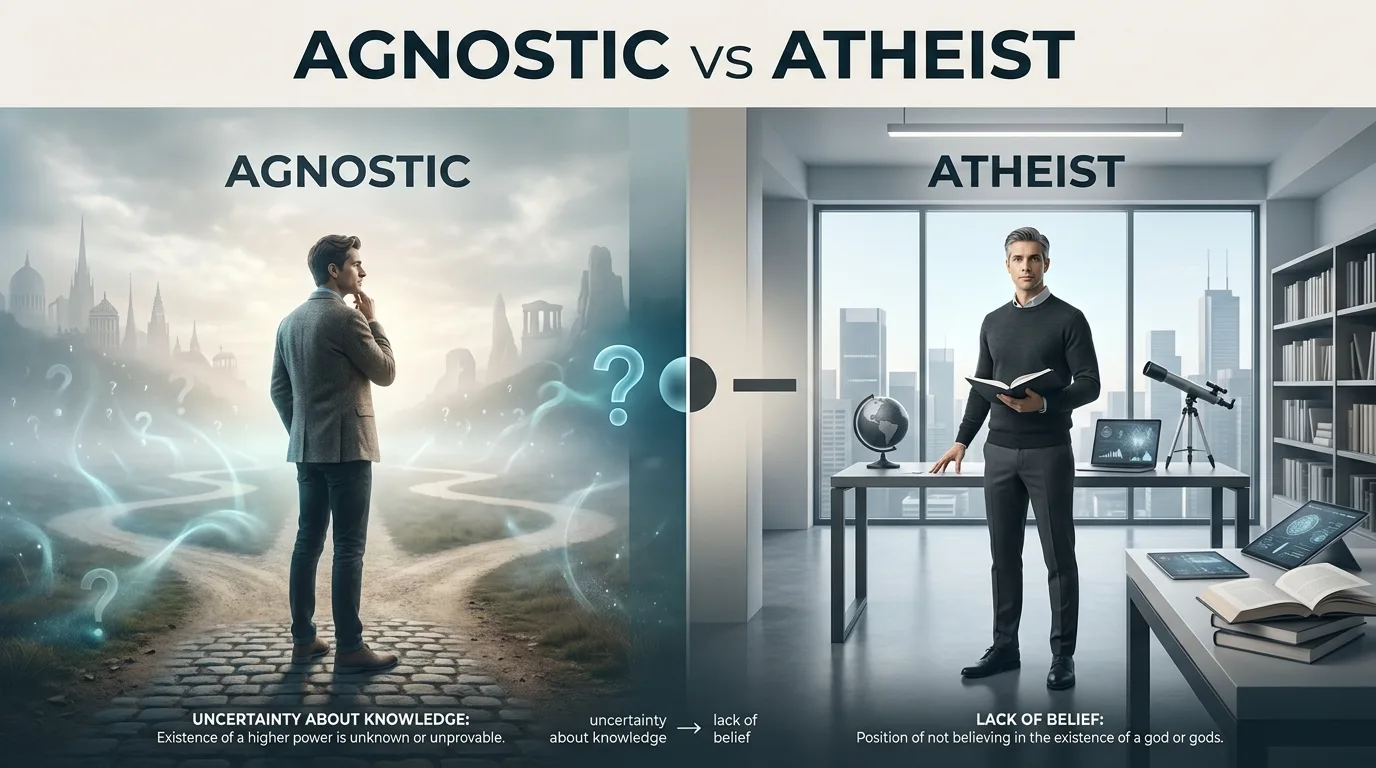
People often use agnostic and atheist as if they mean the same thing. They do not. The difference between agnostic and atheist becomes much clearer when you separate two questions: What do you believe? and What do you think can be known?
An atheist generally does not believe in a god or gods. An agnostic takes a position about knowledge, often saying that they do not know whether a god exists or that the answer may not be known. This means a person can even describe themselves as both agnostic and atheist.
The difference between agnostic and atheist can feel confusing because the words describe related ideas, but they focus on different parts of a person’s view. One mainly concerns belief, while the other concerns knowledge or certainty.
This guide explains the difference between agnostic and atheist in simple language. It covers their origins, pronunciation, spelling, common mistakes, everyday usage, and the different ways people may use these labels.
Quick Answer
The simplest distinction is:
An atheist does not believe in a god or gods. An agnostic says that they do not know whether a god or gods exist, or that this question cannot currently be known with certainty.
Here is a simple example:
- Atheist: “I do not believe that any gods exist.”
- Agnostic: “I do not know whether any gods exist.”
- Agnostic atheist: “I do not believe in gods, but I also do not claim to know with absolute certainty that no gods exist.”
This last position is important because agnostic and atheist do not always sit on opposite sides.
Think of two separate questions:
| Question | Possible answer |
|---|---|
| Do you believe in a god? | Yes / No |
| Do you claim to know whether a god exists? | Yes / No / Uncertain |
Someone could therefore be:
- Agnostic theist: Believes in God but does not claim certainty.
- Gnostic theist: Believes in God and claims to know that God exists.
- Agnostic atheist: Does not believe in gods but does not claim certainty that none exist.
- Gnostic atheist: Does not believe in gods and claims to know that no gods exist.
These labels can describe different levels of belief and certainty.
The Origin of Agnostic and Atheist
The words agnostic and atheist have different Greek roots.
The origin of atheist
Atheist comes from Greek roots involving a-, meaning “without” or “not,” and theos, meaning “god.” The related Greek term atheos was used in ancient contexts with meanings connected to being without gods or impious.
The modern English word developed from this older history and came to describe someone who does not believe in the existence of a god or gods.
The word is a noun when referring to a person:
She is an atheist.
It can also function as an adjective in the form atheist, as in:
He has an atheist viewpoint.
The related adjective atheistic is also common:
The book discusses atheistic philosophy.
The origin of agnostic
Agnostic was coined in English in the 19th century by the English biologist Thomas Henry Huxley. He formed the word from Greek elements associated with not knowing or being unknowable.
The term was intended to describe a position about knowledge rather than simply a denial of belief.
Today, agnostic can be a noun:
She is an agnostic.
It can also be an adjective:
He takes an agnostic position.
The related noun agnosticism refers to the position or belief that knowledge about the existence of God or gods is uncertain, unavailable, or not established, depending on how the term is being used.
Why the words are easy to confuse
Both terms are used in discussions about religion, belief, and God. However, they answer different questions.
- Atheism: What do you believe?
- Agnosticism: What do you claim to know?
That distinction is the key to understanding them.
Pronunciation
The words do not sound alike.
- agnostic: roughly “ag-NOS-tik”
- atheist: roughly “AY-thee-ist”
The main stress in agnostic falls on the middle syllable. In atheist, the first syllable carries the main stress.
Because both words often appear in discussions about religious belief, learners may remember the meanings incorrectly even though the words have clearly different sounds.
British English vs American English Spelling
There is no meaningful British-American spelling difference between agnostic and atheist.
Both British English and American English use:
- agnostic
- atheist
- agnosticism
- atheism
The spelling does not change by region.
Comparison table
| Word | British English | American English |
|---|---|---|
| Agnostic | agnostic | agnostic |
| Atheist | atheist | atheist |
| Agnosticism | agnosticism | agnosticism |
| Atheism | atheism | atheism |
There is also no important regional spelling difference that requires separate forms.
Example
British English:
He describes himself as an agnostic atheist.
American English:
He describes himself as an agnostic atheist.
Both sentences use the same spelling.
Which Spelling Should You Use?
You do not need to choose between British and American spellings here.
If you write for a US audience, use agnostic and atheist.
If you write for a UK or Commonwealth audience, use the same spellings.
For a global audience, these forms are also the safest choices because they are standard English spellings across major varieties of English.
The bigger issue is not spelling. It is meaning. Use the terms carefully because people may understand them in slightly different ways.
For example, someone who says “I am agnostic” may mean:
“I do not know whether God exists.”
Another person may mean:
“I think we cannot know whether God exists.”
The exact meaning can depend on the speaker.
Common Mistakes with Agnostic and Atheist
1. Thinking every agnostic is an atheist
This is not always true.
An agnostic may believe in God while admitting uncertainty.
Better understanding:
An agnostic may be a theist or an atheist, depending on their beliefs.
2. Thinking atheist means “certainly knows there is no God”
This is too narrow.
An atheist can simply mean someone who lacks belief in gods. Not every atheist claims absolute knowledge that no god exists.
3. Treating agnostic and atheist as opposites
They can overlap.
A person may be an agnostic atheist because they neither believe in gods nor claim certainty about the question.
4. Assuming agnostic means “50% believe and 50% do not”
Not necessarily.
Agnosticism concerns knowledge or certainty. It does not require a person to have exactly equal belief and disbelief.
5. Assuming atheist means anti-religious
Not automatically.
An atheist may reject belief in gods while still respecting religious people, studying religion, or participating in cultural traditions.
6. Using “agnosticism” as if it always means one exact philosophical position
The word has broader and narrower uses.
Some people use it to mean uncertainty about God’s existence. Others use it to mean that the question cannot be known.
Context matters.
7. Confusing atheism with certainty
A lack of belief is not automatically the same as a claim of absolute knowledge.
This is why asking someone what they mean by atheist or agnostic can sometimes be more useful than assuming their exact position.
Difference Between Agnostic and Atheist in Everyday Examples
The words appear in many types of writing, from casual conversations to academic discussions.
In emails
A personal email might say:
I have been thinking about religion lately, and I would describe myself as agnostic.
This is a personal description of the writer’s position.
A more formal email might say:
My views are closer to agnosticism than to a specific religious tradition.
In news writing
News articles may use these terms when describing a person’s beliefs:
The author describes himself as an atheist.
Or:
She has publicly identified as an agnostic.
News writing should avoid assuming a person’s beliefs without reliable evidence.
On social media
People often use the terms casually:
I am not religious, but I would not call myself an atheist. I am more comfortable with agnostic.
Or:
I consider myself an agnostic atheist.
Social media language can be less precise than academic writing.
In formal writing
Academic writing often needs greater care:
Atheism concerns belief in gods, while agnosticism is commonly associated with the limits or absence of knowledge concerning such claims.
This wording avoids treating every atheist or agnostic as having exactly the same philosophical position.
In everyday conversation
Someone might ask:
“Are you religious?”
A person could answer:
“No, I am an atheist.”
Another might say:
“I am agnostic. I am not sure what I believe.”
Neither answer automatically tells you everything about that person’s broader views.
Agnostic vs Atheist: Side-by-Side Comparison
| Feature | Agnostic | Atheist |
|---|---|---|
| Main focus | Knowledge or certainty | Belief |
| Basic idea | Uncertain whether gods exist or believes the question is unknowable | Does not believe in gods |
| Can believe in God? | Yes, depending on the person’s position | Generally no |
| Can lack belief in God? | Yes | Yes |
| Can overlap with the other term? | Yes | Yes |
| Common noun | agnostic | atheist |
| Related noun | agnosticism | atheism |
| Main question | “Can I know?” | “Do I believe?” |
The easiest memory trick
Remember these two questions:
Atheist → belief
Agnostic → knowledge
This is not a complete philosophical definition of every person’s position, but it is a useful starting point.
Why Someone Might Use Both Labels
The phrase agnostic atheist may seem contradictory at first, but it becomes simple when the two terms are separated.
Consider this statement:
“I do not believe that any gods exist, but I cannot prove that no god exists.”
The first part describes an atheist position.
The second part describes an agnostic position concerning knowledge.
So the person may use both words.
Likewise, someone could describe themselves as an agnostic theist:
“I believe in God, but I do not claim to know that God exists with certainty.”
This shows why the two terms are better understood as addressing different dimensions of a person’s worldview.
Frequently Asked Questions
1. What is the main difference between agnostic and atheist?
An atheist generally does not believe in gods. An agnostic generally describes uncertainty or a limit on what can be known about whether gods exist.
2. Can someone be both agnostic and atheist?
Yes. An agnostic atheist may lack belief in gods while also saying they do not know, or cannot know with certainty, whether gods exist.
3. Is agnostic the same as not religious?
Not always. A person can be agnostic and still follow a religion or hold religious beliefs. “Not religious” is a broader description.
4. Does atheist mean someone hates religion?
No. Atheism concerns belief in gods. It does not automatically describe someone’s feelings toward religion, religious people, or religious traditions.
5. Is agnosticism a religion?
Agnosticism is generally described as a position about knowledge concerning the existence of God or gods, rather than a religion with its own required worship or doctrine.
6. Which word should I use if I am unsure whether God exists?
If your main point is that you do not know whether God exists, agnostic may describe your position. Your personal beliefs may also make agnostic atheist or agnostic theist more precise.
7. Are agnostic and atheist opposites?
No. They can overlap because they often address different questions. Atheism usually concerns belief, while agnosticism concerns knowledge or certainty.
Conclusion
The difference between agnostic and atheist is easier to understand when belief and knowledge are kept separate. An atheist does not believe in gods, while an agnostic focuses on uncertainty or limits of knowledge.
These labels can overlap, so a person may reasonably describe themselves as an agnostic atheist or an agnostic theist. Context matters when interpreting the words.
There is no British-American spelling difference between the terms. The real challenge is understanding their meaning and using each word with care.
Practice these words in emails, essays, and daily conversations. Clear language helps you discuss difficult ideas with confidence, respect, and kindness.

Ezra Hale is a thoughtful contributor to Distinly.com, where he explores philosophical ideas and the subtle differences behind everyday concepts. His writing blends logic, language, and human insight to clarify complex distinctions. Ezra encourages readers to think deeper, question assumptions, and appreciate the meaning behind words and ideas in modern discourse.