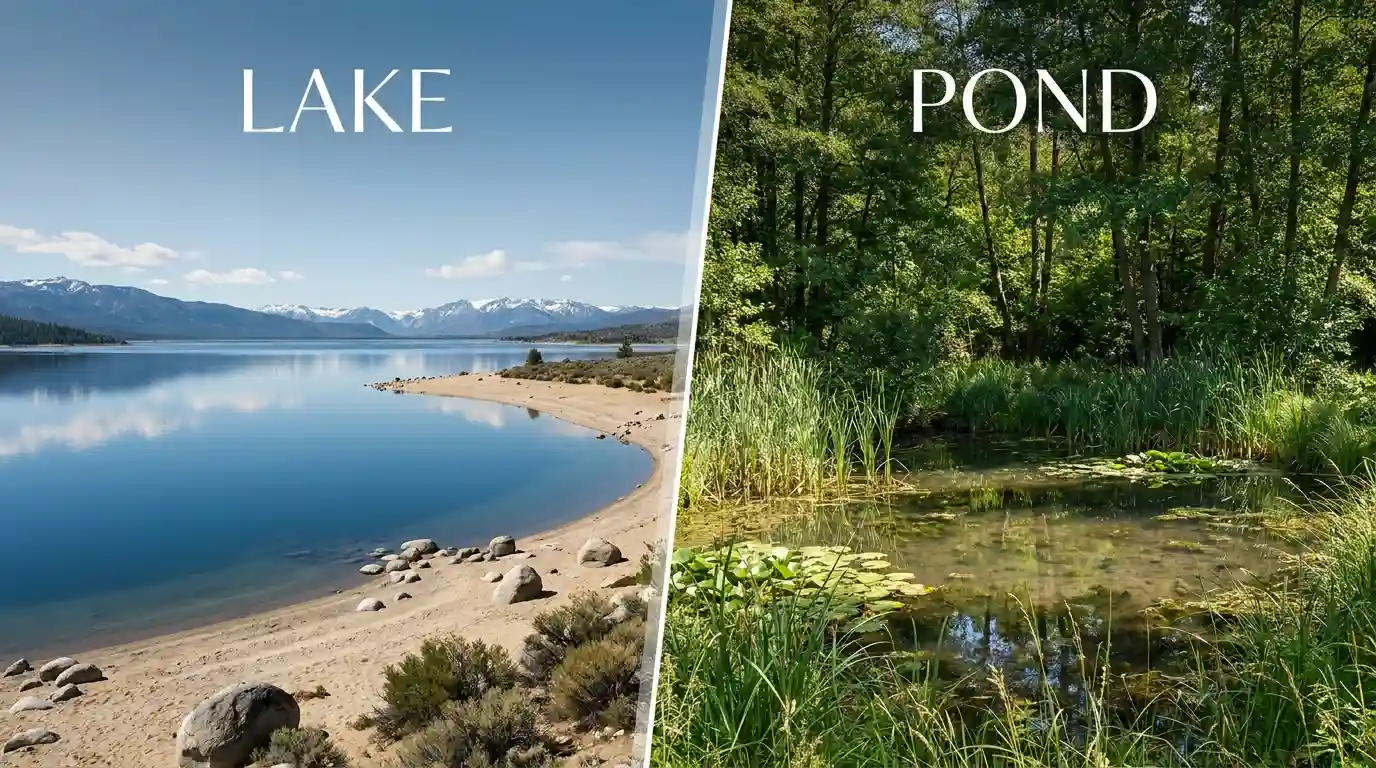
When you look at a calm body of freshwater, it can be hard to tell whether you are seeing a lake or a pond. Both can contain fish, plants, birds, and still water. Both can be natural or connected to human activity. So, what is the difference between lake and pond?
The simple answer is size, but that answer is not always enough. A pond is generally understood as a smaller body of standing water, while a lake is usually larger and deeper. However, there is no single worldwide measurement that officially separates a lake from a pond. The U.S. Geological Survey notes that these geographic terms do not have official classification standards, and even the size-based distinction can be subjective.
Understanding the difference between lake and pond is useful for students, writers, travelers, gardeners, and anyone learning English. The terms also appear often in geography, ecology, environmental science, and everyday conversation.
In this guide, we will explain the difference between lake and pond, look at their meanings and origins, compare their typical features, discuss British and American usage, and show you how to use both words correctly.
Quick Answer
The main difference between lake and pond is that a lake is generally a larger and deeper inland body of standing water, while a pond is generally smaller and shallower.
However, size alone is not an absolute rule.
The U.S. Geological Survey explains that there are no official definitions for generic geographic terms such as lake and pond. Its geographic naming system may classify features broadly, and a feature called a pond can sometimes fit within a broader lake category.
Here is the easiest way to remember the typical distinction:
| Feature | Lake | Pond |
| Typical size | Larger | Smaller |
| Typical depth | Deeper | Shallower |
| Light penetration | May not reach the entire bottom | Often reaches much or all of the bottom |
| Plants | Usually concentrated around edges | May grow across much of the bottom |
| Water temperature | Can vary by depth | Often more easily influenced by air temperature |
| Origin | Natural or artificial | Natural or artificial |
| Official size rule | No universal rule | No universal rule |
A key point is that these are general characteristics, not strict legal or scientific requirements.
For example, one body of water may be called a lake in one location even though another similar-sized body is called a pond elsewhere. Local naming traditions, history, geography, and common usage can all influence the name.
Are all lakes bigger than ponds?
Not necessarily.
People commonly expect every lake to be larger than every pond. In everyday language, this is a useful rule of thumb, but it is not a universal scientific standard. The USGS specifically notes that the distinction can be subjective and that there are no official feature-classification standards for these terms.
So, if you need a simple answer, say:
A lake is usually larger and deeper than a pond, but there is no universal measurement that makes a body of water officially a lake or pond.
The Origin of “Lake” and “Pond”
The words lake and pond have different histories, even though their meanings overlap.
Origin of “Lake”
The English noun lake has a long history. Merriam-Webster traces the water-related noun through Middle English, Old English, Anglo-French, and Latin. It records the first known use of this sense in the 12th century.
The Latin word lacus could refer to a lake, pool, pond, pit, basin, or reservoir. The Old English lacu could mean a stream or pool. English therefore inherited related water meanings from several linguistic sources.
Etymonline also traces lake to Old French lack and Latin lacus, with an older reconstructed Indo-European root associated with a body of water or lake.
The history is important because it shows that the modern distinction between a lake and a pond did not come from two perfectly separate ancient categories. Their meanings have overlapped for centuries.
Origin of “Pond”
The word pond also has an interesting history.
Etymonline dates pond to around the 13th century and describes its earlier sense as an artificially banked or enclosed body of water. It is connected historically with pound, meaning an enclosed place, particularly a place used for animals.
The meaning later expanded. By the late 15th century, pond was also being used locally for natural pools and small lakes.
This helps explain why the modern meanings are not perfectly separated. A pond can be natural or artificial, and the word has historically been used for bodies of water that overlap with what we might now describe as a small lake.
Pronunciation
Lake is pronounced approximately like “layk.”
Pond is pronounced approximately like “pond.”
Unlike pairs such as cue and queue, these words are not homophones. Their sounds are clearly different.
Both are nouns when they name a body of water:
- We walked around the lake.
- The ducks were swimming in the pond.
- The lake attracts many visitors.
- The garden has a small pond.
“Lake” and “pond” can also appear before another noun as modifiers:
- lake water
- lake shore
- pond water
- pond plants
British English vs American English Spelling
There is no meaningful British-versus-American spelling difference between lake and pond.
Both British English and American English normally use:
- lake
- pond
The words may differ in local usage because geographic names and naming traditions vary, but this is not a standard spelling difference like color/colour or center/centre.
| Point | British English | American English |
| Lake spelling | lake | lake |
| Pond spelling | pond | pond |
| Pronunciation | Similar | Similar |
| Basic meaning | Same | Same |
| Spelling variation | None | None |
| Main distinction | Usually size/context | Usually size/context |
The important issue is therefore meaning and usage, not spelling.
American English may use lake for a very wide range of named inland waters, including bodies that do not fit a simple size rule. British English also has many traditional geographic names that do not follow a strict size hierarchy.
So do not assume that a body of water must be called a pond simply because it is small or a lake simply because it is large.
Which Word Should You Use?
Choose lake when you are describing a substantial inland body of standing water that is commonly known or understood as a lake.
Examples:
- We spent the weekend beside the lake.
- The mountain lake was surrounded by trees.
- The town gets its drinking water from the lake.
Choose pond when you mean a smaller body of standing water.
Examples:
- The children fed ducks at the pond.
- There is a fish pond behind the house.
- The park has a small ornamental pond.
For US English readers
Use the normal geographic name when referring to a specific place. If the official or established name says Lake, keep it as Lake. Do not replace it with pond simply because it appears relatively small.
For UK and Commonwealth readers
The same general advice applies. Use established names and ordinary local usage rather than trying to apply an artificial size formula.
For global English
If you are writing for an international audience, the safest explanation is:
A lake is generally larger and deeper than a pond, but there is no universal size rule separating them.
This wording is simple, accurate, and unlikely to create confusion.
Common Mistakes
Mistake 1: Saying a lake must be a specific size
A common claim is that a body of water becomes a lake after reaching a particular number of acres, hectares, meters, or feet.
There is no universal rule like this.
The USGS states that there are no official classification standards for generic geographic terms such as lake and pond.
Better:
“A lake is generally larger than a pond.”
Mistake 2: Assuming every pond is artificial
A pond can be natural or artificial.
Natural ponds can form through processes such as changes in drainage, glacial activity, flooding, or other landscape processes. Artificial ponds can be created for farming, gardens, recreation, wildlife, or water management.
Incorrect:
“A pond is always artificial.”
Better:
“A pond can be natural or artificial.”
Mistake 3: Assuming every lake is completely natural
Lakes can also be affected by humans or created through human activity.
Some reservoirs are described as lakes in everyday speech, while other artificial water bodies may be called ponds. Names and classifications vary.
Mistake 4: Treating depth as the only test
Depth can help describe the difference, but it does not provide a universal dividing line.
A shallow lake can exist, and a relatively deep pond can exist. Depth should therefore be treated as a typical characteristic rather than an absolute rule.
Mistake 5: Using the terms as exact scientific categories
In casual conversation, the terms are easy to understand. But in geographic naming, they can be less precise.
The USGS emphasizes that generic geographic feature names do not have one official classification standard.
Everyday Examples
The easiest way to understand the distinction is to see how the words work in real sentences.
In an email
Natural:
“Could you send me the directions to the lake near the conference center?”
Natural:
“The children will meet at the pond after lunch.”
In an email, the choice usually depends on the established name or the size and context of the water body.
In news writing
A news article might say:
“Heavy rain caused the lake to rise above its normal level.”
Another report could say:
“The storm filled the small pond behind the school.”
News writers normally follow the established geographic name or the terminology used by local authorities.
In social media
People might write:
- “Beautiful morning at the lake!”
- “Found a peaceful little pond on today’s walk.”
- “The lake looks amazing at sunset.”
- “There are frogs all around this pond.”
Here, the distinction is informal and natural.
In academic writing
Academic writing requires more care.
For example:
General:
“The lake supports several aquatic species.”
More specific:
“The shallow pond provides habitat for aquatic plants and amphibians.”
If the exact classification matters to the research, a writer should define the water body’s characteristics instead of relying only on the everyday label.
In travel writing
Travel writers commonly use lake for major scenic water bodies:
- “The trail leads to a beautiful mountain lake.”
For a smaller feature, they may use pond:
- “A quiet pond sits beside the forest trail.”
But the official geographic name should take priority when describing a named location.
Key Differences at a Glance
| Category | Lake | Pond |
| Basic meaning | Inland standing body of water | Smaller standing body of water |
| Typical size | Larger | Smaller |
| Typical depth | Often deeper | Often shallower |
| Bottom visibility | May be limited | More likely in shallow water |
| Aquatic plants | Often concentrated near margins | Can cover much of the bottom |
| Temperature | Can have greater variation by depth | Often changes more quickly throughout |
| Formation | Natural or artificial | Natural or artificial |
| Official universal definition | No | No |
| Spelling in UK English | lake | pond |
| Spelling in US English | lake | pond |
| Part of speech | Noun | Noun |
| Pronunciation | Different from pond | Different from lake |
This table gives a useful general picture, but the most important qualification remains: there is no universal size threshold that officially separates a lake from a pond.
Why Are Some Small Bodies of Water Called Lakes?
This is one of the most interesting parts of the topic.
Geographic names are not always created by applying a modern scientific formula. Historical naming, local tradition, government records, settlement patterns, and long-established usage can all affect what a body of water is called.
That means a relatively small body can have Lake in its name, while another body of similar size may be called a pond.
The USGS gives a broader lesson here: geographic feature names are not governed by one universal set of scientific definitions.
This is why it is risky to say:
“If it is under X acres, it is a pond.”
That kind of statement sounds precise, but it is not a universal English or geographic rule
FAQs
1. What is the main difference between a lake and a pond?
A lake is generally larger and deeper than a pond. However, there is no universal size or depth measurement that officially separates the two terms.
2. Is a pond always smaller than a lake?
Usually, yes in everyday usage. But not always in a strict geographic sense. The names can overlap, and some bodies of water do not fit a simple size-based classification.
3. Can a pond be natural?
Yes. A pond can form naturally or be created by people. The word does not automatically mean an artificial body of water.
4. Can a lake be artificial?
Yes. Human-created water bodies may be called lakes, reservoirs, ponds, or other terms depending on their purpose, history, and local naming practices.
5. Is there an official size limit for a pond?
No universal size limit applies worldwide. The USGS states that geographic terms such as lake and pond do not have official classification standards.
6. Which is deeper, a lake or a pond?
A lake is generally deeper, but depth alone is not a reliable universal test. Some ponds can be relatively deep, while some lakes can be shallow.
7. Are lake and pond different words in British and American English?
The spellings are the same in both varieties. There is no standard British-versus-American spelling difference between lake and pond. Differences are more likely to involve local naming and usage.
Conclusion
The difference between lake and pond is mainly a matter of typical size, depth, ecology, and everyday usage. A lake is usually larger and deeper, while a pond is generally smaller.
Still, there is no universal measurement that officially divides every lake from every pond. Geographic names often depend on local history, tradition, and established usage.
For everyday English, you can safely remember the simple rule: lake usually means a larger inland body of water, while pond usually means a smaller one. Context matters too.
Keep practicing these words in emails, essays, and daily conversations. The more you use them naturally, the easier it becomes to choose the right term with confidence.

Aamer Shahzad is the founder of Distinly.com, a fast-growing educational platform focused on high-intent “difference between” topics. With over 8 years of experience in English language education and analytical writing, I specialize in breaking down complex “difference between” topics into clear, structured, and easy-to-understand explanations. Distinly.com is your go-to resource for enhancing English skills and writing with confidence.
I specializes in building search-optimized, research-driven comparison content designed for clarity, authority, and long-term digital asset value.