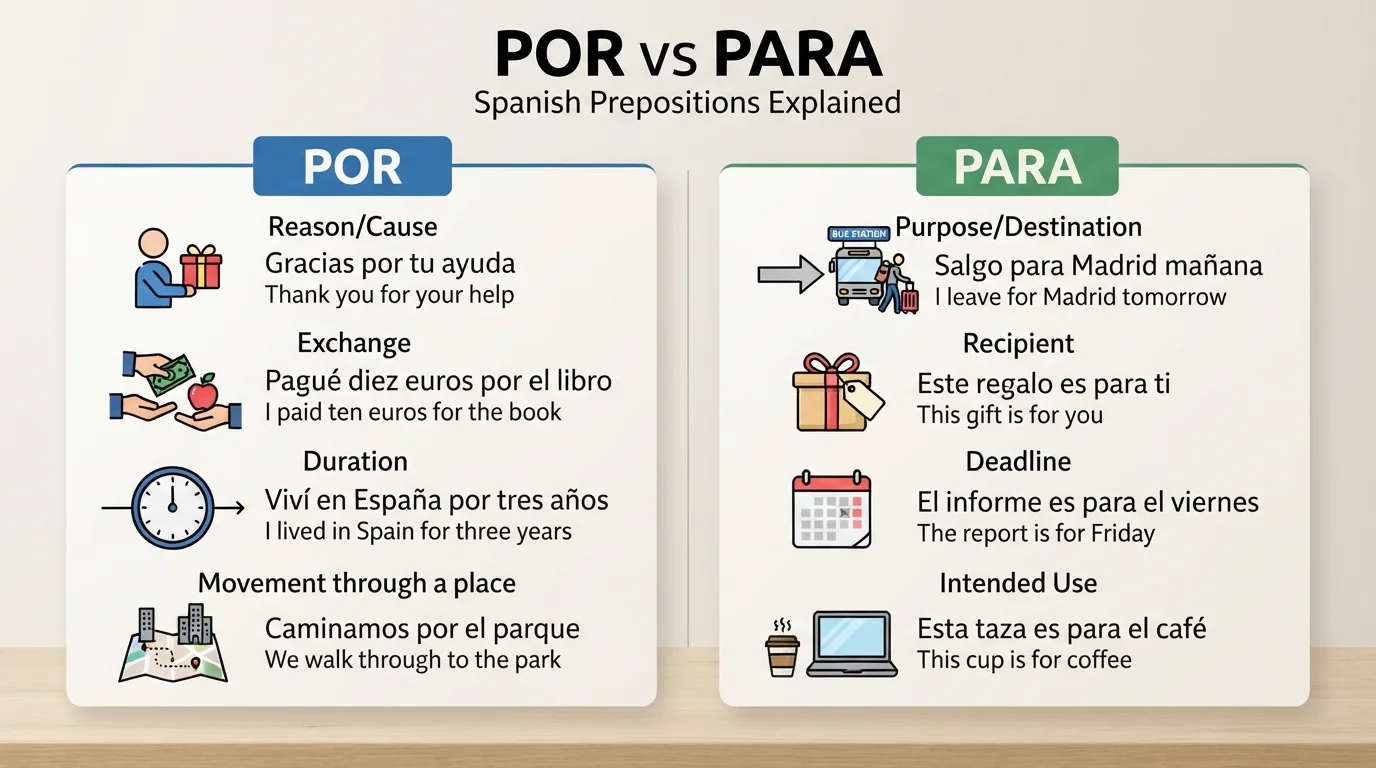
The difference between por and para often confuses learners when they start using Spanish in real life. Imagine writing a message and not knowing which one to choose.
In simple terms, por and para are Spanish prepositions. They both can mean “for” in English, but they are used in different situations.
Many learners struggle because the difference between por and para is not always obvious. Native speakers use them naturally, but learners need clear rules.
Understanding the difference between por and para helps you speak and write Spanish correctly. Let’s explore their meanings and usage step by step.
🔑 Key Difference Between the Both
The main difference is purpose vs reason.
- Por explains why something happens (reason, cause, exchange).
- Para explains what for something is done (purpose, goal, destination).
🌍 Importance – Why This Difference Matters
Knowing the difference helps learners avoid common mistakes. It improves accuracy in speaking and writing.
For professionals, correct usage builds credibility. It shows strong language skills in communication.
In society, clear language avoids confusion. It helps people understand intent and meaning correctly.
🔊 Pronunciation Section
Por
US: /pɔːr/
UK: /pɔː/
Para
US: /ˈpɑː.rə/
UK: /ˈpɑː.rə/
Now that you know how they sound, let’s understand what they mean.
📚 Core Definitions
Por
Por is used to explain reason, cause, or exchange. It answers “why something happens.”
It often has a neutral tone.
Example: I traveled por work.
Para
Para is used to show purpose, goal, or destination. It answers “what something is for.”
It usually feels more intentional.
Example: This gift is para you.
📚 10 Clear Differences Between Por and Para
1. Purpose vs Reason
Por explains reason. Para explains purpose.
- Example for por: He left por health reasons.
- Example for para: He left para a better life.
2. Time vs Deadline
Por refers to duration. Para refers to deadlines.
- Example for por: I stayed por two hours.
- Example for para: Finish it para tomorrow.
3. Cause vs Goal
Por shows cause. Para shows goal.
- Example for por: Thanks por helping me.
- Example for para: I study para success.
4. Exchange vs Recipient
Por shows exchange. Para shows receiver.
- Example for por: I bought it por $10.
- Example for para: This is para you.
5. Movement vs Destination
Por shows movement through. Para shows direction to.
- Example for por: We walked por the park.
- Example for para: We are going para Madrid.
6. General vs Specific Use
Por is more general. Para is more specific.
- Example for por: It happened por many reasons.
- Example for para: This tool is para cutting.
7. Emotion vs Intention
Por often shows feelings. Para shows intention.
- Example for por: I feel sad por him.
- Example for para: I came para help.
8. Passive Agent vs Purpose
Por shows who did something. Para shows purpose.
- Example for por: The book was written por her.
- Example for para: The book is para students.
9. Means vs Function
Por shows method. Para shows function.
- Example for por: I sent it por email.
- Example for para: This is para learning.
10. Motivation vs Result
Por explains motivation. Para shows result.
- Example for por: He works por money.
- Example for para: He works para success.
🎯 Why Knowing the Difference Matters
Students need this knowledge to avoid grammar mistakes. It helps them build confidence in Spanish.
Professionals must use correct prepositions. It improves clarity in emails and communication.
In daily life, wrong usage can confuse meaning. It may change the message completely.
🔍 Real-world Consequences of Confusion
Using the wrong word can lead to misunderstanding. For example, saying the wrong intention or reason can confuse listeners.
🧠 Why People Get Confused
Similar Structure
Both words often translate to “for,” which causes confusion.
Semantic Overlap
They share similar meanings but differ in usage.
Context-Based Usage
The meaning changes depending on the sentence.
Informal Speech Influence
People sometimes mix them casually, which misleads learners.
🎭 Connotation & Emotional Tone
(Connotation = the emotional meaning associated with a word.)
Por
- Positive: Gratitude (Thanks por helping)
- Negative: Cause of problem (Por bad luck)
- Neutral: General reason
Para
- Positive: Goal or purpose (Para success)
- Negative: Rarely negative
- Neutral: Direction or use
🗣 Usage in Metaphors, Similes & Idioms
- Gracias por todo (Thanks for everything)
- Esto es para ti (This is for you)
Both are used naturally in expressions. Context decides meaning.
📊 Comparison Table
| Feature | Por | Para |
|---|---|---|
| Meaning | Reason | Purpose |
| Tone | Neutral | Intentional |
| Usage | Cause, exchange | Goal, direction |
| Context | General | Specific |
| Formality | Neutral | Neutral |
⚖️ Which Is Better in What Situation?
When to use Por
Use por when explaining reasons or causes. It works well for emotions, time, and exchanges.
Example: I stayed por two hours.
When to use Para
Use para when talking about goals or purpose. It fits deadlines and direction.
Example: This is para you.
Situational clarity
Choosing correctly depends on meaning. Ask: “Why?” or “What for?”
Contextual correctness
Always check the sentence context. That helps you pick the right word naturally.
📖 Literary or Cultural References
- Don Quixote (Novel, Miguel de Cervantes, 1605) — Uses both forms in classic Spanish.
- Roma (Film, Mexico, 2018) — Shows real-life usage of Spanish prepositions.
❓ FAQs (10 Questions)
1. What is the main difference between por and para?
The main difference is reason vs purpose. Por explains why something happens. Para explains what something is for.
2. Can both mean “for”?
Yes, both can mean “for” in English. However, their usage depends on context.
3. Is por more common than para?
Both are equally common. Their usage depends on the sentence meaning.
4. How can I remember the difference?
Think of “por = why” and “para = what for.” This simple trick helps.
5. Is para used for deadlines?
Yes, para is used for deadlines. For example: Finish it para tomorrow.
6. Is por used for time duration?
Yes, por is used for duration. Example: I stayed por two hours.
7. Can I use them interchangeably?
No, they are not interchangeable. Using the wrong one changes meaning.
8. Which one shows purpose?
Para shows purpose. It explains the goal behind an action.
9. Which one shows cause?
Por shows cause. It explains the reason behind something.
10. Why is this topic important?
It helps avoid confusion and improves communication in Spanish.
🏁 Conclusion
The difference between por and para is simple when you focus on meaning. One explains reason, while the other shows purpose.
Understanding this difference improves accuracy. It helps you speak Spanish more naturally and confidently.
Using the right word makes your message clear. It avoids confusion and builds strong communication skills.
Keep practicing with real examples. Over time, choosing between por and para will feel easy and natural.

Aamer Shahzad is the founder of Distinly.com, a fast-growing educational platform focused on high-intent “difference between” topics. With over 8 years of experience in English language education and analytical writing, I specialize in breaking down complex “difference between” topics into clear, structured, and easy-to-understand explanations. Distinly.com is your go-to resource for enhancing English skills and writing with confidence.
I specializes in building search-optimized, research-driven comparison content designed for clarity, authority, and long-term digital asset value.