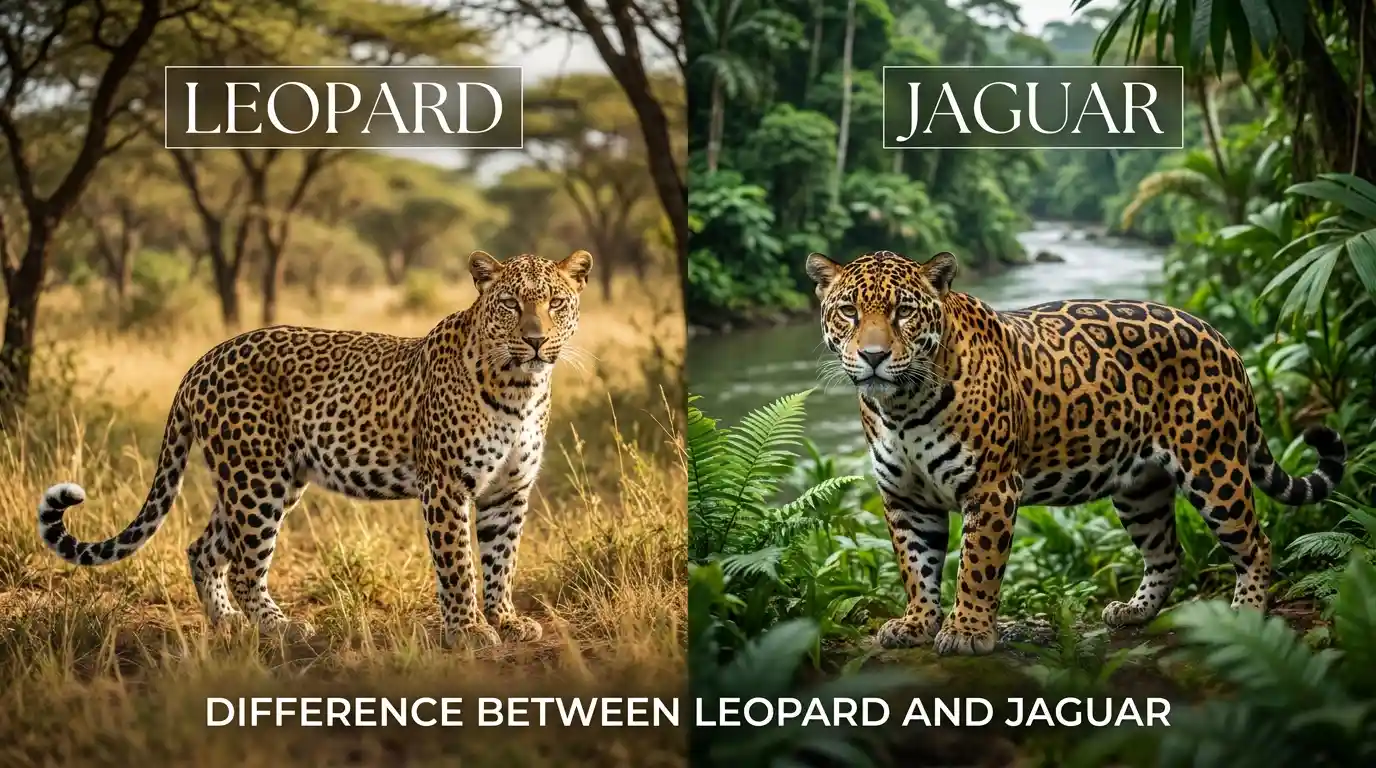
At first glance, a leopard and a jaguar can look almost identical. Both are large wild cats. They have golden coats covered with dark markings. Both are powerful predators, and both are often shown in documentaries, books, films, and wildlife photos. That is why many people search for the difference between leopard and jaguar.
The confusion usually starts with their spots. A quick look at a photograph may make one cat seem like the other. However, the difference between leopard and jaguar becomes much clearer when you look at their body shape, markings, habitat, behavior, and geographic range.
Learning the difference between leopard and jaguar is useful for students, animal lovers, writers, and anyone who wants to describe wildlife accurately. These animals belong to the same broader cat family, but they are different species with different natural homes and physical features.
In this guide, you will learn the difference between leopard and jaguar in simple language. We will also look at the origins of their names, pronunciation, spelling, common mistakes, and real-life examples.
Quick Answer
The simplest difference is this:
- A leopard is native to parts of Africa and Asia.
- A jaguar is native to the Americas.
- Jaguars are generally more heavily built and muscular.
- Leopards usually have smaller and more open rosette patterns.
- Jaguar rosettes often contain one or more dark spots inside them.
Both animals belong to the genus Panthera. However, they are separate species.
A useful visual rule can help:
Leopard: Smaller-looking rosettes, usually without a central dot.
Jaguar: Larger rosettes that often have dark spots inside.
For example:
- The leopard climbed into a tree with its prey.
- The jaguar moved quietly through the rainforest.
So, although they may look similar in pictures, they should not be treated as two names for the same animal.
The Origin of the Words Leopard and Jaguar
The words leopard and jaguar have very different linguistic histories.
Origin of Leopard
The English word leopard came into English through Old French and Latin forms. Its deeper history is connected to Greek words associated with a lion and a spotted big cat.
Historically, people believed that a leopard was connected to a lion and a panther. This old idea influenced the structure of the word. Modern biology, of course, does not classify a leopard as a hybrid between those animals.
Today, leopard refers specifically to Panthera pardus.
Origin of Jaguar
The word jaguar entered English through European languages after contact with the Americas. Its deeper origin comes from an Indigenous language of South America, although historical spellings and transmission through other languages affected its journey into English.
Today, jaguar refers to Panthera onca, the largest wild cat in the Americas.
The two words are therefore not spelling variants of one another. They developed from entirely different linguistic and cultural histories.
Why Do People Confuse Them?
The confusion does not come from spelling. It mainly comes from appearance.
Leopards and jaguars are both spotted big cats with yellow or golden fur. When seen quickly, especially in photographs, their coat patterns can appear very similar.
However, their names represent two different animals.
Pronunciation of Leopard and Jaguar
The words also sound quite different.
Leopard is commonly pronounced with three syllables. The stress falls near the beginning of the word.
Jaguar has more pronunciation variation depending on accent. In many forms of English, it is commonly pronounced with two or three syllables.
This variation can sometimes create confusion in spoken English, especially for learners.
Both words are countable nouns.
Examples:
- A leopard was resting in the shade.
- Two leopards crossed the road.
- The jaguar disappeared into the forest.
- Several jaguars live in protected habitats.
Because both words are nouns, they can act as the subject or object of a sentence.
For example:
- The leopard hunted at night.
- Researchers observed the jaguar.
They can also be used as modifiers before another noun:
- leopard population
- jaguar habitat
- leopard conservation
- jaguar behavior
Physical Differences
The easiest way to understand the difference is to compare their bodies and markings.
| Feature | Leopard | Jaguar |
|---|---|---|
| Scientific name | Panthera pardus | Panthera onca |
| Main range | Africa and parts of Asia | Central and South America |
| Body shape | Leaner and more agile-looking | Stockier and more muscular |
| Head | Relatively narrower | Broad and powerful |
| Rosettes | Usually smaller and more open | Often larger, with central spots |
| Common habitat | Savannas, forests, mountains, and other areas | Forests, wetlands, grasslands, and other habitats |
| Tree climbing | Very skilled | Can climb, but is generally known for a heavier build |
| Overall appearance | Slimmer | More compact and powerful |
1. Body Shape
A leopard often has a slimmer and more flexible-looking body. This body shape helps it climb and move through different environments.
A jaguar usually looks broader and more solid. Its head and jaw area are especially powerful.
If you compare the two side by side, the jaguar often appears more heavily built.
2. Coat Pattern
This is one of the most useful ways to tell them apart.
Both animals have rosettes. Rosettes are dark markings that form flower-like shapes on the coat.
A leopard’s rosettes are generally simpler and more open.
A jaguar’s rosettes are often larger and may contain small dark spots in the center.
This is not the only identification method, but it is one of the easiest for beginners.
3. Head and Face
Jaguars usually have a broader and more powerful-looking head.
Leopards often have a more slender facial appearance.
This difference becomes easier to notice when viewing clear photographs of both animals.
Where Do Leopards and Jaguars Live?
Geography provides one of the clearest answers.
Leopards
Leopards live naturally in parts of:
- Africa
- South Asia
- Southeast Asia
- East Asia
Their exact range depends on the population and habitat.
Leopards are highly adaptable. They can live in forests, grasslands, mountains, and other environments.
Jaguars
Jaguars live naturally in the Americas. Their strongest populations are associated with parts of Central and South America.
They are strongly linked with tropical forests and wet environments, although they can also live in other habitat types.
This geographic difference is important.
A naturally occurring spotted big cat in Africa is not a jaguar. A naturally occurring jaguar is not found as a native wild species in Africa.
Behavior and Hunting Differences
Leopards and jaguars are both predators, but their environments and physical strengths shape their behavior.
Leopard Behavior
Leopards are known for their adaptability.
They can hunt different types of prey depending on where they live. They are also skilled climbers.
One famous behavior associated with leopards is carrying prey into trees. This can help protect food from other predators and scavengers.
Jaguar Behavior
Jaguars are known for their powerful build.
They are also comfortable around water and may swim when necessary. Their strong jaws allow them to handle a wide range of prey.
Like leopards, jaguars are solitary for much of their lives outside mating and parenting situations.
However, each species has its own ecological role and behavior patterns.
British English vs American English Spelling
There is no meaningful British versus American spelling difference between these two animal names.
Both varieties of English use:
- leopard
- jaguar
This differs from pairs such as colour/color or centre/center, where regional spelling conventions create visible changes.
| Word | British English | American English | Meaning |
|---|---|---|---|
| Leopard | leopard | leopard | A large spotted cat, Panthera pardus |
| Jaguar | jaguar | jaguar | A large spotted cat, Panthera onca |
| Leopard’s | leopard’s | leopard’s | Possessive form |
| Jaguars | jaguars | jaguars | Plural form |
There may be some pronunciation differences between British and American speakers, especially with jaguar, but the standard spelling remains the same.
Which Spelling Should You Use?
You do not need to choose between British and American spelling for leopard or jaguar.
The spelling is the same in:
- American English
- British English
- Canadian English
- Australian English
- Other major varieties of English
The real choice is not about spelling. It is about using the correct animal name.
Use leopard when you mean Panthera pardus.
Use jaguar when you mean Panthera onca.
For a global audience, these standard spellings are clear and widely understood.
Common Mistakes
Mistake 1: Calling Every Spotted Big Cat a Leopard
Not every spotted big cat is a leopard.
A jaguar is a different species. Other wild cats may also have spotted or patterned coats.
Incorrect: I saw a leopard in the Amazon rainforest.
This could be incorrect if the animal is actually a jaguar.
Better: I saw a jaguar in the Amazon rainforest.
Mistake 2: Looking Only at Color
Both animals can have similar coat colors.
Do not identify them only by whether they look yellow, gold, or tan.
Instead, examine:
- Rosette pattern
- Body shape
- Head size
- Geographic location
Mistake 3: Assuming Jaguar Is an American Word for Leopard
This is incorrect.
A jaguar is not simply the American name for a leopard.
They are different species.
Mistake 4: Ignoring the Location
Location can provide an important clue.
If the animal is naturally living in Africa or much of Asia, it may be a leopard.
If it is naturally living in the Americas, a jaguar may be the correct identification.
Mistake 5: Confusing Jaguars with Black Panthers
The term black panther is not usually the name of one separate species.
It commonly refers to a melanistic big cat, such as a leopard or jaguar with unusually dark pigmentation.
This can add another layer of confusion.
A black leopard and a black jaguar are still different animals.
Everyday Examples
Knowing how these words work in real sentences can help you remember them.
In an Email
Hi Sarah, I am preparing the wildlife presentation. Could you check whether the image shows a leopard or a jaguar?
In a News Report
Wildlife officials reported a jaguar sighting near a protected forest area.
On Social Media
Can you spot the difference between a leopard and a jaguar? Look closely at the rosettes!
In Formal Writing
Although leopards and jaguars have similar spotted coats, they differ in geographic range, body structure, and species classification.
In School Writing
The leopard lives in parts of Africa and Asia, while the jaguar is native to the Americas.
These examples show that both words are used mainly as nouns, while phrases such as leopard population and jaguar habitat use them as noun modifiers.
Search Interest and General Usage Patterns
People often search for difference between leopard and jaguar because the animals look similar in photographs, quizzes, documentaries, and online posts.
Search interest should not be confused with actual language frequency. A rise in searches may happen because of a viral image, a documentary, a school assignment, or general curiosity.
Without presenting unsupported search numbers, the general pattern is easy to understand: people usually want a fast visual answer first. They then look for details about spots, size, habitat, and location.
That is why the most useful explanation combines appearance with geography.
A simple memory trick is:
Africa or Asia? Think leopard.
The Americas? Think jaguar.
Then check the rosettes and body shape for extra confirmation.
Comparison Table
| Category | Leopard | Jaguar |
|---|---|---|
| Common name | Leopard | Jaguar |
| Scientific species | Panthera pardus | Panthera onca |
| Main natural range | Africa and Asia | The Americas |
| Body build | Leaner | Stockier |
| Head shape | Narrower-looking | Broader and more powerful |
| Rosette pattern | More open | Often contains central spots |
| Strong association | Tree climbing and adaptability | Powerful build and comfort around water |
| British spelling | Leopard | Jaguar |
| American spelling | Leopard | Jaguar |
| Part of speech | Countable noun | Countable noun |
| Same animal? | No | No |
FAQs
1. What is the easiest way to tell a leopard from a jaguar?
Look at the rosettes. Jaguar rosettes are often larger and may contain dark spots inside. Leopard rosettes are usually more open.
2. Is a jaguar bigger than a leopard?
Jaguars are generally more heavily built and muscular. Size can vary between individuals, populations, age groups, and sex.
3. Do leopards and jaguars live in the same place?
Their natural ranges are different. Leopards are native to parts of Africa and Asia, while jaguars are native to the Americas.
4. Is jaguar another name for leopard?
No. A jaguar and a leopard are separate species.
5. Which animal is better at climbing trees?
Leopards are especially well known for climbing and may carry prey into trees. Jaguars can also climb, but their heavier build gives them a different overall appearance.
6. Can a jaguar be black?
Yes. Melanism can make a jaguar appear very dark. Its underlying markings may still be visible under certain lighting.
7. Do British and American English spell leopard and jaguar differently?
No. Both British and American English use the same standard spellings: leopard and jaguar.
Conclusion
The difference between leopard and jaguar is easier to understand once you compare their range, body shape, and rosette patterns closely and calmly.
Leopards belong naturally to Africa and Asia, while jaguars belong to the Americas. Their similar coats may confuse us, but their species are distinct.
Remember to check the markings and location before naming the animal. Small details can turn a quick guess into an accurate description.
Keep practicing these words in emails, essays, and daily conversations. The more you use leopard and jaguar, the easier the difference becomes.

Ezra Hale is a thoughtful contributor to Distinly.com, where he explores philosophical ideas and the subtle differences behind everyday concepts. His writing blends logic, language, and human insight to clarify complex distinctions. Ezra encourages readers to think deeper, question assumptions, and appreciate the meaning behind words and ideas in modern discourse.