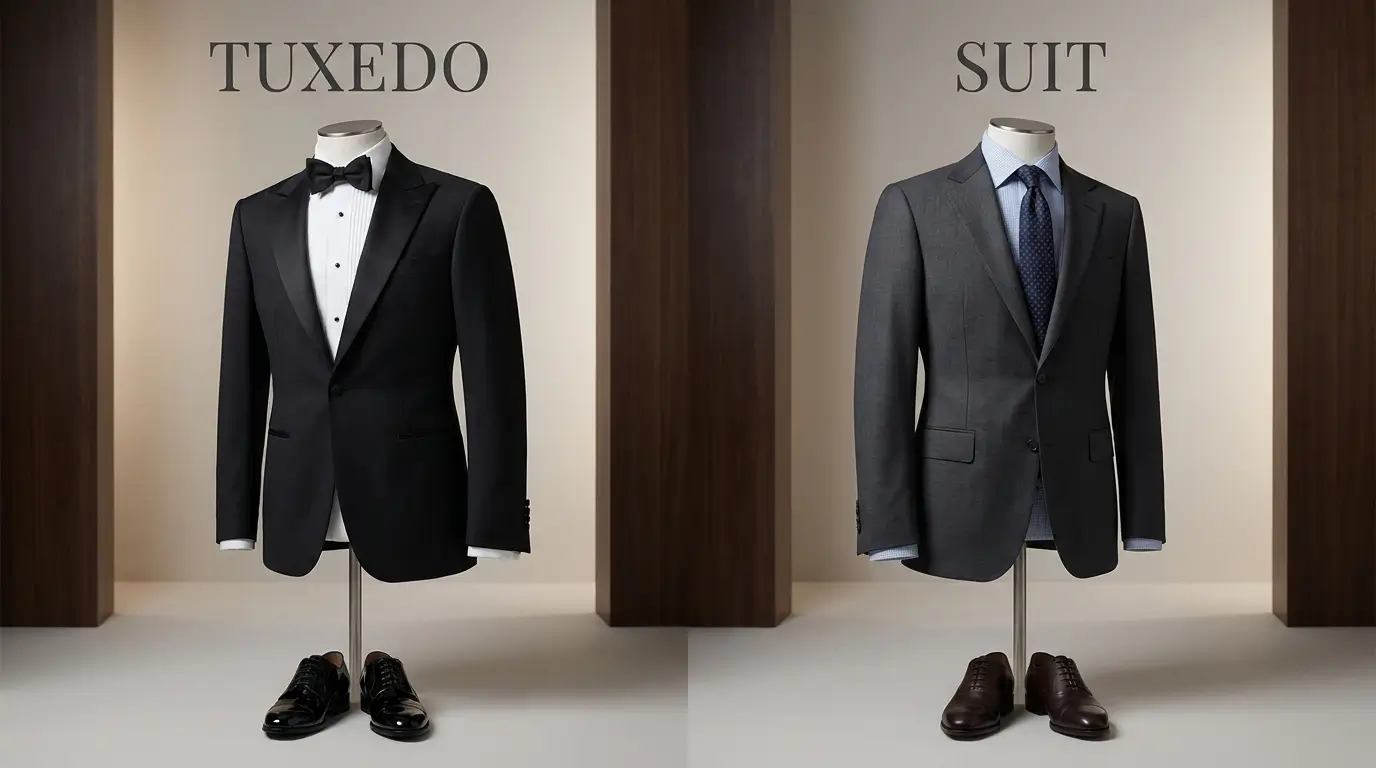
A tuxedo and a suit can both make you look polished, but they are not the same type of formalwear. The difference may seem small at first. Both can include a jacket, trousers, a shirt, and smart shoes. Yet details such as satin trim, shirt style, accessories, and dress code can change the entire look.
That is why people often search for the difference between tuxedo and suit before attending a wedding, gala, prom, formal dinner, or business event. Choosing the wrong one can make an outfit look either too casual or too formal.
The difference between tuxedo and suit is mainly about formality and design. A tuxedo is made for formal evening occasions and traditionally has satin details. A suit is more flexible and works for business, daytime events, weddings, dinners, and many other settings.
Understanding the difference between tuxedo and suit also makes shopping easier. You can choose the right jacket, shirt, shoes, and accessories without guessing. In this guide, we will explain the difference between tuxedo and suit in simple terms, including their history, spelling, dress codes, common mistakes, and everyday use.
Quick Answer
The easiest answer is:
A tuxedo is more formal than a standard suit and traditionally has satin or silk-like contrasting details on the jacket and trousers.
A traditional tuxedo usually includes:
- A black or dark formal jacket
- Satin or grosgrain lapels
- Matching satin trouser stripes
- A formal dress shirt
- A bow tie
- Formal dress shoes
A suit is more versatile. It may include:
- A suit jacket
- Matching trousers
- A dress shirt
- A necktie or no tie
- Dress shoes or other smart footwear
For example:
- Suit: He wore a navy suit to the business meeting.
- Tuxedo: He wore a black tuxedo to the evening gala.
A suit can be appropriate for many levels of formality. A tuxedo is normally reserved for events where a high level of formal dress is expected.
Tuxedo vs Suit at a Glance
| Feature | Tuxedo | Suit |
|---|---|---|
| Formality | Very formal | Formal to business-casual, depending on style |
| Typical use | Black-tie events | Business, weddings, dinners, ceremonies |
| Satin details | Traditionally yes | Usually no |
| Lapels | Often satin-faced | Usually same fabric as jacket |
| Shirt | Formal dress shirt | Dress shirt |
| Neckwear | Traditionally bow tie | Usually necktie, optional in some settings |
| Trousers | Often have satin side braid | Usually no satin stripe |
| Versatility | Lower | Higher |
| Typical color range | Often black or dark shades | Very broad |
| Time of use | Traditionally evening | Day or evening |
The Origin of Tuxedo and Suit
The words tuxedo and suit have different histories.
The Origin of Tuxedo
The word tuxedo is strongly associated with the United States. It comes from Tuxedo Park, a community in New York State that became associated with the formal jacket in the late 19th century.
The name of the place ultimately comes from a Native American place name, often traced through forms used for the area and associated with the Lenape language. The exact linguistic history of the place name has been discussed by historians and etymologists, so it is best not to treat every proposed translation as certain.
In American English, tuxedo became the common name for the formal evening outfit or jacket.
In British English, dinner jacket is a common term for the jacket worn as part of black-tie dress. Dinner suit is also used for the complete outfit.
The Origin of Suit
The English word suit has a much older history. It comes through Anglo-French and Old French forms related to following, accompanying, or a set of things that go together. Over time, the word developed several meanings in English.
The clothing sense refers to garments designed to be worn together, especially a matching jacket and trousers, or a jacket, waistcoat, and trousers in traditional three-piece dress.
This explains an important idea behind the modern word: a suit is a matching set of garments.
Why Are They Called Different Things?
The names reflect different histories.
Tuxedo developed as a name for a particular type of formal evening clothing.
Suit developed from a much older word associated with things that belong together.
Neither word is simply a regional spelling of the other. They identify different clothing concepts.
Pronunciation and Part of Speech
Both tuxedo and suit are commonly used as nouns.
Tuxedo is a countable noun.
Examples:
- He bought a new tuxedo.
- Three tuxedos were hanging in the store.
Suit can also be a countable noun when referring to a set of clothing.
Examples:
- She bought a new suit.
- His gray suit fits perfectly.
The word suit has other meanings too. It can be a verb meaning to be appropriate for someone or something.
For example:
- This color suits you.
- The schedule suits me.
The clothing noun and the verb have the same spelling, but the sentence tells you which meaning is intended.
Pronunciation is not usually a major source of confusion between tuxedo and suit because they sound quite different. The greater challenge for English learners is knowing when each word should be used.
Key Differences Between a Tuxedo and a Suit
1. Level of Formality
This is the biggest difference.
A tuxedo belongs to a higher level of formal dress. It is traditionally connected with black-tie events.
A suit is more flexible. A dark suit can look very formal, but it can also be worn in less formal settings.
For example:
- Wedding ceremony: suit or tuxedo, depending on the dress code
- Job interview: usually suit
- Business meeting: suit
- Black-tie gala: tuxedo
- Formal evening reception: often tuxedo if black tie is requested
The invitation or dress code should guide your decision.
2. Satin Details
Traditional tuxedos have satin or similar contrasting fabric details.
You may see satin on:
- Lapels
- Pocket trim
- Trouser side stripes
- Buttons
A standard suit normally uses the same or closely matching fabric throughout the jacket and trousers.
This creates one of the easiest visual differences between the two.
3. Lapels
Tuxedo lapels often have a satin or grosgrain facing.
Common tuxedo lapel styles include:
- Shawl lapel
- Peak lapel
- Notch lapel
A standard suit can also have these general lapel shapes, but the lapels are usually made from the main suit fabric rather than contrasting satin.
So the shape alone does not tell you whether something is a tuxedo. The material and overall construction matter too.
4. Trousers
Traditional tuxedo trousers often have a narrow satin or grosgrain stripe running down the outer seam.
Suit trousers generally do not have this stripe.
The tuxedo trousers are also normally designed to match the tuxedo jacket closely.
This gives the tuxedo a clean, continuous appearance.
5. Neckwear
A classic tuxedo is traditionally worn with a bow tie.
A suit is more commonly worn with a standard necktie.
Modern formalwear has become more flexible, and fashion choices can vary. However, if an invitation says black tie, a classic tuxedo with a bow tie remains the safest choice.
6. Shirt Style
Tuxedos traditionally use formal dress shirts.
Depending on the style, the shirt may have:
- A pleated front
- A bib front
- French cuffs
- Studs or formal buttons
- A wing or turndown collar
A suit normally works with a standard dress shirt.
A white shirt is a safe choice with both, but the overall shirt design is usually more formal with a traditional tuxedo.
7. Versatility
A suit wins easily in versatility.
You can wear the same navy suit to:
- An office
- A wedding
- A dinner
- A graduation
- A professional event
- A presentation
A tuxedo has a narrower purpose.
It is designed for formal occasions where a special evening dress code is expected.
British English vs American English Spelling
There is no major British-versus-American spelling difference between tuxedo and suit.
Both American and British English use:
- tuxedo
- suit
However, there is an important vocabulary difference.
In American English, tuxedo is the standard everyday term for this type of formal eveningwear.
In British English, dinner jacket is very common for the jacket itself, especially in discussions of black-tie dress. Dinner suit can refer to the complete outfit.
This is a difference in usage, not a spelling rule.
| Meaning | American English | British English |
|---|---|---|
| Formal evening jacket | tuxedo | dinner jacket |
| Complete formal evening outfit | tuxedo / tuxedo suit | dinner suit |
| Matching business/formal clothing | suit | suit |
| Standard spelling of suit | suit | suit |
The word tuxedo is still understood in Britain, while dinner jacket is widely understood in American English in formalwear contexts.
Which Spelling Should You Use?
If you are writing for an American audience, tuxedo is the natural choice.
Example:
The invitation says that guests should wear a tuxedo.
If you are writing for a British or Commonwealth audience, dinner jacket may sound more natural when referring specifically to the jacket.
Example:
He wore a black dinner jacket to the formal dinner.
For a global audience, you can make the meaning clear by using both terms once:
In American English, a tuxedo is often called a dinner jacket in British English.
For suit, there is no regional spelling issue. Use suit in both varieties.
Common Mistakes with Difference Between Tuxedo and Suit
Mistake 1: Treating a Tuxedo and Suit as Exact Synonyms
A tuxedo is technically a type of formal clothing, but it is not interchangeable with every suit.
Incorrect idea: Any black suit is a tuxedo.
Better: A black suit and a traditional tuxedo can look similar, but tuxedos normally have distinctive formal details such as satin-faced lapels.
Mistake 2: Wearing a Tuxedo to Every Wedding
Not every wedding requires black-tie clothing.
If the invitation says black tie, a tuxedo is appropriate.
If it simply says formal attire, a well-fitted suit may also be suitable depending on the event.
Always read the dress code.
Mistake 3: Thinking Color Is the Main Difference
A black suit is not automatically a tuxedo.
Likewise, tuxedos do not have to be limited to one exact color in modern fashion.
The construction, fabric details, and intended dress code matter more than color alone.
Mistake 4: Wearing a Regular Tie With Traditional Black Tie
A regular necktie is normally associated with suits.
Traditional black-tie dress calls for a bow tie.
Modern fashion can bend rules, but if you want to follow classic black-tie standards, use a bow tie.
Mistake 5: Calling a Suit Jacket a Blazer
A suit jacket is designed to be worn with matching trousers.
A blazer is generally a separate jacket designed to work with different trousers.
This is another useful distinction when discussing men’s formal clothing.
Tuxedo and Suit in Everyday Examples
The words appear in many different types of writing.
In an Email
Hi James, the invitation says black tie, so I think we should wear tuxedos rather than regular suits.
In a News Article
The actor arrived at the awards ceremony wearing a classic black tuxedo.
On Social Media
Should I wear a navy suit or a tuxedo to the wedding? The invitation says formal attire.
In Formal Writing
A tuxedo is traditionally associated with black-tie evening dress, while a suit is suitable for a wider range of formal and professional settings.
In a Workplace Conversation
I need a new suit for my interview next week.
At a Wedding
The groom wore a tuxedo, while the guests wore dark suits.
These examples show that tuxedo usually points to a specific formal style, while suit is much broader.
Tuxedo vs Suit: Which One Should You Choose?
Your choice should start with the dress code, not the color or what looks best in a store.
Choose a Tuxedo When:
- The invitation says black tie.
- You are attending a formal evening gala.
- You are part of a wedding with a tuxedo dress code.
- You are attending a highly formal awards event.
- You want a traditional eveningwear look.
Choose a Suit When:
- You are attending a business meeting.
- You have a job interview.
- The event says business formal.
- The wedding does not require black tie.
- You want an outfit that can be reused for different occasions.
A good suit is often the better first purchase because it can serve many purposes.
A tuxedo makes more sense when you regularly attend events that require or strongly favor black-tie clothing.
Search Intent and Usage Patterns
People searching for difference between tuxedo and suit usually want practical advice rather than a dictionary definition.
Common questions include:
- Can I wear a suit instead of a tuxedo?
- Is a tuxedo more formal?
- What makes a tuxedo different?
- Can a black suit look like a tuxedo?
- What should I wear to a black-tie wedding?
- Is a tuxedo appropriate during the day?
This search intent is useful because clothing terms can overlap in everyday speech. A person may call any formal matching outfit a “suit,” while formalwear specialists may make sharper distinctions.
Search interest also does not equal actual clothing usage. People may search these terms because they have an upcoming wedding, formal dinner, graduation, or special event. The most useful answer therefore focuses on dress codes and real-world situations rather than unsupported search-volume claims.
Tuxedo vs Suit Comparison Table
| Feature | Tuxedo | Suit |
|---|---|---|
| Main purpose | Formal eveningwear | Versatile formalwear |
| Typical dress code | Black tie | Business, formal, cocktail, and other settings |
| Formality | Higher | Varies |
| Jacket trim | Traditionally satin or grosgrain | Usually matching main fabric |
| Trousers | Often satin side stripe | Usually plain |
| Neckwear | Bow tie | Usually necktie |
| Shirt | Formal dress shirt | Standard dress shirt |
| Shoes | Formal dress shoes | Dress shoes and other suitable footwear |
| Common colors | Black and other formal shades | Navy, charcoal, gray, black, brown, and more |
| Daytime use | Traditionally limited | Very common |
| Business use | Rare | Common |
| Versatility | Limited | High |
| American term | Tuxedo | Suit |
| Common British term | Dinner jacket | Suit |
FAQs About the Difference Between Lake and Pond
1. What is the main difference between a lake and a pond?
The main difference is usually size and depth. Lakes are generally larger and deeper, while ponds are smaller and often shallower. However, there is no single worldwide size limit that officially separates the two.
2. Is a lake always deeper than a pond?
Not always. Many lakes are deeper than ponds, but depth alone does not define them. A large body of water can be relatively shallow, while a smaller pond can have a surprisingly deep area.
3. Can a pond become a lake?
Yes, a pond can change over time as it grows, becomes deeper, or develops different ecological features. However, there is no exact point at which every pond officially becomes a lake.
4. Do lakes and ponds have different plants and animals?
They can. Shallow ponds often allow sunlight to reach more of the bottom, which supports many aquatic plants. Deeper lakes may have different habitats and water conditions, leading to different plant and animal communities.
5. Are lakes always natural and ponds always artificial?
No. Both lakes and ponds can be natural or artificial. People create ponds for farming, landscaping, recreation, and water management, while reservoirs are examples of large artificial bodies of water often described as lakes.
6. Which is usually warmer, a lake or a pond?
A shallow pond often warms more quickly because sunlight can affect much of its water. Deeper lakes may have cooler water below the surface and can develop distinct temperature layers during certain seasons.
7. Why is it sometimes hard to tell a lake from a pond?
There is no universal scientific rule based only on size. Different regions, organizations, and traditions may use the words differently. This is why some bodies of water can reasonably be called either a lake or a pond.
Conclusion
Understanding the difference between lake and pond becomes easier when you look at size, depth, water conditions, and the habitats they support.
Although lakes are generally larger and deeper, there is no universal measurement that perfectly separates a lake from a pond in every situation.
Both lakes and ponds are important freshwater habitats. They support plants, animals, recreation, and local ecosystems in different ways.
Once you know these basic differences, you can use lake and pond with greater confidence in everyday conversations, schoolwork, and formal writing.

Mira Anand is a writer at Distinly.com who focuses on storytelling, communication, and social perspective. Her work highlights subtle differences in language and meaning across cultures and communities. With a clear and empathetic voice, Mira helps readers understand how narratives shape understanding, relationships, and modern dialogue in an increasingly connected world.