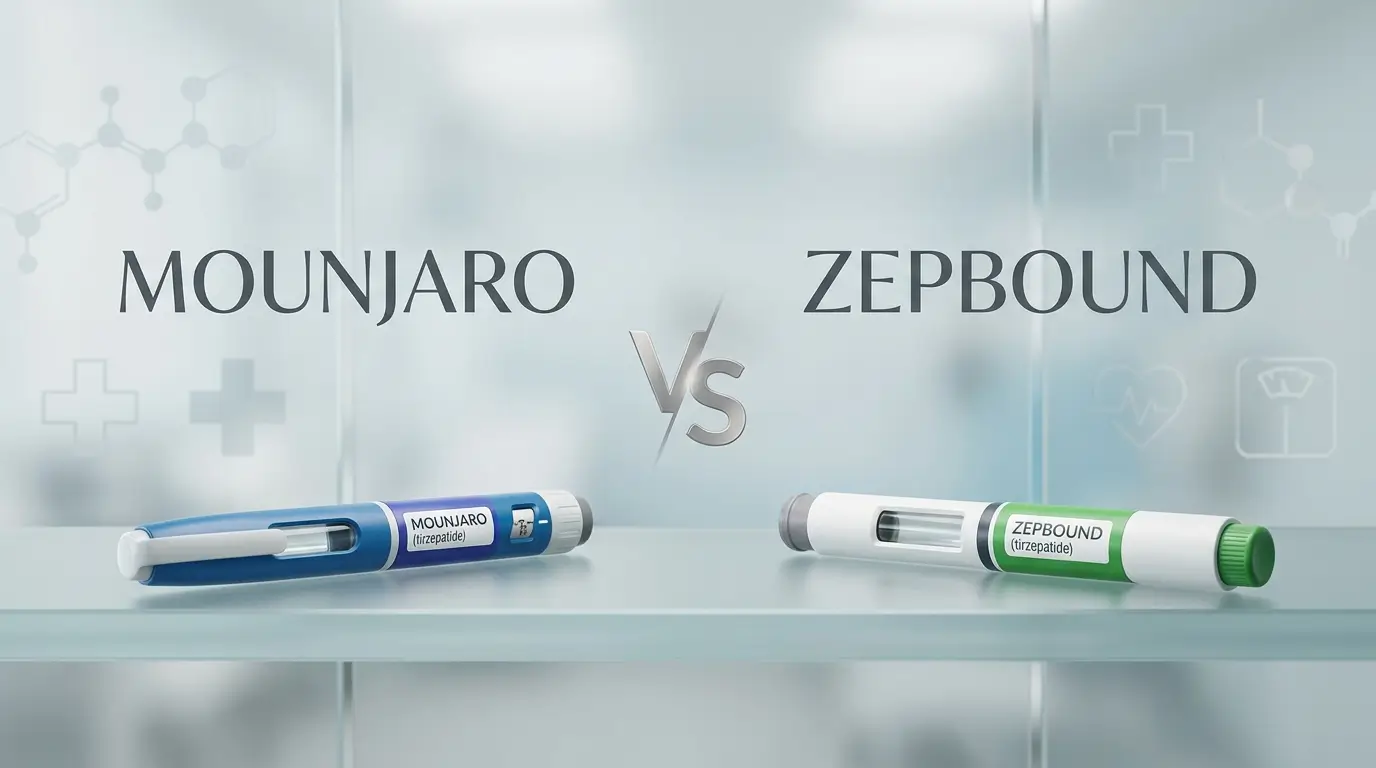
If you have searched for the difference between Mounjaro and Zepbound, you may have noticed something confusing: both medicines contain the same active ingredient, tirzepatide. So why do they have different brand names?
The difference between Mounjaro and Zepbound mainly comes down to their approved uses, not their active ingredient. Both medicines use tirzepatide and act on the same two hormone receptors, GIP and GLP-1. However, U.S. regulators approved Mounjaro primarily for blood sugar control in people with type 2 diabetes, while Zepbound carries approvals for chronic weight management and certain adults with obesity and moderate to severe obstructive sleep apnea.
People often search for the difference between Mounjaro and Zepbound because the medicines look remarkably similar. Both use a once-weekly injection, and both contain tirzepatide. This guide explains their names, uses, dosing basics, pronunciation, similarities, differences, common mistakes, and important safety points in clear language.
Quick Answer
The simplest answer is this:
Mounjaro and Zepbound contain the same active ingredient: tirzepatide. The main difference lies in their FDA-approved uses and brand positioning.
Mounjaro helps improve blood sugar control in adults and children ages 10 and older who have type 2 diabetes. Patients use it alongside diet and exercise.
Zepbound helps adults with obesity, or adults with heavier person plus at least one weight-related health condition, reduce excess body weight and maintain weight loss over the long term. The FDA also approved Zepbound for moderate to severe obstructive sleep apnea in adults with obesity.
Both medicines contain tirzepatide and activate GIP and GLP-1 receptors. Both also use a once-weekly subcutaneous injection.
| Key point | Mounjaro | Zepbound |
|---|---|---|
| Active ingredient | Tirzepatide | Tirzepatide |
| Main U.S. use | Type 2 diabetes | Weight management and certain OSA cases |
| Drug class | GIP/GLP-1 receptor agonist | GIP/GLP-1 receptor agonist |
| Injection | Once weekly | Once weekly |
| Maximum adult dose | 15 mg weekly | 15 mg weekly |
| Manufacturer | Eli Lilly | Eli Lilly |
So, Mounjaro and Zepbound are not two completely different drugs. They are different brand names for tirzepatide products with different approved indications.
The Origin of Mounjaro and Zepbound
Mounjaro and Zepbound do not follow the normal word-origin pattern that we see with everyday English words.
Both names function as proprietary brand names for medicines. Their names do not work like ordinary nouns such as “diabetes,” “weight,” or “injection.” Instead, pharmaceutical companies create brand names to identify specific products.
The active ingredient has a different naming history. Tirzepatide uses the standardized naming system for pharmaceutical substances rather than everyday English vocabulary.
The FDA lists Mounjaro as a tirzepatide injection and records its initial U.S. approval in 2022. The current labeling identifies Mounjaro as a GIP and GLP-1 receptor agonist for improving glycemic control in adults and pediatric patients aged 10 and older with type 2 diabetes.
Zepbound also contains tirzepatide. The current FDA label lists its initial U.S. approval as 2022, while the brand gained its U.S. weight-management indication later. The FDA approved Zepbound for chronic weight management in adults in November 2023 and expanded its approved uses to include moderate to severe obstructive sleep apnea in adults with obesity in December 2024.
Reliable public sources do not establish a simple literal English meaning for the brand names Mounjaro and Zepbound. Therefore, you should not treat them like ordinary words with a confirmed dictionary-style etymology.
Why did the company use two names?
A pharmaceutical company can use different proprietary names for products that contain the same active ingredient when the products serve different approved purposes.
That distinction helps doctors, pharmacists, patients, insurers, and health systems identify the intended product and its approved indication.
Pronunciation and Part of Speech
How do you pronounce Mounjaro?
Mounjaro functions as a proper brand name, not a normal English noun.
The FDA Drug Trials Snapshot gives the pronunciation as “mown-JAHR-oh.”
The name contains three main syllables, with the strongest stress in the middle.
How do you pronounce Zepbound?
Zepbound also functions as a proper brand name. English speakers commonly pronounce it in a way that resembles “zep-bound.”
Unlike ordinary vocabulary words, these brand names do not need a British-versus-American spelling rule. The official product names remain Mounjaro and Zepbound.
What about tirzepatide?
Tirzepatide names the active pharmaceutical ingredient. It also functions grammatically as a proper medication name rather than as a normal everyday noun.
You might write:
- “The doctor prescribed tirzepatide.”
- “Mounjaro contains tirzepatide.”
- “Zepbound contains tirzepatide.”
The grammar stays simple because the medication names normally act as nouns in sentences.
British English vs American English Spelling
You will not find a meaningful British-versus-American spelling difference between Mounjaro and Zepbound.
Both names identify branded medicines, so writers should use the official spellings:
- Mounjaro
- Zepbound
- tirzepatide
Do not change the spelling to create a British or American version.
Some surrounding medical words can show regional differences. For example, American English commonly uses “pediatric,” while British English uses “paediatric.” That difference applies to the general English word, not to the medicine’s brand name.
| Feature | American English | British English |
|---|---|---|
| Brand name | Mounjaro | Mounjaro |
| Brand name | Zepbound | Zepbound |
| Active ingredient | tirzepatide | tirzepatide |
| “Pediatric” | pediatric | paediatric |
| Brand-name spelling | Same | Same |
For international medical content, always preserve the official brand spelling.
Which Spelling Should You Use?
Use Mounjaro when you refer to the Mounjaro brand.
Use Zepbound when you refer to the Zepbound brand.
Do not replace one name with the other simply because both products contain tirzepatide.
If you write for a U.S. audience, use the FDA-approved indications that apply to each product. Mounjaro’s U.S. labeling focuses on glycemic control for type 2 diabetes. Zepbound’s U.S. labeling focuses on chronic weight management and also includes an indication for moderate to severe obstructive sleep apnea in adults with obesity.
For UK, Commonwealth, or other international audiences, check the medicine’s local regulatory approval before describing its approved uses. Drug names and indications can differ between countries.
Most importantly, do not assume that an indication approved in the United States automatically applies in another country.
What Is Actually Different?
The most important distinction involves what the FDA approves each product to treat.
Mounjaro
Mounjaro helps improve glycemic control in adults and children aged 10 years and older with type 2 diabetes. Patients use it with diet and exercise.
Its current U.S. labeling starts treatment at 2.5 mg once weekly. After four weeks, the recommended schedule increases to 5 mg once weekly. Doctors can increase the dose in 2.5 mg steps after at least four weeks on the current dose when the patient needs additional glycemic control. The maximum adult dose reaches 15 mg once weekly.
Zepbound
Zepbound helps adults with obesity, or adults with heavier person and at least one weight-related condition, reduce excess body weight and maintain weight reduction over the long term. Patients use it with a reduced-calorie diet and increased physical activity.
The FDA also approved Zepbound for moderate to severe obstructive sleep apnea in adults with obesity. The approval came in December 2024 and added another important use for tirzepatide under the Zepbound brand.
Zepbound also starts at 2.5 mg once weekly, and its maximum dose reaches 15 mg once weekly.
The important point
The dose alone does not define the difference.
Both products can use similar tirzepatide dose strengths. The approved indication and brand name create the major distinction.
Common Mistakes
People make several common mistakes when they discuss these medicines.
Mistake 1: Calling them completely different drugs
Incorrect:
“Mounjaro and Zepbound contain different active ingredients.”
Correct:
“Mounjaro and Zepbound both contain tirzepatide.”
The brand names differ, but the active ingredient matches.
Mistake 2: Saying Mounjaro only works on GLP-1
Tirzepatide activates both GIP and GLP-1 receptors. Calling it only a GLP-1 drug misses an important part of its mechanism.
Mistake 3: Assuming Zepbound has no diabetes connection
Tirzepatide can affect blood glucose, but the FDA-approved U.S. indication distinguishes Zepbound from Mounjaro. Mounjaro carries the type 2 diabetes indication, while Zepbound carries weight-management and certain OSA indications.
Mistake 4: Treating the brand names as interchangeable
You should not casually switch the names in medical writing.
For example:
Better:
“Zepbound carries a U.S. indication for chronic weight management.”
Not ideal:
“Mounjaro is the weight-management brand.”
That statement can oversimplify the regulatory distinction.
Mistake 5: Assuming the U.S. label applies worldwide
Medication approvals vary by country.
Always check the local regulator and prescribing information when you write for an international audience.
Everyday Examples
Understanding the terms becomes easier when you see them in natural sentences.
In an email
“I am researching the difference between Mounjaro and Zepbound before my appointment.”
This sentence works well because it treats both names as proper medication names.
In medical writing
“Mounjaro contains tirzepatide and carries a U.S. indication for improving glycemic control in people with type 2 diabetes.”
The sentence identifies the product and its approved use.
In an article
“Zepbound contains the same active ingredient, tirzepatide, but its U.S. labeling focuses on weight management and includes an indication for certain adults with obesity and obstructive sleep apnea.”
This wording makes the distinction clear without suggesting that the products contain different ingredients.
On social media
“Are Mounjaro and Zepbound the same thing?”
People often ask this question because both products contain tirzepatide.
A useful short answer would say:
“They both contain tirzepatide, but their U.S. FDA-approved uses differ.”
In formal writing
“Although Mounjaro and Zepbound share the active ingredient tirzepatide, their U.S. labeling identifies different primary indications.”
This sentence suits a formal article or educational report.
Side-by-Side Comparison
| Feature | Mounjaro | Zepbound |
|---|---|---|
| Active ingredient | Tirzepatide | Tirzepatide |
| Drug action | GIP and GLP-1 receptor agonist | GIP and GLP-1 receptor agonist |
| Main U.S. indication | Type 2 diabetes | Chronic weight management |
| Additional U.S. indication | — | Moderate to severe OSA in adults with obesity |
| Injection | Subcutaneous | Subcutaneous |
| Frequency | Once weekly | Once weekly |
| Starting dose | 2.5 mg weekly | 2.5 mg weekly |
| Maximum adult dose | 15 mg weekly | 15 mg weekly |
| Brand owner | Eli Lilly | Eli Lilly |
| Brand spelling | Mounjaro | Zepbound |
The FDA labeling confirms the shared active ingredient, weekly injection schedule, and GIP/GLP-1 activity.
Are Mounjaro and Zepbound the Same Medication?
They share the same active ingredient, tirzepatide, but you should not describe the products as identical in every respect.
Think of them as two branded tirzepatide products with different approved uses.
This distinction matters because doctors and pharmacists rely on the product name, labeling, dose instructions, and indication when they prescribe or dispense medication.
The FDA’s current labeling also gives each product its own safety information and prescribing instructions. Both labels carry a boxed warning about thyroid C-cell tumors based on findings in rats. The labels state that researchers do not know whether tirzepatide causes these tumors in humans and that people with a personal or family history of medullary thyroid carcinoma or MEN 2 should not use the products.
Patients should never choose between these medicines based only on online comparisons. A qualified healthcare professional can consider the person’s diagnosis, treatment goals, medical history, other medicines, and local prescribing rules.
Frequently Asked Questions
1. What is the main difference between Mounjaro and Zepbound?
The biggest difference involves their U.S. FDA-approved uses. Mounjaro targets glycemic control in type 2 diabetes, while Zepbound targets chronic weight management and certain cases of obstructive sleep apnea in adults with obesity.
2. Do Mounjaro and Zepbound contain the same ingredient?
Yes. Both contain tirzepatide as the active ingredient. Both medicines also activate GIP and GLP-1 receptors.
3. Do Mounjaro and Zepbound use the same injection schedule?
Both products use a once-weekly subcutaneous injection. Their prescribing information also uses a 2.5 mg starting dose, with dose adjustments based on the product’s approved use and prescribing instructions.
4. Is Zepbound approved for sleep apnea?
Yes. The FDA approved Zepbound for moderate to severe obstructive sleep apnea in adults with obesity in December 2024. Patients use it alongside a reduced-calorie diet and increased physical activity.
5. Can you use Mounjaro and Zepbound together?
Do not combine or switch these medicines on your own. They contain the same active ingredient, so a healthcare professional should guide any treatment change.
6. Do Mounjaro and Zepbound have the same side effects?
Because both products contain tirzepatide, their labels include many similar adverse reactions. Common reactions include gastrointestinal symptoms such as nausea, diarrhea, vomiting, constipation, and abdominal discomfort.
7. Which one should I choose?
That depends on your medical needs and the indication your healthcare professional is treating. Do not choose Mounjaro or Zepbound based only on price, social-media claims, or online comparisons.
Conclusion
The difference between Mounjaro and Zepbound becomes much easier to understand once you focus on their approved uses. Both products contain tirzepatide, but their brand roles differ.
Mounjaro focuses on improving blood sugar control in type 2 diabetes, while Zepbound focuses on weight management and certain adults with obesity and sleep apnea.
Both medicines share important features, including weekly dosing and GIP and GLP-1 receptor activity. Their labels still differ in important ways.
If you want to remember the distinction, connect Mounjaro with its diabetes indication and Zepbound with its weight-management and OSA indications. Always check current medical guidance.
Keep learning these differences, use the correct names in emails and essays, and discuss treatment choices with a qualified healthcare professional.
Medical note
This article provides general educational information, not personal medical advice. FDA indications and prescribing information can change, and treatment decisions should come from a qualified healthcare professional.

Aamer Shahzad is the founder of Distinly.com, a fast-growing educational platform focused on high-intent “difference between” topics. With over 8 years of experience in English language education and analytical writing, I specialize in breaking down complex “difference between” topics into clear, structured, and easy-to-understand explanations. Distinly.com is your go-to resource for enhancing English skills and writing with confidence.
I specializes in building search-optimized, research-driven comparison content designed for clarity, authority, and long-term digital asset value.