The difference between celsius and fahrenheit becomes obvious the moment you check the weather on two different apps and see completely different numbers for the same day. One says 25°, another says 77°. Confusing, right?
In simple terms, Celsius and Fahrenheit are two temperature scales used to measure how hot or cold something is. They are both widely used, but in different parts of the world. Understanding the difference between celsius and fahrenheit helps you interpret temperatures correctly in daily life.
Many countries use Celsius for weather, cooking, and science, while others, like the United States, prefer Fahrenheit. That’s why knowing the difference between celsius and fahrenheit is important for global communication 🌍.
Let’s explore how these two systems compare and why both still exist today.
🔑 Key Difference Between the Both
The main difference lies in how each scale defines temperature points.
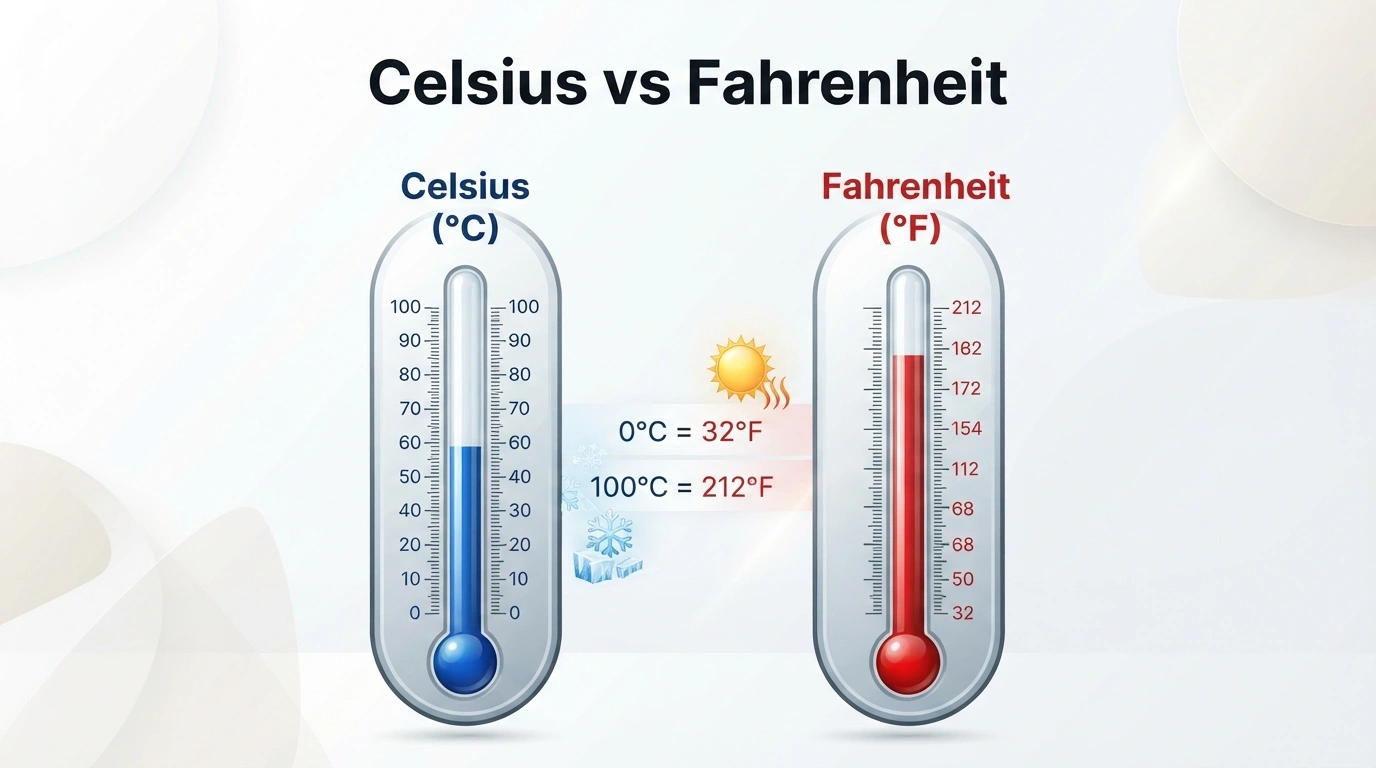
- Celsius sets 0°C as the freezing point of water and 100°C as the boiling point.
- Fahrenheit sets 32°F as freezing and 212°F as boiling.
This means Celsius uses a 100-degree range, while Fahrenheit uses a 180-degree range between these two key points.
🌍 Importance – Why Knowing the Difference Matters
Understanding these scales is essential for both learners and experts.
For students, it builds a foundation in science and geography. You can better understand global weather reports and academic content.
For professionals, especially in science, medicine, and engineering, accuracy in temperature measurement is critical. Using the wrong scale can lead to serious errors.
In society, knowing both scales improves communication. Whether you’re traveling, cooking, or studying abroad, this knowledge avoids confusion and mistakes.
🔊 Pronunciation Section
Celsius
US: /ˈsɛl.si.əs/
UK: /ˈsɛl.si.əs/
Fahrenheit
US: /ˈfær.ən.haɪt/
UK: /ˈfær.ən.haɪt/
Now that you can say them correctly, let’s understand what each term really means.
📚 Core Definitions
Celsius
Celsius is a temperature scale based on water’s freezing and boiling points. It is simple and widely used in science and daily life.
Example: Water freezes at 0°C.
Fahrenheit
Fahrenheit is a temperature scale with different reference points. It provides more detailed gradations between temperatures.
Example: Water freezes at 32°F.
📚 10 Clear Differences Between Celsius and Fahrenheit
1. Measurement Range
Celsius uses a 0–100 scale for water states. Fahrenheit uses 32–212.
- Example for Celsius: 25°C feels warm
- Example for Fahrenheit: 77°F feels warm
2. Precision
Fahrenheit offers more degrees between freezing and boiling.
- Example for Celsius: 20°C to 21°C is a small jump
- Example for Fahrenheit: 68°F to 70°F gives more detail
3. Global Usage
Celsius is used worldwide. Fahrenheit is mainly used in the U.S.
- Example for Celsius: Europe uses °C
- Example for Fahrenheit: USA uses °F
4. Scientific Use
Scientists prefer Celsius due to simplicity.
- Example for Celsius: Lab temperatures use °C
- Example for Fahrenheit: Rarely used in science
5. Freezing Point
Different freezing points.
- Example for Celsius: 0°C freezes water
- Example for Fahrenheit: 32°F freezes water
6. Boiling Point
Different boiling points.
- Example for Celsius: 100°C boils water
- Example for Fahrenheit: 212°F boils water
7. Ease of Calculation
Celsius is easier for calculations.
- Example for Celsius: Simple 0–100 scale
- Example for Fahrenheit: Requires conversion
8. Daily Use Context
Celsius is used in most daily life contexts globally.
- Example for Celsius: Weather apps in Asia
- Example for Fahrenheit: Weather apps in the U.S.
9. Learning Curve
Celsius is easier to learn for beginners.
- Example for Celsius: Straightforward scale
- Example for Fahrenheit: Less intuitive
10. Historical Origin
They were created by different scientists.
- Example for Celsius: Anders Celsius
- Example for Fahrenheit: Daniel Fahrenheit
🎯 Why Knowing the Difference Matters
Students need this knowledge to understand science and geography lessons clearly. It helps them interpret global data correctly.
Professionals rely on accurate temperature readings. A mistake between Celsius and Fahrenheit can lead to errors in medicine, engineering, or cooking.
Socially, confusion can cause miscommunication. Imagine setting an oven incorrectly or misunderstanding weather forecasts 🌦️.
Real-world consequences of confusion
Using the wrong scale can lead to undercooked food, incorrect medical storage, or even safety hazards.
🧠 Why People Get Confused
Similar Concepts
Both measure temperature, which creates overlap.
Different Numbers
The same temperature looks very different numerically.
Context-Based Usage
Different countries use different systems.
Informal Speech
People often assume others use the same scale.
🎭 Connotation & Emotional Tone
Connotation = the emotional meaning associated with a word.
Celsius
- Neutral and scientific
- Example: “The lab is set to 20°C.”
Fahrenheit
- Practical and everyday (in the U.S.)
- Example: “It’s 75°F outside.”
🗣 Usage in Metaphors, Similes & Idioms
While not common in idioms, both appear in descriptive language:
- “The tension rose like a thermometer in Celsius.”
- “The room felt 100 degrees Fahrenheit with anger.”
These expressions add vivid imagery 🌡️.
📊 Comparison Table
| Feature | Celsius | Fahrenheit |
|---|---|---|
| Meaning | Metric temperature scale | Imperial temperature scale |
| Tone | Scientific | Practical |
| Usage | Global | Mostly USA |
| Context | Science, weather | Weather, daily life |
| Formality | Formal/academic | Informal/common |
⚖️ Which Is Better in What Situation?
When to Use Celsius
Use Celsius in scientific work, education, and international contexts. It is simple and widely accepted.
When to Use Fahrenheit
Use Fahrenheit in the U.S. or when dealing with American systems. It provides finer detail.
Situational Clarity
Choose based on location and audience. For example, use Celsius in Europe and Fahrenheit in the U.S.
Contextual Correctness
Always match the scale to the context to avoid confusion.
📖 Literary or Cultural References
- Book: A Brief History of Time (Science, Stephen Hawking, 1988)
- Movie: The Day After Tomorrow (USA, 2004)
Both works reference temperature concepts in scientific and dramatic ways.
❓ FAQs
1. Why are there two temperature scales?
Different scientists created them independently. Over time, regions adopted different systems.
2. Which is more accurate?
Both are equally accurate. Fahrenheit just has more increments.
3. Why does the U.S. use Fahrenheit?
It is a historical preference that continues today.
4. Is Celsius easier to learn?
Yes, because it uses a simple 0–100 scale.
5. How do you convert Celsius to Fahrenheit?
Use this formula:
F=59C+32
6. How do you convert Fahrenheit to Celsius?
C=95(F−32)
7. Which scale is used in science?
Celsius (and Kelvin) are used in science.
8. Is 0°C very cold?
It is the freezing point of water, so yes.
9. What is room temperature?
Around 20–25°C or 68–77°F.
10. Can both scales be used together?
Yes, but conversions are necessary.
🏁 Conclusion
The difference between celsius and fahrenheit lies in their reference points, scale structure, and global usage. Celsius is simple and widely used worldwide, while Fahrenheit offers more detailed temperature steps and remains popular in the United States.
Understanding both systems helps you interpret temperatures correctly in different contexts. Whether you’re studying, traveling, or working professionally, this knowledge improves clarity and prevents mistakes.
With practice, switching between the two becomes easy. Keep learning, stay curious, and you’ll master temperature scales in no time 🌟.

Aamer Shahzad is the founder of Distinly.com, a fast-growing educational platform focused on high-intent “difference between” topics. With over 8 years of experience in English language education and analytical writing, I specialize in breaking down complex “difference between” topics into clear, structured, and easy-to-understand explanations. Distinly.com is your go-to resource for enhancing English skills and writing with confidence.
I specializes in building search-optimized, research-driven comparison content designed for clarity, authority, and long-term digital asset value.