Math becomes much easier when you know the correct order for solving an expression. Yet many students get confused when they see BODMAS or PEMDAS. Are these two different rules? Does one give a different answer? Or are they simply two names for the same mathematical idea?
The short answer is that BODMAS and PEMDAS describe the order of operations used to evaluate mathematical expressions. Both systems tell you to handle grouping symbols first, then multiplication and division, and finally addition and subtraction. The main difference is the wording used for some steps.
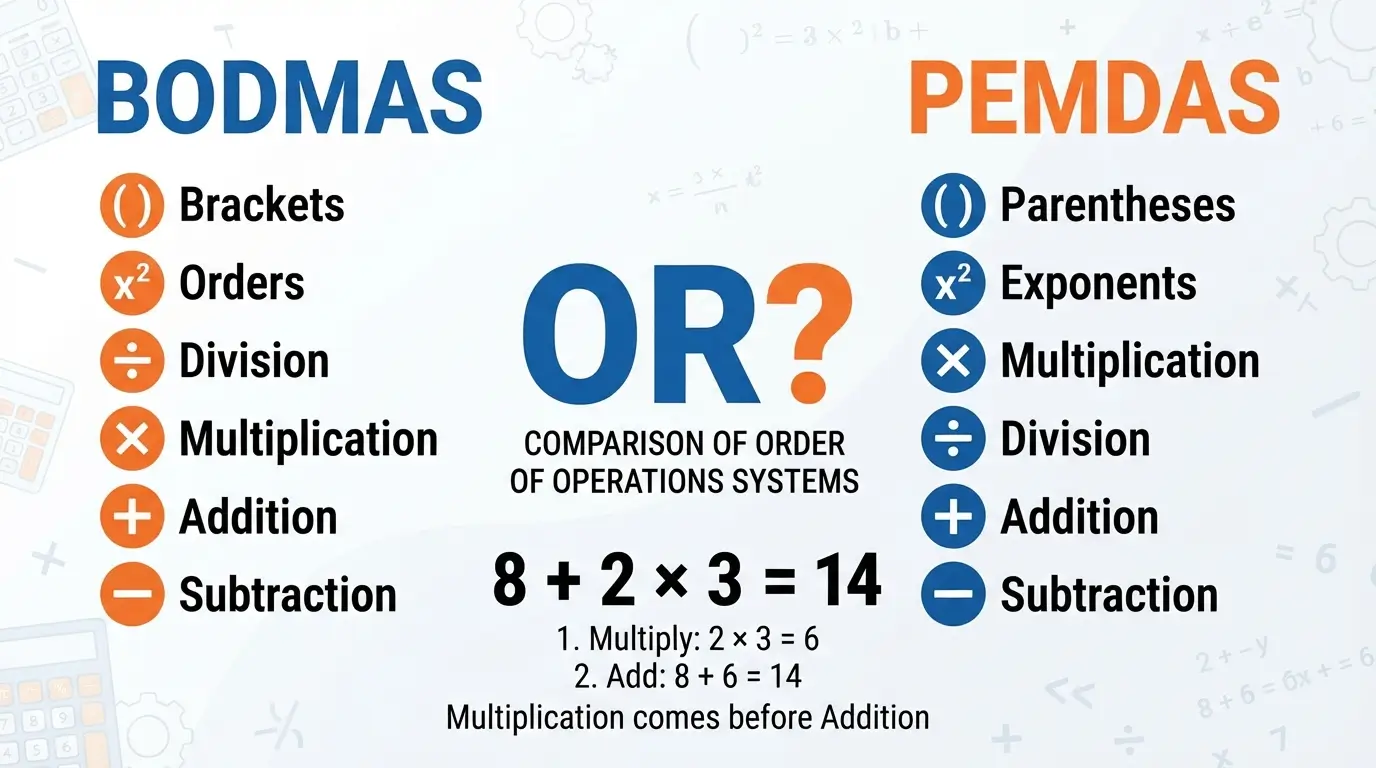
BODMAS stands for Brackets, Orders, Division, Multiplication, Addition, Subtraction. PEMDAS stands for Parentheses, Exponents, Multiplication, Division, Addition, Subtraction.
The biggest source of confusion is the placement of multiplication and division, and of addition and subtraction. They are not performed strictly from left to right by one operation type first. Operations at the same level are evaluated from left to right.
Understanding this point can prevent common mistakes and help you solve expressions correctly in school, exams, programming, science, and everyday calculations.
BODMAS or PEMDAS – Quick Answer
BODMAS and PEMDAS are two naming systems for the same general order of mathematical operations.
The term BODMAS means:
- B = Brackets
- O = Orders
- D = Division
- M = Multiplication
- A = Addition
- S = Subtraction
PEMDAS means:
- P = Parentheses
- E = Exponents
- M = Multiplication
- D = Division
- A = Addition
- S = Subtraction
The terms brackets and parentheses refer to grouping symbols in this context. Orders and exponents refer to powers and related operations.
For example:
8 + 2 × 3
You do multiplication before addition:
2 × 3 = 6
Then:
8 + 6 = 14
So the answer is:
14
You should not calculate 8 + 2 first.
What about multiplication and division?
This is one of the most important parts of the rule.
BODMAS does not mean that division must always happen before multiplication.
PEMDAS does not mean that multiplication must always happen before division.
Multiplication and division have the same priority. Work from left to right.
For example:
24 ÷ 4 × 3
Start from the left:
24 ÷ 4 = 6
Then:
6 × 3 = 18
The answer is 18, not 2.
The same left-to-right rule applies to addition and subtraction.
For:
10 − 3 + 2
Work from left to right:
10 − 3 = 7
Then:
7 + 2 = 9
The Origin of BODMAS or PEMDAS
The terms BODMAS and PEMDAS are mnemonic devices. They were created to help students remember the conventional order in which mathematical operations are evaluated.
The underlying mathematical convention is more important than the acronym itself.
Mathematicians needed a consistent way to interpret expressions containing several operations. Without agreed conventions, an expression such as:
2 + 3 × 4
could be interpreted in different ways.
The standard convention gives multiplication higher priority than addition, producing:
2 + 12 = 14
rather than:
5 × 4 = 20
Where did BODMAS come from?
BODMAS is widely used in the United Kingdom and in several other education systems.
The acronym represents:
Brackets, Orders, Division, Multiplication, Addition, Subtraction.
The word orders is used to describe powers, roots, and related operations.
The exact historical origin of the acronym is less important than the mathematical convention it represents. There is no need to assume that BODMAS was invented by one particular mathematician unless reliable historical evidence supports such a claim.
Where did PEMDAS come from?
PEMDAS is especially familiar in the United States.
It represents:
Parentheses, Exponents, Multiplication, Division, Addition, Subtraction.
Like BODMAS, it is a memory aid rather than a separate mathematical law.
The terminology reflects differences in mathematical vocabulary. American educational materials commonly use parentheses and exponents, while British educational materials often use brackets and orders.
Why are there two acronyms?
The two acronyms developed around different terminology and educational traditions.
The underlying mathematical idea is the same: expressions need a consistent hierarchy of operations.
This means you should not think of BODMAS and PEMDAS as competing mathematical systems. They are different labels for remembering the standard order of operations.
British English vs American English Spelling
There is a genuine regional difference in the terminology used in these acronyms.
British English commonly uses:
BODMAS
American English commonly uses:
PEMDAS
However, this is not simply a spelling difference. The acronyms use different mathematical terms.
| Concept | BODMAS | PEMDAS |
|---|---|---|
| Grouping | Brackets | Parentheses |
| Powers | Orders | Exponents |
| Multiplication | Multiplication | Multiplication |
| Division | Division | Division |
| Addition | Addition | Addition |
| Subtraction | Subtraction | Subtraction |
| Common association | UK and some other systems | US and some other systems |
There are also other mnemonics used in different educational settings, such as BEDMAS, where E represents exponents, and BIDMAS, where I represents indices.
These variations do not mean that the mathematics changes.
A student using BODMAS and a student using PEMDAS should reach the same answer when they apply the order correctly.
Brackets vs parentheses
In British mathematical English, brackets may be used as a general term for grouping symbols.
In American English, parentheses commonly refers specifically to the curved symbols:
( )
The symbols themselves do not change the mathematical purpose.
Orders vs exponents
The word orders in BODMAS is often used as a broad term for powers, roots, and related operations.
American materials commonly use exponents for powers.
For example:
3² = 9
The small 2 is an exponent.
In British terminology, you may hear this discussed under indices or orders, depending on the educational context.
Which Spelling Should You Use?
The best acronym depends largely on your school system, country, teacher, textbook, or audience.
If you study in the United States
PEMDAS is likely to be the most familiar term.
You can remember it as:
Parentheses → Exponents → Multiplication/Division → Addition/Subtraction
Remember that multiplication and division share the same priority.
If you study in the United Kingdom
BODMAS is commonly used.
Remember:
Brackets → Orders → Division/Multiplication → Addition/Subtraction
Again, division does not automatically come before multiplication.
For Commonwealth and international students
You may encounter BODMAS, BIDMAS, BEDMAS, or PEMDAS, depending on the country and curriculum.
The important thing is not which acronym you memorize. The important thing is understanding the hierarchy.
For global writing
If you are explaining the topic to an international audience, it is useful to mention both terms:
BODMAS, also known as PEMDAS in many American classrooms, describes the order of operations.
This approach helps readers recognize the concept regardless of their educational background.
Common Mistakes
Mistake 1: Doing everything from left to right
Consider:
5 + 4 × 2
Incorrect approach:
5 + 4 = 9
Then:
9 × 2 = 18
Correct approach:
4 × 2 = 8
Then:
5 + 8 = 13
The answer is 13.
Mistake 2: Always doing division before multiplication
Consider:
18 ÷ 3 × 2
Both operations have equal priority.
Work from left to right:
18 ÷ 3 = 6
6 × 2 = 12
Answer:
12
Mistake 3: Always doing multiplication before division
The reverse mistake is also common.
Consider:
20 × 4 ÷ 5
Work from left to right:
20 × 4 = 80
80 ÷ 5 = 16
The answer is 16.
You do not postpone multiplication simply because PEMDAS contains the letter M before D.
Mistake 4: Treating addition as higher priority than subtraction
Addition and subtraction have equal priority.
For:
15 − 6 + 4
Work left to right:
15 − 6 = 9
9 + 4 = 13
Answer:
13
Mistake 5: Ignoring brackets or parentheses
Consider:
4 × (3 + 2)
First solve inside the parentheses:
3 + 2 = 5
Then:
4 × 5 = 20
Answer:
20
Mistake 6: Thinking the acronym is the mathematics
BODMAS and PEMDAS are memory tools.
They are useful, but memorizing the letters without understanding equal-priority operations can cause mistakes.
The real skill is knowing which operations have priority and when to work from left to right.
BODMAS or PEMDAS in Everyday Examples
The order of operations is not limited to classroom exercises. It appears anywhere mathematical expressions need to be interpreted consistently.
In emails
A workplace email might include:
The total cost is calculated as 50 + 20 × 3.
The correct calculation is:
20 × 3 = 60
Then:
50 + 60 = 110
So the total is 110, assuming the expression represents the intended calculation.
In spreadsheets
Spreadsheet formulas use their own formal rules for precedence, but the basic mathematical hierarchy remains important.
For example, a formula involving multiplication and addition may calculate multiplication before addition unless parentheses change the order.
Understanding order of operations helps users create formulas that produce the intended result.
In programming
Programming languages use precedence rules to determine how expressions are evaluated.
For example, a programming expression might contain:
a + b × c
Multiplication generally has higher precedence than addition.
Programmers can use parentheses to make the intended order clearer.
In science
Scientific calculations often contain multiple operations, powers, fractions, and grouping symbols.
For example:
2 × 10³ + 5
First evaluate the power:
10³ = 1,000
Then:
2 × 1,000 = 2,000
Finally:
2,000 + 5 = 2,005
Correct operation order helps prevent calculation errors.
In financial calculations
Suppose a simple expression is:
100 + 25 × 4
Multiplication comes first:
25 × 4 = 100
Then:
100 + 100 = 200
If you intended the first two numbers to be added before multiplication, parentheses would be needed:
(100 + 25) × 4 = 500
This shows why grouping symbols matter.
A Better Way to Understand BODMAS or PEMDAS
Instead of thinking of the acronym as six completely separate steps, think of it as a hierarchy.
Level 1: Grouping
First deal with expressions inside parentheses, brackets, or other grouping symbols.
Example:
5 × (2 + 3)
Calculate:
2 + 3 = 5
Then:
5 × 5 = 25
Level 2: Powers and roots
Next handle exponents, indices, powers, and related operations.
Example:
4 + 2³
First:
2³ = 8
Then:
4 + 8 = 12
Level 3: Multiplication and division
These have equal priority.
Work from left to right.
Example:
30 ÷ 5 × 2
First:
30 ÷ 5 = 6
Then:
6 × 2 = 12
Level 4: Addition and subtraction
These also have equal priority.
Work from left to right.
Example:
12 − 5 + 7
First:
12 − 5 = 7
Then:
7 + 7 = 14
This four-level view is often easier to understand than simply memorizing six letters.
BODMAS vs PEMDAS Comparison Table
| Feature | BODMAS | PEMDAS |
|---|---|---|
| Full form | Brackets, Orders, Division, Multiplication, Addition, Subtraction | Parentheses, Exponents, Multiplication, Division, Addition, Subtraction |
| Main purpose | Order of operations | Order of operations |
| Grouping term | Brackets | Parentheses |
| Powers term | Orders | Exponents |
| Multiplication priority | Same as division | Same as division |
| Division priority | Same as multiplication | Same as multiplication |
| Addition priority | Same as subtraction | Same as subtraction |
| Common usage | UK and some international systems | US and some international systems |
| Produces different mathematics? | No | No |
The most important row is the one about multiplication and division.
They have equal precedence.
The same is true for addition and subtraction.
This is why reading the acronym as a strict one-letter-at-a-time sequence can be misleading.
Why Some BODMAS or PEMDAS Problems Cause Debate
Some mathematical expressions become controversial online because people interpret the acronym differently.
A common example is an expression containing multiplication, division, and no obvious grouping symbols.
The safest approach is to apply the standard precedence rules:
- Grouping symbols
- Exponents or powers
- Multiplication and division from left to right
- Addition and subtraction from left to right
When an expression could be interpreted in more than one way because of ambiguous notation, rewriting it with parentheses or a fraction bar can make the intended meaning clear.
For example, instead of writing a complicated expression as one long line, use:
(a + b) ÷ c
or:
a ÷ (b × c)
Clear mathematical notation is often better than relying on an acronym alone.
FAQs
1. Are BODMAS and PEMDAS the same?
Yes. They are different acronyms used to remember the standard order of mathematical operations. The terminology differs, but the underlying rules are the same.
2. Which is correct, BODMAS or PEMDAS?
Both are correct as memory aids. BODMAS is common in the UK and some other educational systems, while PEMDAS is especially common in the US.
3. Does multiplication come before division?
No. Multiplication and division have the same priority. When they occur together, calculate them from left to right.
4. Does addition come before subtraction?
No. Addition and subtraction also have equal priority. When they occur together at the same level, work from left to right.
5. What does the O in BODMAS mean?
The O stands for Orders. It refers broadly to powers, roots, indices, and related operations, depending on the educational context.
6. What does the E in PEMDAS mean?
The E stands for Exponents. An exponent tells you how many times a number or expression is used as a factor.
For example:
2³ = 2 × 2 × 2 = 8
7. Can BODMAS and PEMDAS give different answers?
When both are applied correctly to the same expression, they should not give different answers. Different results usually come from misunderstanding equal-priority operations or interpreting the notation differently.
Conclusion
BODMAS and PEMDAS are two familiar names for the same basic mathematical idea: use a consistent order when an expression contains several different operations.
The key is to remember that multiplication and division share one level, while addition and subtraction share another. Work left to right within each level.
Whether you learned BODMAS, PEMDAS, BEDMAS, or another mnemonic, the underlying mathematics remains consistent. Understanding the rule matters more than memorizing the acronym.
Practice with simple expressions first, then move to longer problems with brackets and powers. A few careful examples can turn this confusing topic into a skill you can use with confidence.
Keep practicing the order of operations in schoolwork, spreadsheets, calculations, and daily math. Once the pattern feels natural, BODMAS or PEMDAS becomes much easier to apply.

Ezra Hale is a thoughtful contributor to Distinly.com, where he explores philosophical ideas and the subtle differences behind everyday concepts. His writing blends logic, language, and human insight to clarify complex distinctions. Ezra encourages readers to think deeper, question assumptions, and appreciate the meaning behind words and ideas in modern discourse.