People often use jealousy and envy as if they mean exactly the same thing. In everyday speech, that is common. But there is a useful difference between the two words, especially when you want to describe emotions clearly.
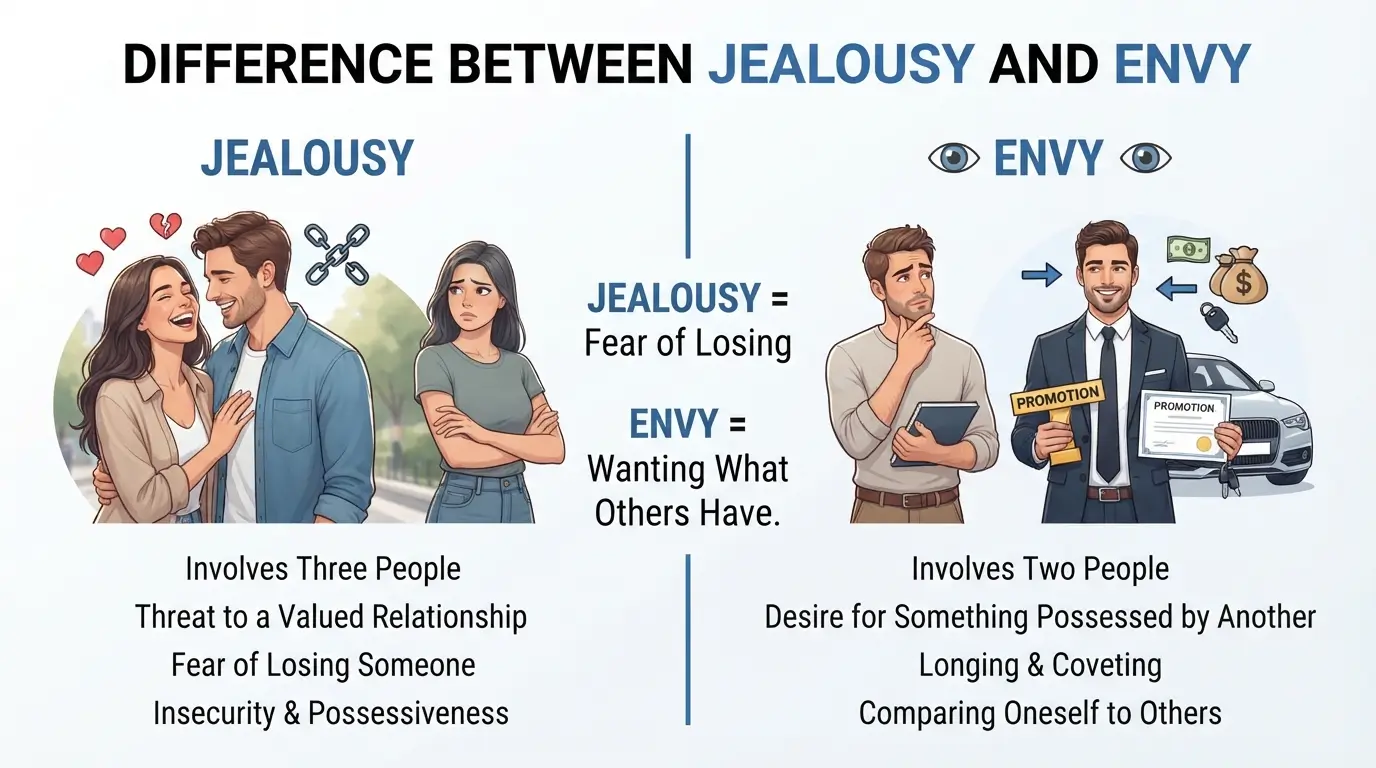
The difference between jealousy and envy becomes easier when you look at what each emotion is focused on. Envy usually involves wanting something another person has. Jealousy often involves fear that something you value may be taken away or that someone may replace you.
For example, you might feel envy when a friend buys a beautiful house that you wish you could afford. You might feel jealousy when you fear that a close friend is becoming more attached to someone else and you may lose your place in that friendship.
The difference between jealousy and envy can become less clear because people often use jealous for situations that traditionally fit envy. Understanding the difference between jealousy and envy helps you choose the right word in essays, emails, conversations, and emotional writing.
Difference Between Jealousy and Envy – Quick Answer
The simplest distinction is:
Envy is usually about wanting something someone else has.
Jealousy is usually about protecting something you already have or fear losing, often because of a rival.
Example of envy
Sarah felt envy when she saw her colleague’s new car.
Sarah wants the car or wishes she had something similar.
Example of jealousy
Mark felt jealous when his best friend began spending all his time with another friend.
Mark fears losing attention, closeness, or an important relationship.
A simple memory trick
Think of the emotions this way:
Envy = “I want what you have.”
Jealousy = “I don’t want to lose what I have.”
This is a helpful distinction, but real human emotions can overlap. A person can experience both emotions at the same time.
For example, someone may envy a coworker’s success while also feeling jealous if that coworker receives the attention they once received.
The Origin of Jealousy and Envy
The words jealousy and envy have different histories.
Origin of envy
Envy comes from Old French envie, which developed from Latin invidia. The Latin word is related to invidere, traditionally understood as “to look at with hostility” or “to look against.”
Over time, envy became associated with the painful or resentful feeling caused by seeing another person’s advantages, possessions, success, or qualities.
Modern English keeps this central idea.
She envied her sister’s confidence.
The sentence suggests that the speaker wishes she possessed that quality herself.
Origin of jealousy
Jealousy developed through French and ultimately traces back to Greek zēlos, associated with zeal, ardor, or passionate feeling. The related word zelos also influenced the English word zeal.
The history of jealousy is interesting because the word has not always had only its modern negative sense. Its history is connected with strong emotional concern, passionate devotion, and intense rivalry.
In modern English, jealousy often refers to fear, suspicion, or resentment involving a valued relationship or possession.
For example:
His jealousy became obvious when his partner started talking to someone else.
Why do people confuse them?
The two emotions can occur together.
Imagine that your friend gets a promotion.
You might envy the promotion because you want the same success.
Now imagine that your friend receives all the praise you once received from your manager. You might feel jealous because you are worried about losing recognition or status.
The boundary is not always perfect. English speakers also commonly use jealous in situations where envious would be the more traditional precise choice.
Pronunciation of Jealousy and Envy
The two words are pronounced differently.
Jealousy
Jealousy is pronounced approximately:
JEL-uh-see
IPA:
/ˈdʒeləsi/
The stress falls on the first syllable.
Envy
Envy is pronounced:
EN-vee
IPA:
/ˈenvi/
The stress also falls on the first syllable.
| Word | Simple pronunciation | Part of speech |
|---|---|---|
| jealousy | JEL-uh-see | noun |
| jealous | JEL-əs | adjective |
| envy | EN-vee | noun or verb |
| envious | EN-vee-əs | adjective |
Notice that jealousy is a noun, while jealous is its related adjective.
Likewise, envy can be both a noun and a verb.
Her envy was obvious.
She envied her colleague.
This difference affects how each word works in a sentence.
Jealousy vs Envy: Part of Speech and Grammar
Understanding grammar makes these words easier to use correctly.
Jealousy as a noun
Jealousy names an emotion.
His jealousy caused problems in the relationship.
Jealousy can damage trust.
The adjective is jealous.
She became jealous.
He is jealous of his brother.
The common structure is:
jealous of + person or thing
For example:
Maria is jealous of her sister’s new relationship.
Envy as a noun
The term Envy can also name an emotion.
His envy was difficult to hide.
She felt envy toward her successful colleague.
Envy as a verb
The term Envy can also describe the action of wanting what another person has.
I envy your ability to stay calm.
She envied her friend’s confidence.
The adjective is envious.
He was envious of his neighbor’s success.
The common structure is:
envious of + person or thing
Important grammar point
Do not automatically treat jealous and envious as interchangeable in every sentence.
For example:
I am envious of your success.
This clearly means:
I wish I had your success.
But:
I am jealous of your success.
This may be understood in everyday English, but depending on context, it can sound less precise or may suggest resentment about the attention or advantage connected with that success.
British English vs American English Spelling
There is no meaningful British-American spelling difference between jealousy and envy.
Both British English and American English use:
- jealousy
- jealous
- envy
- envious
The spelling does not change based on the variety of English.
| Word | British English | American English |
|---|---|---|
| jealousy | jealousy | jealousy |
| jealous | jealous | jealous |
| envy | envy | envy |
| envious | envious | envious |
The difference is therefore not about spelling. It is mainly about meaning, context, and everyday usage.
British and American speakers may both use jealous in a broad way to describe feelings that are technically closer to envy.
For formal writing, however, choosing the more precise word can make your meaning clearer.
Which Word Should You Use?
Choose the word based on what is happening emotionally.
Use envy when:
Someone else has something you want.
This could be:
- Money
- Success
- Beauty
- Skills
- Opportunities
- Possessions
- Social status
- Personal qualities
Example:
I envy her confidence when speaking in public.
The focus is on something she has that you would like to have.
Use jealousy when:
You fear losing something valuable, especially a relationship or position, because of another person.
Examples:
He felt jealous when his partner talked to her former boyfriend.
She became jealous of the attention her coworker received.
What about everyday speech?
In casual conversation, jealous is often used broadly.
Someone might say:
I’m so jealous of your vacation!
Usually, the speaker does not mean:
I am afraid someone will take my vacation away.
They mean:
Your vacation looks great, and I wish I were having the same experience.
In precise English, envious could describe that feeling better. But jealous is very common in informal modern English.
So the best advice is:
Use envy for wanting another person’s advantage. Use jealousy for fear of losing something valuable, especially in relationships.
Common Mistakes with Jealousy and Envy
1. Treating jealousy and envy as perfect synonyms
They overlap, but their traditional meanings differ.
Less precise:
I felt jealous of his new salary.
More precise:
I felt envious of his new salary.
If you simply want the salary yourself, envious is clearer.
2. Using envy for relationship insecurity
Consider:
She felt envy when her boyfriend talked to another woman.
If the emotion is fear of losing her boyfriend, jealousy is the better word.
She felt jealous when her boyfriend talked to another woman.
3. Confusing jealous with jealousy
Jealous is an adjective.
He is jealous.
Jealousy is a noun.
His jealousy is becoming a problem.
A useful rule is:
person = jealous
emotion = jealousy
4. Confusing envy with envious
Envy can be a noun or verb.
I felt envy.
I envy your patience.
Envious is an adjective.
I am envious of your patience.
5. Assuming envy always makes someone a bad person
Feeling envy does not automatically mean someone is cruel or immoral.
People can experience envy without acting badly. The emotion may simply reveal something they value or wish to achieve.
For example:
She felt envious of her friend’s writing skills, so she decided to practice more.
Here, envy becomes a signal that helps her identify a personal goal.
6. Thinking jealousy only happens in romantic relationships
Romantic relationships are a common context, but jealousy can appear elsewhere.
Someone might feel jealous of:
- A sibling receiving attention
- A coworker receiving praise
- A friend spending time with someone else
- A competitor gaining recognition
7. Assuming “jealous” is always grammatically wrong when “envious” is meant
This is too strict.
Modern English commonly uses jealous in situations involving another person’s possessions, achievements, or experiences.
For example:
I’m jealous of your new car!
This is natural informal English.
In formal or carefully precise writing, envious may better express the intended meaning.
Jealousy and Envy in Everyday Examples
These words appear in many forms of communication.
In emails
A professional email would rarely need emotional language, but envy can appear naturally in friendly communication.
I truly envy your ability to manage such a busy schedule.
This is polite and can express admiration mixed with a desire to have the same ability.
For jealousy, a personal message might say:
I felt a little jealous when I saw how much time you were spending with them.
In news writing
News articles may use these words when discussing competition, relationships, social behavior, or public reactions.
For example:
The rivalry was fueled by envy of the company’s rapid growth.
The focus is on wanting another company’s success.
On social media
Informal usage is especially common:
I’m so jealous of this vacation!
Here, jealous usually means:
I wish I could have this experience too.
A more precise version would be:
I’m so envious of this vacation!
But the first version sounds completely natural in casual social media language.
In formal writing
Formal writing benefits from precision.
Instead of:
The employee was jealous of the manager’s promotion.
you might write:
The employee was envious of the manager’s promotion.
This makes it clear that the employee wanted the advantage.
If the employee feared losing status or recognition because of the promotion, jealous may be more appropriate.
Jealousy vs Envy: Comparison Table
| Feature | Jealousy | Envy |
|---|---|---|
| Basic idea | Fear of losing something valued | Wanting what another person has |
| Main focus | Protection and rivalry | Comparison and desire |
| Common context | Relationships | Success, possessions, qualities |
| Typical thought | “I might lose this.” | “I wish I had that.” |
| Part of speech | Noun | Noun and verb |
| Related adjective | jealous | envious |
| Example | She felt jealousy toward her rival. | He felt envy toward his successful friend. |
| Common phrase | jealous of | envious of |
| Informal usage | Very common | Common but often less conversational |
| British spelling | jealousy | envy |
| American spelling | jealousy | envy |
Can You Feel Both Jealousy and Envy?
Yes.
Human emotions do not always fit into neat boxes.
Imagine that two employees are competing for a promotion. One employee gets the position.
The other employee may feel envy because the successful employee now has a benefit that they wanted.
But suppose the successful employee also becomes close to the manager and receives opportunities that the other employee previously enjoyed. The second employee could experience jealousy because they fear losing their influence or position.
The same person can therefore experience both emotions.
This is why context matters more than trying to apply an absolute rule.
Is Jealousy Always Negative?
Jealousy is usually associated with unpleasant feelings, but the emotion itself is not necessarily an indication of bad character.
It can point to insecurity, fear of loss, attachment, or perceived competition.
The important issue is how a person responds.
Feeling jealous is different from behaving in a controlling, aggressive, or unfair way.
For example:
I felt jealous when my friend started spending more time with someone else.
Recognizing the feeling can lead to an honest conversation.
By contrast, acting on jealousy by controlling another person’s choices can damage a relationship.
Is Envy Always Negative?
Envy is also commonly viewed as negative, especially when it leads to resentment.
But the feeling can sometimes reveal what a person wants to achieve.
Suppose you envy someone’s writing skills.
Instead of resenting that person, you might think:
I want to improve my writing too.
The emotion can then become motivation.
This does not make envy automatically positive. It simply shows that emotions can provide useful information about our goals and values.
Search Intent for “Difference Between Jealousy and Envy”
People searching for difference between jealousy and envy usually want more than a dictionary definition.
They may be trying to:
- Understand relationship emotions
- Improve their vocabulary
- Write an essay
- Choose the right word
- Explain someone’s behavior
- Understand psychological language
- Learn the difference between common synonyms
The strongest search intent is educational and comparative. Readers usually want a quick rule first, followed by examples that show when each word works.
A useful takeaway is:
Envy looks at what another person has and wishes for it. Jealousy focuses more on protecting something valued from a perceived rival or threat.
Because everyday English often uses jealous broadly, context should always guide the final choice.
FAQs
1. What is the main difference between jealousy and envy?
Envy usually means wanting something another person has. Jealousy usually involves fear of losing something valuable, often because another person is seen as a rival.
2. Is jealousy the same as envy?
Not exactly. The words overlap in everyday English, but their more precise meanings differ. Envy centers on another person’s advantage, while jealousy often involves threatened possession or relationships.
3. Is it correct to say “I am jealous of your car”?
Yes. This is common in informal modern English. It usually means you wish you had a car like theirs. In more precise language, envious may be a better choice.
4. Which is worse, jealousy or envy?
Neither emotion is automatically “worse.” Both can become harmful when they lead to resentment or unhealthy behavior. The effect depends on how someone handles the feeling.
5. Can jealousy and envy happen at the same time?
Yes. Someone may envy another person’s success while also feeling jealous about the attention or opportunities that person receives.
6. What is the adjective form of envy?
The adjective is envious.
She is envious of her friend’s success.
The related noun is envy, and envy can also function as a verb.
7. What is the adjective form of jealousy?
The adjective is jealous.
He is jealous of his brother.
The noun form is jealousy.
Conclusion
The difference between jealousy and envy becomes clear when you focus on the emotion behind each word. Envy often means wanting what someone else has.
Jealousy usually involves fear of losing something valuable, especially when another person seems to threaten a relationship, position, or source of attention.
Everyday English often uses jealous more broadly, so the two words can overlap. Still, knowing the distinction helps you write with greater accuracy.
Practice these words in emails, essays, and daily conversations. With time, choosing between jealousy and envy will feel natural and easy.

Mira Anand is a writer at Distinly.com who focuses on storytelling, communication, and social perspective. Her work highlights subtle differences in language and meaning across cultures and communities. With a clear and empathetic voice, Mira helps readers understand how narratives shape understanding, relationships, and modern dialogue in an increasingly connected world.