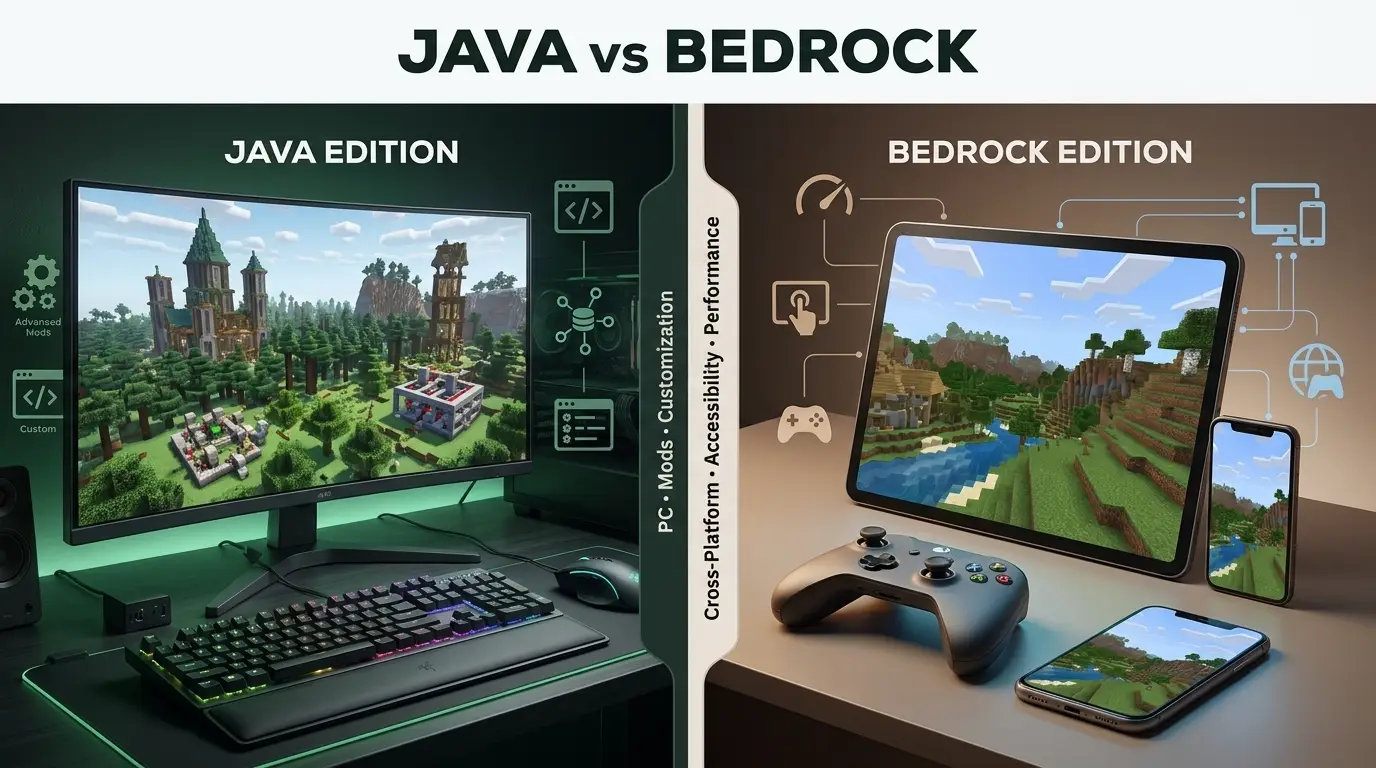
Difference between java and bedrock often comes up when friends try to play Minecraft together but can’t connect. One person is on PC, another on mobile, and suddenly things don’t work as expected. That confusion is common.
The difference between java and bedrock is about two main versions of the same game: Minecraft. One is called Java Edition, and the other is Bedrock Edition. Both let you build, explore, and survive, but they work in different ways.
Many players wonder which version is better or why they behave differently. The difference between java and bedrock affects gameplay, graphics, mods, and even multiplayer options.
Let’s break it down step by step so you can clearly understand both versions and choose the right one.
Key Difference Between the Both
The main difference lies in platform compatibility and performance.
- Java Edition runs only on PC (Windows, macOS, Linux) and supports advanced customization.
- Bedrock Edition runs on multiple platforms like mobile, consoles, and Windows, offering smoother performance and cross-play.
Importance – Why Knowing the Difference Matters
Understanding the difference helps learners and gamers make better choices. Beginners can pick a version that suits their device and skill level.
For experts, the difference matters in game design, modding, and technical gameplay. Java offers deeper control, while Bedrock focuses on accessibility.
In society, gaming is a shared activity. Knowing the difference helps people connect, collaborate, and avoid frustration when playing with others.
🔊 Pronunciation Section
Java
US: /ˈdʒɑː.və/
UK: /ˈdʒɑː.və/
Bedrock
US: /ˈbed.rɑːk/
UK: /ˈbed.rɒk/
Now that you know how to say them, let’s understand what each version really means.
📚 Core Definitions
Java (Minecraft Java Edition)
Java Edition is the original version of Minecraft made for PC. It allows deep customization through mods and community content. It feels flexible and creative.
Example:
“I installed mods on Java Edition to add new creatures.”
Bedrock (Minecraft Bedrock Edition)
Bedrock Edition is a cross-platform version designed for smooth performance. It works on phones, consoles, and Windows devices. It focuses on ease and accessibility.
Example:
“I played Bedrock Edition with my friend on Xbox.”
📚 10 Clear Differences Between Java and Bedrock
1. Platform Compatibility
Java works only on PC systems. Bedrock works on mobile, console, and PC.
- Example for Java: “I play Java on my laptop.”
- Example for Bedrock: “I play Bedrock on my phone.”
2. Performance
Java can lag on weaker systems. Bedrock runs smoothly even on low-end devices.
- Example for Java: “My game slows down with heavy mods.”
- Example for Bedrock: “The game runs smoothly on my tablet.”
3. Cross-Platform Play
Java players cannot play with console or mobile users. Bedrock allows cross-play across devices.
- Example for Java: “I can only play with PC friends.”
- Example for Bedrock: “I play with friends on Xbox and mobile.”
4. Mod Support
Java supports unlimited mods. Bedrock has limited add-ons.
- Example for Java: “I added a dragon mod.”
- Example for Bedrock: “I used a simple texture pack.”
5. Graphics and Rendering
Java has advanced graphics with shaders. Bedrock focuses on consistent visuals.
- Example for Java: “I use shaders for realistic lighting.”
- Example for Bedrock: “The game looks clean and smooth.”
6. Gameplay Mechanics
Some mechanics differ, like redstone behavior. Java offers more complex systems.
- Example for Java: “My redstone machine is very detailed.”
- Example for Bedrock: “Redstone works differently here.”
7. Updates
Java often gets experimental features first. Bedrock focuses on stable releases.
- Example for Java: “I tested a new snapshot update.”
- Example for Bedrock: “My version is stable and polished.”
8. Community Content
Java has a huge modding community. Bedrock relies more on official marketplace content.
- Example for Java: “I downloaded a free mod online.”
- Example for Bedrock: “I bought a skin pack from the store.”
9. Controls and Interface
Java uses keyboard and mouse. Bedrock supports controllers and touch.
- Example for Java: “I use a keyboard to play.”
- Example for Bedrock: “I play using touch controls.”
10. Cost and Access
Java is a one-time purchase. Bedrock may include in-game purchases.
- Example for Java: “I bought the game once.”
- Example for Bedrock: “I purchased skins from the store.”
🎯 Why Knowing the Difference Matters
Students need to know the difference to choose the right version for learning and fun. It saves time and avoids confusion.
Professionals, like developers or content creators, must understand both versions for better design and audience reach.
In social settings, choosing the wrong version can cause connection issues and frustration.
Real-world consequences of confusion
You might buy the wrong version and not be able to play with friends. This leads to wasted money and disappointment.
🧠 Why People Get Confused
Similar Names
Both versions are called Minecraft, which makes them seem identical.
Semantic Overlap
They share the same core gameplay—building and survival.
Context-Based Usage
People often don’t specify “Java” or “Bedrock” clearly.
Influence of Informal Speech
Gamers casually say “Minecraft,” ignoring version differences.
🎭 Connotation & Emotional Tone
Connotation = the emotional meaning associated with a word.
Java
- Positive: Flexible, creative, powerful
- Neutral: Technical, complex
- Example: “Java feels more creative with mods.”
Bedrock
- Positive: Smooth, accessible, simple
- Neutral: Limited, structured
- Example: “Bedrock is easy to use for beginners.”
🗣 Usage in Metaphors, Similes & Idioms
While not common in idioms, you can use them creatively:
- “Java is like a toolbox—full of possibilities.”
- “Bedrock is like a highway—smooth and fast.”
📊 Comparison Table
| Feature | Java | Bedrock |
|---|---|---|
| Meaning | PC version | Cross-platform version |
| Tone | Technical | User-friendly |
| Usage | Advanced gameplay | Casual gaming |
| Context | Modding, customization | Multiplayer, accessibility |
| Formality | Informal gaming term | Informal gaming term |
⚖️ Which Is Better in What Situation?
When to use Java
Use Java if you want customization, mods, and deep gameplay. It’s ideal for advanced players.
When to use Bedrock
Choose Bedrock if you want smooth performance and cross-play. It’s great for beginners.
Situational clarity
Java suits solo or creative play. Bedrock suits social gaming.
Contextual correctness
Pick based on device and goals, not popularity.
📖 Literary or Cultural References
- Book: Minecraft: The Island (Adventure, Max Brooks, 2017)
- Movie: Minecraft Movie (USA, upcoming adaptation)
These works reflect the growing cultural impact of Minecraft across versions.
❓ FAQs
1. Can Java and Bedrock players play together?
No, they cannot directly connect. Java and Bedrock use different systems. However, some servers use plugins to bridge the gap.
2. Which version is better for beginners?
Bedrock is easier for beginners. It runs smoothly and supports many devices. It also has simpler controls.
3. Is Java Edition free?
No, Java Edition is a paid game. You buy it once and get full access. There are no required in-game purchases.
4. Why does Java have more mods?
Java uses open coding systems. This allows developers to create custom mods easily. Bedrock is more restricted.
5. Which version has better graphics?
Java can look better with shaders. Bedrock looks smoother by default. It depends on your device and settings.
🏁 Conclusion
The difference between java and bedrock comes down to flexibility versus accessibility. Java offers deep customization and advanced features, while Bedrock focuses on smooth performance and cross-platform play.
Choosing the right version depends on your needs. If you love creativity and mods, Java is a strong choice. If you want easy gameplay and to play with friends across devices, Bedrock is better.
Understanding this difference helps you avoid confusion and enjoy the game fully. It also makes your gaming experience smoother and more social.
Keep exploring, keep learning, and choose the version that fits your style best.

Aamer Shahzad is the founder of Distinly.com, a fast-growing educational platform focused on high-intent “difference between” topics. With over 8 years of experience in English language education and analytical writing, I specialize in breaking down complex “difference between” topics into clear, structured, and easy-to-understand explanations. Distinly.com is your go-to resource for enhancing English skills and writing with confidence.
I specializes in building search-optimized, research-driven comparison content designed for clarity, authority, and long-term digital asset value.