Difference between fascism and communism often comes up in classrooms, debates, and even casual conversations. Imagine two students arguing about political systems one says fascism is about control, the other claims communism is about equality. Both are partly right, but the full picture is more complex.
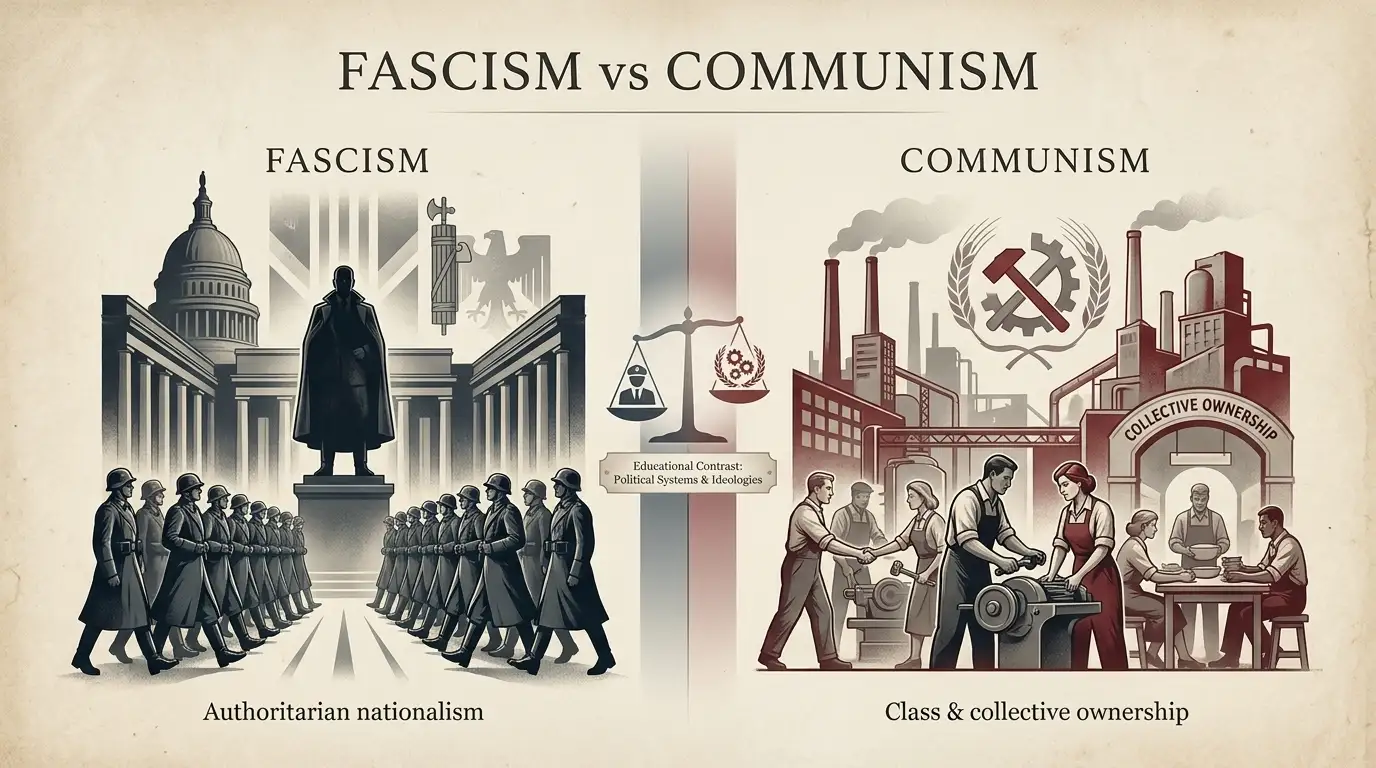
The difference between fascism and communism lies in how power, economy, and society are organized. Fascism focuses on strong national leadership and strict control, while communism aims for a classless society where resources are shared.
Many people mix them up because both systems involve strong governments. However, the difference between fascism and communism becomes clear when you look at their goals and methods.
Let’s explore their meanings, differences, and real-world impact step by step.
🔑 Key Difference Between the Both
The key difference is simple:
- Fascism supports extreme nationalism and authoritarian leadership.
- Communism promotes economic equality and collective ownership.
In short, fascism is about control and hierarchy, while communism is about equality and shared resources.
🌍 Importance – Why Their Difference Matters
Understanding the difference between fascism and communism is essential for both learners and experts.
For students, it builds strong foundations in history, politics, and social studies. It helps them understand major world events like wars and revolutions.
For professionals, especially in politics, education, and journalism, this knowledge ensures accurate communication and analysis.
In society, knowing this difference prevents misinformation. It helps people make informed opinions about governance, freedom, and equality.
🔊 PRONUNCIATION SECTION
Fascism
US: /ˈfæʃɪzəm/
UK: /ˈfæʃɪzəm/
Communism
US: /ˈkɒmjʊnɪzəm/
UK: /ˈkɒmjʊnɪzəm/
Now that you know how to say them, let’s understand what they actually mean.
📚 CORE DEFINITIONS
Fascism
Fascism is a political system where a powerful leader controls the state, often limiting freedom and opposing democracy. It emphasizes national pride and unity, sometimes aggressively.
Example: A government that controls media and suppresses opposition to maintain power.
Communism
Communism is a system where all property is owned collectively, and wealth is shared equally among people. It aims to remove class differences.
Example: A society where industries are owned by the public, not private individuals.
📚 10 Clear Differences Between Fascism and Communism
1. Ideological Focus
Fascism focuses on nationalism and state power.
Communism focuses on equality and classless society.
- Example (Fascism): A leader promotes national superiority.
- Example (Communism): A system removes class distinctions.
2. Economic System
Fascism allows private property but controls it.
Communism removes private ownership entirely.
- Example (Fascism): Businesses exist but follow strict rules.
- Example (Communism): All factories belong to the state.
3. Political Structure
Fascism supports one strong leader.
Communism aims for a classless, stateless society (in theory).
- Example (Fascism): A dictator makes decisions.
- Example (Communism): Power is meant to be shared equally.
4. Individual Freedom
Fascism limits personal freedoms heavily.
Communism also restricts freedoms but focuses on equality.
- Example (Fascism): No freedom of speech.
- Example (Communism): Limited personal ownership.
5. Social Structure
Fascism supports hierarchy and inequality.
Communism aims to remove social classes.
- Example (Fascism): Elite groups dominate society.
- Example (Communism): Everyone has equal status.
6. Role of the State
Fascism strengthens the state above all.
Communism uses the state to achieve equality.
- Example (Fascism): State controls all aspects of life.
- Example (Communism): State redistributes resources.
7. Nationalism vs Internationalism
Fascism is highly nationalistic.
Communism supports global unity of workers.
- Example (Fascism): “Our nation first.”
- Example (Communism): Workers worldwide unite.
8. Leadership Style
Fascism relies on charismatic leaders.
Communism promotes collective leadership (in theory).
- Example (Fascism): One leader dominates.
- Example (Communism): Leadership shared among groups.
9. Use of Force
Fascism often uses military power aggressively.
Communism may use force to maintain control.
- Example (Fascism): Expansion through war.
- Example (Communism): Suppressing dissent.
10. Expression Style
Fascism uses emotional propaganda.
Communism uses ideological messaging about equality.
- Example (Fascism): National pride campaigns.
- Example (Communism): Equality-focused slogans.
🎯 Why Knowing the Difference Matters
Students need this knowledge to understand global history and political systems clearly. It helps them avoid confusion in exams and discussions.
Professionals rely on these distinctions when analyzing policies, writing reports, or teaching. Accuracy matters in these fields.
In everyday communication, using these terms correctly avoids misunderstandings and misinformation.
Real-world consequences of confusion
Confusing fascism with communism can lead to incorrect political arguments and misleading opinions. It may also affect how people interpret historical events or current governments.
🧠 Why People Get Confused
Similar Features
Both systems involve strong government control. This makes them seem similar at first.
Semantic Overlap
They are often grouped under “authoritarian systems,” which adds confusion.
Context-Based Usage
In casual speech, people sometimes use these words incorrectly or interchangeably.
Informal Influence
Media and online discussions often oversimplify both terms.
🎭 Connotation & Emotional Tone
Connotation = the emotional meaning associated with a word.
Fascism
- Negative: Often linked with oppression and dictatorship.
- Example: “The regime showed fascist control over citizens.”
Communism
- Mixed: Can be seen as idealistic or oppressive depending on context.
- Example: “The idea of communism promises equality.”
🗣 Usage in Metaphors, Similes & Idioms
These terms are not commonly used in idioms, but they appear in metaphorical speech:
- “That rule feels like fascism.” → Means strict control
- “They run the group like communism.” → Means shared resources
These are informal and should be used carefully.
📊 Comparison Table
| Feature | Fascism | Communism |
|---|---|---|
| Meaning | Authoritarian nationalism | Classless economic system |
| Tone | Negative | Mixed |
| Usage | Political control context | Economic equality context |
| Context | Dictatorship, nationalism | Social equality, economy |
| Formality | Formal | Formal |
⚖️ Which Is Better in What Situation?
When to Use Fascism
Use this term when discussing authoritarian governments that emphasize nationalism and strong leadership. For example, in history lessons about dictatorships.
When to Use Communism
Use communism when referring to systems focused on equality and shared ownership, especially in economic discussions.
Situational Clarity
Choose the term based on whether the focus is control (fascism) or equality (communism).
Contextual Correctness
In academic writing, always use precise definitions. Avoid using them loosely in casual conversation.
📖 Literary or Cultural References
- Book: The Communist Manifesto (Political, Karl Marx, 1848)
- Book: The Origins of Totalitarianism (Political, Hannah Arendt, 1951)
- Movie: The Great Dictator (USA, 1940)
- Movie: Doctor Zhivago (UK/USA, 1965)
These works explore themes related to both systems.
❓ FAQs (10 Questions)
1. What is the main difference between fascism and communism?
Fascism focuses on national power and control, while communism focuses on equality and shared ownership. Their goals are very different.
2. Are both systems authoritarian?
Yes, in practice both have often been authoritarian, though communism aims for equality in theory.
3. Does fascism allow private property?
Yes, but the state controls it heavily.
4. Does communism allow private property?
No, it removes private ownership entirely.
5. Why are they often confused?
Because both involve strong government control and limited freedoms.
6. Which system supports equality?
Communism strongly promotes equality.
7. Which system promotes nationalism?
Fascism is strongly nationalistic.
8. Can both systems exist today?
Elements of both systems can appear in modern governments, but pure forms are rare.
9. Is communism always peaceful?
Not always. In practice, it has involved force in some cases.
10. Is fascism always negative?
Historically, it has been associated with oppression, so it carries a negative tone.
🏁 CONCLUSION
The difference between fascism and communism becomes clear when you look at their core goals. Fascism centers on control, nationalism, and strong leadership. Communism focuses on equality, shared ownership, and removing class differences.
Although both systems can involve strict government control, their philosophies are very different. This is why understanding the difference is so important.
Clear knowledge helps students, professionals, and everyday readers avoid confusion and communicate accurately. It also deepens your understanding of history and modern politics.
Keep exploring and questioning learning these distinctions builds stronger thinking and better awareness of the world around you.

Aamer Shahzad is the founder of Distinly.com, a fast-growing educational platform focused on high-intent “difference between” topics. With over 8 years of experience in English language education and analytical writing, I specialize in breaking down complex “difference between” topics into clear, structured, and easy-to-understand explanations. Distinly.com is your go-to resource for enhancing English skills and writing with confidence.
I specializes in building search-optimized, research-driven comparison content designed for clarity, authority, and long-term digital asset value.