Difference between objective and subjective often comes up in everyday life. Imagine two friends watching the same movie. One says, “It’s a great film,” while the other says, “It’s boring.” Who is right? Both might be but for different reasons.
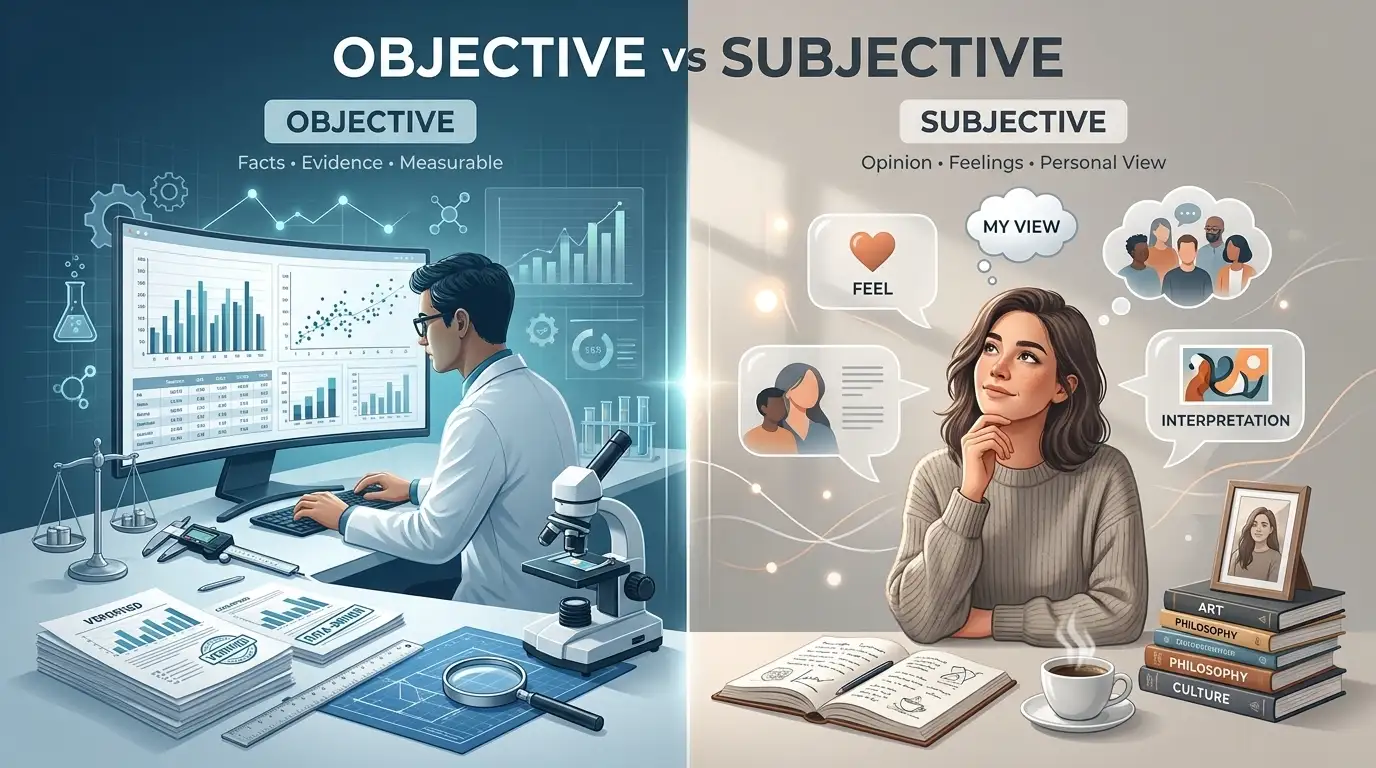
The difference between objective and subjective lies in how we see and describe things. Objective statements rely on facts and evidence. Subjective statements depend on opinions, feelings, or personal views.
Many learners struggle with the difference between objective and subjective because both appear in writing, speaking, and even exams. Yet, they serve very different purposes.
In this guide, you will learn clear meanings, real examples, and practical uses to master this concept easily.
🔍 Key Difference Between the Both
The key difference is simple:
- Objective = based on facts and evidence
- Subjective = based on opinions and personal feelings
Objective statements are neutral and verifiable. Subjective statements are personal and may vary from person to person.
🌍 Importance – Why Their Difference Matters
Understanding the difference between objective and subjective is essential in learning and communication.
For students, it helps improve writing skills. You can clearly separate facts from opinions in essays, exams, and research work.
For professionals, especially in journalism, law, and science, accuracy matters. Objective language builds trust, while subjective language expresses viewpoints.
In society, this difference shapes how we share information. It helps people avoid confusion, bias, and misunderstanding.
🔊 Pronunciation Section
Objective
US: /əbˈdʒɛk.tɪv/
UK: /əbˈdʒek.tɪv/
Subjective
US: /səbˈdʒɛk.tɪv/
UK: /səbˈdʒek.tɪv/
Now that you know how to say them, let’s understand what they really mean.
📚 Core Definitions
Objective
Objective means based on facts, evidence, and reality. It avoids personal feelings and remains neutral.
It has a logical and unbiased tone.
Example:
Water boils at 100°C.
Subjective
Subjective means based on personal opinions, emotions, or beliefs. It varies from person to person.
It carries an emotional or personal tone.
Example:
This tea tastes amazing.
📚 10 Clear Differences Between Objective and Subjective
1. Emotional Intensity
Objective statements have no emotion. Subjective statements often express feelings.
- Example for Objective: The room temperature is 25°C.
- Example for Subjective: The room feels too hot.
2. Duration
Objective facts remain constant over time. Subjective opinions can change.
- Example for Objective: The Earth orbits the Sun.
- Example for Subjective: I like summer more than winter.
3. Focus
Objective focuses on reality. Subjective focuses on personal experience.
- Example for Objective: The book has 300 pages.
- Example for Subjective: The book feels too long.
4. Severity
Objective describes situations clearly. Subjective exaggerates or softens them.
- Example for Objective: The test lasted two hours.
- Example for Subjective: The test felt endless.
5. Rationality
Objective uses logic and evidence. Subjective relies on feelings or beliefs.
- Example for Objective: The data shows a rise in sales.
- Example for Subjective: I feel the product is popular.
6. Formality
Objective language is more formal. Subjective language is more casual.
- Example for Objective: The report indicates growth.
- Example for Subjective: I think things are improving.
7. Context of Use
Objective appears in academic or professional writing. Subjective appears in personal communication.
- Example for Objective: The study confirms the theory.
- Example for Subjective: I believe the idea works.
8. Psychological Impact
Objective informs clearly. Subjective influences emotions.
- Example for Objective: The film runs for 120 minutes.
- Example for Subjective: The film feels too long.
9. Tone
Objective tone is neutral. Subjective tone is expressive.
- Example for Objective: The weather is rainy.
- Example for Subjective: The weather is depressing.
10. Expression Style
Objective uses direct facts. Subjective uses descriptive language.
- Example for Objective: The painting uses blue color.
- Example for Subjective: The painting looks calming.
🎯 Why Knowing the Difference Matters
Students need to separate facts from opinions in essays and exams. This skill improves clarity and marks.
Professionals must use objective language in reports, research, and communication. It ensures accuracy and builds trust.
In daily life, knowing this difference helps avoid arguments. You can respect opinions while still recognizing facts.
Real-world consequences of confusion
If people mix objective facts with subjective opinions, they may spread misinformation. This can affect decisions in education, media, and even law.
🧠 Why People Get Confused
Similar Spelling or Pronunciation
Both words sound alike. This makes them easy to mix up.
Semantic Overlap
Both describe ways of expressing ideas. This overlap creates confusion.
Context-Based Usage
In real life, people often combine facts and opinions.
Influence of Informal Speech
Casual conversations blur the line between objective and subjective statements.
🎭 Connotation & Emotional Tone
Connotation = the emotional meaning associated with a word.
Objective
- Positive: Fair, unbiased
Example: The judge gave an objective decision. - Neutral: Factual description
- Negative: Cold or impersonal
Subjective
- Positive: Expressive, personal
Example: Her subjective view made the story engaging. - Neutral: Personal opinion
- Negative: Biased or unreliable
🗣 Usage in Metaphors, Similes & Idioms
These words appear in figurative language:
- “Stay objective like a scientist.”
- “He gave a subjective view colored by emotion.”
They highlight the contrast between logic and feeling.
📊 Comparison Table
| Feature | Objective | Subjective |
|---|---|---|
| Meaning | Based on facts | Based on opinions |
| Tone | Neutral | Emotional |
| Usage | Academic, formal | Personal, informal |
| Context | Evidence-based | Experience-based |
| Formality | High | Flexible |
⚖️ Which Is Better in What Situation?
When to use Objective
Use objective language when presenting facts, data, or research.
Example: Writing a scientific report.
When to use Subjective
Use subjective language when sharing opinions or personal views.
Example: Writing a review or story.
Situational clarity
Choose based on purpose—inform or express.
Contextual correctness
Use objective for accuracy and subjective for personal voice.
📖 Literary or Cultural References
- Book: Thinking, Fast and Slow by Daniel Kahneman (Non-fiction, 2011)
- Movie: Dead Poets Society (USA, 1989)
These works show how objective facts and subjective experiences shape human thinking.
❓ FAQs
1. What is the basic difference between objective and subjective?
Objective is based on facts and can be proven. Subjective is based on personal opinions and cannot be proven universally.
2. Can a statement be both objective and subjective?
Yes, some statements mix both. For example, a review may include facts and personal opinions.
3. Why is objective writing important?
Objective writing ensures clarity, accuracy, and trust. It is essential in academic and professional settings.
4. Is subjective language always wrong?
No, subjective language is useful for expressing feelings and opinions. It is common in storytelling and reviews.
5. How can I identify subjective statements?
Look for opinion words like “I think,” “I feel,” or descriptive language. These often indicate subjectivity.
🏁 Conclusion
The difference between objective and subjective becomes clear when you focus on facts versus opinions. Objective language presents truth and evidence, while subjective language expresses personal views and emotions.
Understanding this distinction improves your writing, speaking, and critical thinking. It helps you communicate clearly and avoid confusion.
Whether you are studying, working, or simply sharing ideas, knowing when to use each form gives you an advantage. It allows you to balance logic with expression.
Keep practicing, stay curious, and use words wisely to communicate with clarity and confidence.

Ezra Hale is a thoughtful contributor to Distinly.com, where he explores philosophical ideas and the subtle differences behind everyday concepts. His writing blends logic, language, and human insight to clarify complex distinctions. Ezra encourages readers to think deeper, question assumptions, and appreciate the meaning behind words and ideas in modern discourse.