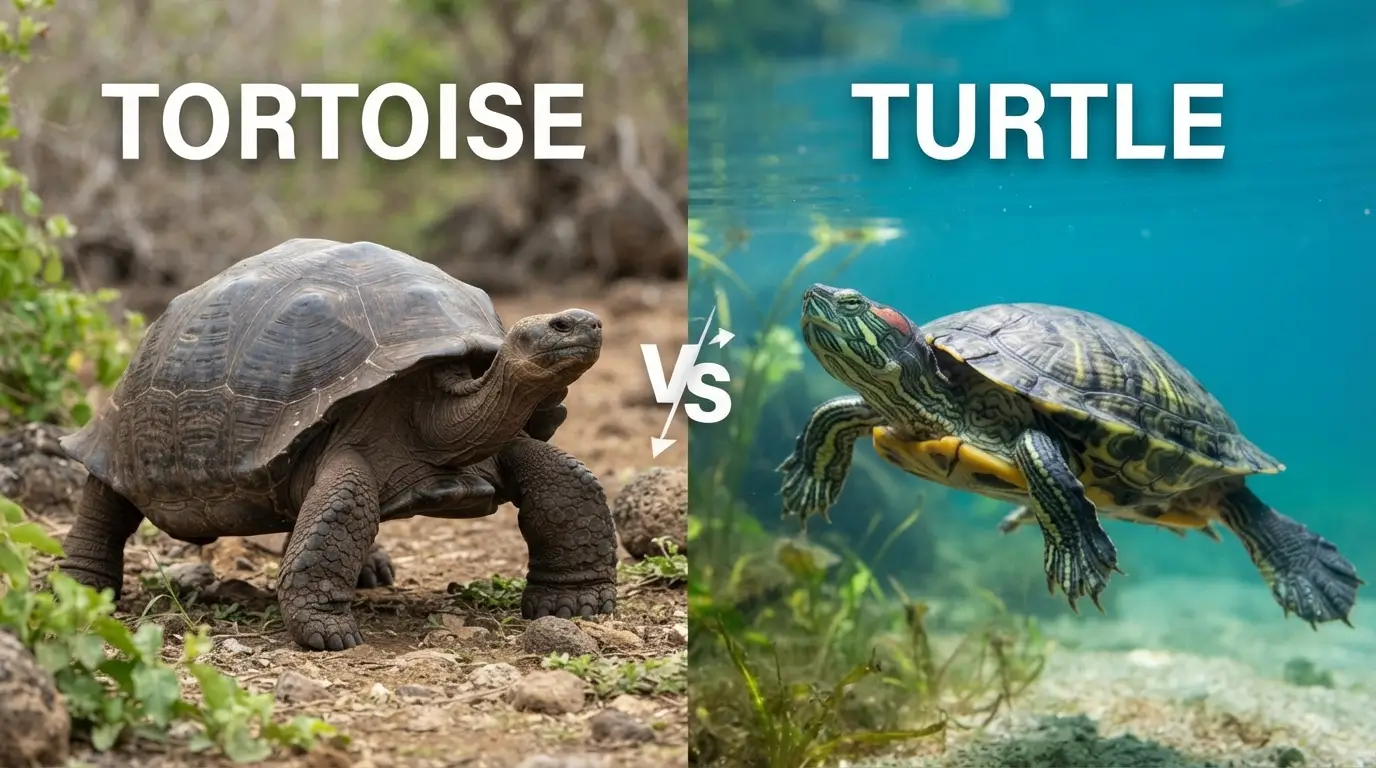
A tortoise and a turtle may look like close relatives and they are but they are not always the same thing. The difference between tortoise and turtle is mainly linked to habitat, body shape, movement, and everyday English usage.
People often search for the difference between tortoise and turtle because both animals have shells, four legs, and similar body structures. The confusion becomes greater because the word turtle can have a broad meaning in biology and in different varieties of English. A land-dwelling tortoise may be called a type of turtle in a broad scientific sense, while everyday speakers often use turtle for animals that spend much of their time in water.
Understanding the difference between tortoise and turtle helps you identify these animals more accurately and choose the right word in conversation or writing. Their feet, shells, habitat, diet, and behavior offer useful clues.
This guide explains the difference between tortoise and turtle in simple English. You will also learn where the words came from, how they are pronounced, whether British and American English use them differently, and what mistakes to avoid.
Quick Answer
The simplest distinction is land versus water.
A tortoise is a turtle adapted mainly to living on land. Tortoises generally have sturdy legs, feet suited to walking, and shells that are often high and domed.
A turtle is a broader everyday term. It commonly refers to shelled reptiles that live in water or spend significant time in water. Many turtles have webbed feet or flippers that help them swim.
For example:
The tortoise walked slowly across the garden.
The turtle swam across the pond.
However, the distinction is not perfectly simple in every scientific or regional context. In biological classification, tortoises are part of the order Testudines, the same larger group that includes turtles and other shelled reptiles.
Tortoise
A tortoise is primarily a land animal.
Common features include:
- Strong, sturdy legs
- Feet adapted for walking
- A high, rounded shell in many species
- Mostly terrestrial behavior
- Many species eat mainly plants
Turtle
A turtle often spends at least part of its life in water.
Common features include:
- Webbed feet or flippers in many species
- A shell suited to its environment
- Swimming ability in many species
- Aquatic or semi-aquatic behavior
- Diet that varies widely by species
One important point: not every turtle looks or behaves the same way. Some species are strongly aquatic, some are semi-aquatic, and land-dwelling species are often called tortoises.
The Origin of the Difference Between Tortoise and Turtle
The words tortoise and turtle have different linguistic histories.
Where “Tortoise” Comes From
The English word tortoise came into English through Anglo-French and Old French forms related to tortue. The word ultimately has connections with Latin tartarūchus, associated with the tortoise or turtle.
The history is not as simple as a direct one-word translation from Latin into modern English. The term changed through different languages and forms before reaching English.
Modern tortoise therefore reflects a long history of borrowing and sound change.
Where “Turtle” Comes From
The word turtle also has a long history. It is related to Old French tortue, the same broad word family that influenced tortoise.
English developed its own form turtle, while tortoise developed through another route. Over time, the two words became established as separate terms in English.
This explains why the words look and sound quite different even though they describe closely related animals.
Why Are There Two Words?
Language often develops separate words for related things when speakers need to distinguish them.
English gradually developed tortoise as a term strongly associated with land-dwelling shelled reptiles, while turtle became a broader term with strong associations with aquatic species.
The exact boundaries between these words can vary by region and context. This is especially important when comparing everyday English with biological terminology.
Tortoise vs Turtle: Biological Difference
Both tortoises and turtles belong to the reptile order Testudines.
This means they share important features, including:
- A protective shell
- A beak-like mouth rather than ordinary teeth
- Reptilian body structure
- Four limbs
- Laying eggs
The main difference is their adaptation to different environments.
Tortoises Are Built for Land
Tortoises generally have heavy, sturdy limbs. Their feet are designed for supporting their bodies and walking over land.
Their shells are often tall and rounded. This shape can provide protection while fitting a terrestrial lifestyle.
Most tortoises are also herbivorous, although diet varies among species.
Many Turtles Are Built for Water
Aquatic turtles usually have body features that make swimming easier.
Freshwater turtles may have webbed feet, while sea turtles have broad flippers.
Their shells are often flatter and more streamlined than those of many tortoises. This helps reduce resistance while moving through water.
However, shell shape varies between species, so you should not identify an animal from its shell alone.
British English vs American English Spelling
There is no major spelling difference between British English and American English for these words.
Both varieties use:
- tortoise
- turtle
The bigger difference is usage, especially in how broadly the word turtle is used.
Comparison Table
| Feature | British English | American English |
|---|---|---|
| Land-dwelling shelled reptile | tortoise | tortoise |
| General term | turtle | turtle |
| Aquatic shelled reptile | turtle | turtle |
| Sea turtle | turtle | turtle |
| Spelling of tortoise | tortoise | tortoise |
| Spelling of turtle | turtle | turtle |
In British English, tortoise is commonly used for land-dwelling species, while turtle is commonly associated with aquatic species.
American English also makes this distinction in everyday speech, but turtle can be used more broadly as a general term for members of the group.
For example, an American speaker may use turtle as a broad category and then distinguish between land turtles, water turtles, and tortoises when greater precision is needed.
There is therefore no useful rule such as “British English spells it one way and American English spells it another.” The spelling is the same.
Which Spelling Should You Use?
The answer depends less on spelling and more on meaning.
For British English
If you are writing for a British audience:
- Use tortoise for a primarily land-dwelling animal.
- Use turtle for aquatic or semi-aquatic species.
- Use the more specific name when the species is known.
For example:
We saw a tortoise in the garden.
The turtle was swimming in the lake.
For American English
The same basic distinction works well in American English.
However, turtle can function as a broader category in American usage.
If you are writing educational or scientific content, it is best to be precise. If you mean a land-dwelling tortoise, say tortoise.
For Global English
If your content is intended for an international audience, clarity matters most.
Avoid assuming that every shelled reptile is a tortoise or that every one is an aquatic turtle.
If you know the animal’s species, use its specific common name.
Common Mistakes with Difference Between Tortoise and Turtle
1. Calling Every Shelled Reptile a Tortoise
Incorrect:
Every animal with a shell is a tortoise.
Better:
Tortoises are land-adapted members of the turtle group.
Not every shelled reptile is a tortoise.
2. Assuming Every Turtle Lives in Water
This is an oversimplification.
Many turtles are aquatic or semi-aquatic, but the word turtle can be used more broadly, particularly in American English and in scientific contexts.
3. Thinking Tortoises Can Swim Like Turtles
Most tortoises are not adapted for swimming.
Their heavy bodies and land-adapted feet make them very different from aquatic turtles.
Some individual tortoises may enter or move through shallow water, but that does not make them aquatic animals.
4. Identifying an Animal Only by Its Shell
A high, domed shell often suggests a tortoise, while a flatter shell may suggest an aquatic turtle.
But shell shape varies greatly among species.
Use habitat, feet, shell shape, and species information together.
5. Assuming “Turtle” and “Tortoise” Are Always Completely Separate Groups
In everyday English, the terms are often treated as separate categories.
Biologically, however, tortoises are part of the larger turtle lineage within Testudines.
So the relationship is better understood as:
Tortoises are a specialized group within the broader turtle family of shelled reptiles.
Difference Between Tortoise and Turtle in Everyday Examples
The words appear in many forms of everyday communication.
In Emails
Imagine writing about an animal found at a school or wildlife center:
We found a tortoise near the garden this morning.
This suggests a land-dwelling animal.
For an aquatic species:
The turtle was moved to a larger pond.
The context tells the reader what type of animal you mean.
In News Writing
A news report might say:
A sea turtle was released into the ocean after treatment.
Here, turtle is the natural choice because sea turtles are marine animals.
Another report could say:
The rescued tortoise was returned to a protected area.
Here, tortoise clearly signals a land-based animal.
On Social Media
People often use these words casually:
Look at this beautiful tortoise!
Or:
We saw a sea turtle while snorkeling!
The specific environment often makes the intended meaning obvious.
In Formal Writing
In scientific or educational writing, precision is more important.
Instead of saying:
Turtles live in water.
A more accurate sentence would be:
Many turtle species are aquatic or semi-aquatic, while tortoises are primarily terrestrial.
This avoids making a claim that is too broad.
Tortoise vs Turtle Comparison Table
| Characteristic | Tortoise | Turtle |
|---|---|---|
| Main environment | Land | Often water or mixed environments |
| Classification | Part of Testudines | Part of Testudines |
| Legs | Strong and sturdy | Often webbed or modified for swimming |
| Sea swimming | Not adapted for it | Sea turtles are highly adapted |
| Shell | Often domed | Often flatter in aquatic species |
| Movement | Built mainly for walking | Many species are adapted for swimming |
| Diet | Often plant-based | Varies by species |
| Common example | Galápagos tortoise | Sea turtle |
| Everyday meaning | Usually land-dwelling | Often aquatic or general |
| British spelling | tortoise | turtle |
| American spelling | tortoise | turtle |
How to Pronounce Tortoise and Turtle
The two words are easy to distinguish when spoken.
Tortoise
Tortoise is commonly pronounced approximately:
TOR-təs
The final part is usually weak in natural speech.
Turtle
Turtle is commonly pronounced approximately:
TUR-təl
The exact sound can vary by accent.
For example:
The TOR-təs is walking slowly.
The TUR-təl is swimming.
Unlike some confusing English word pairs, tortoise and turtle do not normally sound alike. Their different pronunciation makes them relatively easy to distinguish in conversation.
Tortoise, Turtle, and Tortoiseshell: Do Not Confuse Them
Another word that can cause confusion is tortoiseshell.
A tortoiseshell pattern refers to a mottled pattern of colors, usually involving shades such as brown, black, orange, or cream.
The word can describe:
- Animal shell patterns
- Certain cat coat patterns
- Decorative materials or designs
It does not mean that something is necessarily a tortoise.
For example:
She has a tortoiseshell cat.
The cat is not a tortoise. Tortoiseshell describes its coat pattern.
This is a useful reminder that related words can develop meanings beyond the original animal name.
Search Intent and Usage Patterns
People who search for difference between tortoise and turtle usually want a quick way to identify the animals.
Some want to know whether tortoises and turtles are different animals. Others are looking for information about habitat, swimming, shells, or correct English usage.
The strongest practical rule is:
Tortoise = primarily land-based.
Turtle = often aquatic or semi-aquatic, but the term can be broader.
Search interest should not be confused with actual language usage. A large number of people searching for a phrase does not necessarily mean that one word is more common in everyday speech.
For accurate writing, focus on context and meaning rather than trying to force a strict rule onto every species.
FAQs
1. What is the main difference between a tortoise and a turtle?
The main everyday distinction is habitat. Tortoises are primarily land-dwelling, while many turtles live in water or spend significant time in aquatic environments.
2. Is a tortoise a type of turtle?
In a broad biological sense, tortoises are part of the turtle order Testudines. In everyday English, however, tortoise and turtle are often used as distinct common names.
3. Can tortoises swim?
Most tortoises are not good swimmers and are adapted for life on land. They should not be treated like aquatic turtles.
4. Do turtles always live in water?
No. The word turtle can cover a broader range of shelled reptiles, and not all species have the same lifestyle. Many turtles are aquatic or semi-aquatic.
5. Are tortoise and turtle spelled differently in British and American English?
No. Both British and American English use tortoise and turtle with the same spellings.
6. Which has a harder shell, a tortoise or a turtle?
Both have protective shells, but shell structure varies by species. Many tortoises have high, domed shells, while many aquatic turtles have flatter, more streamlined shells.
7. What is the easiest way to remember tortoise vs turtle?
Think of tortoise = land and turtle = water as a simple everyday rule. Then remember that real biological diversity makes the full distinction more complex.
Conclusion
The difference between tortoise and turtle becomes easier when you focus on habitat, body design, and everyday meaning. Tortoises are mainly adapted to life on land.
Turtles are a broader group, with many species adapted to water. Their feet, shells, and bodies often show how well they fit their environment.
The words also have different histories, but British and American English use the same spellings. The main variation is how broadly speakers use “turtle.”
Keep practicing these words in emails, essays, and daily conversations. The more you use them, the more natural the distinction will feel.

Aamer Shahzad is the founder of Distinly.com, a fast-growing educational platform focused on high-intent “difference between” topics. With over 8 years of experience in English language education and analytical writing, I specialize in breaking down complex “difference between” topics into clear, structured, and easy-to-understand explanations. Distinly.com is your go-to resource for enhancing English skills and writing with confidence.
I specializes in building search-optimized, research-driven comparison content designed for clarity, authority, and long-term digital asset value.