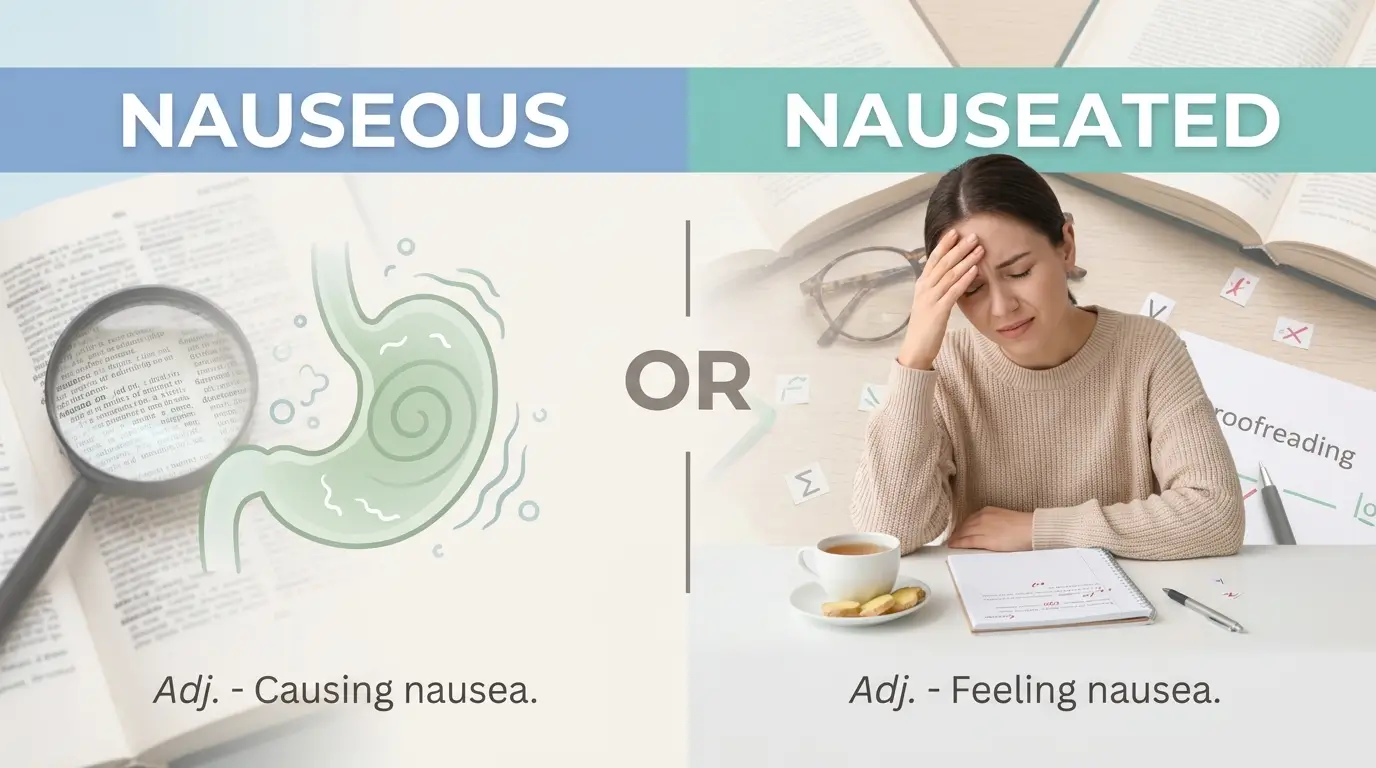
Feeling sick to your stomach can be hard enough. Choosing the right word to describe that feeling should not be. Yet nauseous or nauseated remains a common English question because both words are closely linked to nausea.
The confusion comes from a difference between traditional usage and modern usage. For many years, nauseous was taught to mean “causing nausea,” while nauseated meant “feeling sick.” That rule is still remembered by many teachers, editors, and careful writers. But modern English has changed. Today, nauseous is also widely used to mean “feeling sick.”
So, is one word correct and the other wrong? Usually, no.
Understanding nauseous or nauseated helps you choose a word that fits your audience and tone. Nauseated is often the clearer choice when you mean that a person feels sick. Nauseous is also correct in modern English when it describes that feeling.
This guide explains the difference, pronunciation, history, common mistakes, regional usage, and everyday examples so you can use both words with confidence.
Nauseous or Nauseated – Quick Answer
Nauseous and nauseated can both describe a person who feels sick or wants to vomit.
The main difference is one of traditional meaning and style:
- Nauseous traditionally meant “causing nausea.”
- Nauseated traditionally meant “feeling sick.”
- In modern English, nauseous can also mean “feeling sick.”
- Nauseated remains a clear and precise choice when describing a person’s physical feeling.
Compare these examples:
I felt nauseated after the boat ride.
This clearly means that I felt sick.
I felt nauseous after the boat ride.
In modern English, this also means that I felt sick.
Under the older distinction, however, nauseous would have meant that something caused nausea:
The smell was nauseous.
That traditional use is less common today. A clearer modern choice would often be:
The smell made me nauseated.
Or:
The smell was nauseating.
The easiest rule
If you mean “feeling sick,” use nauseated when you want the safest, clearest wording.
Use nauseous too when writing in normal modern English, especially in casual conversation.
If you mean “causing nausea,” nauseating is usually the clearest word.
The Origin of Nauseous or Nauseated
Both words come from the same family of words connected with nausea.
The English noun nausea comes through Latin from Greek nausia, a word associated with seasickness. Its connection with ships is important because seasickness was a familiar cause of the feeling described by the word.
From nausea, English developed related forms such as nauseous, nauseated, and nauseating.
Where does “nauseous” come from?
Nauseous is an adjective formed from nausea. In older English usage, it was commonly used for something that caused nausea or produced disgust.
For example:
The nauseous smell filled the room.
Over time, English speakers increasingly used nauseous to describe the person experiencing the feeling:
I am nauseous.
That meaning is now well established in modern English.
Where does “nauseated” come from?
Nauseated is the past participle of the verb nauseate.
The verb nauseate means to cause someone to feel nausea or to make someone sick. Therefore:
The rough flight nauseated me.
means that the flight made me feel sick.
The adjective nauseated then describes the resulting state:
I was nauseated during the flight.
Why did the meanings overlap?
Language changes through repeated everyday use. Speakers began using nauseous to describe their own feeling of sickness rather than only something that produced that feeling.
This created the modern overlap:
I feel nauseous.
and
I feel nauseated.
Both are widely understood as meaning that the speaker feels sick.
The older distinction has not disappeared completely. Some people still prefer nauseous for “causing nausea” and nauseated for “feeling nausea.” But treating the modern meaning of nauseous as simply “wrong” is too strict for current English.
Part of speech
Both nauseous and nauseated are adjectives.
They can describe a person, feeling, condition, or sometimes a thing depending on the intended meaning.
- nauseous — adjective
- nauseated — adjective
- nauseate — verb
- nauseating — adjective or present participle
- nausea — noun
Examples:
She feels nauseous.
She feels nauseated.
The medicine nauseated him.
The odor was nauseating.
He complained of nausea.
Pronunciation of Nauseous and Nauseated
The two words do not sound exactly alike.
Nauseous is commonly pronounced with two syllables, while nauseated is commonly pronounced with three or four syllables depending on the pronunciation variety.
nauseous
NAW-shus
Give feedback
nauseated
NAW-zee-ay-tid
Give feedback
The first part of both words is related to nausea, so they can sound similar at the beginning.
When speaking clearly, stress the first syllable of nauseous and the main opening syllable of nauseated.
British English vs American English Spelling
There is no major British-versus-American spelling difference between nauseous and nauseated.
Both British English and American English normally use:
| Word | British English | American English |
|---|---|---|
| Nauseous | nauseous | nauseous |
| Nauseated | nauseated | nauseated |
| Nausea | nausea | nausea |
| Nauseating | nauseating | nauseating |
| Nauseate | nauseate | nauseate |
So you do not need to change the spelling based on whether your reader is from the United States or the United Kingdom.
The more interesting difference is usage preference.
Some speakers, especially those following the traditional distinction, prefer:
I feel nauseated.
and reserve:
nauseous
for something that causes nausea.
Other speakers use:
I feel nauseous.
with no concern about the older distinction.
This is a difference in usage and style, not a British-versus-American spelling rule.
Which Spelling Should You Use?
The choice depends mostly on your audience and the level of precision you want.
For American English
Nauseous is completely natural in everyday speech:
I feel nauseous.
If you want to avoid any possible argument about the traditional distinction, use:
I feel nauseated.
Both can work in ordinary modern American English.
For British English
The same general principle applies. British speakers use both nauseous and nauseated.
If you are writing for a traditional or formal audience, nauseated can be a useful choice when you specifically mean “feeling sick.”
For international readers
If your goal is maximum clarity, nauseated is often the easiest choice for a person experiencing nausea.
For something that causes the feeling, nauseating is especially clear:
The smell was nauseating.
This avoids the older-versus-modern meaning debate around nauseous.
A simple decision guide
| What you mean | Best choice |
|---|---|
| A person feels sick | nauseated |
| A person feels sick in everyday speech | nauseous or nauseated |
| Something causes nausea | nauseating |
| The physical feeling itself | nausea |
| Someone was made sick by something | nauseated |
Common Mistakes with Nauseous or Nauseated
Even though both words are useful, several mistakes appear often.
1. Saying “I am nausea”
Incorrect:
I am nausea.
Correct:
I am nauseous.
or:
I am nauseated.
Nausea is a noun, while nauseous and nauseated are adjectives.
2. Treating “nauseous” as always wrong for people
Some traditional grammar advice says that nauseous should describe something that causes nausea.
Modern English does not support such a strict rule.
I feel nauseous.
is a standard and widely understood modern construction.
You may prefer nauseated for precision, but that does not make nauseous automatically incorrect.
3. Using “nauseated” for the thing that causes sickness
Consider:
The disgusting smell was nauseated.
This does not express the intended meaning.
The smell does not feel nausea. It causes nausea.
Better:
The disgusting smell was nauseating.
Or:
The smell made me nauseated.
4. Confusing “nauseating” with “nauseated”
These forms have different roles.
Nauseating describes something that causes nausea:
The spoiled food had a nauseating odor.
Nauseated describes someone experiencing nausea:
I felt nauseated after smelling it.
A useful pattern is:
cause → nauseating
person affected → nauseated
5. Using “nauseous” when “nausea” is needed
Nausea is a noun:
The patient experienced nausea.
Nauseous is an adjective:
The patient felt nauseous.
Do not swap them simply because they come from the same word family.
Nauseous or Nauseated in Everyday Examples
Seeing these words in real sentences makes the difference easier to remember.
In emails
A workplace email should be clear and natural.
I felt nauseated this morning, so I will work from home today.
This sounds direct and professional.
You could also write:
I have been feeling nauseous since last night.
That is natural in everyday communication.
In news writing
News reports may use either form depending on the situation:
Several passengers reported feeling nauseated during the rough crossing.
Here, nauseated clearly describes the passengers’ physical condition.
A report might also say:
The passengers said the strong odor made them nauseous.
This is normal modern usage.
On social media
Casual writing often favors nauseous:
That roller coaster made me so nauseous!
There is no need to force the more formal-sounding nauseated into every casual post.
In formal writing
For academic, medical, or professional writing, clarity matters most.
Participants reported nausea and dizziness after the procedure.
Or:
The patient reported feeling nauseated.
These forms make the intended meaning very clear.
In daily conversation
Both words are common:
I feel nauseous after long car rides.
I felt nauseated on the flight.
Your choice can depend on personal preference and the level of formality.
Nauseous vs Nauseated: Side-by-Side Comparison
| Feature | Nauseous | Nauseated |
|---|---|---|
| Part of speech | Adjective | Adjective |
| Main modern meaning | Feeling sick; traditionally also causing nausea | Feeling sick or affected by nausea |
| Describes a person | Yes | Yes |
| Describes a cause | Traditionally yes | Usually no |
| Best for “feeling sick” | Yes | Yes |
| Best for formal clarity | Good | Often preferred |
| British spelling | nauseous | nauseated |
| American spelling | nauseous | nauseated |
| Common in conversation | Very common | Common |
| Causes nausea | Better as “nauseating” | Not normally used this way |
The safest modern pattern is simple:
I feel nauseated. = I feel sick.
I feel nauseous. = I feel sick.
The smell is nauseating. = The smell causes sickness.
What Does “Nauseous” Traditionally Mean?
Traditionally, nauseous could mean something that causes nausea.
For example:
The nauseous odor came from the garbage.
However, modern speakers commonly use nauseous for the person who feels sick:
I became nauseous after the ride.
If you want to preserve the traditional distinction, use nauseating for the thing that causes nausea.
That gives you a very clear system:
Nauseated: feels sick
Nauseous: commonly feels sick in modern English
Nauseating: causes nausea
This approach works well because it recognizes both traditional grammar advice and current usage.
FAQs About Nauseous or Nauseated
1. Is “I feel nauseous” grammatically correct?
Yes. I feel nauseous is grammatically correct and widely used in modern English to mean “I feel sick.” Some people prefer nauseated because of the older distinction.
2. Is “I feel nauseated” better than “I feel nauseous”?
Not always. Nauseated is often the clearer choice if you want to specifically say that you are experiencing nausea. Nauseous is also acceptable in modern everyday English.
3. Does nauseous mean that something causes nausea?
That is the traditional meaning. Today, however, nauseous is also commonly used to mean “feeling sick.” If you mean “causing nausea,” nauseating is usually clearer.
4. What is the difference between nauseous and nauseating?
Nauseous can describe a person who feels sick in modern English. Nauseating describes something that causes nausea.
I feel nauseous.
The smell is nauseating.
5. Is nauseated more formal than nauseous?
It can sound more precise or formal in some contexts, especially when describing a person’s physical reaction. But nauseous is not inherently incorrect or informal.
6. Do British and American English spell these words differently?
No. Both varieties normally spell them nauseous and nauseated. There is no major regional spelling change like colour/color or centre/center.
7. Which word should ESL learners use?
Nauseated is a very safe choice when you mean “feeling sick.” But ESL learners should also recognize that native speakers commonly say nauseous with the same meaning.
Conclusion
Nauseous and nauseated can both describe the feeling of being sick. Modern English accepts nauseous in this sense, while nauseated stays clear and precise.
The older rule gave nauseous a “causing nausea” meaning and nauseated a “feeling sick” meaning. Today, real usage is broader.
For the clearest wording, choose nauseated for a person who feels sick and nauseating for something that causes nausea.
With a little practice, these words become easy to handle. Try them in emails, essays, and daily conversations to make your English feel more natural.

Mira Anand is a writer at Distinly.com who focuses on storytelling, communication, and social perspective. Her work highlights subtle differences in language and meaning across cultures and communities. With a clear and empathetic voice, Mira helps readers understand how narratives shape understanding, relationships, and modern dialogue in an increasingly connected world.