Difference between GOOG and GOOGL often confuses new investors. Imagine you’re about to buy shares in Alphabet Inc., and you suddenly see two stock options: GOOG and GOOGL. Which one should you choose? 🤔
The difference between GOOG and GOOGL lies in voting rights, not in the company itself. Both represent shares of the same company, but they behave slightly differently when it comes to control and decision-making.
Many beginners assume these tickers are separate companies. That’s not true. Understanding the difference between GOOG and GOOGL helps you make smarter financial decisions.
Let’s break it down step by step so you can clearly understand what sets them apart.
Key Difference Between the Both
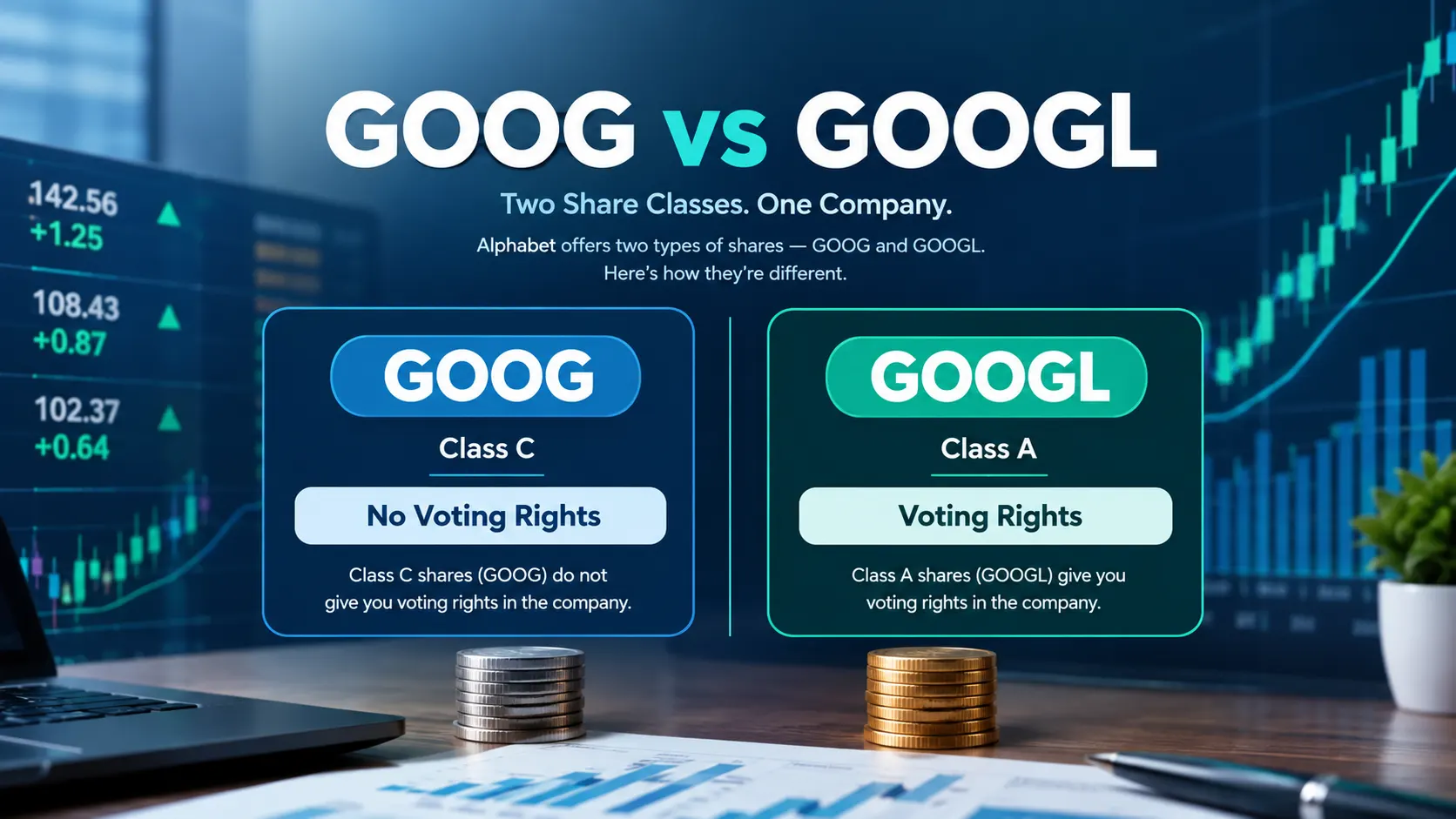
The main difference between GOOG and GOOGL is voting rights.
- GOOGL shares give investors voting power in company decisions.
- GOOG shares do not provide voting rights.
Both shares represent ownership in Alphabet Inc. and have nearly identical financial value. However, only GOOGL allows shareholders to influence company policies.
Importance – Why Knowing This Difference Matters
Understanding the difference between GOOG and GOOGL is important for both beginners and experts.
For learners, it builds a strong foundation in stock market concepts. You begin to understand how companies structure ownership and control.
For investors and professionals, this knowledge affects decision-making power. Voting rights can influence leadership choices, mergers, and long-term strategy.
In society, this distinction shows how large companies maintain control while still raising public funds. It highlights the balance between ownership and authority.
🔊 Pronunciation Section
GOOG
US: /ɡuːɡ/
UK: /ɡuːɡ/
GOOGL
US: /ˈɡuːɡəl/
UK: /ˈɡuːɡəl/
Now that you know how to say them, let’s understand what they actually mean.
📚 Core Definitions
GOOG
GOOG is a Class C stock of Alphabet Inc.. It represents ownership in the company but comes without voting rights.
Example: An investor buys GOOG shares only for profit, not influence.
GOOGL
GOOGL is a Class A stock of Alphabet Inc.. It gives shareholders one vote per share.
Example: An investor buys GOOGL shares to have a say in company decisions.
📚 10 Clear Differences Between GOOG and GOOGL
1. Voting Rights
GOOGL shares provide voting rights, while GOOG shares do not. This is the most important difference.
- Example for GOOG: You cannot vote in company meetings.
- Example for GOOGL: You can vote on major company decisions.
2. Share Class
GOOG is Class C stock. GOOGL is Class A stock.
- Example for GOOG: Classified as non-voting shares.
- Example for GOOGL: Classified as voting shares.
3. Investor Control
GOOGL investors have some control. GOOG investors do not.
- Example for GOOG: No influence on leadership changes.
- Example for GOOGL: Can vote on leadership matters.
4. Purpose of Ownership
GOOG is mainly for financial investment. GOOGL is for both investment and influence.
- Example for GOOG: Bought for price growth.
- Example for GOOGL: Bought for ownership voice.
5. Price Difference
Prices are usually very close, but GOOGL may trade slightly higher due to voting rights.
- Example for GOOG: Slightly lower price sometimes.
- Example for GOOGL: Slight premium for voting power.
6. Target Investors
GOOG attracts passive investors. GOOGL attracts active investors.
- Example for GOOG: Long-term holders seeking returns.
- Example for GOOGL: Investors interested in governance.
7. Corporate Influence
GOOGL shareholders influence company decisions. GOOG shareholders do not.
- Example for GOOG: No say in company policies.
- Example for GOOGL: Can influence corporate actions.
8. Strategic Importance
GOOGL shares matter more in corporate decisions.
- Example for GOOG: Limited strategic role.
- Example for GOOGL: Important in shareholder votes.
9. Market Perception
GOOGL is seen as more “powerful” due to voting rights.
- Example for GOOG: Viewed as purely financial.
- Example for GOOGL: Seen as ownership with control.
10. Use in Corporate Structure
GOOG helps founders maintain control. GOOGL distributes limited power.
- Example for GOOG: Keeps control centralized.
- Example for GOOGL: Allows partial public participation.
🎯 Why Knowing the Difference Matters
Students need this knowledge to understand how modern companies operate. It builds financial literacy early.
Professionals must know the difference to make informed investment choices. Voting rights can impact long-term strategy.
In communication, using the wrong term can cause confusion. Investors may misunderstand your intent or knowledge level.
Real-world consequences of confusion
If you buy GOOG thinking you have voting rights, you may feel misled. Similarly, discussing stocks incorrectly can reduce credibility.
🧠 Why People Get Confused
Similar spelling
GOOG and GOOGL look almost identical. One extra letter creates confusion.
Semantic overlap
Both represent the same company. This makes people think they are interchangeable.
Context-based usage
In casual talk, people often use “Google stock” without specifying the ticker.
Influence of informal speech
Media and social platforms rarely explain the difference clearly.
🎭 Connotation & Emotional Tone
(Connotation = the emotional meaning associated with a word.)
GOOG
- Neutral: Focused on financial returns.
- Example: “I bought GOOG for long-term growth.”
GOOGL
- Slightly Positive: Associated with influence and participation.
- Example: “I prefer GOOGL because I can vote.”
🗣 Usage in Metaphors, Similes & Idioms
While these are stock tickers, you can still use them metaphorically.
- “Buying GOOG is like being a silent partner.”
- “Holding GOOGL is like having a seat at the table.”
These expressions help explain the difference simply.
📊 Comparison Table
| Feature | GOOG | GOOGL |
|---|---|---|
| Meaning | Non-voting shares | Voting shares |
| Tone | Neutral | Slightly empowering |
| Usage | Investment only | Investment + influence |
| Context | Passive ownership | Active participation |
| Formality | Financial term | Financial term |
⚖️ Which Is Better in What Situation?
When to use GOOG
Choose GOOG if you only want financial returns. It suits passive investors who don’t need voting rights.
When to use GOOGL
Pick GOOGL if you want a voice in company decisions. It’s better for active investors.
Situational clarity
If governance matters, GOOGL is better. If not, GOOG works just fine.
Contextual correctness
In professional discussions, always specify the correct ticker. It shows clarity and expertise.
📖 Literary or Cultural References
- Book: The Google Story (Business, David A. Vise, 2005)
- Movie: The Internship (USA, 2013)
These works highlight the growth of Google, which later became part of Alphabet Inc..
❓ FAQs
1. Are GOOG and GOOGL the same company?
Yes, both represent shares of Alphabet Inc.. The difference lies only in voting rights.
2. Which stock is better for beginners?
GOOG is simpler for beginners focused on returns. GOOGL is better if you want to learn about governance.
3. Why does Alphabet have two stock types?
It allows founders to maintain control while raising money from the public.
4. Do GOOG and GOOGL pay different dividends?
No, they generally offer the same financial benefits since they represent the same company.
5. Can I convert GOOG into GOOGL?
No, they are separate share classes and cannot be directly converted.
🏁 Conclusion
The difference between GOOG and GOOGL is simple yet important. Both represent ownership in Alphabet Inc., but only GOOGL offers voting rights. GOOG focuses purely on financial investment, while GOOGL combines ownership with influence.
Understanding this difference helps you make smarter investment decisions. It also improves your financial vocabulary and confidence when discussing stocks.
In today’s world, where investing is more accessible than ever, clarity matters. So next time you see GOOG and GOOGL, you’ll know exactly what they mean and why it matters.

Mira Anand is a writer at Distinly.com who focuses on storytelling, communication, and social perspective. Her work highlights subtle differences in language and meaning across cultures and communities. With a clear and empathetic voice, Mira helps readers understand how narratives shape understanding, relationships, and modern dialogue in an increasingly connected world.