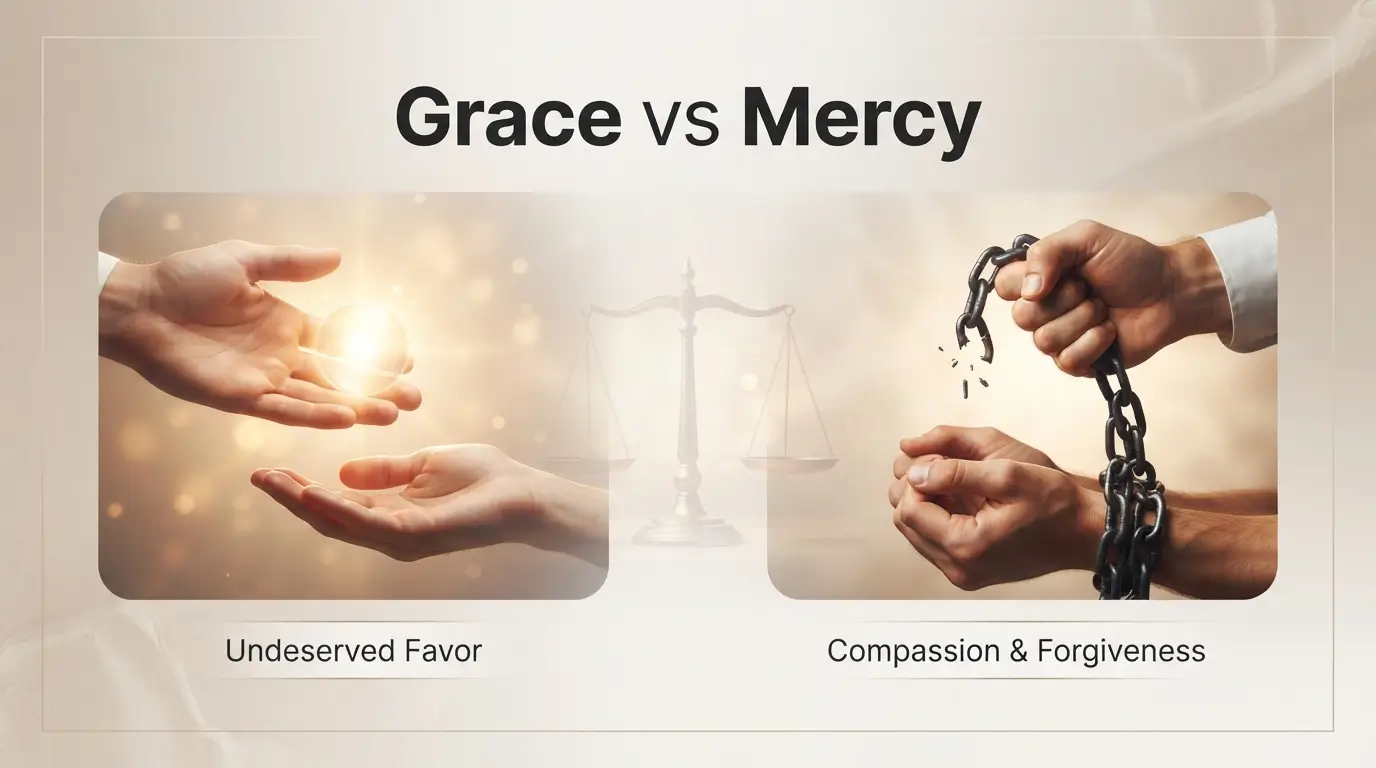
People often use grace and mercy together, especially when talking about faith, forgiveness, kindness, or compassion. Because the two ideas are closely related, it is easy to think they mean exactly the same thing. However, there is an important difference between grace and mercy.
The difference between grace and mercy is easiest to understand by looking at what each one gives or withholds. Mercy is commonly understood as not receiving a punishment or harm that someone deserves. Grace, by contrast, is commonly understood as receiving kindness, favor, or a blessing that someone has not earned. In simple terms, mercy can mean less punishment, while grace can mean undeserved favor.
The difference between grace and mercy also matters because these words appear in religious teaching, literature, everyday speech, and discussions about forgiveness. Knowing how they work helps readers understand sentences such as “show mercy” and “receive grace” more clearly.
This guide explains the difference between grace and mercy, their origins, meanings, examples, common mistakes, and how they are used in different contexts.
Quick Answer
The simplest way to remember the difference is:
- Mercy means showing compassion by withholding or reducing punishment, harm, or suffering that could otherwise be expected.
- Grace means giving kindness, favor, help, or a benefit that has not been earned or deserved.
For example, imagine a student breaks an important school rule. The teacher could give the student the full punishment but chooses not to. That is an example of mercy.
Now imagine the teacher also gives the student extra help, encouragement, and another opportunity to succeed. That additional kindness can be described as grace.
| Grace | Mercy |
|---|---|
| Focuses on undeserved favor or kindness | Focuses on compassion toward someone in difficulty |
| Gives a benefit that was not earned | Withholds or reduces a penalty or harm |
| Often emphasizes generosity | Often emphasizes forgiveness or restraint |
| “Receiving something good” | “Not receiving something harmful” |
A useful memory trick is:
Mercy = not receiving the punishment you might deserve.
Grace = receiving kindness or favor you did not earn.
The distinction is especially common in Christian theology, although the words also have broader meanings in English.
The Origin of Grace and Mercy
The two words have different histories.
Grace comes into English through Old French and ultimately from Latin gratia, meaning ideas such as favor, goodwill, gratitude, or thankfulness. The Latin word is related to gratus, meaning “pleasing” or “thankful.”
Over time, grace developed several meanings in English. It can refer to elegance or beauty of movement, a period of extra time, a short prayer before a meal, or a quality of kindness and favor. Religious use gave the word an especially important sense connected with divine favor.
Mercy entered English through Anglo-Norman and Old French forms related to Latin merces, meaning a reward, favor, or pity in later developments of the word. Its history is connected with ideas of compassion and clemency.
In modern English, mercy usually refers to kindness shown toward someone who could otherwise face punishment, suffering, or severe treatment.
The two words therefore do not come from the same linguistic root. Their meanings became closely associated because compassion, forgiveness, favor, and kindness often appear together in religious and moral discussions.
Are Grace and Mercy Pronounced Differently?
Yes. They are completely different in sound.
Grace is pronounced approximately:
GRAYSS
Its pronunciation is /ɡreɪs/.
Mercy is pronounced approximately:
MUR-see
Its pronunciation is /ˈmɜːrsi/ in many British pronunciations and /ˈmɝːsi/ in many American pronunciations.
Because the words are not homophones, pronunciation is not normally the source of confusion. The confusion comes from their closely related meanings.
What Parts of Speech Are They?
Both grace and mercy are primarily nouns when used in the meanings discussed here.
Examples:
- “She showed mercy to the injured animal.”
- “He asked for mercy.”
- “They were thankful for the grace they received.”
- “The family spoke about divine grace.”
Both words can also appear in related grammatical forms.
For example:
- grace → gracious → graciously
- mercy → merciful → mercifully
The verb grace also exists, as in “Her presence graced the occasion,” but mercy is not normally used as a regular verb in modern standard English.
Grace vs Mercy in Religious Contexts
The distinction becomes especially important in Christian discussions.
In many Christian explanations, mercy is associated with God withholding judgment or punishment that a person deserves. Grace is associated with God’s freely given favor and blessings that cannot be earned through personal merit.
For example:
Mercy: A person deserves judgment but receives forgiveness.
Grace: A person receives God’s favor and blessing despite not being able to earn it.
These concepts are closely connected rather than completely separate. A religious text or speaker may mention both in the same passage because forgiveness can involve mercy while the resulting gift of reconciliation or favor can be described in terms of grace.
Different Christian traditions and theological writers may explain the relationship in slightly different ways. Therefore, the simple “mercy takes away, grace gives” formula is useful for learning, but it should not be treated as the only possible theological definition.
British English vs American English Spelling
There is no meaningful British-American spelling difference between these words.
Both British English and American English spell them:
- grace
- mercy
Their pronunciation can vary slightly by accent, especially the vowel sound in mercy, but the spelling remains the same.
| Feature | British English | American English |
|---|---|---|
| Grace | grace | grace |
| Mercy | mercy | mercy |
| Spelling difference | None | None |
| Main pronunciation variation | Accent-dependent | Accent-dependent |
| Meaning | Generally the same | Generally the same |
This is important because not every word-comparison topic involves regional spelling. In this case, the difference is semantic, not British versus American spelling.
Grace and Mercy: British vs American Usage
Both varieties of English use the words in religious, literary, formal, and everyday contexts.
Examples include:
- “Please have mercy on him.”
- “They were grateful for her grace.”
- “The judge showed mercy.”
- “The ceremony began with a prayer of grace.”
American and British speakers may have different accents, but there is no major regional rule that changes when grace or mercy should be used.
Which Word Should You Use?
Choose the word based on the idea you want to express.
Use mercy when the main idea is:
- forgiveness
- compassion
- avoiding punishment
- reducing suffering
- showing leniency
- sparing someone from harm
Examples:
“The prisoner begged for mercy.”
“The judge showed mercy.”
“Have mercy on the injured animal.”
Use grace when the main idea is:
- undeserved favor
- kindness
- generosity
- blessing
- elegance
- acceptance
- a gift or benefit that was not earned
Examples:
“She accepted the criticism with grace.”
“They were thankful for his grace.”
“He was given another opportunity through an act of grace.”
For religious writing, follow the terminology used by the tradition or source you are discussing. For general English, focus on the intended meaning rather than trying to force a strict formula.
Common Mistakes with Grace and Mercy
1. Treating the words as perfect synonyms
Grace and mercy overlap, but they are not always interchangeable.
Incorrect reasoning:
“Grace and mercy always mean exactly the same thing.”
Better:
“Grace and mercy are related ideas, but they emphasize different aspects of kindness and forgiveness.”
2. Using mercy when you mean generosity
Mercy usually involves compassion toward someone facing suffering, judgment, or punishment.
“The judge showed mercy.”
If you simply mean that someone gave another person an unexpected benefit, grace may fit better.
“She gave him the opportunity through an act of grace.”
3. Assuming grace always has a religious meaning
Grace has many secular meanings.
It can describe:
- physical elegance
- social courtesy
- a delay period
- a prayer before eating
- favor or kindness
For example:
“The dancer moved with grace.”
This has nothing specifically to do with religion.
4. Assuming mercy always means forgiveness
Mercy often involves forgiveness or leniency, but the word can describe compassion more broadly.
“The injured animal needed mercy.”
The sentence does not necessarily involve punishment. It expresses compassion toward suffering.
5. Confusing “grace period” with religious grace
A grace period is extra time allowed after a deadline or before a penalty applies.
For example:
“The company offers a five-day grace period.”
Here, grace means an allowance or extra time. It does not automatically have a religious meaning.
6. Using “merciful” when “gracious” is more natural
These adjectives are related to their nouns but are not interchangeable.
Merciful commonly describes someone who shows compassion or does not punish harshly.
“The merciful ruler spared the prisoner.”
Gracious can describe someone who is kind, polite, generous, or willing to accept something pleasantly.
“She was gracious when accepting the award.”
Grace and Mercy in Everyday Examples
These words appear in many types of writing.
In Emails
Mercy is uncommon in ordinary professional emails unless the subject involves hardship, forgiveness, or a serious personal situation.
Example:
“Thank you for your understanding and mercy during this difficult situation.”
Grace can appear in more general expressions of appreciation or kindness:
“Thank you for giving me the opportunity and treating my mistake with grace.”
In News Writing
News reports may use mercy when describing courts, punishment, disasters, or acts of compassion.
“The family asked the court for mercy.”
Grace may appear when discussing religious events, public behavior, or someone’s calm response to pressure.
“The athlete accepted the result with grace.”
In Social Media
People often use both words in emotional or inspirational posts.
Examples:
“Give yourself grace while you learn.”
“Sometimes people need mercy more than criticism.”
Here, grace often suggests patience and kindness toward oneself or others.
In Formal Writing
Both words can appear in essays, speeches, literature, and religious studies.
Example:
“The novel explores the relationship between justice, mercy, and forgiveness.”
Another example:
“The speech presents grace as an undeserved form of compassion and favor.”
Grace vs Mercy: Comparison Table
| Point | Grace | Mercy |
|---|---|---|
| Basic idea | Favor or kindness that is not earned | Compassion that reduces or avoids suffering or punishment |
| Main focus | What someone receives | What someone is spared |
| Common religious use | Divine favor or blessing | Compassion and withholding judgment |
| Everyday meaning | Elegance, kindness, courtesy, favor | Compassion, leniency, forgiveness |
| Adjective | Gracious | Merciful |
| Common phrase | Grace period | Show mercy |
| Pronunciation | “GRAYSS” | “MUR-see” |
| British spelling | Grace | Mercy |
| American spelling | Grace | Mercy |
The table shows why the words are connected but should not be treated as identical.
How Grace and Mercy Work Together
One reason these words are often confused is that they can describe different parts of the same situation.
Imagine someone makes a serious mistake. Another person decides not to punish them. That response can be described as mercy.
Then imagine the same person goes further and offers help, encouragement, or a fresh opportunity. That additional favor can be described as grace.
This creates a simple conceptual sequence:
Wrongdoing or difficulty → mercy → reduced punishment or suffering
Need or undeserving situation → grace → freely given favor or benefit
Real conversations are more flexible than this model. A single act may reasonably be described using both terms, depending on what the speaker wants to emphasize.
Search Intent and Common Usage
People who search for the difference between grace and mercy usually want a clear explanation of two closely related concepts.
Some readers are studying Christian theology. Others may be learning vocabulary, preparing a school assignment, reading a religious text, or trying to understand an expression.
Search interest should not be confused with actual word frequency. A search query shows that people want clarification; it does not by itself prove how frequently either word appears in everyday language.
For language learners, the most useful approach is to learn the central distinction and then examine how context changes meaning.
A useful shortcut is:
Mercy asks, “What harm or punishment is being withheld?”
Grace asks, “What favor or kindness is being freely given?”
This question-based method can make the distinction easier to remember.
FAQs
1. What is the main difference between grace and mercy?
Mercy generally focuses on compassion that withholds or reduces punishment, suffering, or harm. Grace generally focuses on freely given favor, kindness, or benefit that was not earned.
2. Are grace and mercy the same thing?
No. They overlap, especially in religious language, but they emphasize different ideas. Mercy often concerns what someone is spared, while grace often concerns what someone receives.
3. Is mercy always related to punishment?
No. Mercy can also describe compassion toward someone who is suffering or vulnerable. Punishment is one important context, but it is not the only one.
4. Does grace always have a religious meaning?
No. Grace has many everyday meanings. A person can move with grace, respond to criticism with grace, or receive a grace period without any religious meaning.
5. Which comes first, grace or mercy?
There is no universal rule that one must come before the other. In religious and everyday discussions, they can describe different aspects of the same compassionate response.
6. What is the adjective form of grace?
The common adjective is gracious. It can describe someone who is kind, polite, generous, or pleasant in behavior.
7. What is the adjective form of mercy?
The adjective is merciful. It describes someone or something that shows compassion or does not impose harsh punishment.
Conclusion
Grace and mercy are close companions in English, but they carry different shades of meaning. Mercy centers on compassion and what someone is spared from, while grace highlights freely given favor.
Learning this distinction makes religious writing, literature, and everyday conversations easier to understand. It also helps you choose words with greater care when discussing forgiveness.
You do not need a complex rule to remember them. Think of mercy as compassion that withholds harm, and grace as kindness that gives more than was earned or expected.
Keep practicing these words in your reading, writing, and conversations. With time, their meanings will feel natural, so use them confidently in your everyday English.

Aamer Shahzad is the founder of Distinly.com, a fast-growing educational platform focused on high-intent “difference between” topics. With over 8 years of experience in English language education and analytical writing, I specialize in breaking down complex “difference between” topics into clear, structured, and easy-to-understand explanations. Distinly.com is your go-to resource for enhancing English skills and writing with confidence.
I specializes in building search-optimized, research-driven comparison content designed for clarity, authority, and long-term digital asset value.