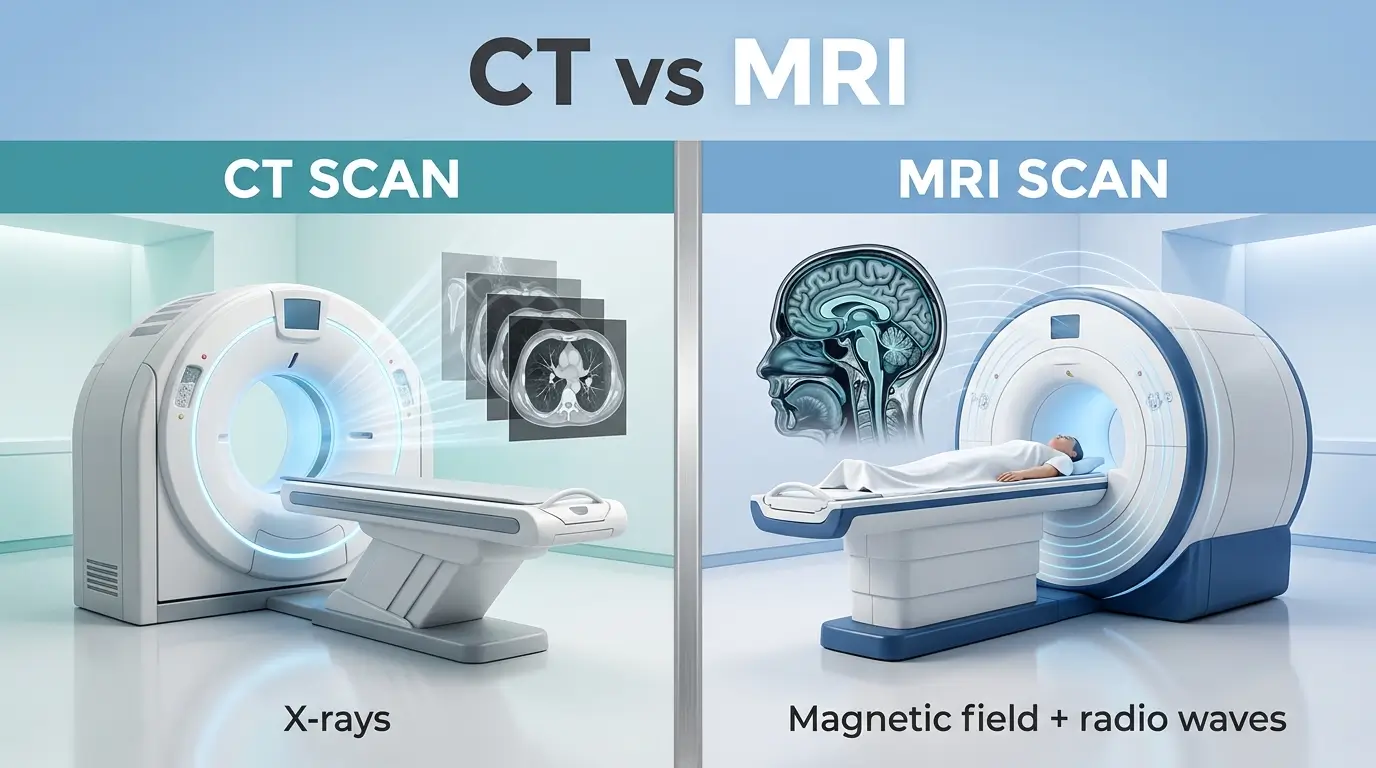
A medical scan can sound simple until two familiar terms raise a serious question: what is the difference between CT and MRI? Both create detailed images of the inside of the body, but they do not work in the same way. They also serve different medical needs.
People often search for the difference between CT and MRI after a doctor recommends a scan, when they want to understand a report, or when they feel unsure about radiation, magnets, or scan time. The difference between CT and MRI matters because the right choice depends on what doctors need to see, how quickly they need an answer, and what is safe for the patient.
This guide explains the difference between CT and MRI in simple language. It covers how each scan works, common uses, contrast dye, safety, cost considerations, and what patients can expect. By the end, you should understand why one scan may be better for a certain problem without assuming that either test is always the better choice.
Quick Answer
The main difference between CT and MRI is how they create images and what they show best.
- CT (computed tomography) uses rotating X-rays and a computer to create cross-sectional images. It is often useful for emergencies, bone injuries, lung problems, and internal bleeding.
- MRI (magnetic resonance imaging) uses a strong magnetic field and radio waves. It is especially useful for soft tissues, the brain, spinal cord, muscles, ligaments, and tendons.
| Feature | CT Scan | MRI Scan |
|---|---|---|
| Full name | Computed tomography | Magnetic resonance imaging |
| Main technology | X-rays + computer processing | Magnetic field + radio waves |
| Ionizing radiation | Yes | No |
| Best known for | Bone, lungs, trauma, rapid imaging | Brain, spine, joints, and soft tissue |
| Typical scan time | Often a few minutes | Often 15–45 minutes |
| Contrast agent | Often iodine-based, when needed | Sometimes gadolinium-based, when needed |
| Main limitation | Uses radiation | Metal safety, noise, and longer scan time |
Neither scan is always better. A doctor chooses the test based on the suspected problem, urgency, body part, and patient safety.
The Origin of CT and MRI
Unlike words such as cemetery or color, CT and MRI are medical acronyms, so the key difference is not a spelling variation between British and American English. Each abbreviation comes from a longer technical term.
CT: Computed Tomography
Computed tomography combines two ideas:
- Computed relates to calculation or processing by a computer.
- Tomography comes from Greek roots associated with a section or slice and writing or recording.
Together, the term describes a method that uses computer processing to create images of body sections. CT was developed from earlier X-ray imaging methods and became an important medical imaging tool because it could show cross-sectional detail rather than only a flat projection.
MRI: Magnetic Resonance Imaging
Magnetic resonance imaging also describes the technology:
- Magnetic refers to the strong magnetic field.
- Resonance refers to the response of atomic nuclei to radiofrequency energy.
- Imaging means creating pictures.
MRI developed from advances in nuclear magnetic resonance research and medical imaging. The word nuclear is often omitted in the medical name because the scan does not involve nuclear radiation.
Why the names matter: CT tells you that the scan uses computer-created sections. MRI tells you that magnetic resonance produces the image. These are different technologies, not two spellings of the same test.
British English vs American English Spelling
There is no meaningful British-versus-American spelling difference between CT and MRI. Both varieties use the same abbreviations and the same full medical terms.
The words computed and magnetic resonance imaging do not change spelling between British and American English. The abbreviations also remain unchanged.
| Term | British English | American English | Difference |
|---|---|---|---|
| CT | CT scan | CT scan | Same |
| MRI | MRI scan | MRI scan | Same |
| Computed tomography | Computed tomography | Computed tomography | Same |
| Magnetic resonance imaging | Magnetic resonance imaging | Magnetic resonance imaging | Same |
| X-ray | X-ray | X-ray | Same |
| Radiologist | Radiologist | Radiologist | Same |
You may see CAT scan in some older or informal American usage. CAT stands for computerized axial tomography. Today, CT scan is the standard term in most medical writing.
Pronunciation and Part of Speech
CT is usually pronounced by its letters: “see tee.” MRI is pronounced by its letters: “em ar eye.”
Both are initialisms, a type of abbreviation pronounced letter by letter.
In a sentence, CT and MRI usually act as nouns:
- “The doctor ordered a CT.”
- “She needs an MRI of her knee.”
They can also modify another noun:
- “The patient had a CT scan.”
- “The hospital scheduled an MRI examination.”
The word scan is a noun in these examples. It can also be a verb:
- “The doctor will scan the abdomen.”
- “The radiologist reviewed the MRI scan.”
Which Scan Is Better for Different Problems?
The best scan depends on the question the doctor needs to answer. A CT may be ideal for one problem, while an MRI may provide more useful detail for another.
CT is often useful for:
- Emergency injuries: It can quickly show fractures, internal bleeding, and damage after trauma.
- Bone problems: CT can reveal complex fractures and detailed bone structure.
- Lung conditions: It can help identify pneumonia, tumors, blood clots, and other chest problems.
- Abdominal problems: CT can show organs, inflammation, stones, and other abnormalities.
- Rapid assessment: CT is often chosen when speed matters.
MRI is often useful for:
- Brain and spinal cord: MRI provides detailed images of the brain, spinal cord, and surrounding soft tissues.
- Joint injuries: It can show ligaments, tendons, cartilage, and other structures.
- Muscles and soft tissue: MRI often gives better contrast between different soft tissues.
- Certain tumors and neurological conditions: It can help distinguish abnormal tissue from healthy tissue.
- Repeated imaging: MRI does not use ionizing radiation, which can be useful when repeated scans are needed.
These are general patterns, not strict rules. CT can show soft tissue, and MRI can show bones. The doctor chooses the method that best answers the clinical question.
How CT and MRI Work
How CT Works
During a CT scan, you lie on a table that moves through a circular opening. An X-ray source rotates around your body and sends beams through the area being examined.
Detectors measure how much of the X-ray beam passes through different tissues. A computer then processes these measurements into thin cross-sectional images. The images can also be combined to create a three-dimensional view.
CT is fast because the scanner collects many measurements during each rotation. You may need to hold your breath briefly, but the scan itself is usually short.
How MRI Works
During an MRI, you lie on a table that moves into a large scanner. The machine creates a strong magnetic field and sends radiofrequency energy into the body.
Hydrogen protons in body tissues respond to this energy. As they return to their usual state, they produce signals. The scanner detects these signals and a computer turns them into detailed images.
MRI can produce different image sequences. Each sequence highlights tissue properties in a different way. This helps doctors distinguish normal tissue from abnormal tissue.
You must remain still during the scan. MRI machines can also make loud tapping or knocking sounds, so ear protection is usually provided.
CT vs MRI: Radiation, Contrast, and Safety
Does CT Use Radiation?
Yes. CT uses ionizing radiation because it uses X-rays. The amount depends on the body part, scan type, and equipment.
Doctors consider the benefits and risks before ordering a CT. A medically needed scan can provide important information that outweighs the small potential risk from radiation exposure. Children are more sensitive to radiation, so their scans should be carefully justified and optimized.
Does MRI Use Radiation?
No. MRI does not use ionizing radiation. Instead, it uses magnetic fields and radio waves.
However, MRI is not risk-free. The strong magnetic field can attract certain metal objects and may interfere with some implants. Patients must tell the MRI team about pacemakers, stimulators, cochlear implants, metal fragments, and other medical devices before entering the scanner room.
Some implants are MRI-safe or MRI-conditional, but the team must check the exact device and conditions. Never assume that every implant is safe.
What About Contrast Agents?
Contrast agents help certain tissues or blood vessels stand out more clearly.
- CT contrast: Often uses iodine-based material. Some CT exams also use barium contrast by mouth.
- MRI contrast: Often uses gadolinium-based material.
Contrast is not required for every scan. It depends on the body part and the medical question.
Tell your doctor about previous contrast reactions, kidney disease, pregnancy, or other relevant conditions. Serious reactions are uncommon, but the medical team needs this information to choose the safest approach.
What Happens During Each Scan?
During a CT Scan
- You lie on a table that moves through the scanner.
- The technologist positions you for the correct body part.
- You may receive contrast through an IV or drink contrast, depending on the exam.
- The scanner takes images while you remain still.
- The scan usually finishes within a few minutes, although preparation may take longer.
CT is often easier for people who find it difficult to stay still for a long time.
During an MRI Scan
- You remove metal items and follow the safety screening process.
- You lie on a padded table.
- The technologist places you inside the scanner.
- The machine makes loud sounds during image sequences.
- You may receive gadolinium contrast if needed.
- You must remain still, and some exams may require short breath-holds.
Many MRI exams take 15–45 minutes, though some take longer. The technologist can communicate with you throughout the scan.
Common Mistakes with CT and MRI
Mistake 1: Thinking CT and MRI are the same test
Correction: Both create medical images, but CT uses X-rays and MRI uses magnetic fields and radio waves.
Mistake 2: Assuming MRI is always safer
Correction: MRI avoids ionizing radiation, but its strong magnetic field creates special risks for some implants and metal objects.
Mistake 3: Believing CT is only for bones
Correction: CT can also examine the lungs, abdomen, blood vessels, brain, and many other areas.
Mistake 4: Thinking MRI always requires contrast
Correction: Many MRI scans use no contrast. The decision depends on the exam.
Mistake 5: Treating “better images” as one universal idea
Correction: MRI may show soft tissue more clearly, while CT may be faster or better suited to certain bone, lung, and emergency problems.
Mistake 6: Confusing CT with CAT scan
Correction: CAT scan is an older abbreviation for computerized axial tomography. CT scan is the standard term used today.
CT and MRI in Everyday Examples
These examples show how the terms appear in real communication.
In an email
“My doctor ordered a CT scan to check for possible internal bleeding.”
“I have an MRI appointment for my knee next week.”
In news writing
“A CT scan helped doctors assess the patient’s injuries after the accident.”
“MRI imaging revealed changes in the brain’s soft tissue.”
Within social media
“I’m waiting for my MRI results.”
“The ER sent me for a CT after the fall.”
In formal writing
“CT is commonly used for rapid evaluation of trauma, while MRI is often preferred for detailed assessment of soft tissues.”
In a conversation
“What’s the difference between CT and MRI?”
“CT uses X-rays and is often faster. MRI uses magnets and radio waves and is especially useful for soft tissue.”
CT vs MRI: Comparison Table
| Category | CT | MRI |
|---|---|---|
| Full name | Computed tomography | Magnetic resonance imaging |
| Technology | Rotating X-rays and computer processing | Magnetic field, radio waves, and computer processing |
| Radiation | Uses ionizing radiation | Does not use ionizing radiation |
| Image style | Cross-sectional slices; 3D images possible | Detailed images in multiple planes |
| Strong points | Bone, lungs, trauma, rapid imaging | Brain, spine, joints, muscles, ligaments, soft tissue |
| Speed | Usually faster | Usually slower |
| Noise | Generally quieter | Loud tapping and knocking sounds |
| Metal safety | No strong MRI-type magnetic field | Requires careful metal and implant screening |
| Contrast | Often iodine-based when needed | Sometimes gadolinium-based when needed |
| Cost | Often less expensive | Often more expensive |
| Best choice | Depends on the clinical question | Depends on the clinical question |
FAQs
1. Is CT better than MRI?
Not always. CT is often better for rapid imaging, complex fractures, and some lung or emergency problems. MRI is often better for soft tissue, brain, spine, and joint detail.
2. Which scan is safer?
Both can be safe when medically appropriate. CT uses radiation, while MRI has special risks involving metal, implants, and strong magnetic fields. The safest choice depends on the patient and the medical need.
3. Is MRI more painful than CT?
Neither scan usually causes pain from the imaging itself. MRI may feel uncomfortable because of the enclosed space, loud sounds, or the need to remain still for longer.
4. Can MRI detect what CT misses?
Sometimes. MRI can reveal soft-tissue details that CT may not show as clearly. But CT can also detect problems that MRI may not be the best tool for, especially when speed or bone detail matters.
5. Can I have an MRI if I have a pacemaker?
Some pacemakers are MRI-conditional, but others may not be safe. The exact device must be checked by the medical team before the scan.
6. Do CT and MRI use contrast dye?
They may, but not always. CT often uses iodine-based contrast, while MRI may use gadolinium-based contrast. The need depends on the exam.
7. Which scan takes longer?
MRI usually takes longer than CT. A CT may take only a few minutes, while many MRI exams take 15–45 minutes or more.
Conclusion
The difference between CT and MRI becomes easier to understand when you focus on how each scan works and what doctors need to see. CT uses X-rays, while MRI uses magnetic fields and radio waves.
CT is often chosen for speed, trauma, bones, and certain chest or abdominal problems. MRI is especially useful for soft tissues, the brain, spine, and joints.
Neither scan is automatically the best. Your doctor considers the suspected condition, urgency, medical history, and safety before choosing an imaging test.
With a little practice, these terms become less confusing. Try using them in emails, essays, and daily conversations so you can speak about medical imaging with more confidence.

Ezra Hale is a thoughtful contributor to Distinly.com, where he explores philosophical ideas and the subtle differences behind everyday concepts. His writing blends logic, language, and human insight to clarify complex distinctions. Ezra encourages readers to think deeper, question assumptions, and appreciate the meaning behind words and ideas in modern discourse.